
M&A advisory is the professional service that guides companies through mergers, acquisitions, divestitures, and related transactions from strategy to closing. The global M&A advisory market was valued at about US$27.9 billion in 2024 and is projected to reach roughly US$33.4 billion by 2031, according to global M&A advisory market estimates.
The counterintuitive reality for 2026 is that advisors increasingly protect value by preventing disputes, not merely by finding buyers. Global M&A value is projected to reach about $4 trillion in 2026, up 13% from 2025, while US deal value reached $1.2 trillion during the first five months of 2026 even as volume fell 4%, according to PwC’s M&A trends analysis. Bigger transactions and fewer available opportunities make pricing discipline, information control, and legal risk allocation central to every serious deal.
The Evolving Role of M&A Advisory in 2026
M&A advisory now operates as a strategic risk-management discipline, particularly when a non-Israeli company enters the Israeli market. The advisor coordinates valuation, diligence, negotiations, regulatory compliance, transaction structure, and integration planning. That coordination can prevent one unresolved liability, weak contractual protection, or poorly controlled disclosure from becoming a post-closing dispute.
The service forms part of the broader investment-banking sector. Market reports describe investment banking as covering financial consultancy, underwriting, and M&A advisory. One global estimate placed the investment banking market at US$150.49 billion in 2025, with projected growth to US$218.16 billion by 2030 at a 7.8% CAGR, according to investment banking market data.
From transaction support to process control
An expert advisor does more than introduce two companies. The advisor designs the process, controls information flow, creates appropriate competitive tension, tests assumptions, and keeps negotiations aligned with the client’s strategic objective.
That discipline matters when information is asymmetric. Sellers know their operations better than buyers, while buyers may have greater negotiating power, diligence resources, and transaction experience. The advisor narrows that imbalance by organizing evidence, sequencing decisions, and identifying issues that require legal or commercial escalation.
Practical rule: A deal process should answer commercial and legal questions before those questions become bargaining weapons.
For a foreign company entering Israel, this changes the practical answer to what is M&A advisory. The issue is not merely whether the advisor can achieve a transaction. The advisor must identify Israeli legal, operational, regulatory, and relationship risks early enough to address them before they trigger litigation or undermine the acquisition thesis.
Why institutional scale matters
Global estimates place the M&A advisory segment near US$28.6 billion in 2025 and project approximately US$41.0 billion by 2032 at a 5.0% CAGR, using a separate methodology within M&A advisory market research. The differing estimates still indicate a large, institutionalized advisory field rather than an informal service.
Institutional judgment is especially important in Israel because legal requirements, commercial expectations, regulatory interactions, and relationship-based business practices may not match those of the buyer’s home jurisdiction. A foreign company can misread approval requirements, contractual assumptions, disclosure standards, or counterpart conduct without local insight. An experienced advisor connects those details to valuation, warranties, indemnities, governance, and dispute planning.
Advisors therefore add value through judgment. They determine which issues deserve escalation, which terms require protection, and which risks justify walking away. Cross-border advice should integrate finance, commercial strategy, and Israeli legal analysis from the beginning.
Defining the Core Functions Sell-Side and Buy-Side
Sell-side and buy-side advisory resemble two different roles in the same negotiation. A seller’s advisor acts like a transaction architect who prepares the business, identifies suitable buyers, and manages competition. A buyer’s advisor acts like an investigative strategist who tests the target, evaluates alternatives, and protects the acquisition thesis.
The distinction matters because the same fact can create opposite consequences. A customer concentration issue may reduce a seller’s bargaining power, while it may help a buyer demand an indemnity, price adjustment, or earn-out. An advisor must therefore understand the client’s objective before recommending a process.

Sell-side advisory
A sell-side mandate usually begins with preparation. The advisor helps the seller define its equity story, test valuation assumptions, prepare financial and operational materials, and identify potential buyers.
The process then moves into controlled outreach. The advisor manages confidentiality, distributes a teaser and confidential information memorandum, answers preliminary questions, screens bids, and maintains a disciplined timetable. This structure prevents the seller from negotiating privately with an unsuitable buyer before understanding the market.
A sell-side advisor typically handles:
- Buyer targeting: Identifying strategic and financial buyers whose objectives support a credible transaction.
- Information management: Controlling disclosures through confidentiality arrangements and organized data-room access.
- Bid evaluation: Comparing price, financing certainty, conditions, indemnities, escrow terms, and post-closing obligations.
- Negotiation support: Maintaining advantage while preventing commercial concessions from undermining legal protections.
The highest offer doesn’t always represent the strongest outcome. A lower headline price may create greater certainty, fewer conditions, or better protection against post-closing claims.
Buy-side advisory
Buy-side work begins with strategic discipline. The advisor helps define acquisition criteria, screen targets, assess strategic fit, and compare the target against other uses of capital.
The advisor then tests the investment case. That includes financial analysis, commercial diligence, legal diligence, operational review, regulatory assessment, and deal structuring. A buyer should know not only what the target is worth, but also which assumptions must remain true after closing.
Buy-side advisors often support:
- Target screening: Filtering opportunities against strategic, financial, geographic, and legal criteria.
- Valuation analysis: Testing price against performance, risk, synergies, and alternative targets.
- Diligence coordination: Organizing specialists so that findings reach decision-makers promptly.
- Term negotiation: Linking identified risks to price, conditions, indemnities, escrow, and termination rights.
For a non-Israeli buyer, local counsel and transaction advisors should work together. Financial analysis may identify a risk, but Israeli legal analysis determines how the parties should address that risk contractually.
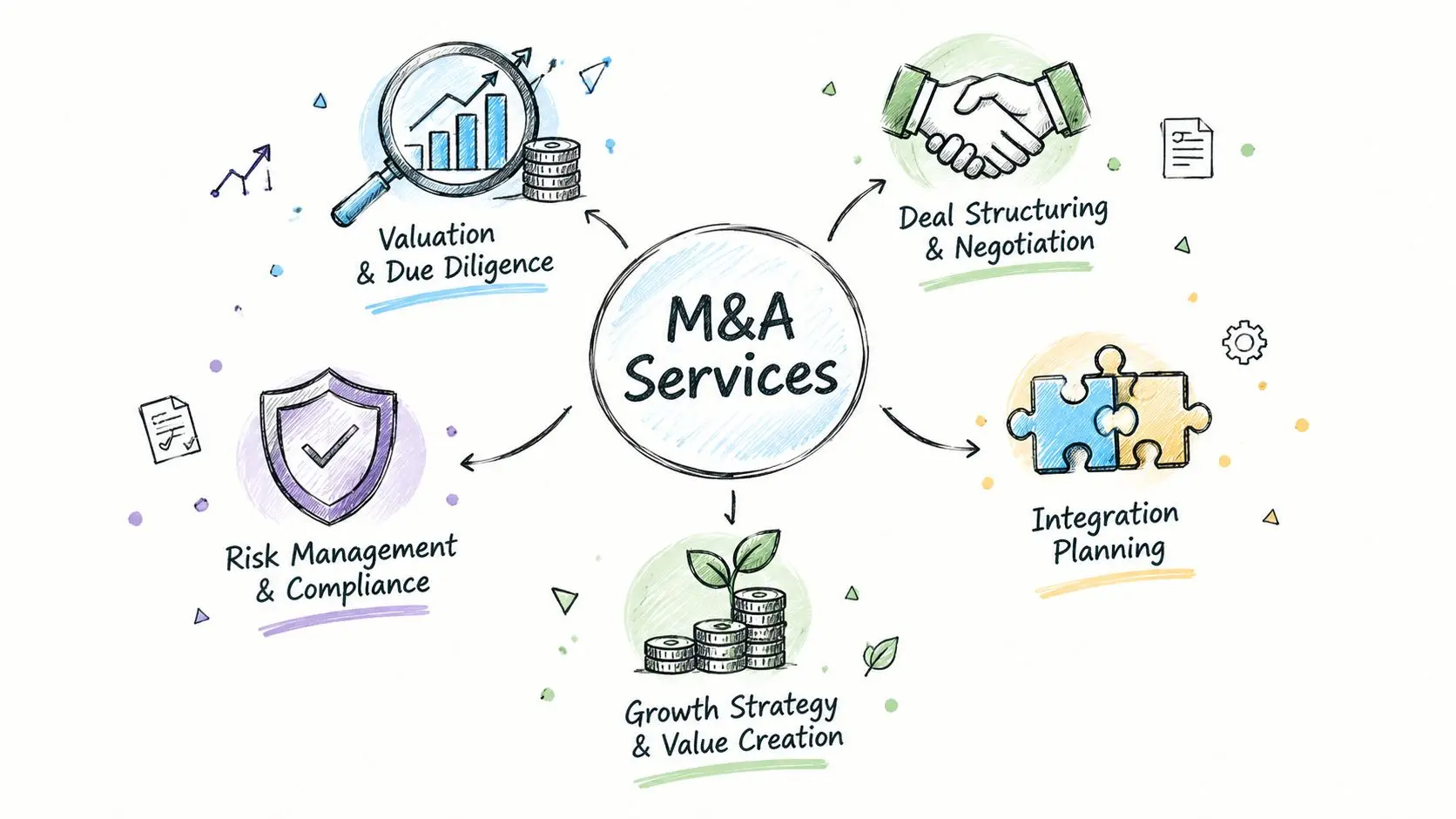
A Breakdown of Key M&A Advisory Services
M&A advisory becomes tangible through the work performed behind the transaction. The advisor translates a broad corporate objective into a sequence of decisions that management, directors, lenders, lawyers, and counterparties can execute.
Strategic valuation
Valuation should produce a defensible commercial narrative, not just a spreadsheet. The advisor tests revenue quality, profitability, customer dependence, operational maturity, growth assumptions, comparable transactions, and the value of strategic synergies.
A seller benefits from identifying weaknesses before buyers discover them. A buyer benefits from separating genuine synergies from optimistic management projections. Both sides need a clear distinction between enterprise value, equity value, debt adjustments, working-capital mechanisms, and contingent consideration.
Due diligence
Diligence converts uncertainty into documented risk. The advisor coordinates financial, tax, legal, commercial, operational, employment, intellectual-property, technology, and regulatory reviews.
A checklist alone doesn’t protect a client. The review must connect findings to consequences. For example, an unresolved license issue may affect closing conditions, indemnity scope, valuation, integration planning, or the buyer’s willingness to proceed.
Negotiation and structuring
The advisor helps determine whether the transaction should use a share purchase, asset purchase, merger, joint venture, or another structure. Each option affects liabilities, tax treatment, approvals, employee arrangements, licenses, and post-closing control.
Negotiation should also address matters that headline price conceals. These include escrow, earn-outs, seller notes, rolled equity, restrictive covenants, transition obligations, termination rights, and dispute resolution.
Financing support
Financing support helps the parties align transaction ambition with funding certainty. The advisor may coordinate with lenders, private-equity sponsors, strategic acquirers, and internal finance teams.
A signed offer without reliable funding creates execution risk. Therefore, the process should test financing conditions early and distinguish committed capital from preliminary interest.
Post-merger integration
Integration planning starts before closing. The parties should identify decision rights, reporting lines, employee communication, technology migration, customer continuity, regulatory obligations, and cultural friction.
A transaction can close successfully and still fail commercially. The advisor’s role includes preserving the assumptions that justified the deal, while giving management a practical method for addressing problems after control changes.
The strongest advisory mandate connects every diligence finding to a decision, a contract term, or an integration action.
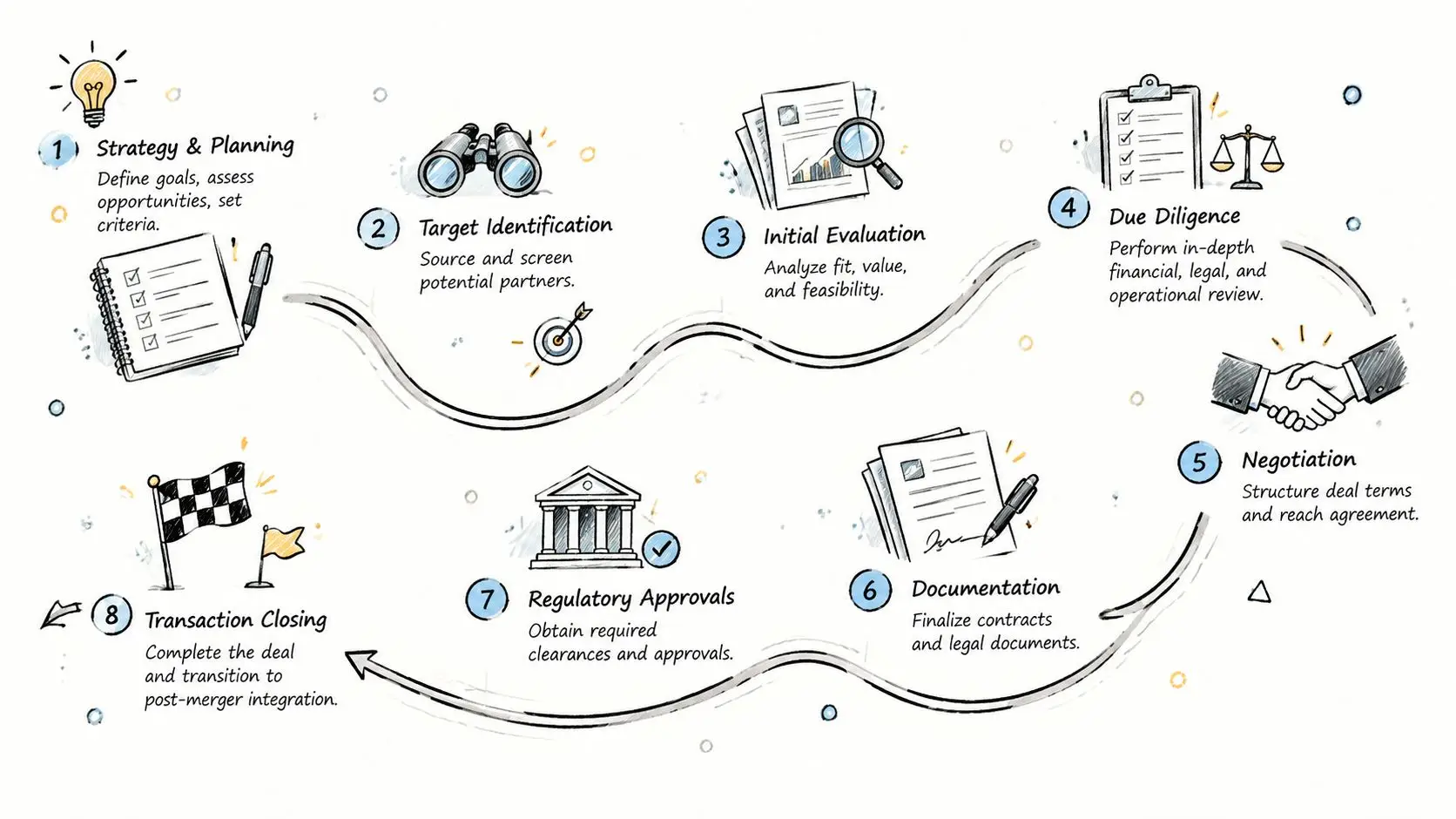
Navigating the M&A Engagement Process
A mid-market transaction usually follows a controlled sequence rather than a single negotiation. Typical workflows span about 6 to 12 months, with due diligence commonly taking 6 to 10 weeks and negotiation taking another 4 to 8 weeks, according to this overview of M&A investment banking workflows.
Preparation and strategy
The advisor first clarifies the transaction objective. A seller may seek maximum value, speed, confidentiality, a strategic successor, or partial liquidity. A buyer may seek market entry, technology, talent, distribution, or geographic expansion.
Next, the advisor reviews readiness. The team identifies missing financial information, contractual restrictions, ownership issues, litigation exposure, regulatory approvals, and operational weaknesses. Early preparation gives management time to fix problems before buyers attach discounts to them.
Market approach and bidding
The advisor then develops the buyer or target list. On the sell side, controlled outreach creates a competitive process while protecting confidentiality. On the buy side, disciplined screening prevents management from spending resources on targets that cannot satisfy the acquisition thesis.
After initial interest, the advisor manages questions, indications of interest, management presentations, and bid comparisons. The advisor should compare complete deal terms, not just purchase prices.
Diligence and definitive documentation
Once the parties select a preferred counterparty, diligence becomes more intensive. The advisor coordinates document requests and routes findings to the relevant lawyers, accountants, tax specialists, and executives.
The lawyers then draft and negotiate definitive agreements. Those documents should reflect the actual diligence record. A contract that ignores discovered risks creates avoidable disputes after closing.
Closing and integration
Closing requires satisfaction of conditions, execution of documents, funds flow, approvals, and completion mechanics. The advisor keeps the parties aligned and identifies unresolved items before they become closing obstacles.
After closing, integration teams implement the agreed operating plan. Effective advisors preserve a clear record of assumptions, responsibilities, deadlines, and escalation paths.
Understanding M&A Advisory Fee Structures
Fee proposals often combine a retainer with a success fee. The retainer compensates continuing work, while the success fee links part of the advisor’s compensation to completion. Market guides also describe work-product fees, expense treatment, minimum fees, and tail provisions within broader engagements.
The Lehman-style fee explanation illustrates a declining percentage structure. The classic formula applies 5% to the first $1 million, 4% to the second, 3% to the third, 2% to the fourth, and 1% above $4 million.
| Fee Model | Structure | Best For |
|---|---|---|
| Retainer plus success fee | Periodic retainer combined with a completion fee | Mandates requiring sustained preparation and execution |
| Lehman formula | Declining percentages across transaction-value bands | Traditional middle-market engagements |
| Modified Lehman | Adjusted bands or percentages negotiated for larger transactions | Complex or higher-value deals |
| Flat percentage | One percentage applied to the agreed fee base | Clear, easily calculated mandates |
| Tiered success fee | Different percentages or amounts linked to outcomes | Sellers seeking incentives for stronger value or terms |
What the proposal must define
The client should identify the fee base. It may involve enterprise value, equity value, total consideration, assumed liabilities, contingent payments, or proceeds paid later. Ambiguity can create disagreement when an earn-out, rollover, seller note, or post-closing adjustment affects consideration.
The engagement should also address exclusivity, termination, reimbursement, minimum compensation, and the tail period. A tail provision may preserve the advisor’s fee entitlement if a transaction closes with an introduced buyer after termination.
Fee pressure has also increased. A recent US middle-market fee survey found that 30% of advisors raised at least one fee in 2024, compared with 37% in 2023, while 71% still charged some upfront fee; the same survey reported that nearly a third charged no upfront work fee, compared with 19% in 2024, according to Firmex’s fee guide. These figures make proposal comparison important, especially for cross-border mandates with multiple professional teams.
Strategic Analysis Mitigating Cross-Border Litigation Risks
By 2026, a poorly managed Israeli M&A transaction may create more than a failed investment. It can generate parallel disputes involving shareholders, directors, sellers, buyers, employees, lenders, regulators, and counterparties across jurisdictions.
A foreign company often assumes that familiar transaction concepts operate identically in Israel. That assumption can fail when local corporate practice, contractual interpretation, regulatory approvals, employment obligations, licensing requirements, or enforcement procedures differ from the buyer’s home market.
The legal risk behind the commercial model
Undisclosed liabilities can lead to indemnity claims. Incomplete diligence can support allegations that the buyer relied on inaccurate information. Poorly drafted governance arrangements can produce shareholder disputes after the buyer acquires control.
Representation and warranty drafting requires particular care. Representations state facts, while warranties operate as promises that those facts remain true. That distinction affects indemnities, closing conditions, disclosure schedules, and post-closing remedies, as explained in this analysis of representations and warranties.
The parties should also select dispute mechanisms deliberately. Governing law, jurisdiction, arbitration, language, service, interim relief, and enforcement all affect the practical influence of the parties. A clause copied from a foreign precedent may not address the transaction’s Israeli elements.
International disputes often create operational pressure before a tribunal reaches the merits. Therefore, a cross-border strategy should protect evidence, preserve confidentiality, coordinate correspondence, and prevent inconsistent positions in different countries. The principles discussed in international commercial litigation guidance apply directly when transaction disagreements escalate.
Objective risk-mitigation steps
- Define local responsibility: Require the advisor to identify which Israeli lawyers, accountants, tax specialists, and regulatory professionals will review the transaction.
- Map liabilities early: Create a register covering litigation, employment, licenses, tax, intellectual property, data, suppliers, customers, and financing.
- Match findings to remedies: Convert each material risk into a price adjustment, condition, covenant, indemnity, escrow, insurance requirement, or termination right.
- Control disclosures: Use a disciplined data room, version control, confidentiality protocols, and written approval for sensitive disclosures.
- Coordinate jurisdictions: Align Israeli agreements with foreign acquisition documents, financing instruments, shareholder arrangements, and corporate approvals.
- Prepare the post-closing record: Preserve diligence materials, disclosure schedules, board approvals, and integration decisions for future enforcement or defense.
The recommended strategic path is to treat advisory work as pre-emptive legal defense, not as a substitute for legal diligence.
How to Hire the Right M&A Advisor for Your Deal
The right advisor is selected against the transaction’s risk profile, not its headline value. A foreign company entering Israel should assess financial judgment, sector experience, Israeli execution capacity, cross-border coordination, and awareness of disputes as one decision.
Questions for the selection process
Ask candidates to explain their proposed process before reviewing credentials. Their answer should show how they will collect information, test valuation, manage counterparties, identify legal exposure, and escalate unresolved issues.
Use questions that reveal how the team works in practice:
- Relevant experience: Which mandates involved Israeli companies, foreign buyers or sellers, or multi-jurisdictional structures?
- Role clarity: Will the advisor represent the buyer, seller, shareholders, or another stakeholder?
- Team composition: Who will perform the work, and what will the lead advisor delegate?
- Diligence method: How will financial findings connect to contractual protections and closing decisions?
- Negotiation approach: How will the advisor protect price while preserving deal certainty and enforceability?
- Conflict controls: Which conflicts checks and confidentiality procedures will apply?
- Dispute planning: Which governing law, forum, language, and enforcement issues require attention before signing?
- Integration support: How will the team preserve value after closing?
Compare capability, not promises
A polished pitch deck does not establish execution quality. Request anonymized examples of comparable mandates, references from relevant clients, and a clear account of difficult issues the advisor has handled.
Test whether the advisor understands the company’s internal limits. A multinational may have strong finance and procurement teams but limited Israeli employment, regulatory, tax, or commercial litigation knowledge. A founder-led Israeli target may need help documenting governance, ownership, intellectual property, and succession arrangements.
The principles in commercial risk management resources help assess whether the advisor addresses prevention rather than reaction. Partnership and founders’ agreement guidance is relevant where ownership rights, reserved matters, deadlock, or founder obligations could affect the deal.
Prioritize advisors who can connect commercial analysis with Israeli legal execution. That capability matters when a transaction may later be examined in litigation, challenged by a shareholder, or enforced across jurisdictions. The selection process should therefore test how the advisor records decisions, coordinates specialists, and turns identified risks into negotiated protections.
RNC Group offers cross-border M&A guidance, Israeli commercial-law analysis, negotiation support, due diligence coordination, and transaction-document assistance for companies entering or operating in Israel. To avoid costly mistakes and build a transaction on stronger strategic and legal foundations, visit RNC Group and contact the firm regarding the proposed deal.
This article provides general information and does not constitute legal advice. The information isn’t intended to create, and receipt of it doesn’t constitute, an attorney-client relationship. Readers shouldn’t act or refrain from acting based on this information without seeking professional legal counsel specific to their circumstances.