
A forum clause can determine whether a cross-border dispute becomes a controlled commercial process or a prolonged fight across national courts. For an Israeli exporter, technology company, or multinational counterparty, the wrong choice can expose the business to procedural delay, duplicated enforcement work, and pressure that the original contract never priced.
Arbitration vs litigation isn’t a contest between a modern solution and an outdated one. Arbitration offers private contractual adjudication before selected decision-makers, while litigation places the dispute before a state court exercising public judicial authority. Each forum can protect a business, but each can also magnify a poorly drafted agreement.
The practical question in 2026 is narrower and more useful: Which forum matches the dispute size, cross-border footprint, and bargaining-power imbalance? Those three levers usually matter more than broad promises about speed or privacy.
Why Forum Selection Can Decide the Outcome Before the Dispute Begins
Forum selection is a business decision made before the dispute exists. The clause can determine where the claim starts, who decides it, what evidence is exchanged, whether outsiders can observe the process, and how the successful party enforces the result. For an Israeli exporter, technology company, or multinational counterparty, those choices affect cash flow, management time, and negotiating pressure long before a hearing.
The relevant test in 2026 is not whether arbitration sounds faster or more private than litigation. It is whether the chosen forum fits three business levers: dispute size, cross-border footprint, and bargaining-power asymmetry. A large claim with assets in several countries raises different concerns from a smaller payment dispute against a local counterparty. A weaker party may also need procedural limits that prevent a stronger opponent from turning complexity into pressure.
International arbitration handles disputes at global and mid-market scale. The ICC reported 881 new cases filed in 2025, involving 2,531 parties from 147 countries or independent territories, with pending cases carrying an aggregate value of US$299 billion (ICC 2025 dispute-resolution statistics). That activity makes arbitration a practical option for Israeli businesses dealing with foreign distributors, licensors, investors, lenders, and joint-venture partners.
The basic distinction
In arbitration, the parties agree to submit defined disputes to one or more arbitrators. They can shape the institution, procedural rules, seat, language, and tribunal structure. In litigation, a party files before a competent state court. The court applies national procedural law, manages evidence under its rules, and issues a judgment that may carry public precedential value.
Neither forum guarantees a better commercial result. An arbitration clause without a clear seat, institutional rules, or interim-relief mechanism can produce expensive satellite proceedings. A court clause can instead place a foreign business in unfamiliar procedure, public hearings, and a congested docket.

Practical rule: Treat the forum clause as a financial and operational risk-allocation term, not boilerplate.
For a closer look at practical dispute mechanisms, businesses can browse Disputely’s blog posts. The final recommendation still requires a contract-specific review of claim value, asset locations, bargaining power, and likely enforcement destinations.
How Each Forum Works From Filing to Award
The forum begins shaping the dispute as soon as a claim crystallizes. Arbitration starts with a notice or request under the selected rules. Litigation starts with a claim filed in a competent state court.
The decision-maker is appointed differently. Arbitration may use a sole arbitrator or a tribunal, with appointment rights shaped by the agreement and institutional rules. Litigation assigns a judge through the court system, generally without party control over that appointment.
The procedural anatomy
Arbitration usually permits the tribunal to tailor document production, witness evidence, expert reports, and hearing formats to the dispute. Litigation follows mandatory national procedure, which may impose broader discovery, stricter evidentiary rules, public filings, or formal hearing stages.
Interim relief requires the clause and the procedural plan to work together. Under the UNCITRAL Model Law text, a tribunal can order temporary measures to preserve the status quo, prevent harm, protect assets, or preserve evidence. Such measures bind the parties and may be enforced through a competent court, subject to the applicable legal framework.
A party may also seek temporary relief from a domestic court before or during arbitration. Court assistance with interim measures is compatible with an arbitration agreement, as reflected in UNCITRAL’s procedural guidance (UNCITRAL Notes on Organizing Arbitral Proceedings).
| Procedural Stage | Arbitration | Litigation |
|---|---|---|
| Initiation | Notice or request under agreed rules | Claim filed in a competent court |
| Decision-maker | Party-influenced arbitrator appointment | Judge assigned through the court |
| Documents | Tailored production often available | National discovery and disclosure rules |
| Evidence | Flexible procedure, subject to tribunal directions | Formal statutory and procedural rules |
| Interim measures | Tribunal relief, plus possible court assistance | Court injunctions and preservation orders |
| Hearing | Private hearing structure, unless agreed otherwise | Generally public court process |
| Decision | Award, with limited review routes | Judgment, often with appeal rights |
| Enforcement | Recognition usually required where assets sit | Judgment enforcement under applicable law |
Where the systems diverge
Privacy is not automatic in arbitration. Israeli arbitration law addresses confidentiality case by case, and arbitrators may face fiduciary-duty exposure for disclosing protected information (Israeli arbitration-law review). Parties should therefore state confidentiality duties expressly, including who may receive documents and how evidence must be handled.
Review rights create a separate trade-off. Arbitration generally restricts merits review, which supports finality but leaves fewer opportunities to correct an erroneous decision. Litigation usually provides a defined appellate route, although an appeal adds time, cost, and uncertainty.
The business consequences extend beyond the hearing. A small domestic claim may fit a court’s established process, especially where coercive powers and appeal rights matter. A large cross-border dispute may benefit from a tribunal chosen for the subject matter, a procedure adapted to the evidence, and an award capable of recognition where the counterparty holds assets.
Bargaining power also matters. A stronger party may be able to insist on a seat, institution, or court that the weaker party cannot practically use. The clause should be tested against likely witnesses, documents, interim-relief needs, and enforcement destinations before the contract is signed.
Cost, Time, and Predictability in Real Numbers
Published benchmarks explain why businesses often view arbitration as faster, while also showing why cost analysis must cover more than filing fees.
A Milan comparative dataset recorded average arbitration duration at 307 days, compared with 764 days for first-instance civil litigation. Appeals added another 597 days in the cited litigation benchmark, while complex international arbitration matters averaged 367 days (Milan arbitration efficiency comparison).
Those figures do not guarantee a particular timetable. They show why arbitration can appeal to businesses with large, cross-border disputes. A tribunal can focus on the issues, limit irrelevant evidence, and avoid some court-docket constraints. A court may offer stronger coercive powers, but its timetable depends on the national system and the complexity of its docket.
What the cost figures mean
The ICC has reported that party costs represent approximately 83% of total arbitration costs, while arbitrator fees represent 15% and case administration represents 2%. Institutional and arbitrator fees matter, but lawyers, experts, documents, and internal management usually drive most expenditure.
The same analysis reported a 20-month median LCIA case duration, a USD 117,653 median total cost, and approximately four months for tribunals to produce awards. These figures are benchmarks, not promises. They also show why a party with limited bargaining power should assess the full procedure before accepting an arbitration clause that requires substantial upfront spending.
WIPO respondents reported that technology-transaction arbitration took a little over one year on average and cost a little over US$400,000 on average (WIPO International Survey on Dispute Resolution in Technology Transactions). That benchmark may assist companies assessing licensing, software, and technology-transfer disputes.
Delay has a balance-sheet effect
Court congestion changes the value of a judgment. The OECD has noted substantial civil-justice backlogs, including a benchmark where the backlog declined by 45% since 2007 but remained high (OECD civil-justice discussion). A delayed decision can prolong uncertainty over revenue, supply obligations, management time, and reserves.
For a high-value international dispute, arbitration often means front-loaded spending with more controllable procedure. Litigation may involve lower initial institutional expense, yet delay can create its own commercial cost. The right choice turns on dispute size, cross-border enforcement needs, and whether both parties can realistically bear the selected forum’s financial and procedural demands.
Enforcement Across Borders and the Israeli Specifics
An award has value only when the successful party can turn it into recovery. Dispute size, cross-border footprint, and bargaining-power asymmetry should shape enforcement planning before the contract is signed. A smaller claim may not justify parallel proceedings across several jurisdictions. A large claim against a party with assets abroad may require arbitration and enforcement planning from the outset.
The enforcement chain generally follows six steps:
- Identify the asset jurisdiction. Locate bank accounts, inventory, receivables, shares, and real property.
- Confirm the award framework. Check the seat, applicable arbitration law, institutional rules, and recognition regime.
- Preserve evidence and assets. Seek tribunal relief and domestic court assistance where the legal threshold supports urgent protection.
- Apply for recognition. File the award and required procedural documents with the competent court.
- Address objections. Prepare for arguments about notice, tribunal authority, procedural fairness, public policy, or non-arbitrability.
- Execute against assets. After recognition, use the enforcement process available in that jurisdiction.
Israeli confidentiality needs drafting
Calling arbitration confidential does not make every related document protected. Israeli law does not impose a blanket confidentiality rule over all arbitration material. Protection depends on the circumstances, and arbitrators may face fiduciary exposure if they disclose protected information, as explained in this Israeli arbitration-law review.
The clause should specify protected information, permitted disclosures, professional-adviser and regulatory exceptions, and remedies for breach. It should also allow disclosures required by a court, regulator, lender, auditor, or enforcement authority. This matters particularly where bargaining power is uneven and one party may otherwise use confidentiality language to restrict ordinary compliance or financing activity.
Court assistance doesn’t defeat arbitration
A court can support arbitration without deciding the merits. Parties may need court assistance for interim protection, recognition, enforcement, or procedural support.
For some interim measures, the requesting party must show likely harm that damages would not adequately repair and a reasonable possibility of success on the merits, consistent with the UNCITRAL Notes on Organizing Arbitral Proceedings. That threshold makes early witness statements, financial records, and asset evidence important.
A foreign company contracting with an Israeli business should separate the seat from the enforcement location. The seat determines the supervisory legal framework. The enforcement location determines where the winning party seeks practical recovery.
Drafting the Forum Clause That Protects the Deal
A forum clause should allocate procedure before either party has an incentive to exploit uncertainty. It must answer the questions that otherwise produce satellite litigation, delay, and avoidable cost. The right drafting choices depend on the dispute’s likely size, cross-border footprint, and the parties’ bargaining power.
Arbitration-only structure
A suitable arbitration clause might state:
Any dispute arising out of or relating to this Agreement shall be finally resolved by arbitration under the Rules of the International Chamber of Commerce. The seat shall be Tel Aviv, Israel. The language shall be English. The tribunal shall consist of one arbitrator. The parties may seek interim or conservatory relief from any competent court. The parties shall maintain confidentiality in accordance with the express obligations set out in this Agreement.
This structure suits parties that need a neutral decision-maker, cross-border enforceability, and a controlled procedure. It may be less attractive for a smaller claim if tribunal and institutional costs outweigh the value in dispute. The drafter should also test whether Tel Aviv is practical for witnesses, documents, and enforcement.
Court-first structure with a narrow carve-out
A court clause can state:
The courts of Tel Aviv, Israel, shall have exclusive jurisdiction over disputes arising out of or relating to this Agreement. Either party may seek urgent interim or conservatory relief from any court with jurisdiction over the relevant person or assets.
This model fits disputes centered on Israeli assets, urgent injunctions, or a business that values appellate review and public precedent. It can also give a party with weaker bargaining power a familiar procedural route, particularly where the other side has greater resources or insists on a foreign arbitral seat. The carve-out should remain narrow. Broad exceptions can undermine the promised exclusivity.
Tiered dispute resolution
A hybrid clause may state:
The parties shall first refer any dispute to senior representatives for good-faith negotiations. If the dispute remains unresolved after the agreed negotiation period, the dispute shall be finally resolved by arbitration under the selected institutional rules. Either party may seek interim relief from a competent court, and the negotiation requirement shall not delay urgent protective measures.
Tiered clauses can create a settlement opportunity, but only if their triggers are objective. The agreement should identify who participates, when the process starts, how notice operates, and when arbitration becomes available. A vague negotiation step can become a jurisdictional objection instead of a useful commercial process.
Drafting points that prevent later fights
- Choose the seat deliberately. A hearing city and legal seat can differ, but the clause must state the seat clearly.
- Name the rules. Institutional rules provide an operating framework that vague references cannot replace.
- State the governing law. The governing law of the contract and the law of the arbitration agreement may require separate analysis.
- Set the language. Language affects witness preparation, translation, and document review.
- Define confidentiality. Protect information expressly while preserving legally required disclosures.
- Reserve urgent relief. State that court applications will not breach the arbitration agreement.
- Avoid contradictory mechanisms. Mismatched seats, institutions, and appointment procedures create avoidable challenges.
Redlines should improve certainty, not merely add length. A shorter clause with coherent choices usually protects the deal better than a long clause containing conflicting instructions.
Choosing the Right Forum by Dispute Profile
Forum choice should follow the dispute’s commercial profile, not a general preference for arbitration or litigation. Test three levers first: size, geography, and bargaining power. Those factors often determine recovery, procedural control, and settlement pressure before anyone files a claim.
Claim value remains relevant, but it is only the starting point. A smaller dispute may justify arbitration when the counterparty holds assets across several jurisdictions and enforcement must occur outside Israel. A large claim may still belong in court when Israeli assets, urgent relief, or a need for public precedent controls the strategy. The market’s continuing attention to forum selection is reflected in the QMUL 2025 International Arbitration Survey.
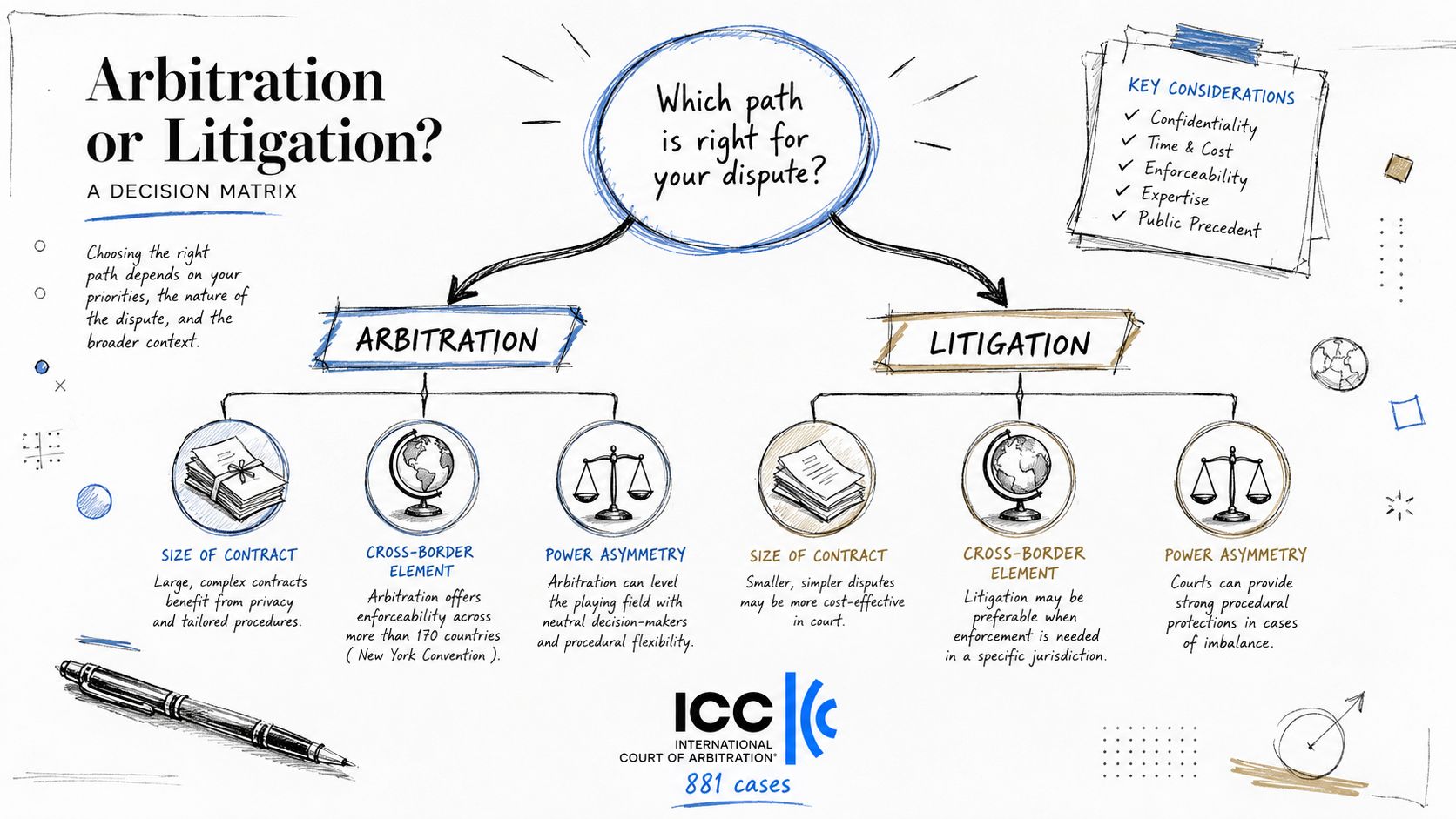
A commercial decision matrix
| Dispute profile | Recommended starting point | Reason |
|---|---|---|
| Large claim, several countries, neutral relationship | Institutional arbitration | Specialist decision-making and cross-border enforcement may justify the process |
| Mid-market claim, limited foreign assets | Compare streamlined arbitration with Israeli litigation | Procedure and recovery economics may outweigh privacy |
| Israeli assets, urgent injunction, local witnesses | Israeli litigation or a carefully drafted hybrid | Court access may provide faster practical relief |
| Unequal bargaining power | Adapted arbitration or court forum | The clause should limit delay, cost pressure, and procedural exhaustion |
| Need for public precedent | Litigation | A judgment can serve broader legal or commercial objectives |
| Sensitive information | Express confidentiality plus chosen forum | Privacy should be contractual, not assumed |
The ten-minute contract review
Before approving the clause, ask:
- Where does the counterparty hold meaningful assets?
- Where are the witnesses and records located?
- Does the claim justify tribunal and administration costs?
- Could the stronger party exploit delay or procedural complexity?
- Does the business need a public judgment or a private award?
- Which court can grant urgent protective relief?
- Does the clause identify the seat, language, rules, governing law, and confidentiality obligations?
The right answer can change within the same transaction. A claim below US$4 million may justify arbitration if enforcement will span jurisdictions. A high-value dispute may be better suited to Israeli litigation when local assets and witnesses dominate. A neutral seat may help an international claimant, while a court forum can give the weaker party a clearer route to urgent relief and public accountability.
The contract team should also test bargaining power realistically. If one side controls the documents, funding, or appointment process, a nominally neutral procedure may still produce strategic delay. Forum design should account for who can afford a long case, who can obtain interim measures, and where an eventual decision can be enforced.
When Israeli Litigation Beats Arbitration and What to Do Next
Israeli litigation can be the better commercial choice when Israeli assets, witnesses, or urgent relief drive the dispute. Arbitration is not automatically preferable for a multinational transaction. The right forum turns on dispute size, cross-border enforcement, and bargaining-power asymmetry.
Litigation may also protect a weaker party where the counterparty could influence tribunal appointments, prolong procedure, or use cost differences to pressure settlement. A business seeking public precedent may prefer court proceedings, since an arbitral award generally does not serve the same precedential function.
Use a focused forum review before signing:
- Identify meaningful assets and likely enforcement jurisdictions.
- Separate governing law from the arbitration-seat analysis.
- Choose a language that limits translation and witness friction.
- Select institutional rules or the competent Israeli court.
- Preserve urgent court relief through a clear carve-out.
- State confidentiality duties and permitted disclosures.
- Test whether the weaker party can realistically fund and conduct the case.
RNC Group advises on international commercial disputes, arbitration-award strategy, Israeli court confirmation, enforceability planning, multilingual correspondence, and cross-border coordination. Its review examines forum mechanics, the opponent’s position, and where recovery must occur.
Businesses can contact RNC Group for review of governing-law, seat, interim-relief, confidentiality, and enforcement provisions. This article provides general information, not legal advice, and does not create a solicitor-client or attorney-client relationship. Applicable law, procedure, facts, and enforcement options vary, so obtain advice on the specific transaction or dispute.