
In 2026, the expensive mistake is not filing first. It is waiting until the dispute has already chosen the forum, the timeline, and the strategic map. A commercial dispute lawyer should therefore act as a risk manager before anyone drafts the complaint, because once deadlines harden, options narrow fast.
That matters in a crowded market. The American Bar Association reported 1,322,649 active lawyers in the United States as of January 1, 2024, and the Bureau of Labor Statistics projected 4% employment growth for lawyers from 2024 to 2034 with about 31,500 openings per year American Bar Association demographics. In a mature market like that, specialization is not decoration. It is the difference between broad legal comfort and dispute-specific execution.
The Hidden Cost of Waiting to Call a Commercial Dispute Lawyer
A dispute feels manageable until the other side files first. After that, the procedural clock starts, the story hardens, and every day of delay makes course correction more expensive. In commercial matters, waiting often costs more than the merits of the case.
Early advice changes the path, not just the paperwork
A commercial dispute lawyer adds value before any complaint is filed. The first job is not courtroom advocacy. It is a fast assessment of claim strength, forum exposure, settlement pressure, and the practical routes to resolution. Early analysis should be a threshold step in most disputes because it improves communication and cuts waste.
That early work matters because commercial litigation is a pricing-sensitive field. Recent market data cited partner rates in the U.S. around $604 on average, with complex matters often priced higher in major markets. So every unnecessary email chain, abandoned theory, or late document search has a visible cost.
Practical rule: The first week often decides whether the dispute becomes a controlled project or an uncontrolled crisis.
Commercial disputes also move inside tighter compliance and enforcement settings. Norton Rose Fulbright found that 65% of respondents experienced employment and labor disputes in 2022, and 51% said those disputes were among the most concerning areas ahead. The same survey found that 50% were involved in at least one regulatory proceeding in 2022 Norton Rose Fulbright litigation trends survey. That is a pressure environment, not a passive one.
Why delay gets punished
A board that waits for “more facts” often loses the chance to shape jurisdiction, preserve privilege discipline, and control narrative sequencing. Early advice does not remove conflict. It keeps the strategy from drifting while the other side is already making moves.
The best commercial dispute lawyer behaves like an architect of options. The wrong one behaves like an emergency responder after the structure has already shifted.
What Defines a Commercial Dispute and Why It Matters
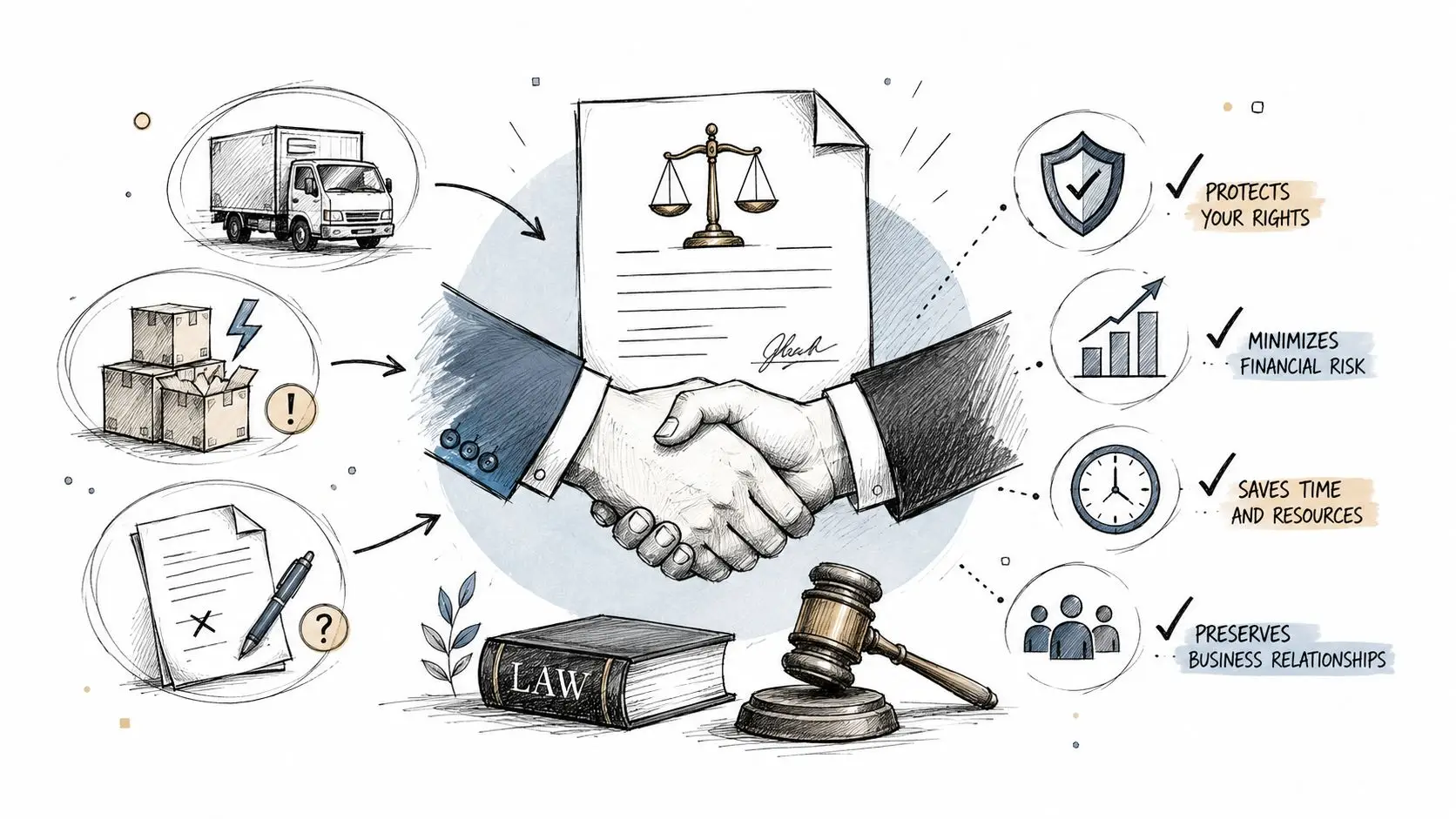
A commercial dispute is not just any disagreement with money attached. It is commonly a dispute arising in a commercial context between two business entities, which distinguishes it from consumer claims and ordinary civil matters Curtis commercial disputes glossary. That business-to-business structure changes everything, including the pace, the evidence, and the settlement posture.
The facts are usually technical, not simple
Commercial disputes often center on contract interpretation, performance metrics, and sector-specific proof. That is why warranty disputes, earn-out fights, outsourcing disagreements, and IT contract claims can turn on accounting records and technical analysis rather than on a neat legal rule Trowers corporate and commercial disputes. The stronger the technical record, the less room there is for loose argument.
Franchise agreements often fail at the level of controls, brand standards, and payment mechanics. Partnership disputes frequently involve exit rights, control rights, and competing narratives about who contributed what. Licensing conflicts usually focus on scope, territory, exclusivity, and misuse. Commercial debt collection brings its own pressure, because the dispute often sits beside liquidity stress and counterclaims.
Why the commercial label matters
The commercial context shapes forum choice, evidence strategy, and settlement tactics. Informed parties assume the tribunal will read the contract carefully, test the chronology, and expect documents to support every major assertion. That means a commercial dispute lawyer must think in terms of paper trails, expert inputs, and business consequences.
In commercial litigation, the side that explains the transaction cleanly often controls the battlefield early.
That is also where Israeli and international business relationships intersect. A contract drafted for one market may fail under another forum’s assumptions about enforcement, disclosure, or damages. The legal label matters because it changes how the dispute gets framed from day one.
The Four Stages of Commercial Dispute Resolution
Commercial disputes rarely move in a straight line. They move through negotiation, pre-action positioning, formal proceedings, and enforcement, and the party that understands that sequence usually spends less and concedes less. In practice, the decisive advantage is often created before anyone files anything. That is why early assessment matters so much in a commercial dispute. The board that treats the first weeks as a strategic phase, not a holding pattern, usually keeps more options open and avoids expensive mistakes.
Stage one starts before the lawsuit
The first stage is pre-litigation analysis. Counsel evaluates the contract, the chronology, the likely defenses, the available evidence, and the settlement range. A board needs more than a yes-or-no view on liability. It needs to know how the claim will behave in the chosen forum, how the counterparty is likely to respond, and whether a fast commercial settlement is realistic or only masks a deeper fight.
This is also where phased escalation earns its value. A measured demand letter, a reservation of rights, targeted document preservation, and an early without-prejudice approach can change the case before it hardens. That work is not theatrical, and it does not need to be. It is the point where a commercial dispute lawyer tests pressure points, identifies weak spots in the other side’s position, and decides whether a filing will improve their position or just increase cost.
Stage two is the formal filing
In commercial litigation, the case normally begins with a complaint filed in the proper court. The defendant then responds with an answer or a motion to dismiss CBM Law commercial litigation process. That first response can shape the entire matter, because it often determines whether the dispute moves into full discovery, gets narrowed early, or is pushed toward settlement on a tighter record.
Procedure matters here. A lawyer who knows how the pleadings will be read, what issues can be trimmed at the outset, and which claims should be defended aggressively can save the client time and exposure. The filing stage is not just about starting the case. It is about controlling the frame of the case before the other side does.
Stage three is the evidence contest
Discovery is where the documents, witnesses, and experts start to define the dispute. The side with the cleaner record usually gains room to settle on better terms. The side with a thin record may have to concede more, especially if internal emails, board minutes, payment records, or inconsistent witness accounts begin to fill the gaps.
Pressure also changes here. Discovery can expose weak assumptions, force a reassessment of damages, and reveal whether the dispute is really about liability, valuation, performance, or negotiation strength. That is why a commercial dispute lawyer has to manage evidence with discipline from the start, not just react once requests arrive. If the record is built carefully, discovery becomes a tool. If it is not, it becomes a drain.
Stage four is enforcement and closure
Even a favorable order can be only half the result. Payment, compliance, injunction effect, and cross-border recognition all matter. A dispute is not finished until the remedy works in business terms, and that often means thinking beyond the courtroom to collection, implementation, and the practical ability to make the outcome stick.
That final stage also exposes the difference between a paper victory and a usable one. A judgment that cannot be enforced, an injunction that is too narrow, or a settlement that leaves open performance disputes can drag the matter back into conflict. Good commercial litigation planning keeps enforcement in view from the beginning, because closure is measured by what the client receives, not by the language of the order.
Bottom line: Trial is not the default outcome. Managed risk is.
Cross-Border Complexity and Israeli Legal Considerations
A commercial dispute stops being local the moment the contract, the executives, the assets, or the payment chain sit in different places. In that setting, counsel has to manage multi-jurisdiction strategy from the outset, because commercial litigation often crosses national boundaries and requires cross-jurisdictional legal knowledge Thomson Reuters commercial litigation glossary. Waiting to think internationally is usually too late.
Forum, injunctions, and parallel tracks
The first strategic question is not always “Who is right?” It is often “Where can this be controlled?” Forum selection can affect pace, disclosure, and influence. At the same time, provisional remedies such as injunctions may be necessary to stop asset movement, preserve a relationship, or keep a breach from compounding.
That is why parallel ADR or arbitration planning matters. A cross-border matter may need mediation, local proceedings, and enforcement planning all at once. The lawyer’s job is to coordinate those tracks so they do not undermine each other.
Israel-specific pressures that get missed
Israeli disputes can involve bank account restrictions due to insufficient funds, multilingual document translation, and cross-border evidence handling. Those issues create practical friction long before any merits hearing. They also shape how fast a business can keep operating while the dispute is pending.
A multilingual file is not a luxury. It is a control mechanism. If the correspondence, invoices, and board materials are not ready in the relevant language, delay and confusion follow quickly.
Some firms, including RNC Group, handle international commercial disputes, multilingual correspondence, and execution across jurisdictions. The core point is not branding. It is that the matter needs one coherent strategy, not fragmented advice from disconnected offices.
What cross-border counsel must protect
The best response usually runs on parallel tracks.
- Containment: Stop the immediate commercial damage.
- Disclosure analysis: Identify what must be preserved and what can wait.
- Stakeholder mapping: Decide who needs to know, and when.
- Privilege protection: Keep sensitive analysis from leaking into bad evidence.
- Commercial continuity: Keep the business operating while the dispute moves.
In practice, the crisis rarely stays in one legal system. A lawyer who sees only one jurisdiction usually misses the full risk.
How to Select Counsel and Prepare Your Case in the First Week
The first week should produce clarity, not busywork. The lawyer you hire has to do more than file papers and wait for responses. Counsel needs judgment about timing, pressure points, translation, and how far to push before the matter hardens into a fight that costs more than the dispute itself.
The test is whether the lawyer can shape the first week into a controlled assessment. That means separating what must move now from what can wait, and deciding whether the case is strong enough to justify escalation or better handled through early settlement pressure.
Questions that reveal real capability
Ask direct questions at the outset.
- Cross-border coordination: Can the lawyer work with foreign counsel without losing control of the strategy or creating conflicting positions?
- Early assessment: Will the lawyer give a fast view of claim strength, defenses, and realistic settlement routes?
- Phased escalation: Does the lawyer recommend staged pressure, or rush straight to full conflict?
- Business fit: Can the lawyer explain the commercial effect in plain language, including the likely cost of delay?
If the answers stay vague, keep looking. A commercial dispute lawyer should be able to explain where the case is weak, where it has strength, and which issues need immediate protection. That is especially important in cross-border matters, where one misstep in one jurisdiction can complicate the entire file.
Documents that belong on the desk immediately
The first file should gather the contract, amendments, emails, notices, invoices, board minutes, payment records, and any pre-dispute correspondence. The chronology should start before the breach, not after it. Commercial cases turn on sequence, and sequence depends on preservation.
Practical rule: If a document might explain intent, performance, or payment, treat it as urgent.
A structured assessment should follow. That means identifying the strongest claims, the strongest defenses, the likely forum, and the most cost-effective path to gain a tactical advantage without wasting credibility. Early analysis is a threshold step because it sharpens communication and cuts avoidable motion practice.
For multinational clients, the right comparison sometimes sits outside the legal file itself. A company moving people across borders may study the process through a guide like Spanish immigration lawyer for expats, because business decisions often depend on parallel mobility, residency, and compliance planning. The same principle applies here, legal strategy must fit operational reality.
Understanding Fee Structures and Realistic Timelines
Cost is often the key decision point. Broader civil-justice data show why many parties hesitate; the Legal Services Corporation reports that low-income Americans did not receive enough legal help for 92% of their civil legal problems, and 46% cited cost as a reason they did not seek help Legal Services Corporation justice gap. Commercial clients are different, but the pressure is familiar.
Fee models and where they fit
| Fee Structure | Best For | Risk Allocation | Typical Timeline |
|---|---|---|---|
| Hourly | Complex disputes with uncertain scope | Client bears more cost variability | Flexible, often hardest to predict |
| Fixed fee | Narrow, defined pre-litigation tasks | Lawyer bears more scoping risk | Short, controlled early phases |
| Contingency | Recovery-driven claims with clear upside | Lawyer absorbs more outcome risk | Longer, tied to recovery timing |
| Hybrid | Businesses that want budget discipline and upside alignment | Shared risk | Useful when facts are developing |
Hourly billing gives flexibility, but it can punish indecision. Fixed fees help on bounded work, but they require tight scope definition. Contingency can work when collection or recovery is the main objective, though it is not always available in commercial conflict. Hybrid models sit between those poles and often fit first-week assessment work.
Time expectations depend on leverage, not hope
A pre-litigation resolution can move quickly if the documents are clear and the counterparty wants certainty. Arbitration can take longer, especially when experts and witnesses are central. Full litigation usually takes the longest path because procedure, motions, and discovery all add friction.
The wrong expectation causes bad decisions. A board that assumes speed may underfund the file. A board that assumes delay may miss the moment when influence is strongest.
Commercial dispute lawyers who manage spend well do one thing consistently. They define the objective, then match the fee structure to that objective instead of letting the file drift.
The Strategic Advantage of Phased Escalation and Crisis Management
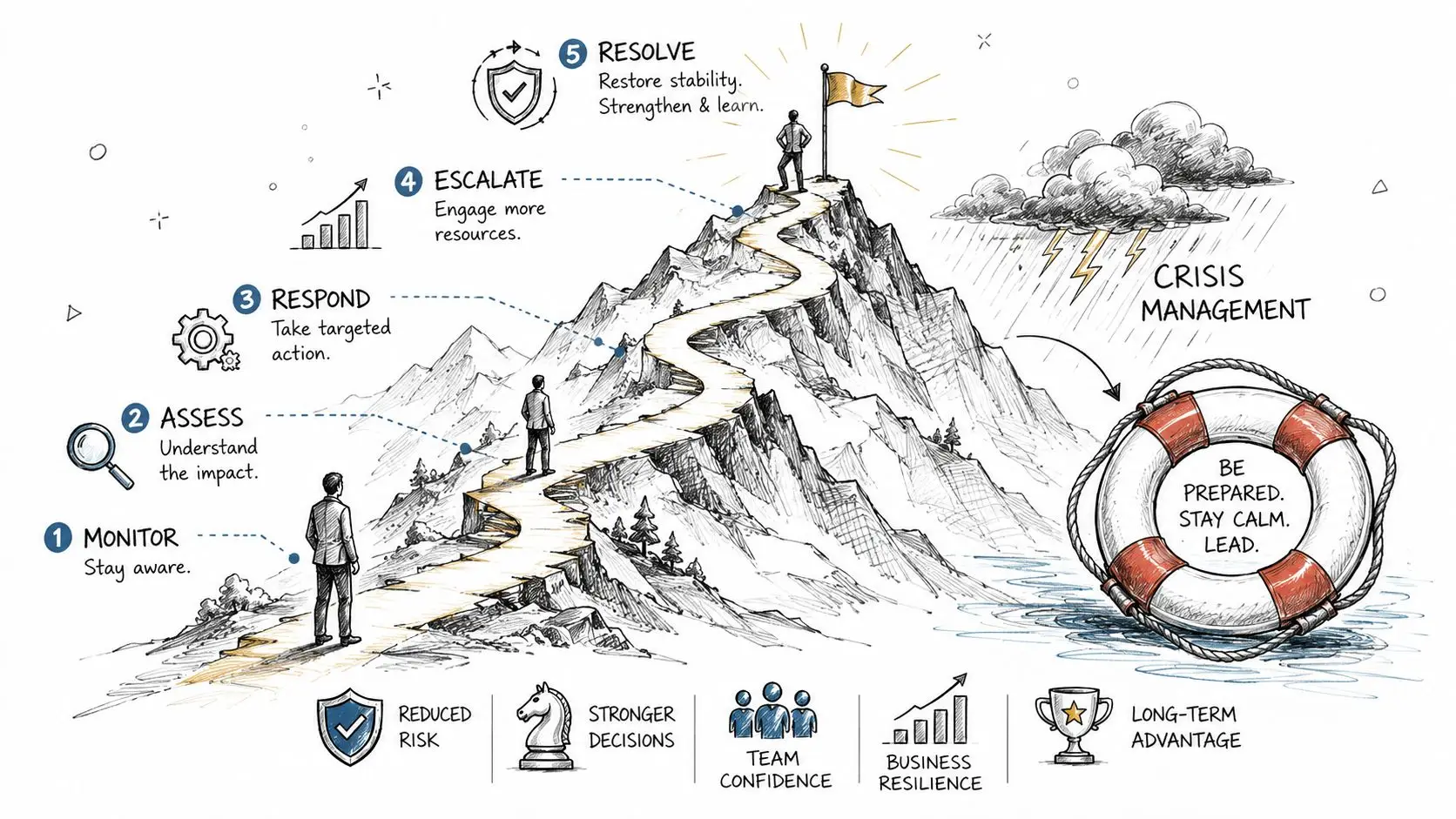
Phased escalation works because not every dispute deserves the same level of force. A carefully sequenced response can create pressure, preserve relationships, and keep the business credible. A reactive filing often does the opposite.
What phased escalation actually looks like
The sequence usually starts with a disciplined legal assessment, then moves to targeted correspondence, then to negotiated pressure, and only then to formal process if the other side refuses reason. That order matters because it preserves options and often shortens the path to resolution. Broad threats too early can harden the opponent. Silence too long can forfeit a key negotiating position.
Crisis management also needs confidentiality discipline. Sensitive business details should not be sprayed across unnecessary recipients. That is especially true in cross-border matters, where one loose message can complicate several forums at once.
Why this approach outperforms reaction
The strongest commercial counsel treats courts and media as tools, not destinations. The aim is not attention. The aim is a result that protects the business and reduces recurrence. That requires specific correspondence, careful stakeholder sequencing, and a plan for what happens if the counterparty escalates first.
The best outcome is often quiet. It resolves the immediate dispute and leaves the business with a usable operating position. That is harder to achieve when strategy starts with anger instead of structure.
Avoiding Costly Mistakes and Next Steps
The most common failure is not weak law. It is weak timing. Businesses wait, overtalk, or send the wrong message first, and then spend the rest of the matter trying to recover control. Early legal assessment, cross-border coordination, and phased escalation remain the decisive advantages in 2026.
A multinational board facing a breach, unpaid invoices, a partnership fracture, or a licensing conflict should treat the first week as decisive. The right process protects evidence, narrows exposure, and creates a stronger negotiating position before the other side defines the fight. A commercial dispute lawyer should be engaged to manage the path, not merely to react to it.
Disclaimer: This article provides general information only and does not constitute legal advice. Commercial disputes turn on specific facts, documents, jurisdictions, and commercial objectives, so any reader should obtain specific advice before relying on this content.
RNC Group handles international commercial disputes, crisis management, and cross-border legal correspondence with a strategy focused on early assessment and phased escalation. If the goal is to reduce avoidable cost and protect business continuity, visit RNC Group and contact the firm for a focused review of the dispute before it hardens into litigation.