

The tenant stopped paying in March. It still trades, still has staff on site, and its finance director answers every email with a promise to settle next quarter. The owner is a holding company registered abroad whose only Israeli asset is that building, and the board has read the lease, found the re-entry clause, and asked the reasonable question: when do we get the keys back?
The lease answers far less than it appears to. In Israel a commercial tenancy ends through a court process, and the commercial eviction process runs as a chain of stages, each with its own clock, its own documents and its own way of going wrong. A claim filed this month won't hand over keys next month. What it produces is a timetable the owner can plan around, and that planning is what protects the asset while the file moves.
In our experience, owners abroad lose the most time in the weeks before the claim is even filed: waiting for one more payment promise from the tenant, sending warnings that do not meet the lease's notice provisions, and discovering only in court that the clock they planned around was the wrong one. The process below is the order in which a commercial eviction file should be built.
Table of Contents
- Commercial Eviction Process Stages and Timing in Israel
- Choose Your Position and Prepare the Claim
- Filing the Claim and the Tenant Response Window
- From Judgment to Recovered Keys Through the Execution Office
- Protecting Operations While Possession Is Pending
Commercial Eviction Process Stages and Timing in Israel
Filing day is not recovery day. The distance between the two decides budgets, board reporting and, in some cases, whether the tenant is still solvent when the hearing arrives.
A commercial tenancy in Israel ends through a defined sequence. The landlord verifies the breach and the lease's own default, notice and cure provisions. It serves the required warning, files a claim for possession, and the tenant receives a fixed window to answer. If the tenant answers, the court sets a hearing. If it doesn't, the landlord can ask for judgment in default. After judgment, possession is transferred through the Execution Office, not by anything the landlord does itself.
Which clock is running matters more than how fast the file moves. The defense period belongs to the tenant. The hearing date belongs to the court. The enforcement date belongs to the Execution Office. Three dates, three owners, three different jobs for the landlord.
Under the expedited track of the Civil Procedure Regulations, 5779-2018, the tenant has 30 days to file a statement of defense, the court is expected to schedule the hearing within 30 days of that deadline, and judgment is generally issued within 14 days after the hearing ends. Contested files with procedural motions, translated foreign documents or a congested docket routinely run past them, which is exactly why the route has to be managed, not just waited out.
| Stage | Timing | What the landlord does |
|---|---|---|
| Tenant defense period | 30 days from service of the claim under the expedited track | Wait for the statement of defense; consider a default judgment request if none is filed |
| Hearing scheduling | Within 30 days after the defense deadline | Finalise evidence, documents and witness arrangements |
| Judgment | Generally within 14 days after the hearing ends | Obtain the possession order |
| Execution Office warning and voluntary period | 21 days under the Execution Office warning | Allow the tenant a final chance to leave voluntarily before enforcement |
| Physical eviction | Scheduled by the Execution Office after the voluntary period ends; the interval is set by that office | Coordinate handover, access and inventory with the Execution Office |
| Full route, straightforward case | Not fixed; set by the tenant's conduct and the court's calendar | Plan operations around the enforcement timetable, not the filing date |
Where the file sits determines the priority. A landlord still inside the notice period is deciding whether it has a claim at all, and a defective warning costs more than a week of delay. A landlord waiting on a defense is building the hearing record and pricing a settlement. A landlord holding a judgment is managing an enforcement file and the operational handover behind it.
Choose Your Position and Prepare the Claim
Before a single notice goes out, the business has to decide what it's buying. There are three positions and they need different documents. Possession now ends the relationship and usually the rent stream with it. A standstill or payment arrangement keeps the tenant in place and converts arrears into an enforceable schedule. Keeping the lease while enforcing payment preserves the asset's income while the money claim runs on its own track.
The recommended strategic path turns on the breach, the lease terms, the tenant's actual position and what delay costs the owner. Eviction isn't automatically the fastest route to value. A tenant that's still trading with stock and equipment on site may pay a negotiated schedule faster than a landlord re-lets a vacant unit, and a possession order against an empty shell recovers nothing but the walls.
The assessment that runs before any spending
Before committing to litigation costs, establish what can be recovered. The first step is an assessment that checks whether the debtor company is active, whether it owns identifiable assets, and whether judgments or liens already sit against it. A check of this kind takes days, not weeks, and it answers the harder question underneath the dispute: is collection realistic at all?
The documents for that first look are modest. Contracts or purchase orders, invoices, correspondence and whatever company details the owner holds on the tenant are usually enough for an initial assessment. Add the signed lease and every amendment, because in a possession claim the lease is evidence rather than background. Where an insolvency or restructuring process is already running, that changes the route entirely and should be identified before drafting anything.
Six steps to a claim that survives the file
- Read the signed lease, not a summary. The default clause, cure period, notice address, delivery method, guarantee and sublease consent each decide what the claim must prove. The common slip is working from a term sheet or a broker's email and discovering at the hearing that the notice clause names a different address.
- Confirm the breach against the ledger. Reconcile invoices, bank receipts and any payment received after the breach date. Accepting a partial payment without a written reservation opens a waiver argument, so get advice before banking the cheque.
- Serve a warning that states the breach, the cure deadline and the consequence of non-compliance. Keep proof of how it arrived: courier receipt, registered mail confirmation, a dated delivery record. One warning delivered to the contractual address with evidence beats three sent wherever the tenant happens to answer emails.
- Assemble the evidence set early. Signed lease and amendments, the correspondence trail, photographs or an inspection report for damage, and every demand. These files turn on documents that existed before the dispute, not on ones drafted for it.
- Count deadlines from actual delivery. A cure period runs from the moment the notice reached the tenant, not from the day it left the office. Check the count against any protected-tenancy rule before choosing the procedure.
- Fix the objective in writing. Possession only, arrears, or a negotiated handover with a defined exit date. Each needs a different pleading and a different bundle, and mixing them produces a claim that asks for everything and proves nothing.
A question worth asking at step one: if the tenant paid everything tomorrow, would the owner still want the premises back? If the answer is no, the file is a collection matter with an eviction threat attached, not an eviction.
A landlord can only hold that together if it can produce, on demand, the lease, delivery proof for every notice, the ledger and the correspondence. Missing pieces are the first thing to fix, before filing fees are spent.
Filing the Claim and the Tenant Response Window
In Israel, possession of commercial premises is recovered through a claim, not through a lock. Under the Civil Procedure Regulations, 5779-2018, a landlord seeking possession generally has to bring an eviction claim rather than use self-help measures such as changing locks or physically removing the tenant, and the expedited track is governed by Regulations 78 to 82. A landlord that bypasses the court hands the tenant a counter-claim for interference with possession and delays its own recovery.
Once the claim is served, the tenant has 30 days to submit a statement of defense. Two outcomes follow, and they diverge quickly. If no defense is filed, the landlord can seek judgment in default and move to enforcement. If a defense is filed, the matter proceeds to a hearing, and the calendar belongs to the court.
Possession is pleaded separately from rent arrears and damages, which are normally pursued in their own claim. That separation matters commercially: a possession claim is a focused instrument and moves faster when it isn't carrying a damages case behind it. An owner that assumes one filing resolves every money question ends up with the premises back and the debt untouched.
What to do during the response window
- Verify service. Who was served, at which address, on what date, and whether the court record reflects it.
- Watch the docket. Deadlines move, and a defense filed late in the window resets the practical calendar.
- Build the hearing file now. Witnesses identified by name, original documents located, translations of foreign-company records commissioned early.
- Price the alternatives. A payment plan with a signed schedule or an agreed surrender date may beat a hearing on both cost and time.
Is the defense substantive or delaying
The distinction is usually visible in the first two pages. A substantive defense engages with the breach and the documents: a receipt the ledger missed, an amendment, a repair log that supports a withholding argument. A delaying defense raises procedural objections without a factual basis, or disputes facts the landlord can prove with a single document.
The response differs accordingly. A substantive defense is a settlement conversation with evidence behind it. A thin defense is a hearing to be prepared for, and often the fastest route to judgment.
For orientation on how lease work is structured on the Israeli side, the firm's commercial leasing and property management practice covers lease agreements, management contracts, usage licences and property administration. It's a reference point for context, not a substitute for advice on a specific file.
From Judgment to Recovered Keys Through the Execution Office
A possession judgment changes the legal position. It doesn't change who holds the keys. Enforcement in Israel runs through the Execution Office, and the landlord's own hands stay off the door.
The handover itself is a scheduling exercise, and it usually begins after the court has already ruled. The image below captures the point where the legal document and the physical keys finally meet.
The record that carries a file from claim to judgment is the same record that carries it into enforcement: the commercial lease, a precise description of the breach, written warnings, proof of delivery, rent ledgers or bank records, photographs where relevant and the material correspondence, as set out in this strategic guide to eviction claims for leased commercial premises. After judgment, the landlord doesn't recover possession independently. Enforcement proceeds through the Execution Office, which issues a formal warning and allows a final voluntary-compliance period, reported in that guide as 21 days, before forcible enforcement may occur. Confirm the current period and the local office's practice for the file in question.
The sequence then runs in order. Judgment is obtained. An enforcement file is opened with the Execution Office. The formal warning is served on the tenant. The voluntary period runs. The enforcement step is scheduled with the bailiff. Possession is handed over. Each of those is a separate milestone with its own paperwork, and rent or damage claims still need their own track.
What the landlord prepares while the enforcement file is open
- Access and keys. Who holds keys, alarm codes, parking permits and loading access, and who will be on site for the handover.
- Inventory. Tenant equipment, stock and fixtures listed with dates and photographs, separating what the tenant owns from what is affixed to the premises.
- Utilities and security. The position on electricity, water and communications, and who secures the unit once control returns.
- Evidence for the money claim. Condition reports, meter readings and dated photographs taken before anything is moved.
For an owner coordinating from abroad, the binding constraint is usually decision latency rather than law. Appoint one decision-maker with authority to instruct Israeli counsel, agree a reporting interval, and settle who can sign for the company before the enforcement step is scheduled. Documents executed or translated overseas take longer than the hearing does, and a power of attorney arranged in advance costs far less than one arranged against a deadline.
The choice at the end of this stage is whether to keep the enforcement timetable or convert it into a supervised handover. A dated exit, a signed surrender document and an agreed inventory often cost less than bailiff enforcement, and they preserve the evidence the owner needs for the claim that follows.
Protecting Operations While Possession Is Pending
Legal entitlement to possession and operational control of the premises are different things, and the gap between them is where most of the damage happens. Guidance for foreign businesses holding Israeli commercial leases makes the point directly: eviction explainers tend to present a straight line of notice, lawsuit, judgment and enforcement, while understating the post-judgment stage of voluntary departure periods, filing with the enforcement authority, bailiff scheduling, access control, inventory, utilities, signage and evidence preservation for rent or damage claims. See this commercial lease guidance for foreign businesses.
That dead time isn't idle time. A local eviction can interrupt supply chains, regulated activity, staff and inventory held in another jurisdiction, which is why multinational occupiers plan the operational side as a separate workstream from the litigation.
The premises often look closed to customers long before the legal process is anywhere near finished.
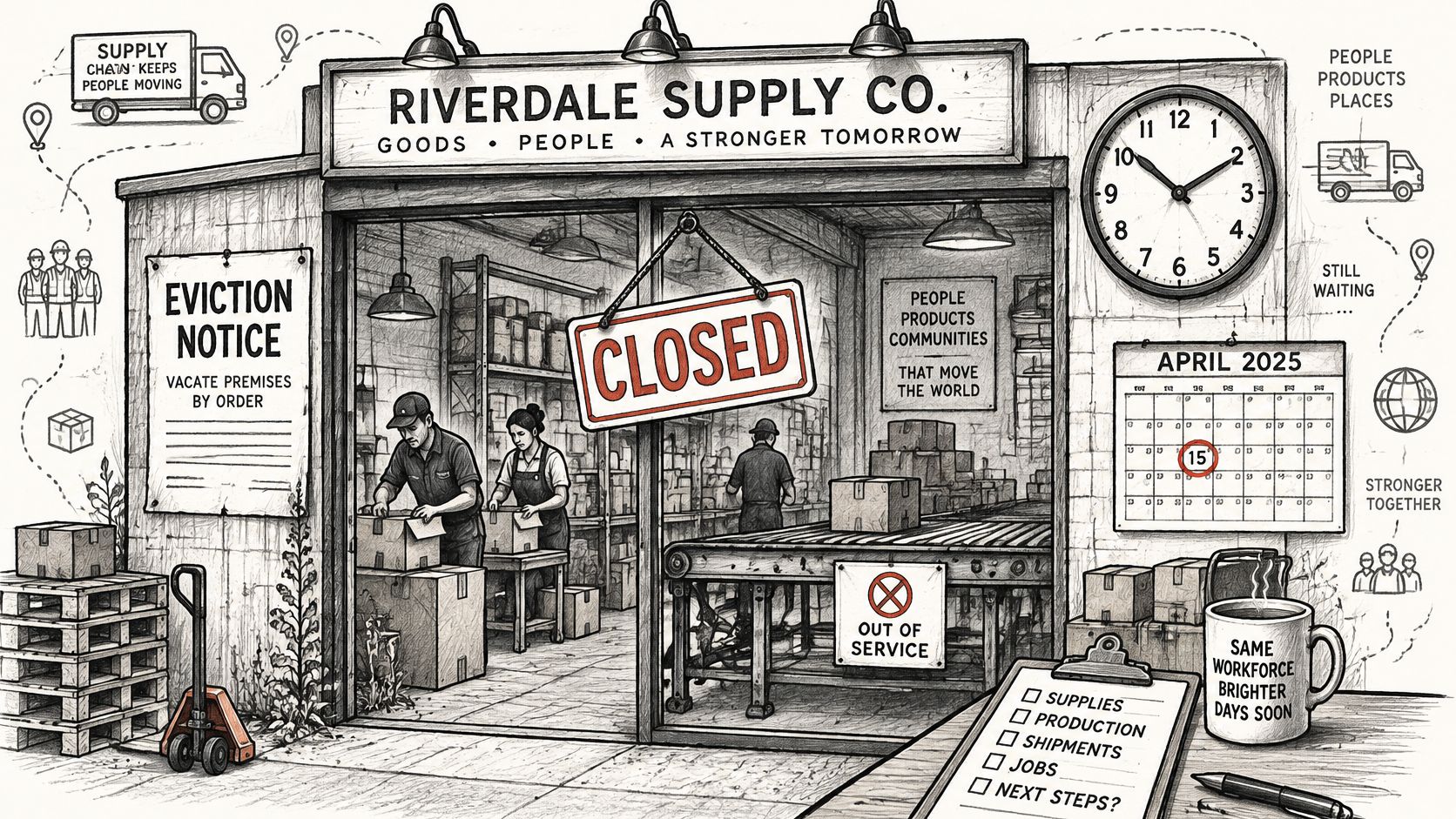
Six areas of work belong in that plan, and none of them involves touching the tenant's possession.
- Business continuity. Where stock, equipment and records physically sit, who can lawfully move them, and what the business does if access is interrupted.
- Security and access control. Alarm, locks, guards and loading access, arranged without any step that amounts to self-help against the tenant.
- Insurance. Whether cover continues while the premises are in dispute, and whether the policy requires notification of a vacant or contested unit.
- Customer and supplier communication. Deliveries, service visits and collections shouldn't stop unannounced, and a short holding statement prevents a supply chain from assuming the worst.
- Subtenants and licensees. Their position has to be checked before any notice goes out, because an occupant with its own rights can reset the timetable.
- Evidence preservation. Dated photographs, inventories and utility readings, taken before anything is removed.
Where operations have to continue somewhere else, arranging interim space early beats scrambling later. Short-term modular office leasing from Pacific Mobile Structures, Inc. is one route to a furnished footprint on a shorter commitment while the dispute resolves.
Speed is a tactic, not an objective. A negotiated handover, a payment arrangement or a supervised removal can preserve evidence and cut business interruption more effectively than pushing immediately for physical enforcement.
The sequencing that works is unglamorous. Establish the facts, fix the dates, keep the premises secure without interfering with the tenant's possession, and decide whether the fastest enforcement or the cleanest exit serves the balance sheet. Owners who would rather not learn this the expensive way can contact RNC Group before the first notice is served, while the options are still open.
The tenant has stopped paying and the keys are not coming back on their own? Contact our firm before another quarter of promises goes by. We manage the commercial eviction process for overseas owners from the first notice through the possession claim, the Execution Office file and the handover itself, so the legal timetable and the operational plan move together instead of one waiting on the other.
This article is for general information only and does not constitute legal advice. Laws and their application depend on the facts and jurisdiction and may change. Although we aim to keep this information accurate and current, we do not guarantee that it is complete or up to date. The article may contain omissions or errors. Reading this article does not create an attorney-client relationship with RNC Group. Before making a decision or taking action, seek advice from a qualified lawyer in the relevant jurisdiction.