
A non-Israeli tenant often assumes that a commercial lease renewal protects continuity. In Israel, that assumption can fail at the exact moment the business needs certainty most. The main issue in 2026 isn’t whether a renewal option exists. It’s whether the clause gives a usable right, or merely sets up a costly negotiation under pressure.
Foreign companies usually focus on rent first. That is too narrow. The larger exposure sits in notice mechanics, undefined pricing language, bank guarantee requirements, VAT treatment, Arnona allocation, transfer restrictions, and redevelopment risk. A disciplined commercial lease renewal strategy treats the renewal as a fresh contract with cross-border finance consequences, not as an administrative extension.
Is Your Renewal Option a Right or a Trap
Many tenants read an option clause and relax. That is often the first mistake.
If the clause says the tenant may renew, but leaves rent open for later agreement, the tenant may hold a procedural right with no real economic certainty. In Israel, that distinction matters more than many foreign legal teams expect. A clause that looks familiar under another legal system can operate very differently once timing, the landlord’s bargaining power, and local cost allocation enter the picture.

The problem with false comfort
A tenant usually wants continuity of operations, customer access, employee stability, and budget control. By contrast, a landlord wants pricing flexibility and optionality over the asset. Those interests can coexist, but they don’t align automatically.
In Israeli commercial practice, the dangerous clause is the one that appears simple. If the option is silent on price, service charges, guarantee reset terms, repair allocations, or notice delivery mechanics, the tenant can reach the notice window without a strong negotiating position. At that point, the tenant isn’t exercising a secured right. The tenant is entering a compressed negotiation while trying to avoid operational disruption.
Practical rule: If the renewal clause leaves core economics unresolved, treat it as an open negotiation, not as a protected extension.
What a real renewal right should contain
A workable renewal right usually includes defined mechanics, not hopeful language. At minimum, legal and real estate teams should test whether the clause answers these questions:
- Price certainty: Does it fix the rent, cap the increase, or define a market-rent process with actual comparables and a short determination path?
- Notice certainty: Does it say exactly when, how, and where notice must be sent?
- Term certainty: Does it identify the renewal period, or does it defer duration for later discussion?
- Operational certainty: Does it preserve assignment, subletting, signage, use rights, and access arrangements during the renewal term?
This distinction matters even more for multinational groups. Headquarters may assume the local subsidiary can “just renew.” Local management may assume legal can regularize terms later. Both assumptions fail when the clause was never drafted to carry that weight.
The safer view is blunt. A renewal option isn’t valuable because it exists on paper. It’s valuable only if it can be exercised without giving the landlord a fresh opportunity to reprice risk on vague terms.
Mastering the Commercial Renewal Timeline
Most renewal losses happen before the first formal letter goes out. They happen when the tenant starts late.
Expert guidance states that negotiations should begin 9 to 18 months before expiry to maintain a strong negotiating position and avoid rushed decisions that can reduce rent concession success rates by up to 40% according to commercial lease renewal negotiation best practices. For multinational occupiers, the internal timeline should start even earlier because approvals often need local finance, regional real estate, tax, and legal review.
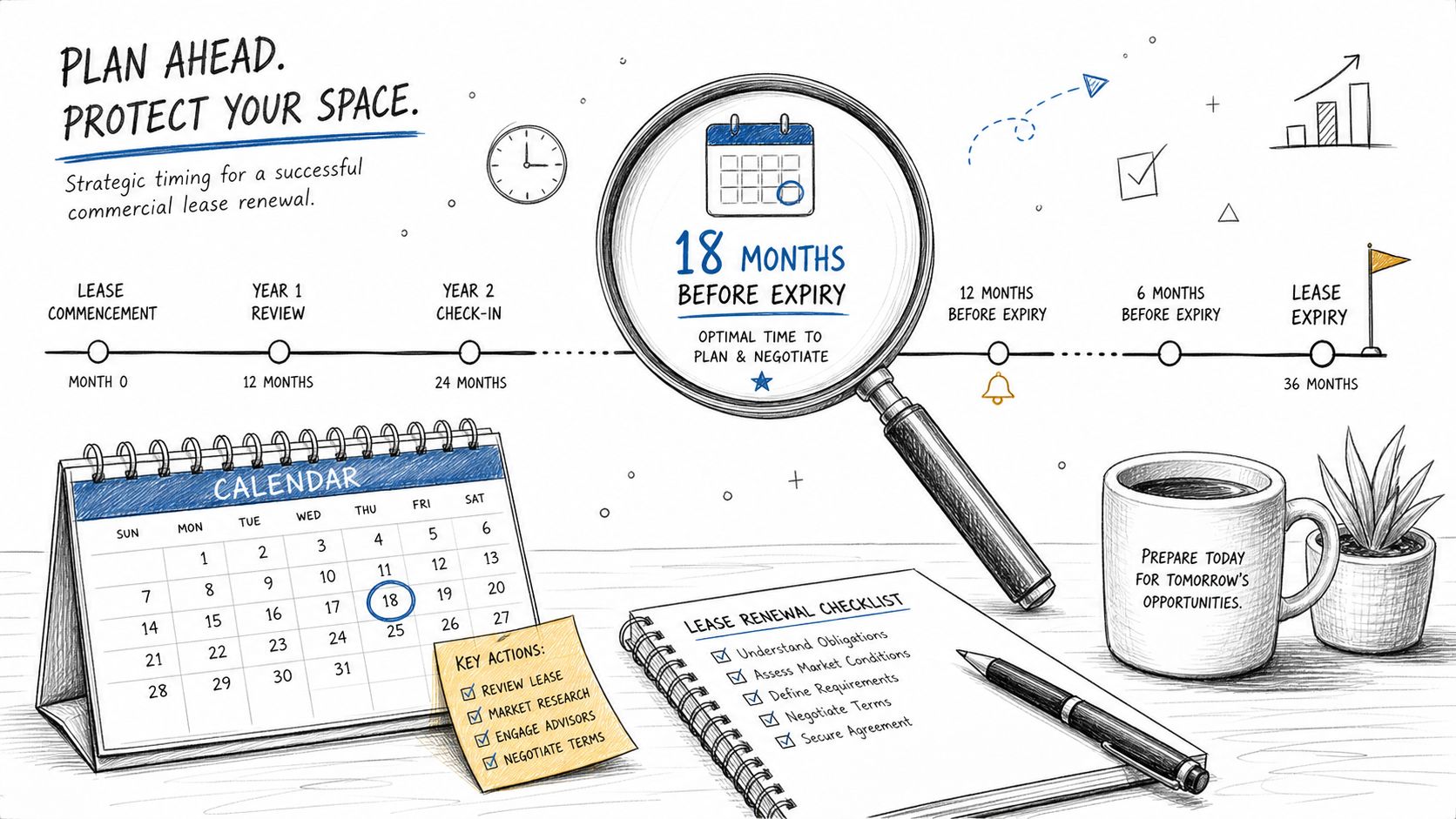
Eighteen to twelve months before expiry
This is the diagnostic phase. The tenant should review the lease abstract, identify every notice date, map all renewal conditions, and test whether any prior default could let the landlord challenge the option.
The business side should also decide what it wants. More space, less space, shorter term, stronger break rights, landlord-funded works, or a hard exit. If the company hasn’t made those choices early, the landlord will shape the agenda instead.
A disciplined file at this stage should include:
- Lease audit: Rent, escalations, operating expenses, guarantees, repair clauses, assignment restrictions, and renewal language.
- Business forecast: Hiring plans, licensing issues, regulatory dependencies, and any restructuring risk.
- Alternative map: Real relocation options, not theoretical ones.
For readers comparing the tenant and owner perspective, this overview of the landlord lease renewal process is useful because it shows how landlords sequence their own decisions and where they expect tenant hesitation.
Twelve to nine months before expiry
Now the tenant should establish a strong negotiating stance. That means assembling local comparables, pressure-testing occupancy costs, and modeling three scenarios: renew, renegotiate, or move.
This phase also exposes internal contradictions. A regional business unit may want flexibility, while headquarters may want term certainty for accounting and budgeting. If those views aren’t reconciled now, the tenant will negotiate against itself later.
Start before the notice window, or the notice window will control the deal.
A practical working table helps keep the negotiation grounded:
| Issue | Weak approach | Strong approach |
|---|---|---|
| Rent | Wait for landlord number | Submit a supported opening proposal |
| Space needs | Assume current footprint | Test rightsizing and operational impact |
| Timing | React near deadline | Sequence approvals before notice date |
| Alternatives | Mention moving vaguely | Document actual options and costs |
Nine to six months before expiry
This is often the formal engagement phase. The tenant should send a written proposal, not a casual inquiry. The proposal should cover rent, term, guarantees, fit-out scope, operating cost controls, and transfer rights.
A surprising number of tenants still wait for the landlord’s first draft. That approach weakens the negotiation immediately. The first coherent term sheet often becomes the reference point for later compromise.
Final months before expiry
The last stage is execution discipline. Lawyers should not still be debating basic commercial points at this point. By then, only drafting, clarifications, and board-level approvals should remain.
Late-stage drift is expensive. It creates pressure, weakens bargaining power, and invites “temporary” side deals that later produce litigation.
Decoding Key Clauses in an Israeli Lease
What looks like a standard renewal clause in an Israeli lease, and what can cost a foreign tenant months of exposure and a failed option exercise, are often two different things.
International occupiers get into trouble here because they import assumptions from other jurisdictions. The clause headings look familiar. The risk allocation often is not. Under Israeli rent increase and renewal rules, private commercial leases are not subject to a statutory cap on rent increases, and a tenant must notify the landlord no later than 60 days before lease expiry to exercise a renewal option. If the renewal clause does not fix the pricing method with enough precision, the tenant is not renewing on protected terms. It is entering a compressed negotiation with the clock already running.
For a non-Israeli company, that 60-day period is shorter than it appears. Internal legal review, regional sign-off, local counsel comments, translation issues, and holiday timing can consume a large part of it before anyone sends a compliant notice.
That is where informal conduct becomes expensive.
I have seen tenants assume the option remained alive because the landlord kept talking. Then the landlord took the position that no valid notice was served, the option expired, and the tenant was left negotiating from a position of occupancy risk. If that tenant also has relocation costs, IT migration, and business continuity concerns, the economics move fast. Even basic operational planning, including planning IT for office moves, can become a forced cost rather than a managed alternative.
The notice clause needs exact compliance
A renewal notice succeeds or fails on mechanics. The sender, method, address, and timing must match the lease.
The recurring failure points are predictable:
- Wrong sender: The notice comes from a local manager, but the lease requires the tenant entity, a director, or external counsel.
- Wrong method: The business team sends email, while the lease requires registered mail, courier, or hand delivery.
- Wrong recipient: The notice goes to the asset manager instead of the contractual address for service.
- Wrong timing: Commercial discussions continue past the deadline, and the tenant assumes active negotiations preserve the option.
A missed deadline is not a drafting issue. It is a control failure with legal and financial consequences.
Hidden economics often sit outside headline rent
Foreign tenants also misprice renewals by focusing on base rent and ignoring the local cost structure. As the Israeli rental contract guide notes, commercial tenants commonly face VAT on rent, full Arnona exposure, and a security package that may include a substantial bank guarantee. Those items can change the actual renewal price more than a modest movement in headline rent.
| Cost item | Common foreign assumption | Israeli commercial reality |
|---|---|---|
| Rent adjustment | Customary moderation or implied limit | Pricing follows the lease language or current bargaining power |
| Security package | Limited cash deposit | Bank guarantee and related exposure can be materially higher |
| Tax on rent | Included in quoted occupancy cost | VAT may sit on top of rent |
| Municipal tax | Shared cost or landlord-administered | Arnona is often passed fully to the tenant |
Many cross-border clients often understate risk on internal approval papers. A renewal that looks acceptable on face rent can become unattractive once VAT, Arnona, guarantee increases, and reinstatement obligations are priced correctly.
Informality is usually exposure, not flexibility
Commercial teams sometimes treat an unsigned side understanding, email exchange, or short-form extension as good enough while the long-form renewal is being negotiated. Under Israeli law, that approach can create an evidence problem at the exact moment the tenant needs certainty.
As noted earlier in the same Israeli leasing guide, some commercial lease arrangements may fall outside stricter writing and registration expectations. That does not make informality safe. It means the parties are more likely to fight later about what was agreed, when it took effect, and which conditions were carried forward. For a multinational reporting to headquarters, that uncertainty affects accounting, provisioning, and operational planning well before any court dispute begins.
Repair and default clauses deserve the same scrutiny
Renewal disputes do not start and end with price. Repair allocation, structural responsibility, cure periods, access rights, and default triggers often become more aggressive on renewal because the landlord knows the tenant is time-pressured.
The same Israeli guide describes repair timing rules that can affect structural issues and response periods. That matters in practice. If the lease shifts too much maintenance responsibility to the tenant or leaves response obligations vague, the tenant can pay for landlord-side building problems while still facing operational disruption.
Enforcement timing cuts both ways. Delay in removing a defaulting tenant can push landlords to demand heavier guarantees and stricter default language at renewal. Foreign tenants should read that for what it is. Not boilerplate, but a transfer of risk into security documents, cure mechanics, and event-of-default drafting.
The safest reading approach is simple. Treat every renewal clause as an allocation of money, timing, and litigation position, not as a formality carried over from the original lease.
Negotiating Favorable Rent and Terms
What does a “good” renewal save if the tenant accepts vague pricing language, inflated security, and open-ended operating costs under Israeli law?
For non-Israeli companies, that question is usually answered too late. Headquarters sees a modest rent increase and assumes the renewal is under control. Exposure often sits elsewhere: guarantee lockup, reinstatement costs, service-charge drift, and pricing mechanics that leave the tenant arguing about rent after the option window has already narrowed. In practice, an informal understanding or poorly controlled notice sequence can turn a manageable renewal into a forced acceptance exercise.
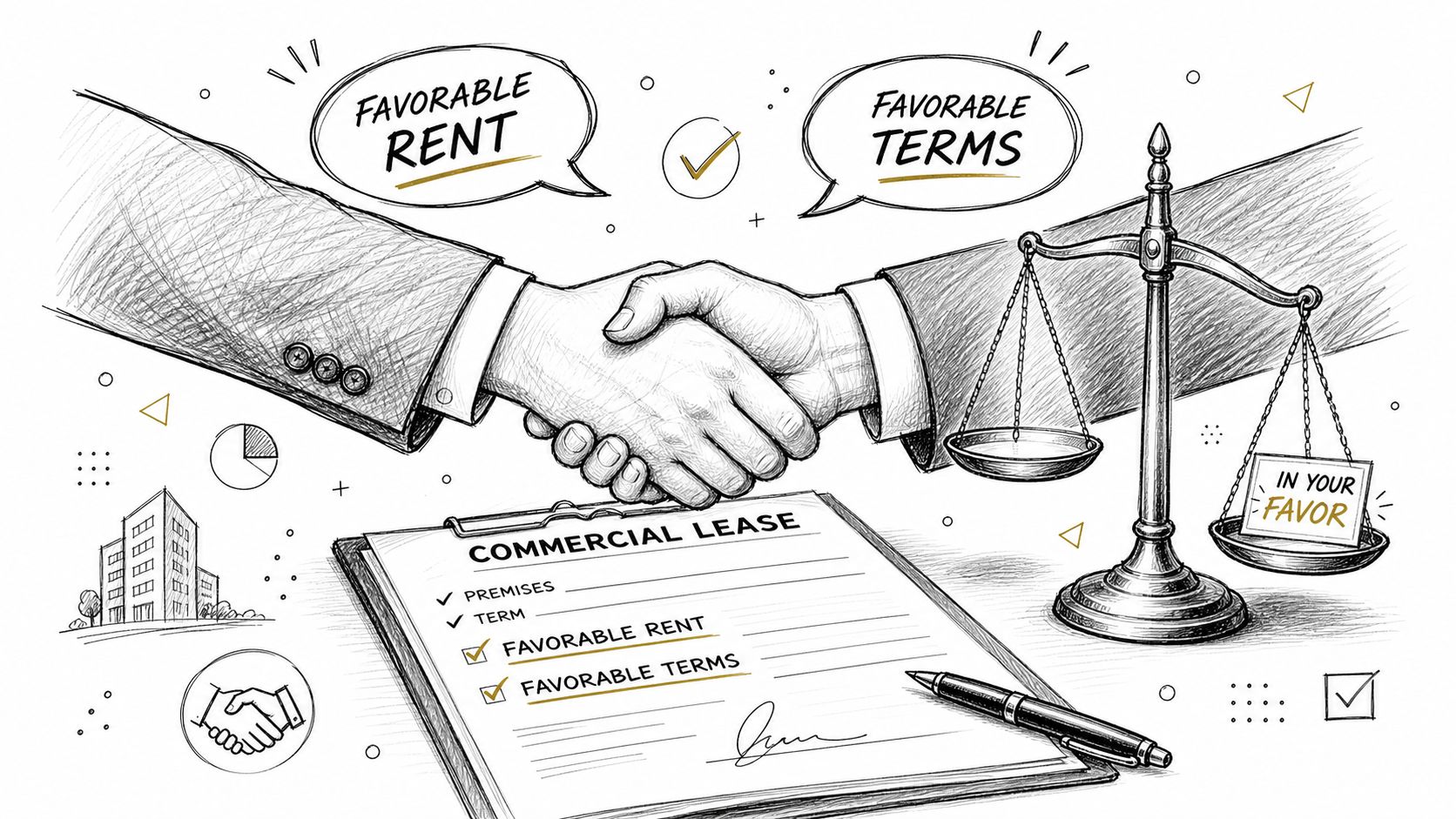
Control the first draft of the economics
The party that frames the renewal package usually shapes the outcome. A landlord proposal built around headline rent can hide more cost than it gives away. A disciplined tenant response sets the commercial variables together: rent, review method, term, security, works, expenses, and exit flexibility.
In Israel, renewal pricing works better when the lease fixes a formula, sets a cap, or defines a market-rent process with clear comparable criteria and a short determination timetable. “Market rent as agreed between the parties” is weak drafting. It creates room for delay, pressure, and positional bargaining at the point where the tenant may have no operationally realistic exit.
A serious opening proposal usually covers:
- Rent mechanism: Fixed amount, indexed formula, or market-rent method with objective comparable standards
- Term structure: Length of renewal term, any further option, and any negotiated break right
- Security: Reduction path for bank guarantee, deposit, or parent support after a clean payment history
- Works and fit-out: Landlord contribution, approval process, ownership of improvements, and end-of-term removal rules
- Operating costs: Defined service-charge scope, exclusions, audit rights, and caps on controllable items
For a multinational, these are not secondary drafting points. They affect cash allocation, internal approvals, and how much legal and finance teams must reserve if the relationship deteriorates.
Negotiate the full liability profile
A tenant that focuses only on rent is negotiating the least interesting number in the room.
The recurring liabilities usually sit in four areas.
-
Make-good and reinstatement
Renewal often triggers new works. If the lease stays vague, the tenant may pay for the upgrade, leave the improvement behind, and still pay again to strip it out later. The renewal should state what becomes part of the building and what, if anything, must be removed at expiry. -
Annual increases and indexation
A soft opening rent can become expensive quickly if the review clause compounds or if the index mechanism has no meaningful limit. The drafting must show exactly when adjustments apply and whether there is any floor, cap, or catch-up feature. -
Service charges and management costs
Undefined building expenses destroy budget certainty. The tenant should press for a closed list of recoverable items, exclude capital expenditure except in tightly defined cases, and reserve the right to inspect the calculations. -
Relocation credibility
Negotiation improves when the landlord believes the tenant can leave. That requires operational preparation, not just legal posturing. This guide on planning IT for office moves is useful for that reason. A relocation option is only credible if the business has tested the cost, systems impact, and execution timing.
Trade terms as a package
Experienced landlords rarely negotiate issue by issue. They trade one protection for another. Foreign tenants should do the same, especially where the local team is under pressure to close before a notice deadline or board reporting date.
| Landlord objective | Tenant counter |
|---|---|
| Longer income visibility | Better rent certainty, narrower review mechanics, or fit-out contribution |
| Higher security cover | Step-down in guarantee exposure after timely payment performance |
| Redevelopment flexibility | Binding relocation standards, business-interruption protections, and cost coverage |
| Tight transfer control | Pre-approved affiliate transfers and internal reorganizations without discretionary consent |
Many cross-border renewals often lose value. The Israeli business team may accept a harsher guarantee package to preserve rent optics, while headquarters would have preferred a slightly higher rent and lower contingent exposure. That disconnect matters. The wrong trade can tie up capital, distort internal risk reporting, and weaken the tenant’s position in any later dispute.
What usually goes wrong
The failure pattern is familiar.
- Commercial terms are agreed in principle, but the pricing mechanism is left soft
- The tenant accepts broad landlord cost recovery to win a small rent concession
- Legal review starts after business people have exchanged statements that neither side drafted carefully
- Side emails record “understandings” that do not match the lease form
- Renewal timing slips, and the tenant negotiates under implied relocation pressure
For non-Israeli companies, the cost of that slippage is rarely limited to rent. It can mean months of internal reporting uncertainty, avoidable guarantee exposure, and a renewal document that preserves occupancy while worsening the tenant’s litigation position.
A strong renewal package does three things. It fixes the money terms clearly, prices the hidden liabilities, and records every concession in binding language before the timeline starts working against the tenant.
Mitigating Cross-Border Business Risks
How much exposure is the group taking if the Israeli subsidiary misses a notice date, relies on an email exchange, or renews on wording that blocks an internal reorganization later?
For non-Israeli companies, lease renewal risk is rarely limited to rent. Exposure lies in the gap between standard renewal advice and the way multinational groups operate under Israeli law. A missed notice window can put business continuity at risk. An informal agreement can leave the local team believing renewal is settled while headquarters still lacks an enforceable amendment. In practice, that can mean forced holdover, relocation costs, duplicate fit-out spend, trapped guarantees, and a weaker record if the dispute reaches court.

Assignment and subletting must match corporate reality
A multinational tenant does not stay static through a full lease term. Ownership changes. Tax structures shift. Regional functions move. If the renewal gives the landlord broad control over assignment, subletting, or affiliate transfers, the lease can interfere with transactions that have nothing to do with the landlord’s actual credit risk.
The drafting goal is straightforward. The lease should allow transfers within the group, transfers to a buyer of the business, and successor entities created through merger or reorganization, subject to clear conditions instead of open-ended consent rights. If the clause says the landlord may withhold consent on vague commercial grounds, the tenant is carrying avoidable transaction risk.
I use a simple test with cross-border clients. If the parent sells the Israeli operation next quarter, can the lease move with the business without a second negotiation with the landlord? If not, the renewal still contains structural risk.
Break rights should tie to objective events
Israeli lease forms often assume the tenant’s business model will remain stable for the full term. That assumption does not hold for foreign groups entering or expanding in Israel. Regulatory approvals can fail. A product launch can be cancelled. A regional consolidation can make the site unnecessary. A financing event can require a smaller footprint.
A break option tied to objective triggers addresses that problem better than a broad discretionary exit right, which landlords usually resist. The trigger must be specific enough to enforce and broad enough to cover the actual corporate event. Good examples include loss of a required license, failure of a condition tied to building delivery, group restructuring that eliminates the Israeli business line, or a sale of the operating business.
The pricing point matters. A landlord may accept an objective break right if the notice period, restoration standard, and rent consequences are defined with precision. Vague drafting creates the worst outcome for both sides. The tenant assumes it has flexibility. The landlord assumes the clause is narrow. The dispute arrives when the business event occurs.
Redevelopment language can erase occupancy certainty
Foreign tenants often treat redevelopment and relocation wording as secondary points. That is a mistake. A renewal can look stable on paper and still give the landlord a route to move the tenant, shrink usable space, or terminate for works that are described too loosely.
The clause has to answer operational questions, not just legal ones:
- Equivalent space: What size, layout, technical specification, and access rights must the replacement premises provide?
- Cost allocation: Who pays legal fees, cabling, IT migration, branding changes, physical move costs, and business interruption losses?
- Notice and sequencing: How much advance notice is required, and when must the replacement space be ready for occupation?
- Economic adjustment: What happens to rent and service charges if the replacement space is inferior, smaller, or less efficient?
As noted earlier in the article, market guidance often treats these clauses as drafting detail. For a multinational occupier, they are financial risk provisions. If relocation language is loose, the tenant often pays later through downtime, duplicated vendor costs, and management distraction across multiple jurisdictions.
Informality is a special cross-border hazard
This issue causes more damage than many rent disputes. Local management treats the renewal as agreed in principle. Regional or global legal teams assume nothing is binding until the final amendment is signed. Israeli law questions are then layered onto a record full of partial approvals, translated comments, and emails that use commercial shorthand instead of defined terms.
The result is predictable. Notice is served late, or by the wrong entity, or to the wrong address. The business team refers to a “renewed lease” that is really a set of unresolved emails. The landlord signs nothing and still argues the option lapsed or the commercial terms changed.
For a foreign group, the cure is process discipline. Keep one controlled renewal file. Match the notice mechanics exactly to the lease. Confirm the correct tenant entity, signatory authority, guarantee form, tax treatment, and Hebrew and English drafting consistency before anyone states that the deal is done. That is not administrative caution. It is how the tenant avoids paying for a five-year occupancy commitment on terms it did not approve.
Finalizing Your Renewal and Preventing Disputes
The most dangerous moment in a renewal often comes after the handshake. Commercial teams think the deal is done. Legal teams still have unresolved language. The landlord then circulates a draft that narrows concessions, broadens defaults, or rewrites the economics through definitions.
The rule is strict. Final lease amendments must be completed 3 to 0 months before expiration, and every negotiated term, including rent, operating expense caps, and maintenance responsibilities, must be documented in writing under this renewal amendment guidance. A side email is not a substitute for an executed amendment.
Closing checklist for legal and business teams
Before signature, the tenant should confirm the amendment answers every operational point that mattered in the negotiation.
- Parties and authority: Confirm the exact tenant entity, guarantor structure, and signatory authority.
- Renewal mechanics: Confirm term dates, notice mechanics for any future option, and delivery details.
- Economics: Confirm rent, review method, VAT treatment, guarantee amount, Arnona allocation, and expense controls.
- Works and condition: Confirm fit-out scope, landlord contributions, make-good treatment, and repair duties.
- Flexibility rights: Confirm assignment, sublease, affiliate transfer, and any break triggers.
- Landlord rights: Confirm relocation, redevelopment, access, and default cure language.
- Entire agreement: Confirm all side understandings are folded into the signed document.
Drafting mistakes that lead to litigation
Most post-renewal disputes don’t arise from exotic legal theory. They arise from lazy drafting and false assumptions.
Common examples include inconsistent rent definitions, silent treatment of VAT, unclear guarantor release mechanics, undefined “market rent,” and notice clauses that don’t match actual communication practice. Another recurring error is leaving prior defaults unresolved. If the landlord reserves historical claims while granting a renewal, the tenant may inherit a dispute into the new term.
A clean amendment should also state what survives from the original lease and what changes. Without that integration language, the parties can end up arguing over whether old clauses still control.
If a negotiated point matters commercially, it must appear clearly in the signed paper.
A business with significant Israeli exposure shouldn’t treat the final draft as a clerical step. It is the point where bargaining power gets converted into enforceable rights, or lost.
Avoid costly mistakes before a routine renewal becomes an operational dispute. For strategic advice on Israeli commercial leasing, cross-border risk allocation, and high-stakes negotiation planning, contact RNC Group through its contact page.
This article provides general information only and doesn’t constitute legal advice. It is not a substitute for advice suited to specific facts, documents, jurisdictions, or regulatory developments, and reliance on it without obtaining professional legal counsel is not recommended.