
A multinational tenant can sign a lease that looks routine, then face a leak, an HVAC failure, or a roof defect that stops operations on the worst possible day. In a commercial lease, who is responsible for repairs is usually not answered by ownership, common sense, or the label on the building. It is answered by the lease text, any mandatory local statute, and the cost-recovery machinery hidden in service-charge and casualty clauses.
The practical problem is simple and expensive. A defect at the boundary of the unit, the structure, and shared systems can trigger a repair decision within hours, while the financial allocation may take months to surface. A lease review should therefore focus on four questions, what the document assigns, what local law overrides, who ultimately bears the cost through service charges, and whether insurance, access, and rent suspension change the economics.
In an Israeli commercial lease, assess repair responsibility under the Rental and Borrowing Law together with the agreed allocation of repairs, service charges and insurance.
For a tenant entering Israel or auditing a cross-border portfolio, the safest approach is to read the lease as a system, not as a set of isolated sentences. A useful starting point is a commercial lease checklist that forces the reviewer to separate premises, structure, systems, and recovery language, such as the Texas commercial lease checklist.
Table of Contents
- When the Lease Meets Reality and Repair Risk Surfaces
- Repair Responsibility: Contract and Statutory Defaults
- How Lease Type Shapes the Repair Matrix
- The Boundary Problem Where Structure Meets Demised Premises
- Casualty Events Climate Upgrades and Repair Cost Inflation
- A Practical Negotiation and Audit Checklist for Repair Clauses
- Common Misconceptions That Distort Lease Negotiation
When the Lease Meets Reality and Repair Risk Surfaces
A retailer opens for peak season in a multi-let Israeli building and finds water staining above the sales floor. The leak seems to sit where the tenant's ceiling, the shared plenum, and the slab above all meet. Within hours, someone has to decide whether to call an emergency contractor, notify the landlord, alert insurers, and protect stock.
That is where commercial repair disputes begin, not in a courtroom. The pressure comes from lost trading time, customer disruption, and the risk that each party will later argue the other side should have acted first. In that moment, labels like “landlord” and “tenant” tell very little.
Practical rule: the first response should be based on the lease matrix, not instinct. If the document does not clearly allocate the defect, escalation should happen in parallel, not sequentially.
The key question is whether the defect belongs to the demised premises, the structure, or a shared system. A ceiling leak can be a tenant issue, a landlord issue, or a shared issue depending on the wording. The same is true for HVAC, roof penetrations, façade defects, and access problems.
A fast commercial decision usually turns on four documents, the lease, the schedule of condition, the insurance arrangements, and the service-charge wording. If those documents are inconsistent, the business may still need to act first and argue later. That is why commercial occupiers should treat repair responsibility as a bottom-line risk, not a housekeeping issue.
Repair Responsibility: Contract and Statutory Defaults
In an Israeli commercial lease, start with the contract and the statutory default rules. Section 7 of the Rental and Borrowing Law generally requires the landlord, after a demand, to repair a defect materially interfering with ordinary or agreed use, subject to the statutory exceptions and the allocation in the agreement. It is wrong to assume that no landlord repair obligation can arise unless the lease expressly creates one.
For an Israeli occupier, silence is not the same as shifting every repair to the tenant. Read the repair clause with the definitions, service charges and applicable law. Section 8 also limits reliance on an exemption for an undisclosed defect the landlord knew or should have known about. Residential-tenancy protections should not simply be copied into a commercial lease.
Three words that do different work
The words repair, maintain, and replace are not interchangeable. A covenant to repair may reach much further than routine upkeep, especially when deterioration is so advanced that patching is no longer enough. A covenant to maintain can also be read broadly if the lease is not disciplined about scope.
Working definition: a repairing covenant is the clause that tells the parties who must restore a specified item to working condition, and whether the obligation stops at patching or extends to renewal.
That is why a schedule of condition matters. It freezes the starting point, shows pre-existing defects, and makes it easier to argue what was already worn out before the lease began. It also helps distinguish tenant damage from ordinary aging.
The question is not whether the premises are “good” or “bad.” The question is whether the lease allocates the risk of putting them back into repair, and if so, to whom.
How Lease Type Shapes the Repair Matrix
Lease structure drives the repair outcome before the clause language even begins. In a single-let deal, the tenant is often expected to take the whole building burden. In a multi-let building, the tenant usually handles the interior, while the landlord keeps the structure and common parts.
| Lease Structure | Internal Repairs | Structure and Roof | Building Systems | Common Areas | Cost Recovery |
|---|---|---|---|---|---|
| Single-let or whole-building | Usually tenant | Often tenant | Often tenant, depending on wording | Usually tenant | Usually direct tenant burden |
| Multi-let or part-premises | Usually tenant | Usually landlord | Split by system and wording | Usually landlord | Often service charge recovery |
| NNN or FRI style | Broad tenant exposure | Often tenant, sometimes by express wording | Often tenant | Landlord may retain ownership but recover costs | Direct charges and service-charge tail |
The RICS basis for conclusions draws the key distinction clearly, a whole-building lease traditionally places repair and maintenance of the entire premises on the tenant, while a partial-premises lease usually leaves structure and common parts with the landlord, with communal costs recovered through a service charge (RICS basis for conclusions). That is the starting point, not the ending point.
In the UK, FRI leases historically made more commercial sense when lease terms were much longer, including the 1970s and 1980s. Today, shorter terms make tenants far less willing to accept open-ended exposure for major renewal items like an entire roof. The same negotiation logic appears in cross-border leasing even where the labels differ.
Commercial point: the lease title is less important than the allocation underneath it. A lease called “full repairing” can still hide very different economics depending on what the service-charge and exclusions sections say.
For a multinational tenant, the right question is not whether the lease is labeled NNN, FRI, or something else. It is whether the repair matrix shifts the cost of structure, roof, systems, and common infrastructure to the tenant, and whether the lease says so in plain language.
The Boundary Problem Where Structure Meets Demised Premises
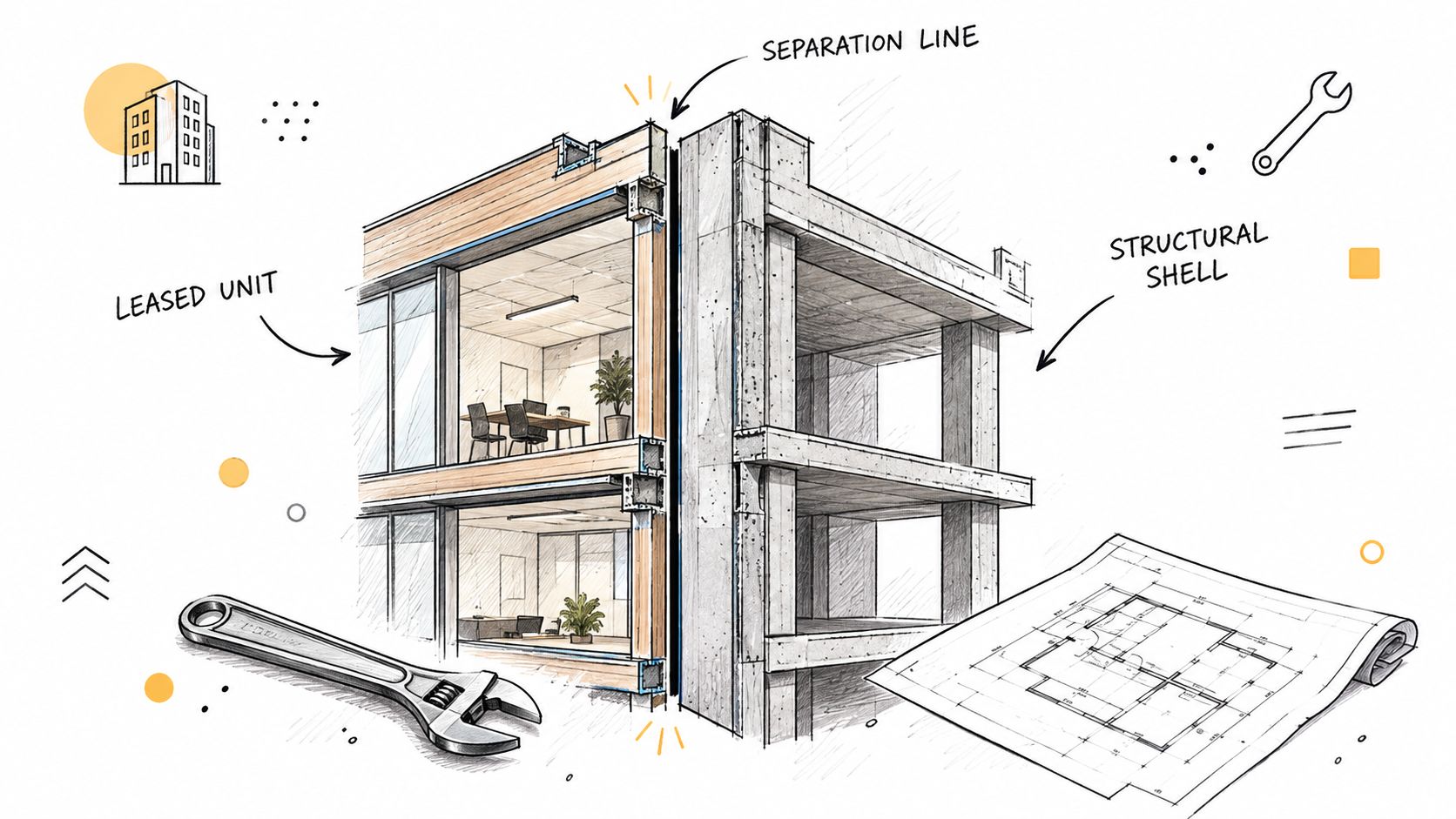
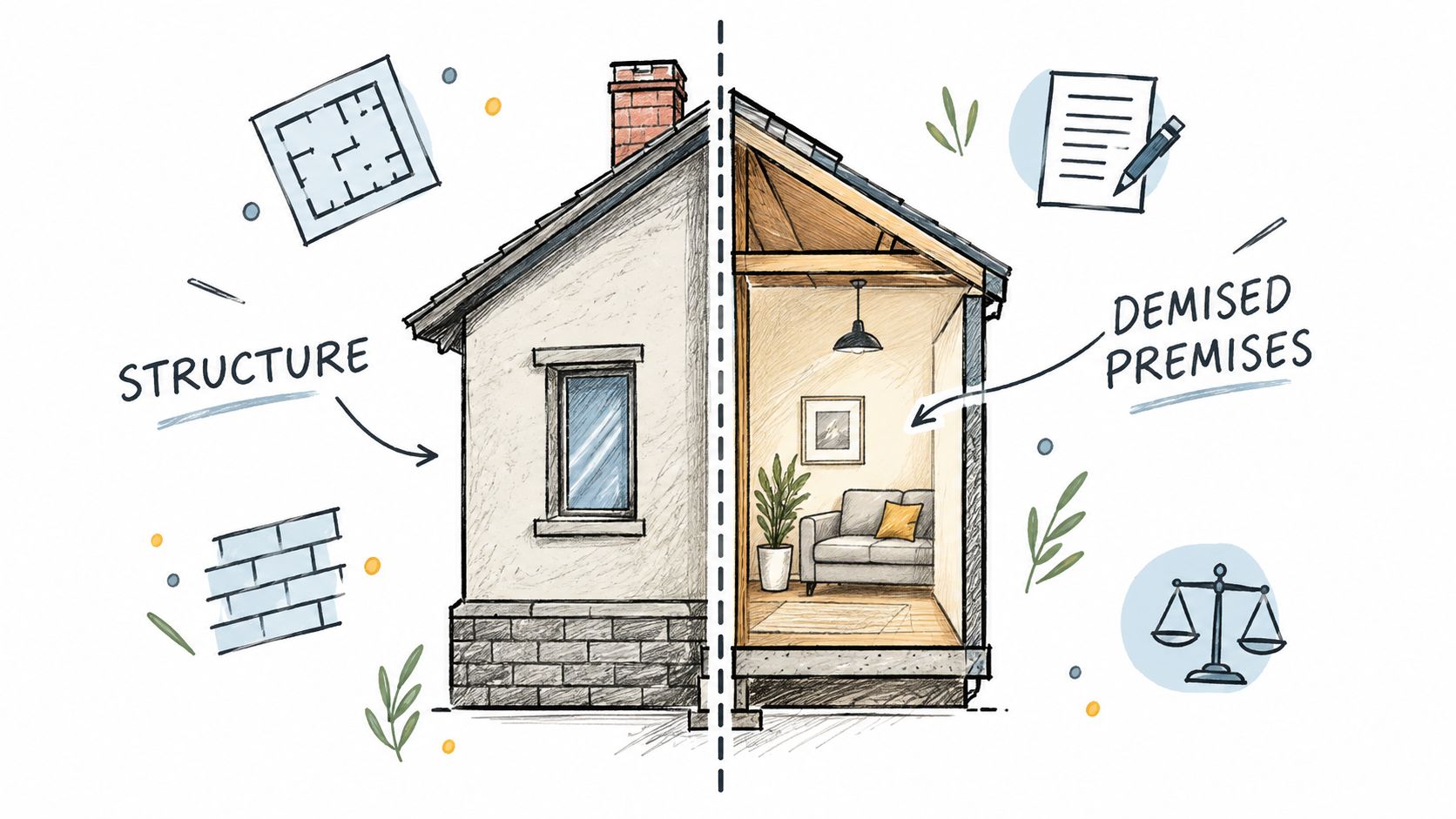
A defect can cross the boundary between the leased premises and shared structure or systems. A leak may enter through the roof, travel across the slab, and appear inside the shop. An HVAC failure may serve more than one tenant. A façade defect may affect both the occupied unit and the common entrance. These defects can require the parties to separate the duty to carry out repairs from the duty to pay for them.
What the lease has to answer
The decisive text is usually not the heading “repairs.” It is the demise plan, the definitions of structure and common parts, the repair schedule, and the service-charge clause. If the lease does not define the boundary clearly, the cost can be pushed back and forth between direct repair obligations and indirect recovery.
English multi-let practice illustrates the point well. The landlord generally retains responsibility for structure and common areas while tenants handle internal premises, but the landlord frequently recovers the cost of maintaining shared facilities from tenants through a service charge, making the economic allocation different from the physical performance obligation (DLA Piper Real World on repairing the leased space).
That matters because a tenant can lose the economic argument even when the landlord performs the physical repair. If the landlord is entitled to recharge the cost, the tenant may still fund the work indirectly. Windows and shopfronts are especially tricky, because they can be treated as structural in one lease and tenant fixtures in another.
The practical reading test is simple. If the defect touches the building envelope, shared access, or a system serving more than one occupier, the lease should say who pays, who performs, and who can recharge. If it does not, the dispute will often turn on the building plan and the recovery language instead of the tenant's intuition.
Casualty Events Climate Upgrades and Repair Cost Inflation
Repair clauses become far harder to read once casualty, compliance, and retrofit work enter the picture. A fire or flood can force immediate works. A new energy or resilience requirement can trigger building-wide upgrades. A lease that looks clear on ordinary maintenance may say very little about those situations.
The discussion of dilapidations and sustainability upgrades examines the boundary between restoration and improvements. In a repair dispute, distinguish the work needed to restore function from improvements the owner wants to make.
What should be separated in the lease
A good lease should separate ordinary repair from these other buckets:
- Casualty loss, where insurance and reinstatement mechanics matter.
- Compliance work, where a law or regulator requires something more than a patch.
- Capital improvement, where the landlord wants an upgrade rather than a repair.
- Climate adaptation, where resilience work may change access, trading, or use.
The lease should also say what happens if the premises become unusable during the works. Rent suspension, access rights, and termination rights should not be left to implication. If the work is building-wide, the cost-recovery clause becomes as important as the repairing covenant.
For facilities teams managing roofs, mechanical systems, and water ingress, a practical technical starting point can help frame the problem before lawyers draft the solution. A resource on Rooftop Solutions for facility managers may assist operational planning where a roof issue touches the trading floor, but the legal allocation still depends on the lease.
Useful approach: preserve evidence from day one. Photos, maintenance logs, contractor scopes, notices, invoices, and insurer correspondence often decide whether a later claim is treated as repair, replacement, or a broader project.
For Israeli and cross-border tenants, the safest drafting move is to separate repair, replacement, compliance, insurance proceeds, business interruption, emergency access, and rent abatement into distinct clauses. Broad “good repair” language is rarely enough once the defect is caused by weather, regulation, or building-wide retrofit work.
A Practical Negotiation and Audit Checklist for Repair Clauses
A repair clause only works when it reads like an operating rule, not a slogan. It should tell the parties what falls within the structure, what sits in the demised premises, and who pays when a building system fails.
What to test before signing
Classify the lease structure. Confirm whether the deal is single-let, multi-let, or built around service-charge recovery. That decides where repair cost is likely to land before any dispute starts.
Build the repair matrix. The lease should name the structure, roof, foundations, external walls, windows, building systems, common areas, and tenant installations. It should also say whether replacement is included, because “repair” can widen when worn-out equipment must be renewed rather than patched (Alan Boswell commercial landlord rules and regulations).
Separate repair from replacement. If the lease is silent, the argument often turns on age, useful life, and whether the work restores function or amounts to an upgrade. That is where cost pressure starts to move fast.
Read casualty and insurance together. A tenant needs to know who handles reinstatement, who receives the proceeds, and whether rent keeps running while access is restricted. The clause should also deal with trading interruption if the space cannot be used.
Write the response mechanics. Notice, access, self-help, and cure periods belong in the document. A general duty to repair is harder to use than a clause that sets out steps and timing.
Record the starting condition. A schedule of condition, maintenance logs, service-charge reconciliations, and contractor records give the baseline for later disputes over dilapidations or hidden disrepair.
For HVAC-related operational context, see this overview of business AC repair before allocating responsibility in the lease. Building systems are often the point where a tenant, landlord, and managing agent each assume someone else is carrying the risk.
The same checklist works after signature when the business audits exposure. What matters is whether the clause is internally consistent and aligned with the rest of the lease, especially the service-charge wording, casualty provisions, and compliance obligations. A lease with precise definitions usually performs better than one built on broad language and optimistic assumptions.
For multinational occupiers, that audit should also separate repair, replacement, insurance, business interruption, emergency access, and rent suspension into distinct clauses. Repair risk reaches the bottom line only when those pieces are blurred together.
Common Misconceptions That Distort Lease Negotiation
Ownership alone does not settle the allocation, but neither does a broad statement that only the lease creates duties. Israeli statutory defaults, the actual agreement and limits on exemption clauses must be read together.
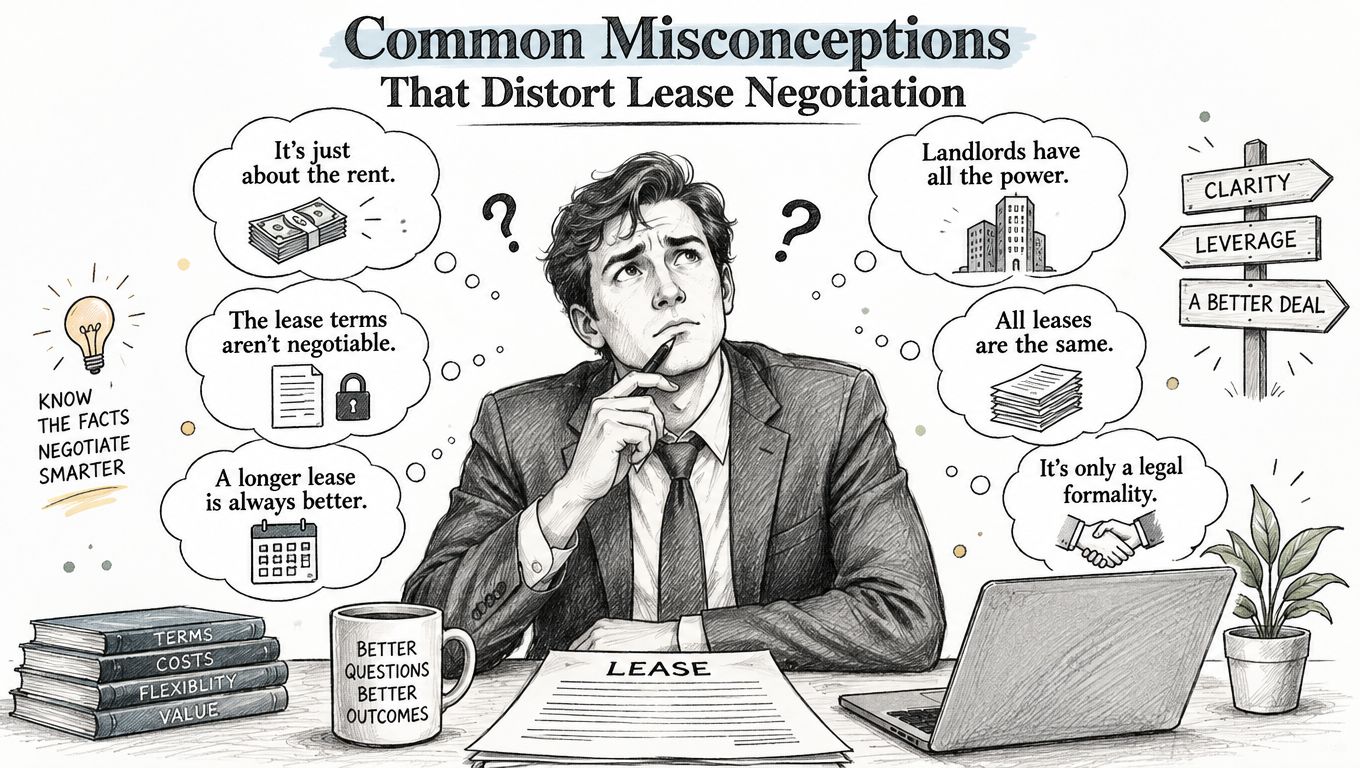
Four assumptions that cause trouble
Habitability applies automatically. In commercial leasing, residential-style habitability protection is not the usual baseline. Mandatory retail or consumer rules can override the lease in some places, but only where the statute applies. Victoria, Australia is a clear example, because section 52 of the Retail Leases Act 2003 imposes repair and maintenance obligations on the landlord for specified retail leases and overrides inconsistent lease provisions (Victorian Small Business Commission on repairs and maintenance).
Repair means replacement. It usually doesn't. A covenant to repair can be much narrower than a demand for renewal, and a landlord cannot always convert a defect into a larger refurbishment bill.
There is one global standard. There isn't. The governing law, asset class, and condition at entry all matter, and the same wording can shift differently in different jurisdictions.
The landlord always ends up paying anyway. Not necessarily. Even where the landlord performs the work, a service-charge clause may move the economic burden back to the tenant.
Bottom line: the lease should be read as an allocation device. If the document is broad, the tenant may be buying more than routine upkeep, and if it is silent, mandatory local law may be the only thing standing between the occupier and an unfunded repair bill.
For boards and procurement teams, the best response is to challenge the clause before signature, not after failure. That means asking for a clear matrix, a defined service-charge regime, and express language on casualty, compliance, and replacement.
Need a review of an Israeli commercial repair clause or an active dispute? Contact RNC Group on WhatsApp. See also our RNC Group website.
Before withholding rent or arranging your own repair
Section 9 sets out remedies where the landlord fails to repair after a demand within a reasonable time, including reasonable repair costs or a proportionate reduction in rent, subject to its conditions. Advance notice a reasonable time before self-repair is required, with a specific urgent-repair exception. Section 25 concerns set-off of debts arising from the tenancy. These provisions do not justify stopping all rent whenever a defect appears. Contractual variations, the facts, urgency and the amount claimed need separate review.
The useful first step is a dated defect file: photographs, the handover condition report, maintenance records, the notice and proof of delivery, access offered, and a contractor assessment. It helps separate the repair decision from the later argument about cost.
Statutory sources: Rental and Borrowing Law, original official publication and 2017 official amendment. Read the applicable current law and the signed agreement before acting.
This article is for general information only and does not constitute legal advice. Laws and their application depend on the facts and jurisdiction and may change. Although we aim to keep this information accurate and current, we do not guarantee that it is complete or up to date. The article may contain omissions or errors. Reading this article does not create an attorney-client relationship with RNC Group. Before making a decision or taking action, seek advice from a qualified lawyer in the relevant jurisdiction.