
Commercial property due diligence is a control system for hidden legal and financial risk. For a foreign buyer entering Israel for the first time, that matters because a polished data room can still conceal contractual limits, inherited obligations, or compliance gaps that change deal economics after signing. A seller’s package is only a starting point. The buyer has to test whether the asset can perform as represented.

The right approach treats diligence as a live investigation into the asset’s actual capabilities, moving beyond the claims in the marketing package.
A useful starting point is the broader checklist discipline reflected in property investment due diligence. In commercial acquisitions, though, the critical work begins where standard checklists end, in the inherited agreements, operating restrictions, and risk allocations that standard inspections often miss.
Due Diligence Is Not A Checklist
A polished deal file can mislead even experienced buyers. The first mistake is treating the seller’s summary package as a neutral source of truth. It rarely is. Serious review starts by testing the seller’s narrative against primary documents, then asking what those documents still leave out.
The Core Question: What Breaks the Economics?
The legal file, the rent roll, the title documents, and the inspection reports need to tell the same story. If they do not, the mismatch usually points to a hidden problem rather than a clerical one. Commercial property due diligence should run as a parallel investigation instead of a linear review.
The practical target is verification. Buyers should confirm the rent roll against executed leases, rebuild NOI from trailing actuals, and test financing assumptions against verified cash flow rather than seller pro formas. That approach also matters because a thorough process usually pairs title and zoning review with an ALTA/NSPS survey, a Property Condition Assessment under ASTM E2018, and a Phase I ESA under ASTM E1527-21, since each workstream tests a different layer of risk (Ryan O’Connell Finance).
Practical rule: if the seller’s summary and the source documents disagree, treat the source documents as the starting point.
International buyers often underestimate how much value sits outside the building itself. The asset may look sound physically, yet inherited restrictions, unresolved occupancy issues, or financing conditions can still make it unbankable or hard to resell. In Israel, the commercial file often carries inherited agreements that affect control, income, and future flexibility long after signing. The first objective is document control, because that is where the hidden constraints show up.
Verifying Legal Title And Unseen Encumbrances
A clean deed does not guarantee a clean acquisition. Title review should start with ownership, but it should not stop there. The more important question is whether the property comes with hidden rights that limit use, redevelopment, or financing.
The hidden geometry around the site
Practical risk often sits in unregistered rights, historic access arrangements, rights of first refusal, and special district obligations that can materially limit redevelopment. Industry checklists specifically flag these as common gaps, which means standard title work often under-teaches the hidden contractual geometry of a site (Ison Harrison).
That issue matters in Israel, where layered use rights and legacy arrangements can affect how a property operates long after closing. A foreign buyer should not assume recorded ownership answers the key question. The essential question is whether the intended business use fits the recorded and unrecorded rights already attached to the asset.
What the legal file should actually prove
A useful legal package should include title materials, zoning confirmations, easements, covenants, restrictions, permits, certificates of occupancy, and litigation exposure. It should also include the seller’s title-insurance policy, any loan documents if debt will be assumed, and notices of violations or compliance issues tied to health, fire, building, zoning, safety, and environmental rules (Angel Law Offices).
A property can be perfectly “clean” on title and still be economically impaired.
That is especially true where shared parking, cross-access rights, or reciprocal easements control circulation and redevelopment. In those cases, the paper trail matters as much as the parcel itself. The right legal review asks not only who owns the asset, but who can use it, cross it, restrict it, or force a consent process later.
Analyzing Financials and Inherited Commercial Contracts
Commercial property due diligence fails when buyers audit the building but ignore the operating platform. Income comes from contracts, not from optimism. A rent roll is useful, but it is only the beginning of the financial story.

Rebuild the income, don’t inherit the seller’s version of it
The buyer should verify the rent roll against executed leases and supporting lease documents. A serious diligence file commonly includes the last three years of real-estate tax bills and the prior two years of utility bills, along with a certified rent roll that shows current rent, prior rent if relevant, delinquencies, security deposits, years of occupancy, and lease start and end dates (Thompson Coburn).
That documentation matters because it lets the buyer test reported income against actual collections and confirm whether stated NOI is sustainable. A buyer who accepts a seller pro forma without reconstruction is not doing diligence. The buyer is accepting a narrative.
Treat service contracts like value drivers
The contract review should extend beyond leases. Recent guidance on hidden risks emphasizes reviewing inherited service contracts, termination-for-convenience rights, and sensitive personnel data, because the newest risks often come from the property’s operating platform rather than the shell itself (Strategylaw). That shift is especially relevant in managed, multi-tenant, or operationally intensive assets.
For a first Israeli acquisition, the smart move is to map every inherited obligation before closing. That includes vendor pricing escalators, termination rights, management agreements, and any contract that can create post-closing cost drift. If the asset is still tied to legacy service terms, those terms can erode value.
A focused lease review is essential here, and a practical starting point is reviewing commercial lease agreements. The same discipline should apply to cleaning contracts, security agreements, maintenance services, and any agreement that survives closing.
Commercial reality: the asset’s financial performance is often constrained by old agreements, not current market demand.
Executing Physical And Environmental Inspections
Paper diligence is incomplete without technical inspection work. Buildings fail in ways that financial models can’t see, and environmental issues often surface only when specialists ask the right questions. That is why physical and environmental diligence should run in parallel with the legal review, not after it.
What the technical reports should uncover
A Property Condition Assessment should identify deferred maintenance, structural issues, roof risk, and major capital needs. A Phase I Environmental Site Assessment should look for recognized environmental conditions, and if it finds them, the process often moves to a Phase II assessment (Businessscreen).
Practitioners also commonly request mold abatement reports, underground storage-tank testing, soil tests, boring reports, and foundation studies. Those documents matter because they can change acquisition pricing and post-closing capital planning.
Why timing matters more than most buyers admit
These reports are most useful when they arrive early enough to affect the deal. If the findings come in late, the buyer loses their negotiating advantage and may inherit the issue anyway. If they arrive on time, the findings can support a price adjustment, an escrow holdback, or a seller-funded remediation plan.
For buyers with sustainability objectives, physical diligence should also be aligned with operational standards and long-term asset quality. A practical reference point is the green building practices guide, especially where capital planning and construction sequencing affect future performance.
Negotiation leverage comes from evidence, not suspicion.
The best outcome is not merely discovering defects. It is using those defects to reshape the deal before closing. That is why technical inspections should be treated as decision tools, not housekeeping.
Navigating Israeli Regulatory And Zoning Compliance
Foreign buyers often assume that a property’s current use proves its future use. That assumption fails quickly in practice. In Israel, as in most serious commercial markets, zoning, permits, and operating approvals can define whether the asset is stable, expandable, or effectively trapped.
Verify the use before you assume it exists
The first step is to confirm that the current use is permitted, and if not, whether it is legally nonconforming or already in violation. The buyer should also confirm whether the intended business change requires additional approvals, variance relief, or local consent. Waiting until after closing is too late.
A useful due diligence file should include permits, certificates of occupancy, municipal records, and any notices of violation. It should also check for unresolved code issues and ask whether utilities, site access, and development plans support the intended operation. A property that looks compliant on paper can still become a problem if the local authority views the use differently.
Why local approval history matters
Public records often reveal more than the seller does. They can show prior violations, enforcement actions, or restrictions that affect tenant use and future repositioning. That matters most where a foreign buyer plans a refurbishment, a change of use, or an expansion strategy.
The buyer should also examine adjacent and neighborhood factors, because local objections can slow or reshape approvals. Even a solid asset can turn into a planning dispute if the intended use conflicts with local land use norms or future development plans. A practical example is a warehouse or mixed-use asset that looks efficient on paper, but needs a use change that the municipality won’t treat as routine.
In that sense, Israeli zoning diligence is not administrative. It is strategic. It tells the buyer whether the asset can support the business plan that justified the acquisition in the first place.
Synthesizing Findings And Managing Cross-Border Risk
A foreign buyer should treat diligence as one question with commercial consequences, not as a folder of separate findings. The key issue is whether the asset can support the acquisition thesis after title, contracts, operations, and regulation are tested together. A clean result in one workstream can still be misleading if another workstream exposes a restriction that changes the economics.
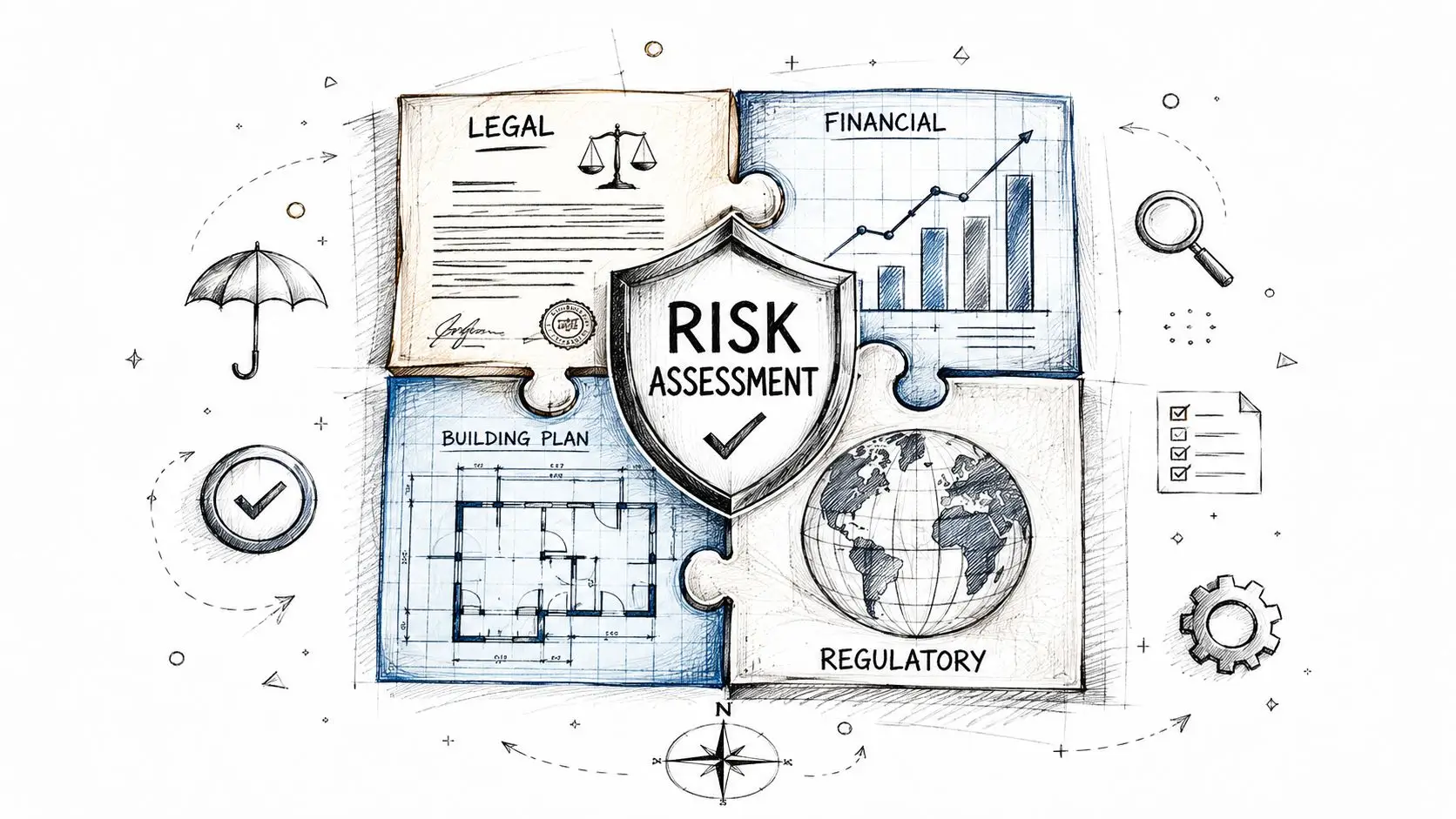
Build one risk memo, not twelve separate silos
The decision should come from a single, unified risk narrative instead of a stack of disconnected reports. That memo should tie legal title, rental income, operating costs, capex exposure, contract terms, and local approvals to one view of what the buyer is acquiring. If the reports do not point in the same direction, the buyer is not ready to price the deal.
Benchmarked timing and cost data show why sequencing matters. Commercial property due diligence is commonly completed in about 30 to 90 days, with some practitioners mapping a 45-day decision path from document receipt to go or no-go. Third-party report budgets are often roughly $12,000 to $30,000 for core reports (Peony).
That window is short, and the pressure is real. The buyer needs to reconcile rent rolls, expense assumptions, and capital expenditure forecasts against source documents before exclusivity runs out. If those numbers are accepted too early, the transaction can move forward on a story rather than evidence.
Cross-border issues need early control
A foreign buyer also has to plan for banking, signing authority, and post-closing operating setup. Those points matter when funds move across jurisdictions, when corporate signatories change, or when the acquisition vehicle needs local coordination. For remote buyers, steps for buying Israeli property remotely is a useful reference for the logistics, but the legal sequence still needs close control.
The most dangerous issues are usually familiar. Seller projections that have not been stress-tested. Deferred maintenance that was not priced into the deal. Tax reassessment risk or environmental exposure that appears only after the first document review. Inherited service contracts with termination limits that trap the buyer after closing. Zoning support that is narrower than the business plan assumes. Any one of these can justify a second look. Several together can justify walking away.
In practice, the acquisition call should turn on how the risk stack affects financing, permitted use, and exit options. If those three move in the wrong direction, the buyer should renegotiate before closing.
Your Strategic Path Forward
Commercial property due diligence only works when it acts like a battlefield map. It should expose legal restrictions, inherited commercial contracts, physical defects, environmental liabilities, and regulatory friction before the buyer becomes the owner. For a non-Israeli company, local market knowledge is not optional, because the cost of misunderstanding a title burden, a lease term, or a zoning limit can be permanent.
The safest path is disciplined, integrated, and early. Start with source documents, verify every operating assumption, and force each report to answer a commercial question. If the answers don’t align, the transaction should change, not the facts.
For international buyers entering Israel, the difference between a good acquisition and an expensive mistake often comes down to sequencing and escalation. The recommended strategic path is to use local counsel who can coordinate title review, contract analysis, regulatory diligence, and risk containment as one process rather than four disconnected tasks.
RNC Group handles complex commercial transactions, cross-border risk, and high-stakes dispute prevention for foreign buyers entering Israel. For a first Israeli acquisition, the firm can help identify hidden contract, title, and compliance risks before they become post-closing liabilities. Visit RNC Group and contact the team now through the contact page to avoid costly mistakes.
This article provides general information only and does not constitute legal advice, tax advice, or a substitute for advice on a specific transaction. Reliance on any part of this text should follow a case-specific review by qualified counsel familiar with the relevant property, documents, and governing law.