
A foreign supplier misses a delivery deadline, the Israeli distributor withholds payment, and an email intended as a firm commercial reminder is read as an accusation of bad faith. Within days, lawyers are copied, executives stop speaking directly, and each side starts preserving evidence for a dispute that neither side initially wanted. The business question is no longer who breached the contract. It is whether the next intervention will restore commercial control or make settlement materially harder.
The conflict escalation model gives international businesses a disciplined way to answer that question. It helps counsel and executives distinguish an unresolved misunderstanding from a hardened legal dispute, then select an intervention that fits the dispute's actual stage. The model doesn't replace contract analysis, evidence review, or jurisdictional advice. It improves the timing and sequencing of those tools.
Table of Contents
- The High Cost of Unmanaged Commercial Disputes
- Understanding the Stages of the Conflict Escalation Model
- Strategic Intervention at Early Escalation Phases
- The Reality of Escalation in Cross-Border Litigation
- Navigating Bank Account Restrictions and Commercial Crises
- Leveraging Specialized Counsel for International Disputes
The High Cost of Unmanaged Commercial Disputes
A commercial disagreement rarely begins as a fully formed lawsuit. It may start with a disputed invoice, a missed milestone, an alleged quality failure, or a disagreement about who was responsible for obtaining an approval. In a cross-border relationship, language, time zones, different business customs, and separate legal systems can add friction before either party has clearly stated its position.
The first response often determines the direction of travel. A demand letter that accurately identifies a contractual right can still worsen the dispute if it arrives before the recipient understands the underlying factual issue, or if it combines a legitimate reservation of rights with unnecessary personal criticism. Conversely, a conciliatory message can create risk if it appears to waive a right, admit liability, or ignore an urgent need for interim protection.
Why ordinary negotiation fails under pressure
Traditional negotiation assumes that the parties remain capable of evaluating the same problem from a relatively stable position. Escalation changes that assumption. The parties may stop treating the dispute as a question of performance and start treating it as a test of credibility, authority, or future deterrence.
That shift affects legal strategy in practical ways:
- Facts become identity markers. A disputed delivery date may become evidence, in each side's mind, of incompetence or dishonesty.
- Communication becomes performative. Emails are written for a future judge, board, lender, or parent company rather than for the commercial counterparty.
- Concessions acquire a different meaning. A reasonable compromise may be interpreted as weakness, while a minor procedural objection may be treated as proof of hostile intent.
- Internal stakeholders multiply the dispute. Finance, sales, compliance, insurers, local management, and a foreign headquarters may each issue different instructions.
A structured approach matters because the recommended response at an early disagreement isn't the same as the recommended response after threats, public allegations, or an application for urgent relief. A business assessing negotiation mediation for exporters should therefore examine not only the available process, but also whether the parties can still exchange information without treating every exchange as a tactical concession.
The cost of misdiagnosis
The central risk isn't merely that a dispute becomes more hostile. Misdiagnosis can cause the business to use the wrong instrument at the wrong time. A premature lawsuit may close off a commercially useful resolution, while delayed action may allow evidence to disappear, payment positions to harden, or a bank-related consequence to develop.
The conflict escalation model became a major social-science framework after Friedrich Glasl's 1999 work, which divides conflict into nine stages grouped into three main phases. Academic summaries describe the model as one of the field's influential escalation frameworks and note that a fuller cross-level theory did not emerge until work by Pruitt and others in 2003. The model's value for a board isn't academic recognition alone. Its stepwise structure gives decision-makers a vocabulary for identifying whether the dispute remains negotiable, has become adversarial, or is producing destructive conduct.
Practical rule: Before approving a demand letter, emergency application, or public response, the decision-maker should identify the dispute's behavioral stage, not only the legal claim.
That assessment should be recorded separately from the merits. A party may have a strong contractual case and still choose a measured first intervention. It may also have a defensible commercial position but need urgent legal protection. The model helps separate those questions, which is the first step toward strategic control.
Understanding the Stages of the Conflict Escalation Model
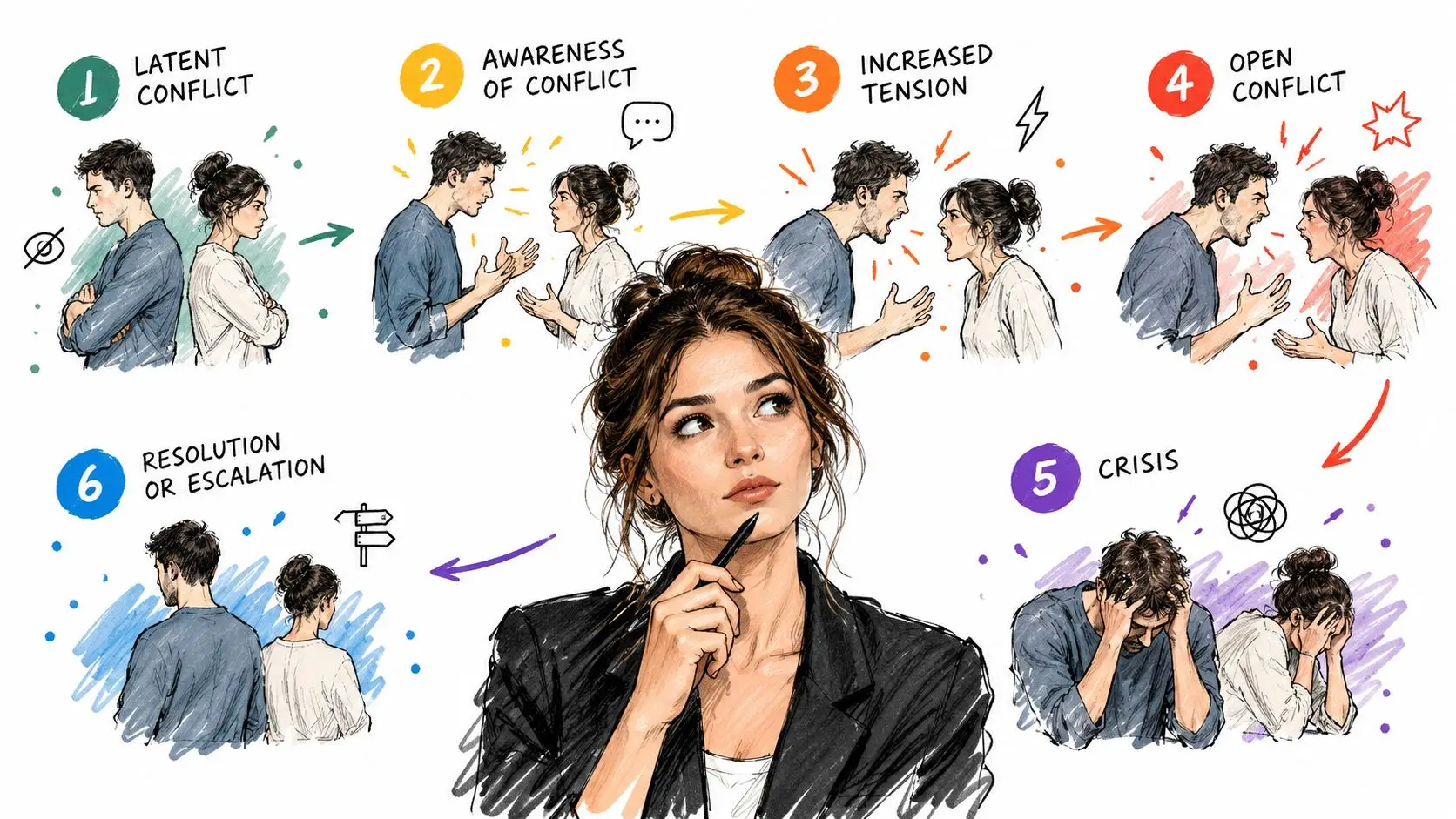
Glasl's framework contains nine stages, arranged within three broad phases: win-win, win-lose, and lose-lose. The labels describe the changing logic of the dispute, not the guaranteed outcome. A conflict can move forward, pause, de-escalate, or return to a more hostile pattern.
The first phase begins with tension and attempts to persuade. The parties still believe that discussion, clarification, or a negotiated adjustment may solve the problem. In a commercial contract dispute, this may involve competing interpretations of a service level, a request for additional time, or disagreement about whether a condition precedent has been satisfied.
Three phases, different legal responses
The win-win phase is not necessarily comfortable, but both parties can still recognize mutual interests. Counsel can often use a focused factual exchange, contract interpretation, senior-level negotiation, or mediation without either side viewing participation as surrender. The legal task is to preserve rights while keeping the problem narrow.
The win-lose phase begins when the parties organize around positions and seek to impose a solution. Communications become more formal, accusations become more explicit, and each side may recruit internal or external supporters. In this phase, a neutral process can be useful, but it must be carefully designed. A mediator cannot repair a dispute if the parties are still exchanging inconsistent facts or if one side is using the process solely to delay.
The lose-lose phase involves conduct that damages both sides, including retaliation, threats, reputational attacks, deliberate obstruction, or legal steps whose commercial cost exceeds the original dispute. Court proceedings may then be necessary, but litigation alone doesn't restore judgment. Counsel must protect the client while testing whether any narrow route remains for containment.
What the model tracks
The framework is more precise than a scale of anger. It tracks qualitative shifts in:
- Behavior, including movement from discussion to pressure or retaliation.
- Interaction patterns, including reduced direct contact and increasingly formal communications.
- Perceptions, as the counterparty's actions are interpreted through a hostile narrative.
- Emotions, which can influence decisions even when the written position appears rational.
That distinction has direct importance in commercial contracts. A party that has moved from “the invoice is disputed” to “the counterparty is deliberately undermining the business” may require a different communication protocol, even if the underlying invoice evidence hasn't changed.
A self-assessment instrument based on Glasl's model showed good validity across two studies, including an independent cross-sectional sample of 154 participants, supporting its practical use in diagnosing the phase of a dispute and matching intervention tactics to escalation level. The empirical validation of the model doesn't turn the framework into a legal test. It supports its use as a structured diagnostic aid.
The model should therefore be used as a decision filter:
| Diagnostic question | Strategic implication |
|---|---|
| Can the parties still discuss the underlying facts? | Prioritize clarification and controlled negotiation. |
| Are communications focused on blame and leverage? | Add senior oversight, preserve evidence, and consider a neutral process. |
| Is either side pursuing harm beyond the original claim? | Prepare protective legal measures and a containment plan. |
The most useful question isn't "Which stage applies?" It is, "What action can interrupt the present pattern without conceding the client's legal position?"
Strategic Intervention at Early Escalation Phases
Early intervention doesn't mean sending a soft letter or settling every disagreement immediately. It means acting while the parties can still change the dispute's structure. The recommended strategic path is to preserve legal rights, reduce avoidable ambiguity, and create a credible route to resolution before reciprocal conduct becomes self-reinforcing.
A disciplined early response
The first step is a short internal assessment. It should identify the contract, governing law, forum clause, relevant communications, payment status, operational dependencies, and the commercial objective. It should also distinguish verified facts from assumptions about motive.
The second step is to control communications. One senior person should coordinate the business message, with legal review where the correspondence could affect rights or admissions. The communication should address the specific conduct at issue, state the requested next step, reserve appropriate rights, and avoid language that turns a performance dispute into a personal contest.
The third step is to test whether the apparent disagreement consists of three different disputes. A payment dispute may include a quality dispute and a governance dispute. Separating those strands gives the parties room to resolve the least contested issue without waiting for complete agreement on everything.
Tools that lower the temperature
Multilingual legal correspondence can be decisive where a translated phrase carries a different commercial or legal implication. Translation isn't only a linguistic exercise. Counsel should examine whether the message accurately conveys the intended reservation of rights, the requested remedy, and the level of urgency in the relevant business culture.
A neutral third-party review may also reset the narrative. That review could address a technical specification, delivery record, accounting reconciliation, or chronology. It shouldn't be presented as an attempt to outsource the legal decision. Its purpose is to give the parties a common factual reference point.
The recommended sequence is usually:
- Preserve the record. Collect the agreement, amendments, purchase orders, delivery records, invoices, notices, and relevant messages. Prevent informal deletion or editing.
- Map the escalation. Identify the first disputed event, each response, any threats or refusals, and the point at which direct communication deteriorated.
- Choose the narrowest effective message. Ask for a specific correction, payment, inspection, meeting, or standstill rather than demanding a complete surrender.
- Set a controlled deadline. The deadline should support a real business decision and shouldn't be used as a theatrical ultimatum.
- Prepare the next instrument privately. If negotiation fails, counsel should already understand the mediation, arbitration, interim relief, or court options available under the governing documents and applicable law.
The objective isn't to appear conciliatory. It is to make the next escalation deliberate, proportionate, and legally useful.
What doesn't work
Public pressure is usually a poor substitute for evidence. So is sending multiple uncoordinated letters from different advisers, threatening every available remedy, or allowing operational staff to debate legal liability directly with the counterparty. Those methods may satisfy an immediate demand for action, but they can create admissions, destroy trust, and make a later settlement look like capitulation.
Early intervention also has limits. Allegations involving fraud, asset dissipation, discrimination, harassment, threats, or imminent harm require a separate legal and safety assessment. A model can improve timing, but it cannot justify delaying a protective step that the facts require.
The Reality of Escalation in Cross-Border Litigation
Escalation is powerful, but it isn't deterministic. Research on militarized disputes provides a useful caution for commercial decision-makers because it shows that force changes the settlement environment without guaranteeing either war or resolution. In one major study, 49% of disputes began with force by one side, 67% of compromise outcomes occurred only after at least one party used force, and 71% of those compromises occurred in disputes that had already escalated to crises or wars. Yet only 5% of militarized disputes lasting more than one day ended in war, and only 7% of disputes involving force by one side ended in war. These findings are reported in the research on escalation and settlement outcomes.
The lesson for a commercial board is not that aggressive tactics are effective. It is that escalation changes the bargaining context. A party may use litigation, a formal notice, or an interim application to demonstrate resolve and gain an advantage, but the same step can narrow the space for compromise and increase operational costs.
Proactive management versus reactive litigation
A proactive strategy starts with a decision about the desired business outcome. Does the client need continued supply, payment, access to data, replacement performance, preservation of a distribution channel, or a clean exit? The legal remedy should serve that objective.
Reactive litigation starts elsewhere. It treats the latest hostile email as the decision point, then selects the most visible legal response. That approach can produce a strong filing while leaving the commercial problem unresolved. It may also cause the counterparty to escalate in response, even where both sides would prefer a negotiated outcome.
| Proactive strategic management | Reactive litigation |
|---|---|
| Separates facts, legal rights, and business objectives. | Treats the latest event as the whole dispute. |
| Uses correspondence to narrow issues. | Uses correspondence primarily to increase pressure. |
| Preserves negotiation while preparing protection. | Assumes filing automatically improves leverage. |
| Anticipates jurisdiction, evidence, language, and enforcement. | Addresses those issues after the dispute has hardened. |
This comparison doesn't mean that early settlement is always best. A weak concession can reward obstruction, and delay can expose a client to asset movement or operational harm. Timing is the central judgment. A firm position may be appropriate when a counterparty is exploiting ambiguity, but it should be paired with a clear objective and an exit route.
Escalation is often uneven
Detailed research on civil and interstate wars from 1946 to 2008 found that variations in fighting intensity within a conflict help explain conflict severity and that greater escalation magnitude is associated with a greater likelihood of war. The same work emphasizes that disputes often move in jagged patterns of escalation, de-escalation, and renewed escalation rather than along a smooth upward line. The quantitative analysis of escalation dynamics supports a practical conclusion for cross-border counsel: a temporary calm doesn't prove that the dispute has reset.
Commercial disputes follow the same strategic logic, although the legal and factual settings differ. A payment is made, a meeting occurs, or a complaint is withdrawn, but an unresolved governance issue may remain. Counsel should therefore record the specific changes that occurred after each intervention and identify which triggers would justify renewed action.
The best intervention may be a carefully framed demand, a standstill, mediation, emergency arbitration, or court relief. No single instrument is more refined than the others. The correct choice depends on the client's bargaining power, the forum, the evidence, the counterparty's conduct, and the cost of allowing the current pattern to continue.
Navigating Bank Account Restrictions and Commercial Crises
A returned check can look like a narrow payment problem. For an international business operating in Israel, repeated returned checks can become an account restriction issue with consequences for payroll, suppliers, taxes, financing, and the credibility of the local operation. The dispute may begin with a withheld payment or an accounting error, but the business response must quickly shift from ordinary negotiation to statutory risk management.
Consider a hypothetical Israeli subsidiary whose customer disputes delivery and stops paying several checks. The subsidiary then issues checks against expected receipts, those receipts are delayed, and additional checks are returned. The commercial disagreement and the bank-account exposure are related, but they aren't the same legal question. A board that treats them as one issue may overlook the need for immediate account analysis, cash-flow controls, and evidence concerning each returned check.
The statutory threshold
Israel's Checks Without Cover Law restricts an account for one year if 10 or more checks without cover are returned within a 12-month period. The Bank of Israel's guide to checks without cover also states that the restriction doesn't apply if the first and tenth returned checks were less than 15 days apart.
That exception is technical and fact-sensitive. It doesn't mean that returned checks are harmless, and it doesn't resolve other contractual, collection, credit-reporting, or enforcement consequences. The dates, account identity, returned-check records, notices, and relevant banking communications must be reviewed carefully.
The practical response should include:
- Create a check-by-check chronology. Record the issue date, presentation date, return reason, account, beneficiary, and communications concerning payment.
- Separate legal categories. Examine account-restriction exposure separately from the underlying contract dispute and from collection rights.
- Protect essential operations. Review lawful payment alternatives and operational dependencies without assuming that a new arrangement removes existing liabilities.
- Escalate internally. Finance, treasury, local management, and counsel should use one verified record rather than separate spreadsheets and informal explanations.
- Avoid unsupported assurances. A bank, customer, or board should receive a qualified position based on the available records, not a prediction that a restriction “won't happen.”
Emergency rules and continuing consequences
The Bank of Israel describes an emergency 2023 regulation under which returned checks from October 7, 2023 through October 31, 2023 were removed from the count for restriction purposes. Its information on the emergency check measures also explains that other consequences remained, including reporting to the Central Credit Register and the beneficiary's right to collect through the Enforcement and Collections Agency.
That distinction illustrates why generic advice fails. Removal from a particular count doesn't erase the underlying debt, eliminate collection rights, or prevent credit consequences. The relevant date range and the precise legal effect must be verified against the facts and the applicable rule.
A phased response to a banking crisis
The first phase is containment. The business should identify which payments are essential, confirm the bank's current position, and stop relying on unverified assumptions about incoming funds. The second is legal analysis, including the check chronology, the underlying contracts, possible defenses, and the available procedural routes. The third is communication, with the bank, beneficiaries, and counterparties receiving consistent and carefully qualified information.
The conflict escalation model is useful here because it exposes the moment when a payment disagreement has become an institutional crisis. A hostile exchange with a customer may still be negotiable. A formal bank notice, repeated returned checks, or threatened collection action may require parallel commercial and legal responses. The recommended strategic path is neither automatic capitulation nor automatic confrontation. It is a documented decision about which risk must be reduced first.
Leveraging Specialized Counsel for International Disputes
International disputes require more than knowledge of a claim. Counsel must understand how the contract, evidence, language, banking system, governing law, forum, and commercial relationship interact. A lawyer who addresses only the pleaded issue may miss the operational trigger that is driving the escalation.
The strongest strategic plan usually has phases. Initial analysis identifies the client's objective and the opponent's likely points of influence. Negotiation then tests whether the dispute can be narrowed. Mediation may provide a controlled setting for a commercial solution. Emergency arbitration or Israeli court relief may become appropriate where urgent protection is needed, followed by merits proceedings if the dispute cannot be resolved.
Courts and formal processes should be treated as instruments, not destinations chosen for their own sake. The same applies to public communications. A carefully timed legal step can preserve negotiating position, while an unnecessary public attack can make a workable resolution politically or commercially impossible.
Cross-border capability matters
Multilingual correspondence is important where a legally significant message must be understood by management, employees, banks, or counterparties in different jurisdictions. International matters may also require coordination with local counsel and business contacts outside Israel. RNC Group identifies Israel as its representative in the ADVOC network, which it describes as connecting clients with trusted legal partners and business contacts in over 73 countries.
The recommended strategic path is to appoint counsel early enough to coordinate the factual record, preserve options, and distinguish an appropriate escalation from an impulsive one. Businesses confronting a developing dispute or bank-account restriction can contact RNC Group for an assessment of the relevant Israeli and cross-border issues.
RNC Group offers international commercial dispute analysis, multilingual legal correspondence, and phased strategy for contractual conflicts, partnership breakdowns, and bank-account restrictions. Businesses seeking to avoid costly escalation should visit RNC Group now to discuss the facts, available protections, and the next legally appropriate step.
In our experience, the cheapest moment to resolve a commercial dispute is the first written exchange, before positions harden and each side starts building a record for court.
A business conflict escalating? The order of your moves decides the settlement range.
Documentation, first written positions and the timing of legal steps shape the outcome more than the argument itself. Acting late or emotionally is expensive.
We manage commercial conflicts from first signal to resolution. Reach us on WhatsApp or by email.
This article is for general information only and does not constitute legal advice. Laws and their application depend on the facts and jurisdiction and may change. Although we aim to keep this information accurate and current, we do not guarantee that it is complete or up to date. The article may contain omissions or errors. Reading this article does not create an attorney-client relationship with RNC Group. Before making a decision or taking action, seek advice from a qualified lawyer in the relevant jurisdiction.