
A foreign company can absorb a pricing error, a delayed shipment, or even a failed distributor. It often can’t absorb a badly drafted Israeli contract after the 2026 rules on interpretation change the dispute map.
Most executives still treat a contract dispute lawyer as a courtroom asset. In serious Israeli commercial disputes, that view is too narrow. The stronger approach starts earlier, before proceedings, before positions harden, and before advantage shifts to the other side.
Will Your Contract Survive 2026 Israeli Law
A non-Israeli company entering Israel should ask a hard question now. If a commercial contract breaks down in 2026, will the text alone protect the deal, or expose it?

Under the 2026 amendment to the Israeli Contracts Law, a commercial contract without explicit interpretation provisions will be interpreted solely by its wording, unless that wording creates an absurd result or an internal contradiction, as outlined in this analysis of the Israeli Contracts Law amendment. That shift matters because many cross-border contracts rely on commercial context, prior drafts, side emails, and business assumptions that never make it into the final text.
Why wording now carries more commercial risk
International firms often assume a court or tribunal will reconstruct the business deal from conduct and surrounding circumstances. That assumption becomes dangerous when the contract is silent on interpretation hierarchy, notice mechanics, cure rights, annex priority, language control, or conflict clauses.
A contract dispute lawyer in this environment doesn’t merely ask whether a breach occurred. The central question is narrower and more difficult. Which sentence controls, which document prevails, and which ambiguity can be weaponized first?
Practical rule: If a point matters in a dispute, it should appear in the operative contract, not in a negotiation thread.
Three drafting failures recur in Israeli cross-border matters:
- Unclear hierarchy: The parties attach schedules, commercial proposals, and policy documents, yet they never state which one overrides the others.
- Soft performance language: Terms like “best efforts” or “commercially reasonable” appear without objective benchmarks.
- Split-language confusion: Hebrew and English versions circulate, but the contract never names the controlling text.
What sophisticated parties do differently
The prudent move is to test the contract as if a hostile reader will interpret it strictly. That review should cover definitions, payment triggers, default notices, exclusivity scope, termination rights, and forum design.
It should also stress test the deal against a practical crisis. For example, can a counterparty suspend supply, freeze information access, hold inventory, or pressure a local bank relationship while claiming technical compliance? A board that ignores those scenarios may discover that the “commercial understanding” never became a legal protection.
A capable contract dispute lawyer helps management identify those points before conflict begins. In Israel, after the 2026 amendment, foresight isn’t an added service. It’s part of the core risk analysis.
The Lawyer as a Risk Mitigation Architect
Most commercial disputes are lost before the statement of claim is filed. They’re lost in the first reactions, the wrong internal email, the premature accusation, or the failure to gather facts before sending pressure signals.
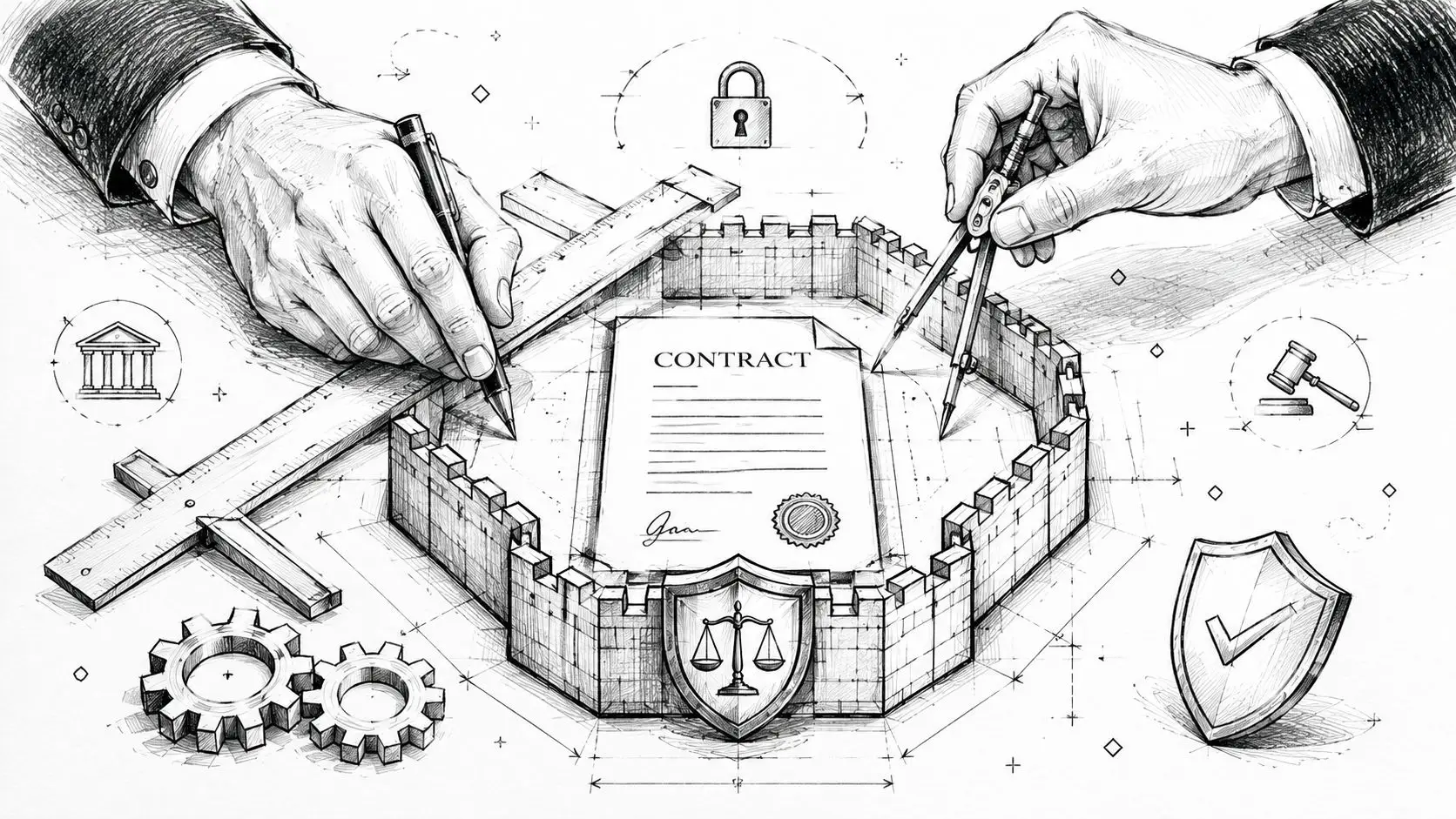
In serious cases, the decisive work often happens before formal proceedings. A successful strategy often depends on pre-suit negotiations and investigations that resolve the conflict before extensive litigation, reducing administrative burden and legal cost, as discussed in this overview of the role of contract lawyers.
What pre-suit work actually involves
A strong contract dispute lawyer acts like a risk architect. The lawyer builds a factual and pressure map before choosing a legal forum.
That work usually includes:
- Document reconstruction: assembling the signed contract, annexes, amendments, purchase orders, board approvals, notices, and message trails.
- Witness sequencing: identifying who negotiated, who approved, who performed, and who can explain operational reality without harming the case.
- Industry framing: measuring the dispute against standard practice in the relevant sector, whether distribution, licensing, construction, technology, or management services.
The point isn’t volume. The point is control. When counsel understands the factual record before the other side shapes it, negotiations change.
Why cross-border companies need a wider lens
Foreign directors often focus only on the immediate breach. They should also review governance exposure, delegated authority, and signatory discipline across jurisdictions. For multinational groups with Irish entities in the structure, this practical note on legal obligations for Irish directors is useful because board conduct and director duties can affect how counterparties frame their bargaining power during a dispute.
A disciplined pre-suit plan also considers pressure outside the pleadings. It asks whether the opponent depends on a regulator, a distributor network, a funding event, a tender process, a public listing timetable, or a banking relationship. Legal rights matter. Commercial vulnerability often decides timing.
Courts are one tool. They shouldn’t be the first reflex in every contract crisis.
A firm handling crisis work in Israel will often review whether a matter belongs in a broader strategic response, especially where reputation, counterpart messaging, and operational continuity intersect. That’s why readers dealing with fast-moving disputes often study approaches used in commercial crisis management matters before choosing a formal escalation path.
What doesn’t work
Several common moves damage otherwise strong cases:
- Sending a generic demand too early. It alerts the counterparty without locking the facts.
- Threatening criminal or regulatory consequences without basis. That usually hardens the dispute and weakens credibility.
- Ignoring internal inconsistency. If sales, finance, and legal teams tell different stories, the opponent will exploit the gap.
The lawyer who matters most in a contract dispute isn’t the loudest litigator. It’s the one who can investigate, sequence pressure, and preserve room for resolution.
Common Disputes in Israeli Commercial Agreements
Cross-border disputes in Israel rarely arrive as abstract “breach” questions. They usually emerge from operating relationships that worked well until money, control, exclusivity, or termination became contested.
Where foreign companies usually get surprised
A franchisor may discover that local operating promises were documented loosely. A technology licensor may learn that support duties expanded in practice, but not in the signed papers. A shareholder in a commercial collaboration may find that management authority was shared informally and later denied.
Those disputes tend to cluster around several agreement types:
- Agency and distribution agreements: termination, post-termination compensation, and ownership of client relationships.
- Partnership and founders’ agreements: deadlock, contribution failures, access to books, and side arrangements.
- Licensing and service agreements: scope creep, acceptance criteria, service levels, and dependency on local personnel.
- Commercial leasing and operational agreements: default notices, possession issues, offsets, and business interruption consequences.
The agency trap
One recurring mistake involves agency termination. Under the Agency Contract Law (Commercial Agent and Principal), 2012, the principal must compensate the agent on termination if three conditions are met: the contract lasted at least one year, the agent was the efficient factor in new transactions or business growth, and the principal continues benefiting afterward, as summarized in this review of Israeli commercial agency contracts.
That rule matters because foreign principals often assume they can terminate under the contract and move on. The commercial document may say one thing, while statutory consequences say another.
A clean termination clause doesn’t guarantee a clean exit.
Examples that change the leverage analysis
Consider a service agreement with an Israeli distributor tied to collection rights. The foreign company may think the dispute concerns underperformance. The distributor may frame it as wrongful termination plus entitlement linked to the business it developed.
Consider a commercial collaboration where payment defaults trigger pressure on local operations. In practice, the core issue may become access to premises, stock, records, or payment channels. For companies dealing with occupancy risk, related issues often intersect with commercial lease disputes in Israel.
A different pattern appears when a dispute spills into banking friction. Funds are delayed, checks are returned, or account restrictions disrupt performance and settlement. In those situations, legal strategy often overlaps with the operational issues discussed in bank account restrictions in Israel due to returned checks.
What experienced counsel checks first
A contract dispute lawyer handling Israeli commercial agreements should test five points early:
- Who contracted: the named entity, affiliate, branch, or individual signatory.
- How authority was exercised: formal board approval or commercial habit.
- Which law governs: Israeli law, English law, or a mixed structure with Israeli enforcement issues.
- What survives termination: commissions, confidentiality, non-compete, data return, and client ownership.
- Which operational choke points exist: inventory, IT access, banking, staff, premises, and public messaging.
That approach is more useful than reciting the basic elements of breach. International companies usually know that a breach must be proven. They need counsel who knows where the key pressure points sit.
The Dispute Resolution Playbook
A contract dispute lawyer in Israel should never present litigation as the default answer. In cross-border matters, the better question is which process creates pressure without surrendering control.
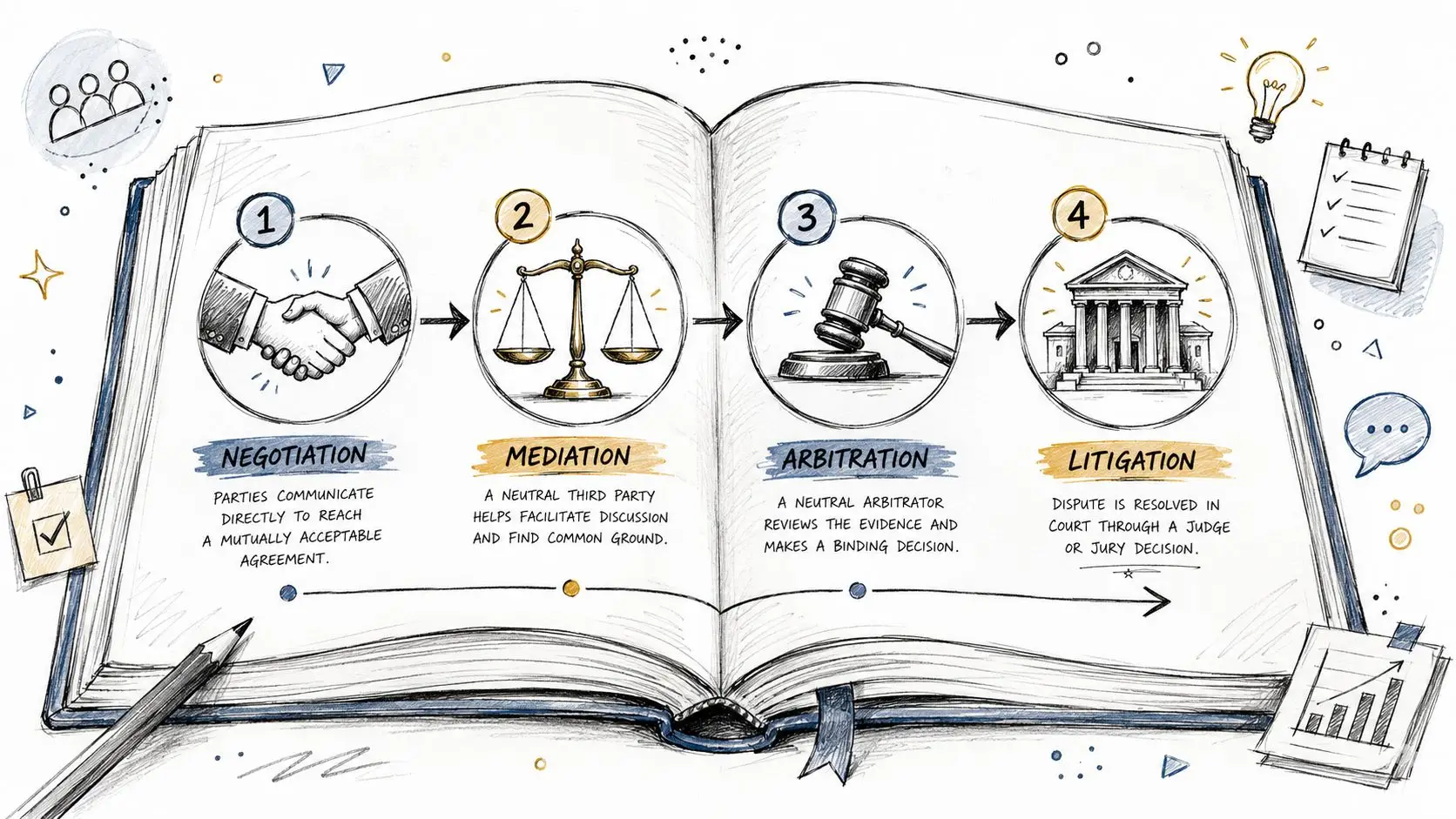
That question matters even more in international contracts because around 40% of global business and financial transactions are governed by English law, according to the Law Society international data insights report 2025. Many disputes touching Israel therefore involve more than one legal grammar, even when the assets, witnesses, or urgent relief sit locally.
Comparing Dispute Resolution Methods
| Method | Cost | Speed | Confidentiality | Control Over Outcome |
|---|---|---|---|---|
| Negotiation | Usually the most efficient when facts are developed early | Often fastest if leverage is credible | High if managed carefully | High, because parties shape terms directly |
| Mediation | Moderate | Often quicker than adjudicative routes | Usually strong | Moderate to high, since settlement remains voluntary |
| Arbitration | Can become substantial in complex matters | Often more structured than court, but not always fast | Usually better than open court | Moderate, because the tribunal decides if settlement fails |
| Litigation | Often the heaviest procedural burden | Usually the slowest path | Limited compared with private processes | Lower, because the court controls timetable and outcome |
This table simplifies the choice. Real cases turn on enforceability, urgency, evidence location, and pressure value.
When each path makes sense
Negotiation works when the parties still need each other, the facts are mostly known, and a calibrated escalation can force a rational business decision. It fails when one side uses talks only to buy time or erode their advantage.
Mediation works when the dispute includes ego, operational friction, or a need for creative terms that a court won’t order. It performs poorly when one side needs a public precedent or interim coercive relief.
Arbitration suits confidential commercial disputes, especially where parties want specialist decision-makers and cross-border enforceability planning. It becomes less attractive when urgent third-party measures are central, or when fragmented issues require multiple actors outside the arbitration clause.
Litigation becomes necessary when injunctions, evidence compulsion, asset pressure, or public procedural authority matter more than privacy. It’s also useful when the other side only moves under visible legal threat.
For in-house teams building internal process, this external guidance on contract disputes for legal teams offers a practical overview of dispute handling frameworks. It’s useful as a checklist, though Israeli cross-border matters still require local adaptation.
The best forum isn’t the most sophisticated one. It’s the one that gives a business usable leverage at the right moment.
The hidden factor in Israel-related disputes
The forum clause is only part of the answer. Counsel must ask where the bank accounts are, where performance occurs, where directors travel, where counterpart communications can be served, and where interim pressure can lawfully be applied.
That is why strong dispute planning starts with enforcement reality, not doctrinal elegance. A beautiful clause is worth little if the recovery path runs through the wrong jurisdiction or arrives too late to matter.
How to Select Your Legal Counsel in Israel
Companies often choose counsel by reputation, years in practice, or the size of the firm. Those factors matter, but they don’t answer the question that determines negotiating power.

The sharper criterion is relative lawyer expertise. Research based on acquisition contracts found that the client’s outcome turns primarily on the expertise of its lawyer relative to opposing counsel, with stronger relative expertise producing contracts that shift more risk to counterparties and secure better target prices, as discussed in this Berkeley paper on lawyer expertise and contract outcomes.
What that means in practice
A contract dispute lawyer doesn’t operate in a vacuum. The lawyer is competing against the other side’s drafting discipline, procedural instincts, appetite for escalation, and understanding of pressure points.
That means a board shouldn’t ask only, “How experienced are you?” It should ask, “How do you outperform the team across the table?”
Good answers usually sound concrete. They refer to sequencing, evidence control, venue choice, pre-suit advantage, and opponent analysis. Weak answers rely on generic assurances about being tough or responsive.
Questions sophisticated clients should ask
When interviewing Israeli counsel, decision-makers should ask questions that expose strategic depth:
- How do you assess opposing counsel early? A serious lawyer should discuss patterns, not personalities.
- How do you strengthen your position before filing? The answer should mention facts, documents, counterpart dependencies, and timing.
- When do you avoid immediate proceedings? Good counsel knows that filing too soon can reduce settlement value.
- How do you handle multilingual records and parallel jurisdictions? Cross-border discipline matters in Israel-facing disputes.
- What would make you change strategy in the first week? The answer reveals whether counsel thinks dynamically.
Warning signs during selection
Some firms still sell a litigation-first model because it sounds aggressive. That can be expensive and strategically clumsy.
Look carefully at these red flags:
- They discuss claims before facts. That usually means they’re fitting the problem into a template.
- They ignore operational consequences. A dispute can damage distribution, financing, staff retention, or reputation before judgment.
- They can’t explain escalation discipline. If every matter becomes a lawsuit, the client loses optionality.
Strong counsel doesn’t just know Israeli law. Strong counsel knows when the opponent is overplaying a weak hand.
A foreign company should also test whether the lawyer can coordinate with accountants, investigators, PR advisers, overseas counsel, and banking contacts when needed. In difficult matters, isolated legal advice is rarely enough.
Your Next Strategic Move to Avoid Costly Mistakes
The safest way to win a contract dispute in Israel is rarely to fight better after the breakdown. It’s to structure the contract, the evidence trail, and the escalation path before the crisis starts.
That requires three disciplines. First, draft for hostile interpretation, especially under the 2026 rules. Second, investigate before accusing. Third, choose counsel based on strategic advantage over the other side, not on resume length alone.
A strong contract dispute lawyer helps management do more than preserve claims. The lawyer helps management preserve options. That distinction matters in cross-border disputes involving agency relationships, commercial collaborations, licensing chains, banking pressure, or multi-jurisdiction enforcement.
Executives should act before the other side controls the narrative. The recommended strategic path is to review active Israeli commercial agreements now, identify clauses that won’t survive hostile interpretation, map operational choke points, and create a pre-litigation escalation protocol for each material relationship.
Those steps reduce avoidable error. They also improve settlement quality because the company enters negotiations with a clear legal record and a realistic pressure model.
Businesses facing Israeli commercial risk should avoid waiting until a frozen relationship becomes a formal claim. To avoid costly mistakes and assess the right strategic response, contact RNC Group now through its contact page.
This article provides general information only. It does not create an attorney-client relationship, does not constitute legal advice, and should not be relied on as a substitute for case-specific counsel on Israeli law, foreign law, procedure, strategy, or enforcement.