
A signed contract can become commercially useless when the counterparty stops paying, moves assets abroad, or forces the claimant into the wrong court. The critical question isn’t whether a business can win. It’s whether the business can collect where the money sits.
A foreign supplier may owe an Israeli company substantial sums while holding its bank accounts, inventory, and receivables in another jurisdiction. A judgment from the home court might confirm the breach, yet still require a separate recognition and enforcement process abroad. That gap determines recovery economics.
In 2026, commercial disputes demand faster risk assessment and tighter procedural planning. The 2025 disputes outlook identifies continuing pressure around commercial disputes and evolving enforcement routes, including the UK’s Hague 2019 framework for certain judgments. Businesses therefore need counsel who treats enforcement as a collection strategy, not merely a lawsuit.
Introduction Why Enforcement Decides Commercial Outcomes in 2026
The first mistake often occurs before filing. Management concentrates on the unpaid invoice, breach clause, and correspondence while the counterparty transfers assets, changes its trading structure, or moves receivables beyond practical reach.
A contract enforcement attorney should map the recovery route before recommending proceedings. The review covers governing law, forum, service requirements, interim measures, and identifiable assets. It must also connect any likely judgment to the recognition and collection procedures available where those assets sit.
Commercial rule: A legal victory has limited value unless the enforcement route reaches recoverable assets.
The World Bank measures contract enforcement through time, cost, and judicial-process quality, rather than judgment entitlement alone. Its DB17–20 methodology records enforcement costs as a percentage of claim value, including attorney fees, court costs, and enforcement costs. The methodology also records Singapore at 84.91 and Austria at 78.24 on the Enforcing Contracts DTF measure, compared with 33.24 for the Central African Republic, illustrating how forum quality affects recovery prospects (World Bank contract-enforcement methodology).
That difference affects settlement strength. A credible enforcement plan can prompt payment or a structured settlement. Filing in a slow or procedurally difficult forum can consume the recovery budget while the defendant reorganizes its assets.
The recovery question comes first
Historical research reviewed by the World Bank and ifo found that low- and lower-middle-income economies generally required about 600–700 days to enforce claims, while high-income economies averaged around 550 days. It also reported average enforcement costs above 50% of claim value in low-income countries, approximately 29–37% in lower- and upper-middle-income economies, and about 20% in high-income economies (World Bank and ifo review).
These figures do not predict a particular dispute. They establish the commercial test: counsel must protect evidence, identify pressure points, coordinate jurisdictions, and match the enforcement budget to the assets that can be recovered. The objective is collection, not a judgment that cannot be converted into payment.
What a Contract Enforcement Attorney Actually Does
A contract enforcement attorney doesn’t draft a complaint. The attorney designs a sequence that moves from breach, to proof, to remedy, to payment.
Start with the contract architecture. Counsel identifies the governing-law clause, jurisdiction clause, arbitration agreement, notice provisions, limitation periods, security rights, and contractual remedies. Counsel then tests whether those provisions work against the current facts.

The service map
Effective counsel separates four connected jobs:
- Advisory analysis: The attorney identifies breach, defenses, damages, forum, and collection obstacles.
- Pre-filing pressure: Counsel prepares a demand strategy that preserves credibility without revealing unnecessary litigation plans.
- Formal proceedings: The team files, serves, manages evidence, and seeks the remedy that matches the commercial objective.
- Post-judgment recovery: Counsel pursues recognition, execution, garnishment, liens, seizure, or negotiated payment.
The sequence matters because an early procedural error can restrict later options. Improper notice can delay a claim. An incomplete damages record can weaken settlement position. A missed interim remedy can leave the defendant free to dissipate value.
For contract preparation, a structured Caseledge contract review template can help business teams identify clauses, obligations, and documentary gaps before a dispute escalates. It doesn’t replace legal advice, but it can improve the initial information package sent to counsel.
Evidence must tell one connected story
The attorney should build an evidentiary chain that maps breach to damages to remedy. That chain normally includes the signed agreement, amendments, purchase orders, delivery records, invoices, correspondence, transaction logs, performance data, and records showing mitigation.
Practical enforcement guidance recommends preserving those materials and using them to support a legally precise complaint, proper service, and a suitable remedy. Potential remedies can include compensatory damages, specific performance, injunctions, garnishment, liens, or seizure (practical business-agreement enforcement guidance).
The recommended strategic path is phased. First, preserve the record and map assets. Next, send a demand that creates a clear decision point. Then file only when the forum, remedy, and collection route justify the expense.
Enforcement Remedies and How to Choose Between Them
The right remedy depends on where the money or value sits, how quickly it may disappear, and what outcome the business needs. A judgment alone may not produce payment. Counsel should select a collection route before filing, then match each procedural step to the defendant’s assets and conduct.
Choosing the Right Enforcement Remedy
| Remedy | Best For | Speed and Strategic Value |
|---|---|---|
| Negotiated payment demand | Clear debt and cooperative counterparty | Fast, with strength tied to credible escalation |
| Commercial litigation | Breach requiring binding court relief | Variable speed, broad procedural powers |
| Arbitration | Contractual arbitration clause and international parties | Procedurally flexible, subject to award enforcement |
| Injunction | Ongoing misuse, disclosure, transfer, or interference | Potentially urgent and highly coercive |
| Asset freeze | Risk of dissipation before judgment | Powerful preservation tool, subject to strict requirements |
| Garnishment | Known bank accounts or receivables | Direct collection power after required orders |
| Lien | Secured or identifiable property interests | Preserves priority or supports later recovery |
| Seizure | Tangible assets linked to enforcement | Strong coercive effect, but operationally complex |
| Specific performance | Unique goods, services, or contractual acts | Useful where money cannot replace performance |
Start with the commercial objective. If the business needs payment and the counterparty remains cooperative, a focused demand with defined settlement terms may be more efficient than full litigation. If confidential information is still being used or assets are being transferred, urgent court protection may matter more than a later damages award.
Match the remedy to the threat
A damages claim is appropriate when the defendant remains solvent and the loss can be proved clearly. Specific performance suits unique assets, access rights, or continuing contractual cooperation. The requested order must connect directly to the contractual duty and the practical harm. Courts may resist orders that would require them to manage ordinary business operations.
Interim remedies call for a separate risk assessment. Identify the asset, document the danger of dissipation, satisfy the relevant procedural requirements, and prepare for scrutiny of the merits. An application that is too broad can increase cost and expose weaknesses before the main claim is ready.
Arbitration requires the same collection planning as litigation. An award does not itself place funds in the claimant’s account. Before choosing arbitration or treating it as sufficient, counsel should assess recognition, possible defensive challenges, enforcement procedure, and the defendant’s assets in the target country.
Debt collection may be the most efficient route when liability is straightforward and the counterparty wants to protect ongoing commercial relationships. It becomes less useful when the debtor has no accessible assets, shifts value between entities, or operates through several jurisdictions. Asset tracing should therefore precede major spending, especially in a cross-border dispute.
Use a phased strategy. Begin with the least expensive step that can preserve value and support realistic payment. Escalate to interim relief, proceedings, and execution when the counterparty refuses a rational resolution or the asset position deteriorates. The winning remedy is the one that reaches recoverable value, not merely the one that produces the strongest judgment.
Jurisdiction and Cross Border Enforcement Where Collection Happens
A favorable judgment can still produce no payment if the debtor’s money sits beyond the court’s reach. A contract may select Israeli law, a foreign court, or arbitration, while valuable accounts, receivables, property, or operating assets remain elsewhere. Counsel should connect those choices before filing, because collection jurisdiction often matters more than the place where the agreement was signed.
Governing law identifies the rules used to interpret obligations and assess breach. Jurisdiction identifies where the dispute can proceed and what relief the court or tribunal may issue. Asset location answers the commercial question that follows: where can the claimant turn a legal result into money?

Sequence the enforcement route
Build the cross-border plan around these questions:
- Forum: Can the chosen court or tribunal hear the dispute and grant effective relief?
- Service: How must the defendant receive the proceedings, and which local formalities apply?
- Interim protection: Can the relevant jurisdiction preserve assets or restrict dissipation?
- Recognition: How will the target country treat the judgment or award?
- Execution: What procedure allows attachment of accounts, receivables, property, or other recoverable value?
- Defensive challenges: Which objections may concern jurisdiction, public policy, service, or procedure?
International practitioners describe combining litigation or arbitration with later award-enforcement or defense proceedings. That model requires asset identification and execution planning from the start, not after the claimant obtains a result (international arbitration and dispute-resolution practice).
Time and cost reshape settlement dynamics
The quality of the collection forum affects the pressure created by a demand. Where enforcement is faster and cheaper, a demand letter carries more weight. Asset location should therefore drive forum choice, alongside the contract, evidence, parties, and jurisdiction rules.
A fast forum is not automatically the right forum. Counsel must assess whether its judgment or award can be recognized where the assets sit, whether urgent relief is available, and whether execution can reach value controlled through related entities. Delay and procedural friction should be priced before assuming that a home-country judgment will produce practical pressure.
For Israeli businesses and multinationals, the working structure often combines Israeli counsel with trusted lawyers in the asset jurisdiction. The Israeli team coordinates commercial objectives, evidence, and escalation. Local counsel handles recognition, urgent applications, service, and execution rules.
The Enforcement Process Timelines and How to Prepare Your Case
A debtor can move money, close an account, or place assets beyond easy reach while a claimant is still preparing its first pleading. Build the evidence and recovery plan before announcing your next move.
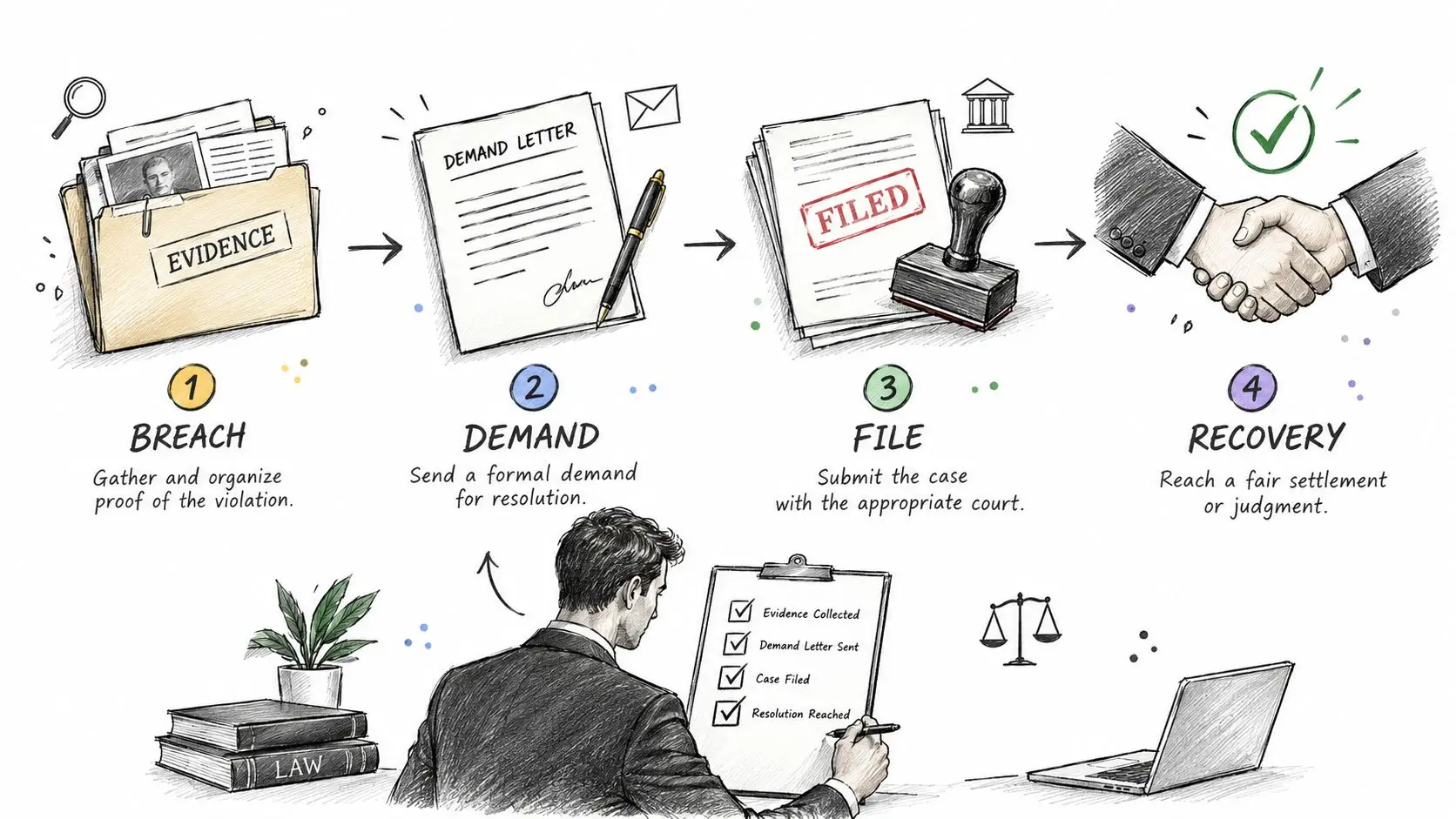
Follow a seven-step chronology
First, preserve evidence. Secure the signed contract, amendments, orders, invoices, delivery records, correspondence, meeting notes, payment records, and relevant digital logs. Keep originals and record who created, received, and stored each item.
Second, define the claim. Identify the exact obligation, breach, provable loss, mitigation steps, and likely defenses. Check notice requirements, limitation periods, arbitration provisions, and escalation clauses before sending a demand.
Third, map the counterparty. Confirm the contracting entity, parent company, guarantors, beneficial owners, banks, receivables, inventory, real estate, and operating subsidiaries. Separate legal ownership from practical control. This research determines whether a judgment can become a recovery.
Fourth, issue the demand. State the breach, required cure, supporting documents, deadline, and consequences. Preserve legal rights without threatening remedies the selected forum cannot grant. A precise demand can also reveal whether the counterparty wants to resolve the dispute or is preparing to resist.
Fifth, choose the proceeding. Confirm service, jurisdiction, interim relief, and recognition before filing in court or commencing arbitration. Draft the pleading so each fact supports a legal element and each loss connects to a remedy.
Sixth, protect value. Seek urgent relief when the evidence supports it. Asset freezes, injunctions, garnishment, liens, and similar measures can prevent value from disappearing before execution.
Seventh, enforce the result. Treat judgment or award enforcement as a separate workstream. Prepare recognition papers, translations, authentication, local filings, and execution applications before the merits phase ends.
Plan for procedural friction
Contract enforcement can involve repeated filings, service problems, translations, evidence disputes, appeals, recognition proceedings, and difficult asset identification. The World Bank and ifo contract-enforcement review provides broader context for that procedural burden, but it is not a forecast for a particular case.
Preparation should follow the money. Confirm where assets sit, which entity owns them, and which court can reach them. Then sequence the response: preserve evidence, demand payment, seek interim protection, file the merits case, and prepare execution in the jurisdiction holding recoverable value. That sequence reduces avoidable delay and keeps enforcement focused on collection rather than judgment alone.
Fees Risk Assessment and When Not to Enforce Aggressively
Enforcement spending should follow recovery economics. A strong breach claim may still produce a poor business outcome if the debtor lacks reachable assets, the forum moves slowly, or the collection process consumes disproportionate resources.
Compare the fee structure to the risk
| Fee model | Suitable situation | Main risk |
|---|---|---|
| Hourly billing | Complex proceedings with changing scope | Budget uncertainty |
| Fixed or capped fees | Defined demand or procedural phase | Scope disputes when facts expand |
| Hybrid structure | Matter needs predictable base costs and flexibility | Requires precise phase definitions |
| Contingency-linked structure | Recovery value supports shared risk | Availability and commercial terms vary |
The claim value matters, but it isn’t decisive alone. Counsel should assess solvency, asset location, evidence quality, counterclaims, enforcement cost, delay, and management distraction. A smaller claim with accessible assets may justify action more readily than a larger claim against an empty shell.
Aggressive enforcement can be the wrong move
Immediate filing can destroy a settlement route, trigger defensive restructuring, or increase reputational exposure. It can also force the claimant to disclose its evidence and strategy before securing meaningful advantages.
Businesses should consider a phased escalation plan:
- Private resolution: Test whether a focused demand, commercial meeting, or settlement conference can produce payment.
- Structured pressure: Combine deadlines, security demands, staged payments, and carefully chosen disclosures.
- Protective action: Seek interim relief when asset dissipation or continuing harm creates a genuine risk.
- Formal proceedings: File when the counterparty refuses a credible solution or threatens recovery value.
Recent litigation commentary describes greater use of compulsory settlement conferences, legal project management, and stronger dispute-resolution design in response to cost and delay pressure (commercial litigation trends). The strategic answer isn’t softness. It’s controlled escalation based on the opponent’s solvency, assets, incentives, and likely reaction.
How to Choose the Right Attorney and Take the Next Step
The right attorney should understand both the contract and the collection environment. A lawyer who can prove breach but cannot coordinate recognition and execution may leave the commercial problem unresolved.
Test the adviser before engagement
Ask for clear answers to these questions:
- Which forum works: Has counsel explained the governing law, jurisdiction, arbitration, service, and recognition consequences?
- Where are the assets: Has the team identified realistic recovery targets rather than relying on the debtor’s registered address?
- What happens first: Has counsel proposed a phased plan covering evidence, demand, interim relief, proceedings, and execution?
- Who acts abroad: Does the matter require local counsel, translation, authentication, or foreign procedural support?
- How are costs controlled: Does the engagement define phases, reporting, authority limits, and settlement decisions?
- What prevents recurrence: Will the team improve contract language, security, guarantees, reporting, and escalation clauses?
Israeli commercial contracts primarily rely on the Contracts (General Part) Law, 5733-1973, and the Contracts (Remedies for Breach of Contract) Law, 5731-1970, alongside sector-specific legislation (Israeli commercial-contract framework). International businesses should therefore obtain advice that connects Israeli contract principles with the enforcement law of the target asset jurisdiction.

RNC Group handles contract dispute resolution through negotiation, mediation, arbitration, litigation, and demand-letter strategy. Its international contract enforcement work includes enforceability assessment, cross-border asset preservation, recognition, and coordinated execution planning. The firm also connects Israeli clients with international legal partners through the ADVOC network.
The recommended strategic path is immediate risk mapping. Assemble the contract and evidence, identify the counterparty’s jurisdictions and assets, preserve urgent remedies, and obtain a phased opinion before sending an irreversible threat or filing.
RNC Group advises Israeli and international businesses on contract enforcement, cross-border recovery, demand strategy, arbitration, litigation, and execution planning. To avoid costly mistakes and protect collection options, contact the firm through RNC Group and request a focused assessment of the contract, counterparty, assets, and available enforcement route.
This article provides general information only and doesn’t constitute legal advice. Laws, procedures, deadlines, remedies, and enforcement outcomes depend on the specific contract, facts, jurisdiction, and current legislation, so readers should obtain advice from qualified counsel before acting.