
A foreign subsidiary faces a regulator's inquiry while the Israeli parent's finance team receives an urgent email changing a supplier's bank details. At the same time, the company's Israeli account is flagged after returned checks. The immediate question is not whether a holding company exists. It's whether the group can identify who controls each asset, who may authorize payments, and what evidence must be preserved before access or value is lost.
Corporate asset protection should be treated as a continuously tested legal-and-operational program, not a one-time incorporation exercise. For Israeli businesses operating abroad, and overseas companies with Israeli exposure, that means connecting entity governance, ownership records, banking access, cybersecurity, contracts, and crisis response. The practical starting point is an evidence-based assessment of what could realistically go wrong next, and which people have authority to act.
Table of Contents
- Why Corporate Asset Protection Matters in 2026
- Choosing the Right Protection Structures
- Building the Risk-Ranked Asset Register
- Handling Israeli Bank Account Restrictions
- Why Beneficial Ownership Accuracy Is the Hidden Differentiator
- Fraud Controls That Hold Under Override Pressure
- Phased Escalation Playbook and Red Flags
Why Corporate Asset Protection Matters in 2026

A frozen account or compromised payment instruction can affect more than one company in a group. Shared treasury systems, cloud services, staff, and supplier relationships can make a legal entity's assets dependent on operational arrangements controlled elsewhere. A structure that looks separate on paper may not protect the business if one person or service provider can block access to funds, data, or essential contracts.
Limited liability remains a foundational protection. Shareholders generally risk the amount invested, and their personal assets ordinarily aren't available to satisfy corporate creditors' claims. But that protection depends on preserving the company's separate legal identity through governance, documentation, capitalization, and accounting. The OECD has identified shareholder protection as a condition for attracting domestic and foreign investment, and its corporate-governance materials emphasize safeguards against fraud, managerial misconduct, and controlling-shareholder self-dealing (OECD corporate-governance report).
Start with the next credible failure
The board and CFO should identify the risks that could interrupt the company's ability to operate or defend its position: an account restriction, unauthorized payment, supplier outage, ownership dispute, or cross-border enforcement action. Each risk needs an accountable decision-maker, current records, and a tested response. The aim isn't to make the group unreachable to legitimate creditors. It's to ensure that liabilities, assets, and responsibilities sit with the correct entity, while preserving lawful access and transparent governance.
Choosing the Right Protection Structures
No structure protects against every kind of exposure. Limited liability separates shareholders from corporate obligations in the ordinary course, but it doesn't erase the company's debts or make personal guarantees disappear. A holding company and subsidiaries can help allocate distinct businesses, assets, and contracts to distinct entities, provided the group respects that separation in practice.
| Tool | What it actually protects | Common limit |
|---|---|---|
| Limited-liability entity | Shareholders' personal assets from many company obligations | Misuse, inadequate records, or personal guarantees can undermine protection |
| Holding and subsidiary structure | Separation of activities, ownership, and certain liabilities across entities | Shared accounts, staff, or undocumented transfers can blur the boundaries |
| Contractual safeguards | Allocation of specific risks through indemnities, guarantees, security, and payment terms | Contract rights depend on the agreement, the counterparty, and enforcement |
| Insurance | Covered losses and defence costs within policy terms | Exclusions, limits, and notification requirements may leave exposures uninsured |
| Trust, where appropriate | Ownership and administration arrangements for eligible assets | Its effect depends on governing law, purpose, control, and creditor rights |
Make separation real
A group should maintain separate books, bank accounts, approvals, contracts, and decision records for each entity. Intercompany services, loans, and asset transfers should have documented terms and a business rationale. The OECD's emphasis on legal separateness matters most when a creditor, shareholder, bank, or court asks who owned an asset, who controlled it, and why the transaction took place.
Contract terms need the same discipline. Indemnities can allocate specified losses between contracting parties; guarantees can add a source of payment but also create direct exposure for the guarantor. Security and set-off provisions may affect how particular claims are resolved, subject to the contract and applicable law. Insurance is a complement to these tools, not a substitute for entity governance or sound contract drafting.
For businesses weighing an ownership structure, how to set up a holding company offers a useful general overview. The decisive question for an international group is not where a holding company is formed. It's whether each entity has a clear role, credible records, and governance that can be demonstrated under scrutiny.
Building the Risk-Ranked Asset Register
A company can't protect what it hasn't identified. NIST CSF 2.0 calls for managing assets through their lifecycle and prioritizing them according to classification, criticality, resources, and business impact (NIST Cybersecurity Framework 2.0). Applied to corporate asset protection, that approach creates a practical record for legal, finance, IT, and executive teams.
Build an inventory that supports decisions
The register should cover hardware, software, services, data, facilities, personnel, and suppliers. For each asset, record its legal owner, operational custodian, access rights, contractual dependencies, and relevant jurisdictions. Then:
- Document authorized flows. Record how data and payments move between systems, entities, and providers.
- Classify exposure. Assess confidentiality, integrity, availability, legal exposure, business criticality, and recovery impact.
- Log threats and vulnerabilities. Put identified risks in a register rather than leaving them in separate departmental notes.
- Assign treatments and accountability. Set priorities, testing dates, and an executive owner for each material risk.
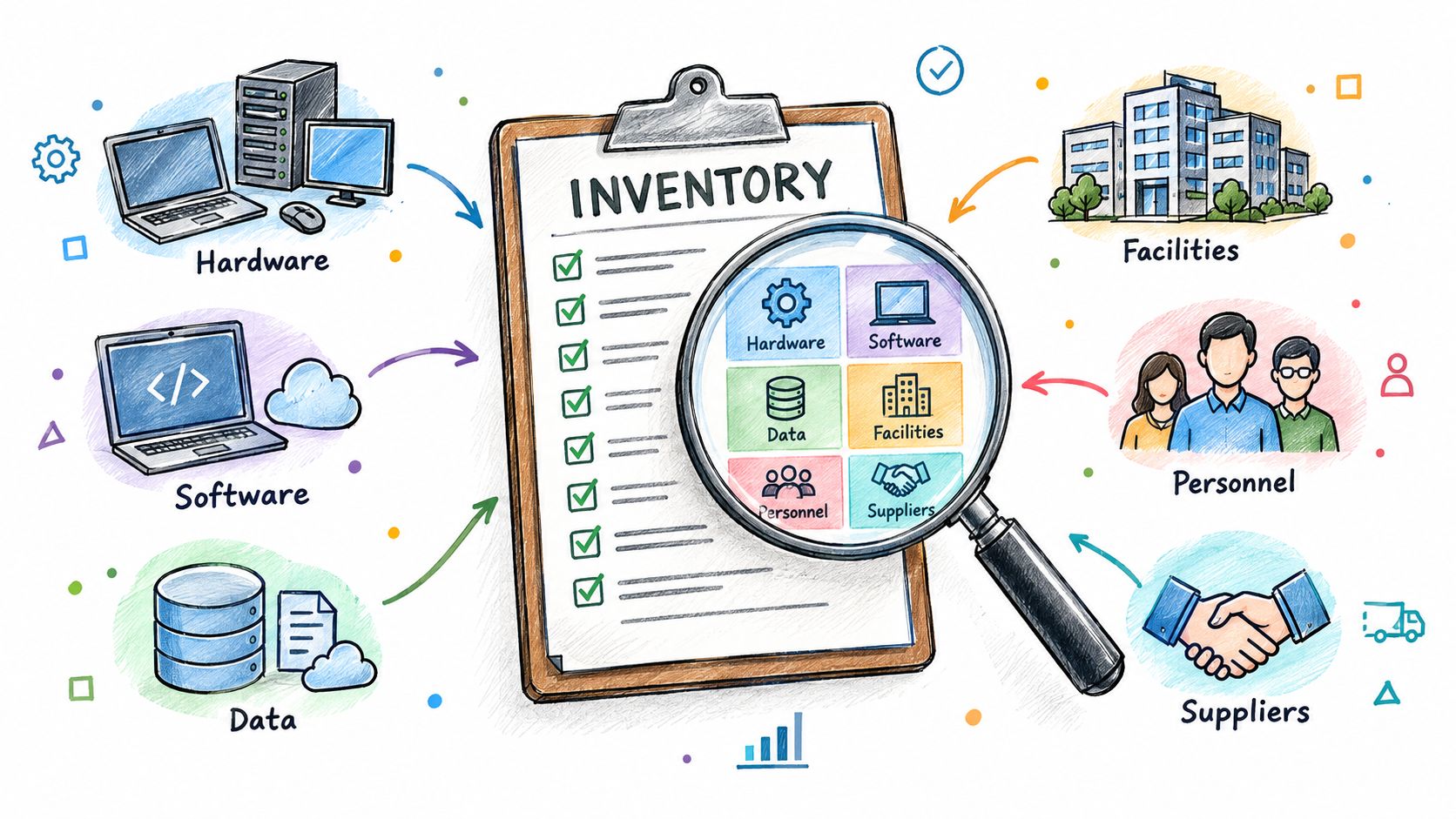
The same inventory can support merger and acquisition diligence, bank enquiries, commercial disputes, and incident response. It also exposes a common blind spot: legal ownership isn't the same as operational control. A company may own its data or intellectual property while a cloud provider, employee, lender, franchisee, or foreign affiliate controls access or creates recovery risk.
Control test: Each critical asset needs a named owner, a dependency map, a tested fallback, and evidence that the company can exercise its contractual rights where the asset is held or used.
At a minimum, the control specification should address unique user accounts, least-privilege access, multifactor authentication for privileged and financial systems, encryption in transit and at rest, supplier-access logging, immutable backups, and quarterly access recertification. The board should ask for proof that these controls work, not merely a policy stating that they exist.
Handling Israeli Bank Account Restrictions
For an Israeli company, returned checks can become a statutory banking restriction, not just a supplier-relations problem. Under Israel's Checks Without Cover Law, an account becomes restricted when 10 checks drawn on it are refused for insufficient funds within a one-year period beginning with the first returned check. The restriction lasts one year. During that period, the bank may not honor checks drawn on the account, provide additional check forms for it, or open a check-writing account for the restricted customer (Bank of Israel information on restricted accounts).
The Bank of Israel's electronic-information rules provide for a warning when five checks have been refused. For corporate accounts, the bank must send an insufficient-funds warning to all authorized signatories authorized to cover the check, using its latest signatory list. The notice must be sent by 8:00 a.m. on the business day after the business day the check was presented (Bank of Israel electronic-information rules).
Separate basic banking from credit
The Bank of Israel states that banks must generally enable customers to open and operate at least a current account without a credit facility, unless there's reasonable cause not to provide that service (Bank of Israel guidance on current accounts). A refusal of credit and a refusal of ordinary current-account services aren't the same issue. The company should identify the bank's stated reason and preserve the written record.
Finance should immediately verify the authorized-signatory list and internal alert process, record returned-check notices and bank communications, and gather relevant funds and payment evidence. If restriction is signaled, the company should document its requests, responses, beneficial-owner information, and compliance materials. Missing a notice to one director or finance officer doesn't necessarily prevent an account from reaching the statutory threshold.
Why Beneficial Ownership Accuracy Is the Hidden Differentiator
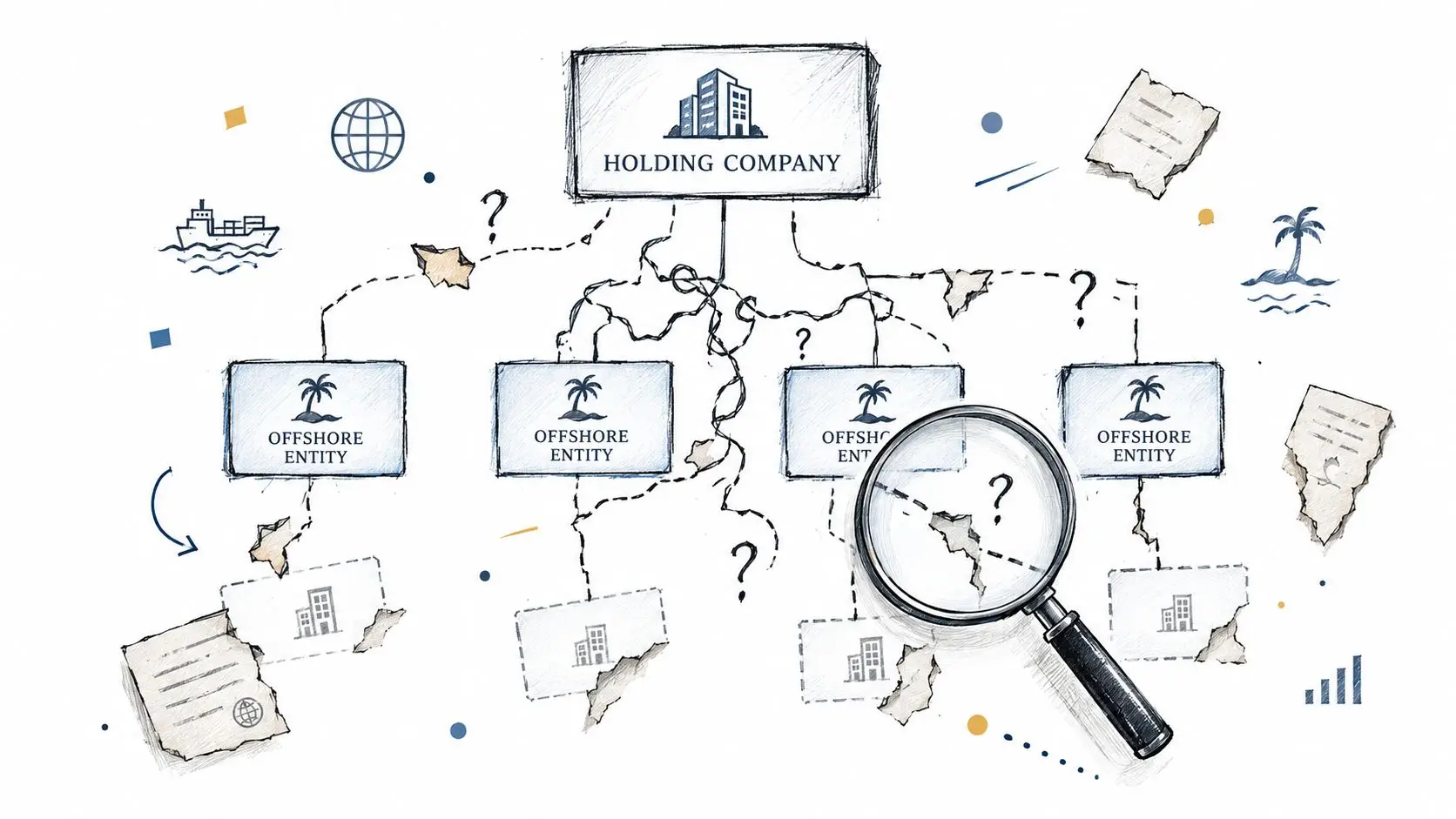
An offshore company or holding structure doesn't provide practical protection if the group can't explain who ultimately owns or controls it. Fragmented or inaccessible ownership data can obstruct asset tracing and freezing. Inconsistent records held by a registry, bank, regulator, and counterparty can also create delay and invite further scrutiny.
The EU's 2024 Asset Recovery and Confiscation Directive is pushing member states toward coordinated tracing, freezing, confiscation, and cross-border information exchange. For a company operating across borders, that makes ownership information part of governance and evidence, not merely a filing task (EU statement on asset recovery).
Keep ownership evidence current
Each jurisdiction may apply different tests for beneficial ownership and reporting. The company should identify which individuals exercise direct or indirect control, record nominee arrangements and shareholder disputes, and set a jurisdiction-by-jurisdiction verification calendar. When registry information is wrong, an escalation protocol should identify who contacts the registry, bank, and affected counterparties, and what evidence supports the correction.
A structured identity-check process can help teams verify names and records consistently. For a general reference on identity verification in KYC workflows, see TaxID KYC verification. It doesn't replace legal analysis of the applicable ownership test or reporting obligation.
Opacity may appear to offer privacy, but it can impair banking access, delay transactions, and complicate a company's response to an inquiry. The better protection is accurate, reconcilable information with a clear audit trail.
Fraud Controls That Hold Under Override Pressure
Internal fraud controls must still work when the person seeking an exception is a founder, senior executive, or trusted finance employee. The ACFE's 2024 study examined 1,921 occupational-fraud cases across 138 countries and territories. It found that lack of internal controls contributed to 32% of cases and management override to 19%. It also reported that surprise audits, financial-statement audits, hotlines, and proactive data analysis were each associated with at least a 50% reduction in fraud loss and duration (ACFE 2024 Report to the Nations).
Build controls around the transaction
Separate initiation, approval, payment, reconciliation, and vendor-master maintenance. Require dual authorization for payments, asset transfers, related-party transactions, and bank-instruction changes. Independent monthly reconciliations and exception analytics should identify irregularities before they become routine.
Add a confidential reporting channel, surprise audits, and periodic financial-statement audits. When an anomaly arises, preserve evidence under a documented protocol, investigate independently, and review control effectiveness after the incident. Logs should show who approved each action and when.
A written policy isn't a control if one person can approve an exception, change payment details, and close the audit trail.
For cross-border groups, the workflow should also identify local signatories, beneficial owners, sanctions exposure, records-retention duties, and the forum in which recovery or urgent relief may be pursued. Those details should be mapped in advance, because improvising authority during an incident invites delay and disputes over who was entitled to act.
Phased Escalation Playbook and Red Flags
When an account restriction, cyber incident, or suspected misuse of assets emerges, order matters. Preserve evidence before making public statements or changing records, then assign decision rights across finance, legal, IT, and senior management.
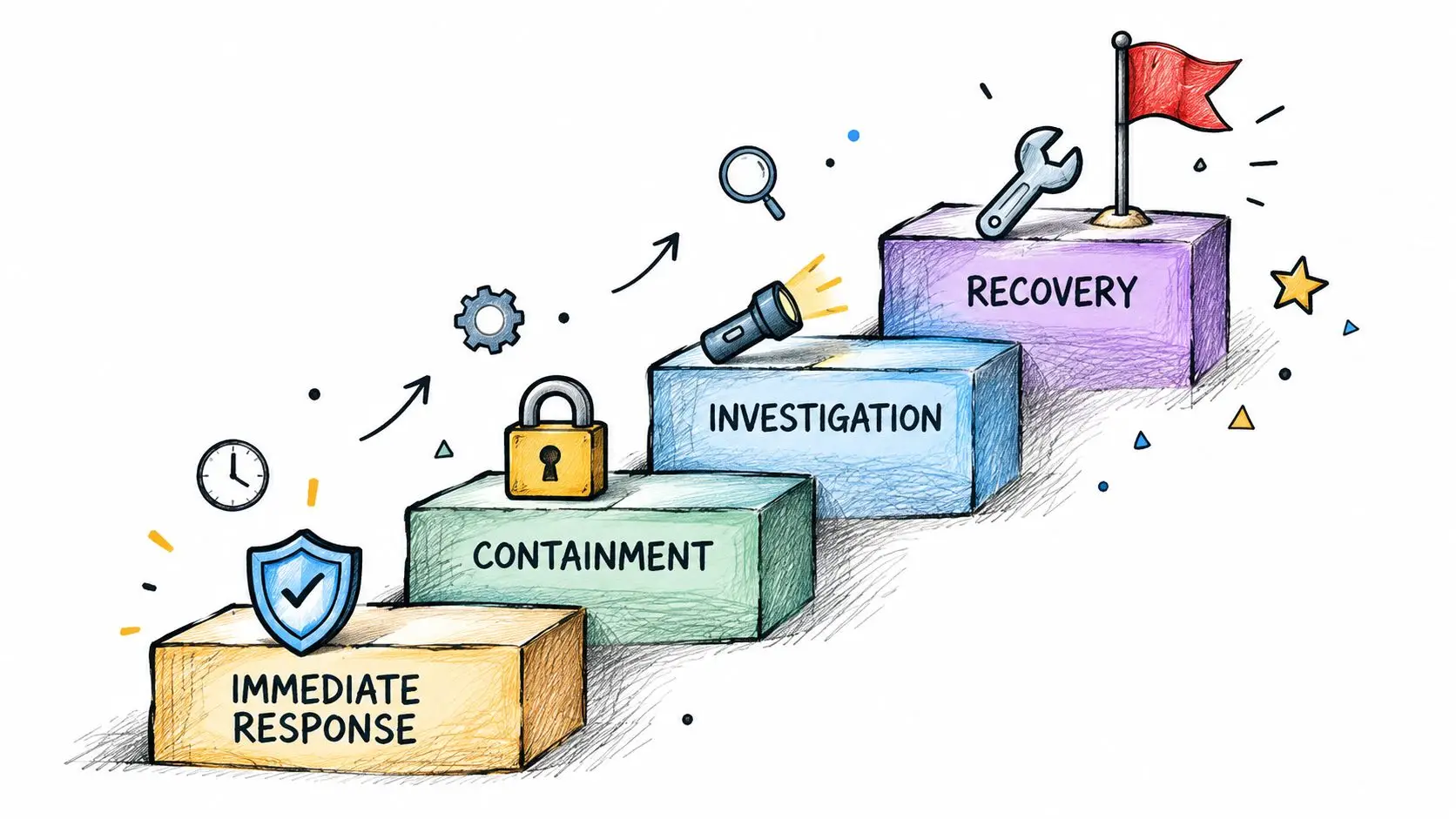
Escalate in phases
- Immediate response: Secure relevant records, preserve payment instructions and system logs, and identify who can freeze or authorize payments. For an Israeli account issue, confirm returned-check notices and the signatory information on file.
- Containment and engagement: Restrict compromised access where appropriate, contact the bank through verified channels, and coordinate with relevant counsel and technical specialists. Keep a record of decisions, requests, and responses.
- Investigation and correction: Establish what happened, which entities and assets are affected, and whether contractual, governance, or ownership records conflict. Preserve evidence and separate fact-finding from external communications.
- Recovery and review: Plan how to restore access, pursue contractual or legal remedies, and update controls. Assign an independent reviewer to assess whether the incident exposed a broader weakness.
Red flags include unverified changes to supplier banking instructions, a single person controlling approval and reconciliation, stale signatory lists, unexplained intercompany transfers, inconsistent ownership records, and critical services with no tested fallback. The board should require a clear owner and documented response for each.
In our experience, the weak point is rarely the structure itself. It is usually a gap between what the documents say and what people actually do, such as a signatory list nobody updated or a payment instruction that one person could change alone. Closing that gap before an incident is far cheaper than explaining it during one.
For Israeli and international businesses, RNC Group's work includes commercial crisis management, international commercial disputes, and support concerning business bank-account restrictions. To avoid costly mistakes in structuring, documentation, or a live incident, contact RNC Group to discuss the company's circumstances and the appropriate escalation path.
Structuring asset protection? Do it before a claim appears.
Protection structures stand or fall on timing, consideration and corporate separateness. Moves made after a dispute starts can be undone.
We design lawful protection structures for companies and owners. Reach us on WhatsApp or by email.
RNC Group advises businesses on international commercial disputes, crisis management, and Israeli business-bank account restrictions. To assess a potential restriction or strengthen the company's legal-and-operational response, contact RNC Group before decisions made under pressure create avoidable complications.
This article is for general information only and does not constitute legal advice. Laws and their application depend on the facts and jurisdiction and may change. Although we aim to keep this information accurate and current, we do not guarantee that it is complete or up to date. The article may contain omissions or errors. Reading this article does not create an attorney-client relationship with RNC Group. Before making a decision or taking action, seek advice from a qualified lawyer in the relevant jurisdiction.