
Most boards still misclassify governance work as paperwork. The evidence points the other way. In a study of S&P 1,500 companies, the share with the General Counsel serving as a corporate officer rose from 66% in 1995 to 81% in 2012, while the share with an “exec lawyer” rose from 33% to 44%. The same research found measurable lawyer effects on regulatory compliance, monitoring failures, and business development, which means governance-lawyer influence isn't symbolic according to the underlying study.
For a multinational with Israeli operations, that's the practical point. A Corporate Governance Lawyer doesn't earn value by producing prettier board packs. The role earns value by sequencing decisions across AI, cyber, sanctions, disclosure, and shareholder pressure before those issues turn into simultaneous legal events.
Why Corporate Governance Is a 2026 Crisis Discipline
Governance became a mainstream legal function long ago, but many boards still treat it as clerical support. That view is obsolete. A governance failure now spreads across disclosure, internal controls, data incidents, banking relationships, and shareholder claims with very little time between them.
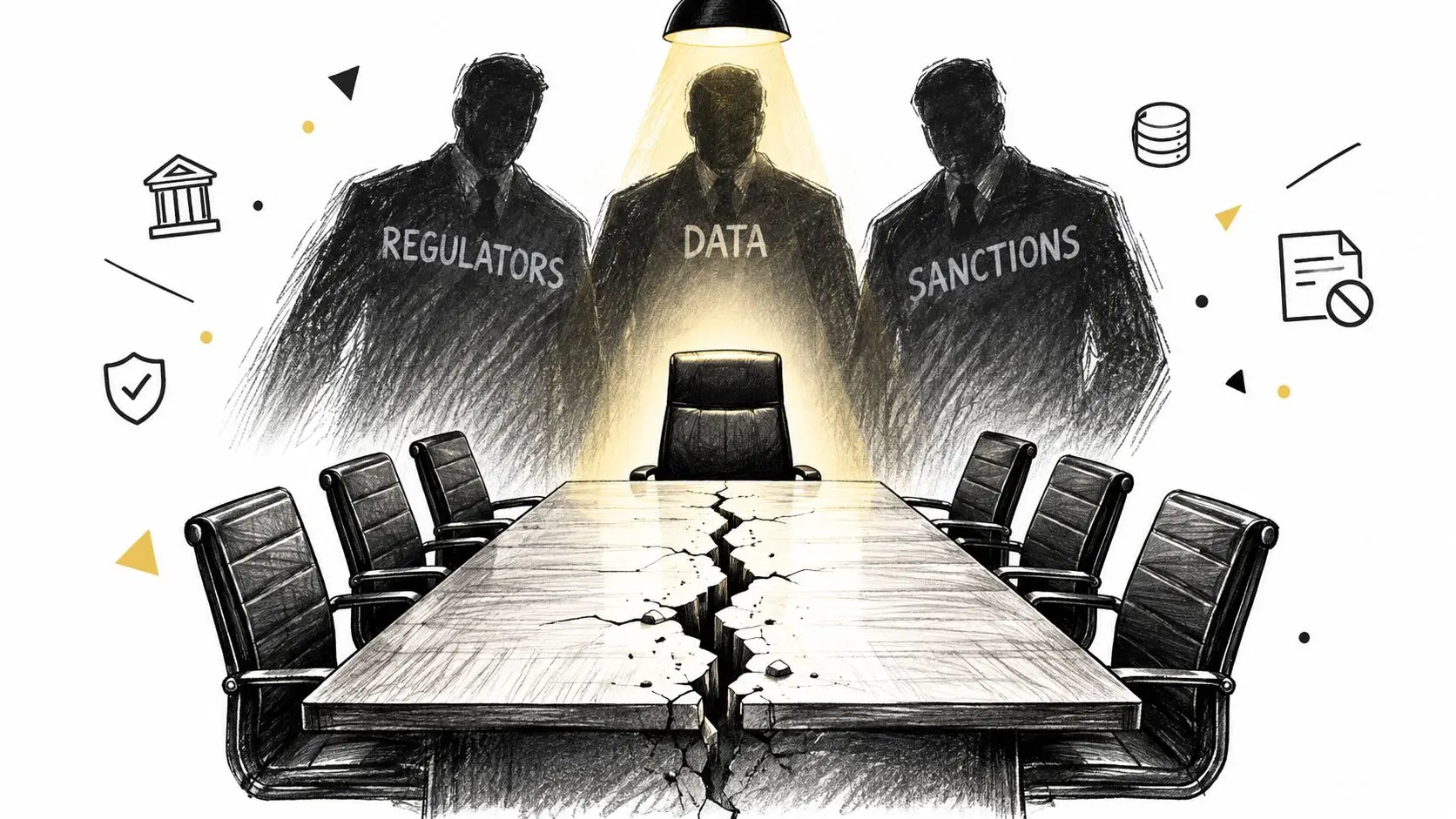
The older model focused on charters, minutes, quorum, and annual approvals. The 2026 model treats governance as a crisis discipline. Boards now need an escalation architecture that links legal, finance, cyber, compliance, and investor communications before a problem reaches the market.
The role changed because the risk map changed
The modern timeline matters. The term “corporate governance” appeared in the U.S. Federal Register in 1976. The Foreign Corrupt Practices Act followed in 1977, the Cadbury Code in 1992, Sarbanes-Oxley in 2002, and Dodd-Frank in 2010. That sequence tracks the shift from general board advice to a specialized field built around disclosure, anti-bribery controls, audit oversight, and shareholder rights in the U.S. and U.K. as reflected in this governance timeline.
That history explains today's pressure on Israeli and multinational companies. If an Israeli issuer, subsidiary, or founder-led group has U.S., U.K., or EU touchpoints, governance isn't local administration anymore. It's cross-border control design.
Practical rule: If the board hears about a cyber event, AI deployment issue, or sanctions exposure after management has already improvised a response, governance has already failed.
Boards facing hybrid meeting, cross-jurisdiction, and disclosure pressure can also learn from the wider European discussion around digital crossroads hybrid readiness. The useful insight isn't procedural novelty. It's that governance design now has to anticipate where participation, authority, and evidence may later be challenged.
What fails when the role is missing
A missing governance function usually doesn't produce one dramatic legal error. It produces several smaller ones at once.
- Escalation fails: Management doesn't know when an issue belongs with the board.
- Documentation fails: Minutes record conclusions but not oversight steps.
- Disclosure discipline fails: Legal, finance, and operations don't align timing.
- Control ownership fails: Everyone assumes someone else owns the decision.
That is why the Corporate Governance Lawyer now looks less like a board secretary and more like a risk integrator.
What a Corporate Governance Lawyer Does
A corporate governance lawyer is not a board-paperwork drafter. The role is to build a control system that forces the right issue to reach the right decision-maker before an AI failure, cyber incident, sanctions problem, or shareholder fight turns into a disclosure crisis.

Core deliverables
The technical baseline appears in the G20/OECD Principles of Corporate Governance. The framework calls for timely and accurate disclosure of material matters, along with integrity in accounting, financial reporting, risk management, financial and operational controls, and legal compliance under the OECD text. A governance lawyer turns those principles into evidence that the board exercised oversight in a disciplined way.
That work product should be concrete:
- Board and committee charters that assign authority and reserve the right decisions for the right forum.
- Escalation protocols that set trigger points for management to notify the CLO, CEO, audit committee, or full board.
- Subsidiary governance matrices that show approval paths across entities, jurisdictions, and signing authorities.
- Related-party transaction frameworks that isolate conflicted participants and document independent review.
- Insider trading and disclosure workflows that align legal review, finance input, and market timing.
- Minutes and evidentiary records that show what directors reviewed, what they challenged, and why they approved or rejected a course of action.
The role is risk sequencing
The job is to sequence pressure points before they collide. If a cyber event creates disclosure risk, sanctions screening questions, customer notification issues, and activist attention at the same time, someone has to decide the order of analysis and escalation. That is governance counsel's function.
Deal lawyers close transactions. General counsel often manage legal operations and internal legal workflows. Governance counsel designs how information reaches the board, how privilege is protected, how conflicts are contained, and how the record will read when regulators, auditors, shareholders, or courts examine it later.
Boards need decision architecture, not thicker board packs.
This becomes acute when internal conduct may create securities or fiduciary exposure. Governance analysis on reporting-up obligations explains that counsel who learns of a material violation must report it to the chief legal officer and, in some circumstances, to the board, while certain SEC-related counsel may have permissive external disclosure in extreme cases as discussed in this reporting-up analysis. The practical question is operational. Who classifies the issue, who preserves the factual record, who controls circulation, and who decides whether the matter stays at management level or goes up immediately?
What boards should demand
A board should hire this role for control design and crisis discipline.
Ask for four outputs early:
- A current-state governance map that shows where authority sits across the board, committees, management, and subsidiaries.
- A trigger list for AI, cyber, sanctions, whistleblower, and related-party events, with named escalation owners.
- A documentation protocol that preserves oversight evidence without flooding directors with unnecessary detail.
- A board reporting cadence that separates routine updates from matters that require immediate escalation.
If counsel cannot produce those items, the company does not have governance coverage. It has board administration.
Core Services That Define the Role
Boards do not hire governance counsel to draft cleaner minutes. They hire this role to integrate risk before a technical issue turns into a disclosure failure, sanctions breach, cyber event, AI control gap, or shareholder fight.
The work breaks into five functions. Each one should produce a usable board artifact, a clear escalation path, and a measurable reduction in decision risk.
Five functions boards buy
| Function | Primary Deliverable | Measurable Governance Outcome |
|---|---|---|
| Board advisory | Charter set, committee mandates, director onboarding pack | Faster routing of issues to the right decision-maker |
| Regulatory compliance | Jurisdictional compliance matrix, disclosure workflow, policy updates | More consistent disclosure and fewer preventable reporting failures |
| Enterprise risk management | Board risk dashboard, named owners, trigger thresholds | Earlier visibility into cyber, AI, sanctions, and operational exposure |
| M&A governance | Conflict protocol, approval roadmap, integration governance plan | Cleaner approvals and fewer process disputes during transactions |
| Shareholder disputes and activism | Response protocol, evidentiary file, litigation coordination plan | Lower dispute friction and a stronger board record under scrutiny |
Board advisory sets the operating rules
Board advisory determines who decides, who investigates, who is recused, and who informs the chair. If those lines are vague, the board will lose time at the worst moment.
Good counsel does more than maintain charters. Counsel sets committee scope, defines when independent advice is required, aligns signature authorities with real business practice, and gives new directors a usable briefing on the company's pressure points. That includes conflicts, whistleblower routes, related-party approvals, D&O indemnification terms, and protocols for bringing in separate counsel.
A board should be able to answer one basic question immediately. Who owns the first governance response when allegations touch management?
Compliance mapping should prevent contradictory instructions
Cross-border groups often split governance into local corporate maintenance, disclosure, privacy, sanctions, and product compliance. That structure fails under pressure. Separate workstreams produce separate instructions, and management picks the most convenient one.
A corporate governance lawyer should force those streams into one decision system. The deliverable is not a binder. It is a working map that ties Israeli company law, foreign listing obligations, beneficial ownership review, data governance, sanctions controls, and AI oversight to one escalation sequence.
RNC Group's corporate governance compliance work, noted earlier, reflects the formal side of this task, including board minutes, shareholder registry, foundational resolutions, and governance manuals. That work matters because authority defects usually surface during financing, diligence, banking review, or a shareholder dispute.
Enterprise risk integration is now part of governance
Chambers' 2026 guidance identifies AI governance, geopolitical risk, sanctions and AML, and beneficial ownership transparency as major governance themes in its corporate governance guide. The practical point is sequencing.
Someone has to decide whether an AI incident triggers privacy review first, cyber containment first, export control analysis first, or immediate board notice. The corporate governance lawyer should own that integration logic and translate it into thresholds, owners, and timing rules the board can test.
Without that discipline, each team treats its issue as separate until they collide in public.
Board test: If management cannot state who informs the board, within what timeframe, and on what record, the company is relying on custom rather than governance.
Transactions and disputes expose weak governance fastest
Deals reveal dormant defects. Activism and internal disputes turn those defects into evidence.
Before a transaction, governance counsel should review director conflicts, subsidiary authority, approval sequencing, disclosure dependencies, financing conditions, and post-closing oversight. In a shareholder dispute, the same lawyer should lock down the record, control circulation, coordinate with litigators, and protect the process that directors will later need to defend.
That is why this role matters. The best governance lawyers are not board-paperwork drafters. They are risk integrators who keep AI, cyber, sanctions, transaction, and shareholder problems from collapsing into one unmanaged board crisis.
Israel-Specific Rules and Cross-Border Pressure Points
Israel creates a demanding governance environment because local company law, regulator interfaces, and cross-border capital expectations often intersect in one file. Foreign boards usually underestimate that intersection. They treat Israel as one subsidiary line item until a dispute, financing, or investigation exposes structural gaps.
Use a decision matrix, not a checklist
The smarter approach is comparative. A board should test each Israeli governance requirement against the foreign trigger most likely to magnify it. That forces action at the design stage rather than during a crisis.
| Israeli Rule / Authority | Cross-Border Trigger | Board Action Required |
|---|---|---|
| Companies Law fiduciary and board process duties | U.S. or EU investors challenge oversight quality | Record deliberation, conflicts review, and basis for board reliance |
| Listed company independence expectations and committee structure | Dual-listing or foreign institutional scrutiny | Recheck committee composition and independent review procedures |
| Israel Securities Authority disclosure environment | Simultaneous foreign disclosure obligations | Align materiality, timing, and spokesperson control before any release |
| Competition and regulatory approvals in sensitive transactions | Multijurisdictional deal timetable | Build a staged approvals map and stop management from overpromising closing timing |
| Israeli privacy and internal data handling obligations | EU data-flow, cyber, and incident response pressure | Coordinate legal, DPO, security, and board reporting in one chain |
The pressure points that catch boards off guard
The first pressure point is dual-board coordination. Parent companies often assume the foreign parent can direct the Israeli subsidiary. That assumption becomes dangerous when local directors owe duties inside the Israeli entity and the parent expects immediate execution.
The second pressure point is control evidence. In cross-border disputes, the question often isn't whether management acted in good faith. The question is whether the board can prove it had a working reporting system and used it.
A third pressure point appears in banking and counterparty friction. Governance failures often reach the bank before they reach the court. A sanctions concern, ownership opacity problem, or unresolved authority question can freeze practical operations even before formal proceedings begin.
A board minute that merely records approval is weak. A board minute that records what directors reviewed, what risks they tested, and what escalation path they set is useful.
For groups handling disputes in Israel, related timing rules also matter after the crisis breaks. For example, where the parties opt for an appeal procedure under the Borerut Arbitration Institute rules, the appeal must be filed within 45 days of the date the arbitral award is rendered to the parties. That short deadline matters because governance disputes often move from boardroom conflict to urgent post-award review with very little room for indecision.
How to Choose the Right Corporate Governance Lawyer
Most selection processes fail because boards ask soft questions. They ask whether counsel has “experience,” “commercial sense,” or “international reach.” Those aren't useless questions, but they don't test governance capability.
Ask structural questions in the first meeting
A board chair or general counsel should start with direct diagnostics.
- Can counsel reconstruct the control architecture quickly? Ask how the lawyer would map board, committee, management, and subsidiary decision rights in a working session.
- Can counsel triage across legal silos? Ask how the lawyer would handle an issue that touches cyber, sanctions, disclosure, and employee conduct at the same time.
- Can counsel draft operative documents? Ask for the outputs they would deliver in the first ninety days. If the answer stays abstract, move on.
- Can counsel explain escalation discipline? Ask when they would bring an issue to the board, to a committee, or to outside specialists.
Red flags appear early
Some warning signs are obvious once someone looks for them.
- Fee-first conversations: If the first substantive focus is billing mechanics, not governance architecture, the lawyer is probably not acting as strategic counsel.
- Paperwork mentality: If counsel talks only about templates, annual approvals, or minute-taking, they are underscoping the role.
- No crisis sequencing: If counsel can't describe how they classify and stage a fast-moving problem, they won't perform when events accelerate.
- Rubber-stamp drafting: If every answer assumes management's first narrative is correct, the board won't get independent control design.
The right governance lawyer challenges reporting lines before the crisis. The wrong one summarizes them after the failure.
The procurement sequence that works
Boards should run a disciplined selection process.
- Shortlist narrowly. Include lawyers with Israeli company law fluency and cross-border governance judgment.
- Run the conflict check early. Governance matters often touch founders, investors, subsidiaries, and lenders at once.
- Define the mandate tightly. Require a written scope covering diagnosis, remediation priorities, and board-facing deliverables.
- Demand a ninety-day plan. Good counsel should identify the first approvals, policy fixes, and escalation gaps without delay.
Don't buy credentials. Buy architecture.
Two Scenarios That Show the Recommended Strategic Path
Governance quality appears most clearly when the facts turn hostile. The useful question isn't what policy exists on paper. The useful question is who acts first, what gets documented, and when the board enters the file.

Scenario one, founder deadlock before a major round
An Israeli technology company reaches a 50/50 founder deadlock while negotiating a significant financing round with a foreign strategic investor. Each founder claims board support. Management starts leaking positions to the investor, the company misses internal approvals, and the financing timetable begins to slip.
The recommended strategic path starts with standstill control, not merits argument. Governance counsel should freeze unilateral acts, secure the corporate records, confirm signing authority, and isolate any communications that could prejudice the financing. Next comes a close reading of the articles, shareholder arrangements, veto rights, and any dispute-resolution sequence already embedded in the company's documents.
Then the lawyer should force a decision tree. If the documents require mediation or a buy-sell sequence, use it quickly. If they don't, design a board-supervised process that protects the financing while preserving evidence for possible court intervention. The objective isn't to win a rhetorical fight. It's to preserve authority, avoid unauthorized commitments, and prevent the investor from viewing the company as legally unstable.
Scenario two, sanctions exposure inside the supply chain
An Israeli subsidiary of a European group learns mid-quarter that a counterparty in its supply chain appears on an updated sanctions list. Operations wants continuity. Finance wants to check payment exposure. The parent wants immediate answers. In this situation, governance either works or collapses.
The right sequence is strict:
- Stop operational improvisation. Suspend new discretionary steps with the counterparty until legal triage occurs.
- Notify the right internal actors. Legal, compliance, finance, and the relevant board channel must receive the same facts.
- Review disclosure materiality. If the issue could affect operations, counterparties, or financial statements materially, align the disclosure assessment quickly.
- Check banking and payment pathways. A bank response may arrive before any regulator does.
- Create a board record. Minutes should reflect what the board reviewed, which assumptions it tested, and what follow-up it ordered.
These scenarios prove the same point. The Corporate Governance Lawyer's value lies in triage order, escalation judgment, and evidentiary discipline.
A Board-Ready Checklist Before the Next Escalation
Governance failures become public because boards sequence the wrong problem first. They argue about messaging before authority, investigate before preserving records, or chase operations before checking sanctions, cyber, banking, and disclosure consequences. A corporate governance lawyer earns value by imposing order before any of those failures harden into litigation, regulator contact, or shareholder action.

The minimum checklist
Use this before the next incident, not during it.
- Map decision rights. Confirm who can approve disclosures, internal investigations, sanctions responses, cyber escalation, AI-related remediation, and subsidiary action.
- Test whether the board can judge technical risk. If directors cannot challenge cyber, AI, export-control, or cross-border enforcement assumptions, fix the composition, committee structure, or adviser access now.
- Align the legal calendar with the operating calendar. Reconcile Israeli filings, foreign reporting dependencies, lending covenants, banking friction points, and minority-protection requirements.
- Run a live escalation exercise. Use an AI output failure, ransomware event, payment blockage, or shareholder confrontation. Test triage order, not just attendance.
- Build the record before the crisis. Set minute templates, evidence holds, reporting lines, and privilege protocols in advance.
- Retain governance counsel before activation. Boards make slower and less defensible decisions when they first assemble legal architecture under pressure.
Two Israeli timing traps boards should treat as governance alerts
Treasury stress can become a board issue fast. As noted earlier, Israeli banking rules on returned checks can trigger account restrictions on a timetable that affects liquidity, supplier confidence, and board oversight. The legal classification of the return reason matters. So does the notice period. A board that treats this as a back-office inconvenience risks missing a financing, disclosure, or control problem.
Severe restriction risk is worse. It can collide with founder disputes, distressed cash management, and cross-border payment approvals at the same time. That combination belongs in board minutes, escalation protocols, and lender communication planning.
The practical conclusion is simple. Governance is the company's risk-integration system. It must sequence AI, cyber, sanctions, banking stress, and shareholder conflict before those issues become public facts.
RNC Group advises on governance failures that become cross-border corporate crises in Israel, including board process breakdowns, authority defects, shareholder conflict, sanctions-sensitive escalations, and banking-related operational pressure. The right approach is to engage counsel before the next escalation hardens into a regulator, investor, or counterparty event.
In our experience, governance problems rarely start as legal problems; they start as unclear decision rights between founders, the board and investors.
Governance questions surfacing? They rarely stay internal for long.
Board deadlocks, related-party deals and disclosure duties escalate fast once investors or regulators look in. Early structure prevents later litigation.
We advise boards and shareholders on governance, conflicts and compliance. Reach us on WhatsApp or by email.
This article is for general information only and does not constitute legal advice. Laws and their application depend on the facts and jurisdiction and may change. Although we aim to keep this information accurate and current, we do not guarantee that it is complete or up to date. The article may contain omissions or errors. Reading this article does not create an attorney-client relationship with RNC Group. Before making a decision or taking action, seek advice from a qualified lawyer in the relevant jurisdiction.