
2026 is already punishing companies that wait for formal insolvency. The better question is whether management can still control the process before creditors, courts, and advisors force the issue. That’s where a corporate restructuring lawyer becomes decisive, especially when the business still has value but the balance sheet no longer looks cooperative.
The global advisory market reflects that reality. A market study valued corporate restructuring advisory at USD 27.2 billion in 2025, with demand at USD 29.1 billion in 2026 and a projection to USD 56.2 billion by 2036 (Fact.MR). In practice, that growth tracks a simple business truth. Companies need counsel when debt, liquidity, and creditor pressure stop fitting inside ordinary commercial law.
Understanding Corporate Restructuring in 2026
A distressed company rarely announces its problems in one dramatic moment. More often, suppliers tighten terms, lenders ask harder questions, and management starts delaying decisions that used to be routine. By the time that pattern becomes visible across the organization, a corporate restructuring lawyer is often the difference between a controlled reset and a forced outcome.
The market data tells the same story from another angle. USD 27.2 billion in 2025 advisory value, rising to USD 29.1 billion in 2026, shows that restructuring has moved well beyond a niche insolvency specialty (Fact.MR). That growth aligns with rising capital costs, tighter balance sheets, and more intensive creditor negotiations. In other words, restructuring is now a mainstream corporate risk function.
Practical rule: The earlier counsel sees the capital structure, the more options remain on the table.
For international businesses, that matters even more. A company with operations, lenders, or contract exposure in several countries cannot afford a single-jurisdiction mindset. The legal strategy has to protect enterprise value, preserve bargaining power in negotiation, and reduce the chance that one missed step triggers a broader collapse.
A useful way to think about restructuring is this. It is not only about failure. It is also about preserving optionality while the business still has assets, customers, and negotiating power. That mindset separates reactive legal triage from strategic turnaround work.
What a Corporate Restructuring Lawyer Does
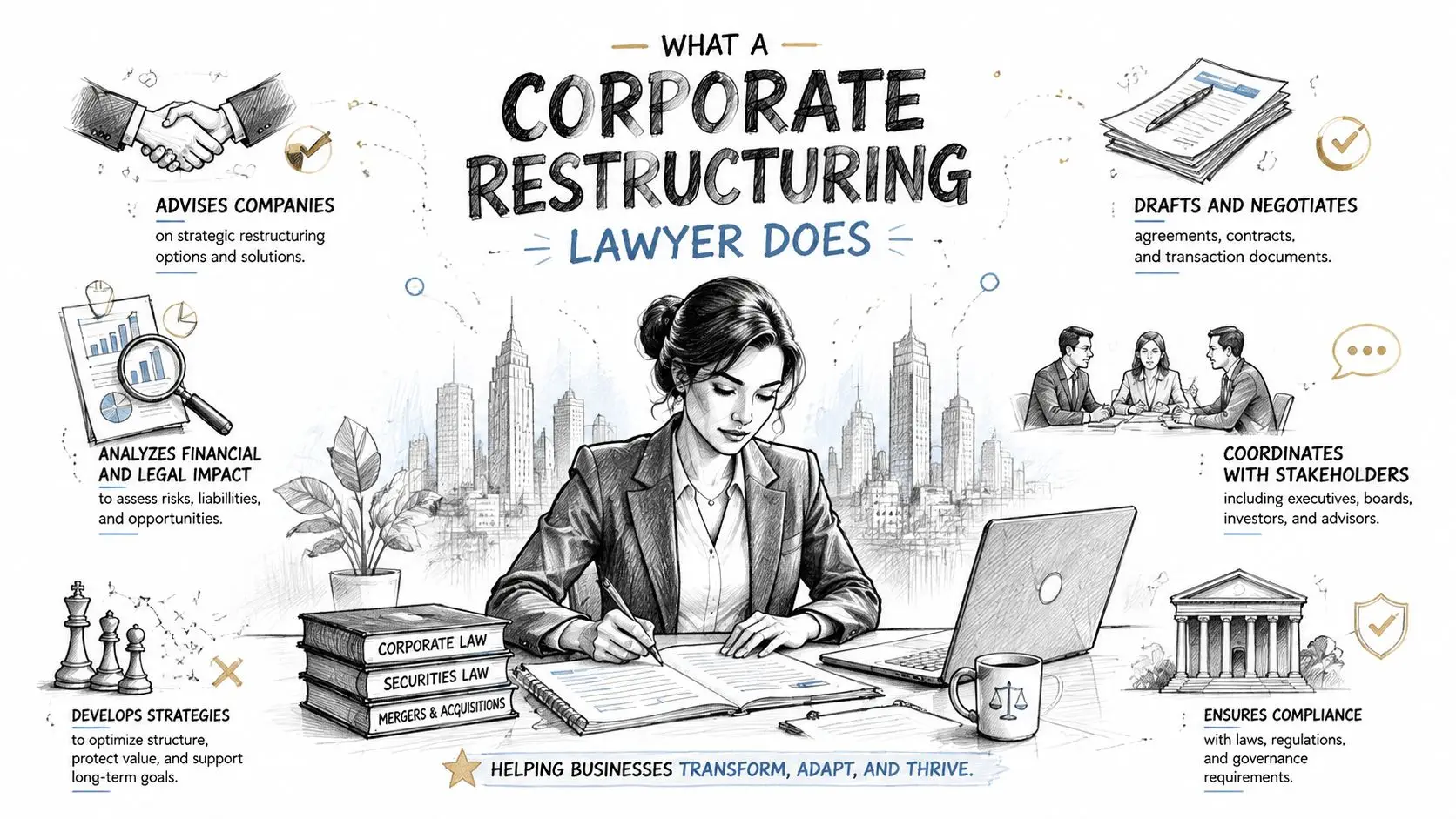
The core job is not courtroom theater. It is liability management, which means redesigning debt, preserving enterprise value, and structuring negotiations so the company can survive without immediate liquidation. Major firms explicitly combine restructuring, finance, tax, capital markets, and M&A capabilities for that reason (Paul Hastings restructuring practice).
The technical work behind the title
A restructuring lawyer maps who is owed what, how those claims rank, and which moves can be made without triggering avoidable litigation. That can include debt-for-equity resets, distressed debt transactions, recapitalizations, or negotiated payment standstills. The technical point is simple. A sequence that looks efficient on a spreadsheet can still fail if it accelerates debt, breaches covenants, or invites creditor claims.
This is why sequencing matters more than slogans. A well-structured liability management exercise can reduce the likelihood of a formal insolvency filing. A badly sequenced one can do the opposite, because creditors move faster when they smell unfairness or hidden preference.
Core functions of a Corporate Restructuring Lawyer
| Function | What It Involves |
|---|---|
| Liability management | Restructuring debt and adjusting the balance sheet |
| Creditor negotiation | Coordinating with lenders, bondholders, and other claimants |
| Capital structure design | Preserving value while reducing insolvency risk |
| Transaction support | Aligning restructuring with financing, tax, and M&A work |
| Process control | Choosing between out-of-court solutions and formal proceedings |
A senior practitioner also watches for strategic points outside pure finance. Contracts, ownership structure, employee issues, and transfer mechanics can all shape the result. That’s why the title looks narrow but the work is broad.
Signs You Need a Restructuring Lawyer
The biggest mistake is waiting for the bankruptcy filing to become the first legal discussion. The better trigger is earlier. If management is still deciding whether the company can stay out of formal proceedings, that is already restructuring territory.
A useful warning pattern appears when creditor pressure becomes repetitive rather than isolated. One demand letter can be noise. Repeated acceleration threats, covenant stress, or a chain of missed payments tells a different story. So does a business that still sells, but can’t fund its own working capital cleanly.
Early intervention usually buys more than it costs. It gives management time to test options before creditors harden their positions.
Cross-border operations add another layer. If a lender in one jurisdiction, a counterparty in another, and an asset holding structure somewhere else can all pull in different directions, the company needs legal coordination before the pressure becomes public. Chambers’ restructuring coverage also emphasizes early feasibility analysis, not just formal insolvency work (Chambers Associate).
A corporate restructuring lawyer is usually needed when the following show up together:
- Liquidity is tightening. Cash timing is getting more important than margin.
- Creditors are coordinating. Lenders or suppliers stop acting individually.
- Standstills become necessary. Management needs time to negotiate.
- The structure crosses borders. One legal fix won’t solve the whole problem.
- Going-concern value still exists. The company is stressed, not dead.
For owners who want a fast diagnostic, an AI-assisted intake tool can help organize facts before counsel steps in. A practical starting point is the AI legal assistant for business owners, especially when the immediate task is collecting documents, deadlines, and stakeholder names.
The Stepwise Restructuring Process
The process starts with diagnosis, not drama. Counsel needs a clear picture of cash, debt, secured positions, looming maturities, and operational liabilities before any negotiation begins. Without that map, management is guessing, and guessing is expensive.
Phase one, preparation
Preparation means identifying the company’s real pressure points. That includes creditor classes, financing documents, contract obligations, and the assets that support value. It also means deciding whether the business has enough going-concern value to justify a restructuring at all.
At this stage, the legal team should also assess how much influence management still has. If the company can still pay selectively, refinance parts of the stack, or slow enforcement through discussion, the strategy should keep those doors open. If not, the plan has to pivot quickly.
Phase two, negotiations
Negotiation is where the lawyer earns the fee. Lenders, bondholders, trade creditors, and sometimes regulators need a coordinated message, not a series of disconnected calls. The goal is to secure standstills, revised payment terms, or a debt-for-equity path that avoids value destruction.
The process is rarely linear. A creditor may resist today and reengage tomorrow if the numbers change. So counsel should build a phase-based escalation plan that can move from informal settlement to more formal steps without losing momentum.
Phase three, implementation
Implementation turns the deal into enforceable documents and operational change. That can mean amending finance papers, documenting transfers, adjusting corporate approvals, or preparing court filings if the deal requires one. The legal theory matters less than execution at this point.
A clean implementation plan should answer three questions. Who signs, when does the new structure take effect, and what happens if a party defaults again? If those points stay vague, the restructuring remains vulnerable.
How to Choose the Right Restructuring Lawyer
International clients should compare counsel on substance, not branding. The cheapest option often becomes the most expensive once jurisdictional problems, creditor pushback, or documentation errors appear. A general commercial lawyer can handle ordinary deals, but restructuring needs a different discipline.
Compare counsel on these points
| Criterion | Strong signal | Weak signal |
|---|---|---|
| Liability management experience | Has handled debt redesign and creditor negotiations | Talks generally about “corporate law” |
| Cross-border fluency | Understands multi-jurisdiction coordination | Focuses only on one local forum |
| Process judgment | Knows when to stay out of court | Pushes litigation too early |
| Documentation discipline | Anticipates transfer, consent, and ranking issues | Treats restructuring like a simple amendment |
| Commercial realism | Protects value and optionality | Treats every issue as a legal technicality |
The best candidate should explain how it would preserve value before discussing filings. That includes whether a standstill is possible, whether secured and unsecured claims need different treatment, and whether operations can stay intact while negotiations continue. If the answer is always “file first,” the lawyer may be too process-driven for a turnaround.
Another selection mistake is delay. When counsel enters too late, leverage shifts to creditors and counterparties. At that point, the legal work becomes more defensive, and the commercial solution gets narrower.
A good interview question is straightforward. What would the first 30 days look like if the company wanted to stay out of formal insolvency? The answer should be concrete, phased, and jurisdiction-aware.
Cross-Border and Crisis Management Considerations
Cross-border restructuring is never just a finance problem. It is a coordination problem across boards, lenders, bondholders, trustees, acquirors, and local counsel. Global firms describe restructurings as work that spans financial centers and different insolvency systems, because priority rules and negotiation timelines rarely line up neatly (Jones Day restructuring and reorganization).
Israel adds a further layer. The Insolvency and Economic Rehabilitation Law, 2018 introduced a formal rehabilitation track designed to preserve viable businesses while improving creditor recovery (ACC Israel overview). That means control and court supervision can interact in ways that surprise non-Israeli clients. A restructuring strategy has to account for both.
A good cross-border plan protects timing as much as it protects claims.
This is also where related crisis tools become useful. If a banking relationship is disrupted, a company may need parallel work on account restrictions, cash access, or urgent correspondence. In practice, restructuring and crisis management often move together, because one problem rarely appears alone.
For Israeli-connected businesses, the relevant legal response should stay coordinated across restructuring, debt pressure, and transactional control. That is also why some firms treat multilingual correspondence, bank restriction issues, and commercial crisis management as part of the same client path rather than separate silos.
RNC Group Approach to Restructuring Engagements
RNC Group approaches restructuring work as a controlled escalation problem. The file starts with a factual review of the client’s position, then moves into stakeholder mapping, then into a phased response that matches the actual pressure on the business. That approach fits clients who need an Israeli firm that understands cross-border commercial risk, not just local procedure.
A representative matter often begins with a company that still has revenue but faces competing demands from creditors, counterparties, and internal management. The first move is not always litigation. It is often a structured sequence of correspondence, standstill efforts, and documentation review that keeps the company from making a premature concession.
When the matter touches international business development, some clients also look for adjacent operational support. In that context, a useful reference point is career at Recepta.ai, because the client-facing discipline in commercial legal work often depends on rapid fact gathering, clear communication, and stakeholder follow-through.
RNC’s value proposition sits in its combination of international commercial law, crisis management, and multilingual execution. That matters when a restructuring issue overlaps with contracts, debt pressure, or cross-border enforcement. The objective is not spectacle. It is a resolution that preserves value, reduces recurrence, and keeps the business moving.
Conclusion and Next Steps
A corporate restructuring lawyer is not just a filing specialist. The right one helps management preserve options before the business loses them. The strongest strategy is usually early engagement, because formal insolvency is easier to enter than to control.
Non-Israeli clients should treat restructuring as a commercial risk discipline, not a last-minute rescue. The key questions are simple, but the answers are not. Can the company stay out of court, which creditors matter most, and how much value can still be preserved?
Avoid costly mistakes by contacting RNC Group for a confidential consultation through RNC Group. The firm handles restructuring-related commercial crises, cross-border coordination, and multilingual execution for businesses that need a clear legal path.
This article provides general information only and does not constitute legal advice. Any restructuring matter depends on its facts, governing law, timing, and documentation, so no reader should rely on this article alone for a specific decision.
RNC Group advises businesses on corporate restructuring, commercial crises, cross-border coordination, and creditor-sensitive strategy. When a company still has value but the capital structure has turned hostile, the right move is early, disciplined intervention. Visit RNC Group to review the firm’s commercial and restructuring services and start a confidential discussion.