
A foreign company rarely expects its Israeli legal crisis to begin with a blocked bank account. Yet that’s often how cross border legal issues become real in 2026. A payment fails, a bank freezes activity, suppliers panic, and an overseas dispute suddenly turns into an operating emergency.
Executives usually focus on market entry, tax, and distribution. They pay less attention to the legal wiring behind payments, data, jurisdiction, and enforcement. That gap is where international risk turns into immediate commercial damage.
Your Guide to Cross Border Legal Issues in 2026
Will your expansion plan survive if your Israeli bank account can’t send a payroll file or pay a foreign vendor on time? That question captures the essential nature of cross border legal issues. They don’t stay inside contract files. They move straight into operations, credit, reputation, and control.

A blocked transfer can trigger questions from banks, counterparties, and regulators in several countries at once. Moreover, one local compliance issue can expose weaknesses in contracts, document handling, and dispute planning. That’s why a finance problem often becomes a legal problem within hours.
International trade also depends on mechanics that many boards treat as routine. Payment routing, settlement timing, document language, and proof of source of funds all affect risk. For a practical commercial view, this guide to global payment strategies helps illustrate how payment design can support cross-border execution when legal friction rises.
Why the abstract becomes urgent
Most multinational disputes start before anyone says the word “dispute.” They start with late performance, mismatched invoices, rejected compliance documents, or data that can’t move where counsel needs it. Consequently, the business loses room to negotiate from strength.
Three failures appear again and again:
- Unclear operational authority: Local staff can’t explain who controls funds, approvals, or document release.
- Weak legal architecture: The contract says what the parties want, but not how they’ll solve a failure.
- False confidence in enforceability: Management assumes a judgment or bank decision will travel cleanly across borders.
Practical rule: If cash movement stops, legal planning has already arrived late.
What control looks like
A strong response starts with mapping exposure in business terms. Which payment failed. Which counterparty can terminate. Which regulator might ask questions. Which assets sit in a country that won’t easily recognize a foreign order.
That approach changes the conversation. Instead of asking whether an issue is “legal” or “commercial,” management asks which step restores advantage fastest, while preserving evidence and avoiding a second breach.
The Anatomy of an International Legal Crisis
Every serious international dispute rests on three structural elements. Contract sets the rules. Jurisdiction decides who interprets them. Enforcement determines whether the result has any practical value.
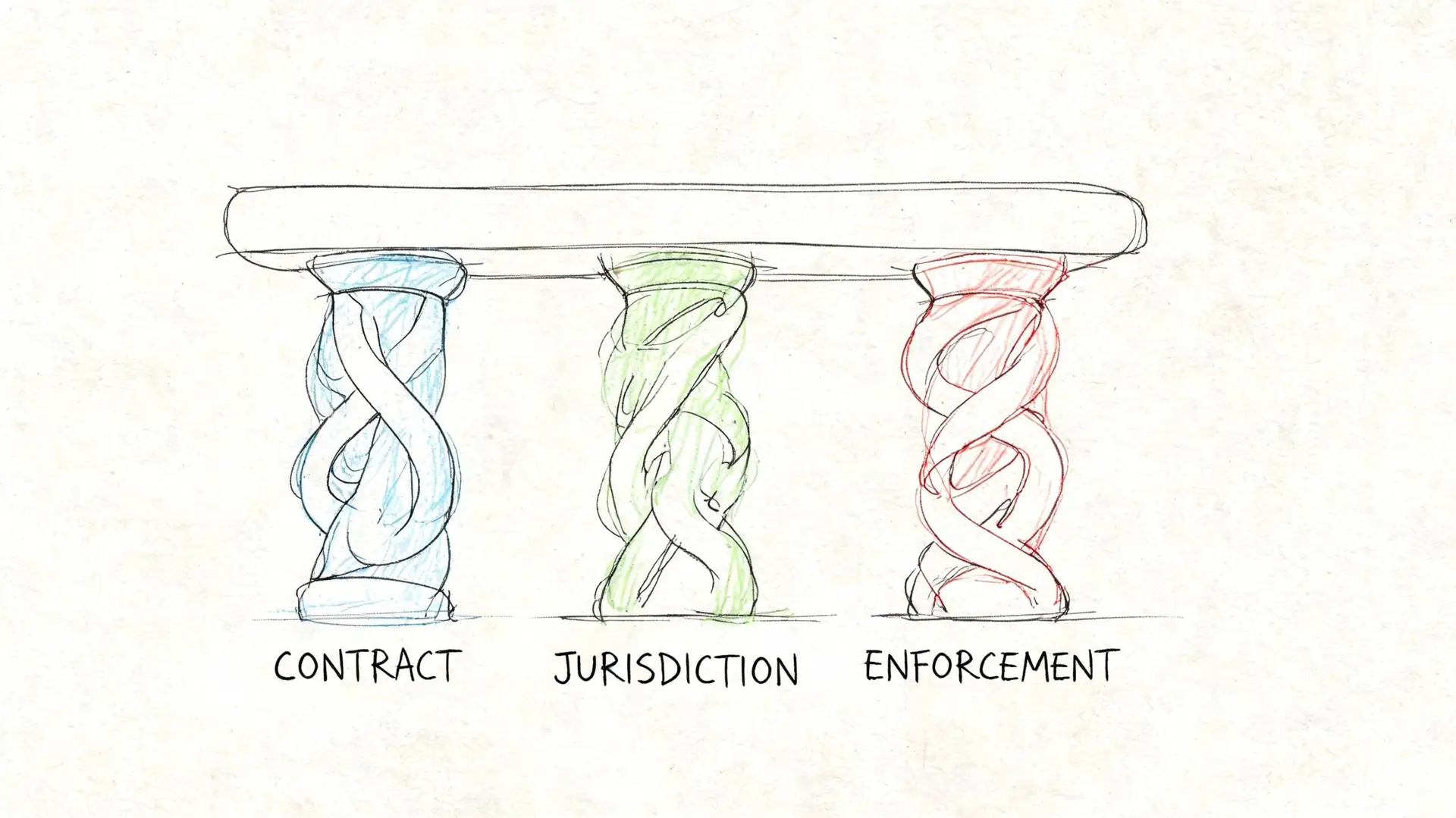
Leaders often overinvest in the first pillar and underinvest in the other two. However, a well-drafted contract won’t rescue a company that chose the wrong forum or chased assets in the wrong country. International legal strategy fails when these pillars don’t align.
Contract defines the operating logic
The contract should answer more than price and delivery. It should define notice methods, evidence standards, interim relief, intellectual property ownership, language priority, and what happens if data, funds, or goods become trapped in one jurisdiction.
A weak contract creates ambiguity at the exact moment a company needs precision. For example, a vague payment clause can turn a temporary transfer delay into an alleged repudiation. A loose confidentiality clause can also conflict with disclosure obligations during a foreign investigation.
Jurisdiction shapes leverage
Jurisdiction decides where the fight begins, but it also influences bargaining power before formal proceedings start. A counterparty behaves differently when it knows the dispute will land in a forum with unfamiliar procedures, slower interim relief, or costly local steps.
A 2016 Thomson Reuters survey found that 55% of legal professionals viewed litigation risks as the primary concern when selecting governing law, ahead of predictability at 52% and judicial independence at 50%. That finding shows how strongly practitioners connect forum choice with commercial danger in cross-border deals (Thomson Reuters survey).
A hostile forum can punish the better legal position and reward the better local advantage.
Enforcement decides whether the win matters
Enforcement is the least glamorous pillar. It’s also the one that decides whether a victory produces money, documents, injunctions, or nothing at all. Many executives still assume that a favorable judgment ends the problem. It doesn’t.
Here is the practical sequence that counsel should test before signing any major deal:
- Asset location: Where are the bank accounts, receivables, inventory, or shares.
- Forum realism: Will the chosen court or tribunal move fast enough for the business risk.
- Evidence mobility: Can documents lawfully move to counsel or the tribunal.
- Remedy portability: Will the result travel to the place where recovery must happen.
| Pillar | Wrong assumption | Commercial consequence |
|---|---|---|
| Contract | Good drafting alone solves disputes | Ambiguity appears at the worst moment |
| Jurisdiction | Any major forum is acceptable | Procedure becomes leverage against you |
| Enforcement | A judgment automatically gets results abroad | You win on paper and lose in practice |
When these pillars align, a company can absorb friction without losing control. When one fails, the other two usually weaken with it.
Strategic Analysis Israeli Bank Account Restrictions
For a foreign company, an Israeli bank account restriction is never just a banking issue. It’s a live cross-border crisis that can freeze payroll, interrupt supplier chains, trigger covenant concerns, and damage credibility with overseas counterparties. The legal response must start immediately because delay changes how banks, creditors, and partners interpret the event.
The operational danger is simple. Once a bank treats account activity as problematic, routine transactions begin to look suspicious rather than delayed. That shift affects not only liquidity, but also the company’s narrative in any parallel dispute abroad.
Why the restriction spreads beyond Israel
A restricted account in Israel quickly creates secondary risk outside Israel. A parent company may miss obligations under foreign contracts. A distributor may claim material breach. An investor may ask whether the company still controls its payment infrastructure.
That’s why the first task is not only to challenge the restriction. The company must also contain the interpretation of the restriction.
A useful starting point is the legal framework around returned checks and account limitations in Israel. Businesses dealing with this issue often need immediate analysis of local banking conduct, procedural options, and commercial continuity planning. In that context, this overview of bank account restrictions in Israel due to insufficient funds provides a relevant legal reference point.
The real strategic path
The recommended path usually runs on parallel tracks, not in sequence.
- Challenge the bank’s action: Review the bank’s notices, account history, communications, and internal reasons for the restriction. The legal issue often turns on reasonableness, procedure, and whether the bank ignored corrective information.
- Stabilize counterparties: Suppliers, landlords, and service providers need a controlled explanation, not silence. Otherwise, they may escalate on assumptions that are worse than the facts.
- Protect evidence: Preserve account records, payment instructions, correspondence, and internal approvals. Those materials may become essential in court, arbitration, or negotiations with lenders.
- Create a temporary payment path: The business must keep operating lawfully while the restriction is challenged.
The company that explains the problem first usually controls the commercial narrative.
Where international enforcement changes the advice
Cross-border clients often ask whether they should sue first and sort out collection later. In many cases, that’s the wrong sequence. If the ultimate goal is recovery against foreign assets, enforcement planning should shape the initial strategy.
For Israeli firms, a more effective route is often to prioritize arbitration under the New York Convention rather than rely on Israeli court judgments for international disputes. Enforcement success rises from under 35% for court judgments to 85% for arbitration awards across 170+ states, which directly affects collection strategy against assets in civil law jurisdictions (cross-border enforcement analysis).
That doesn’t mean litigation has no place. It means the company should assess where assets sit, which emergency measures are available, and whether an Israeli court win would travel. In a bank restriction crisis, local relief may still be urgent, but the longer-term dispute plan should reflect where collection can occur.
What works and what usually fails
What works is fast factual reconstruction, disciplined external messaging, and a remedy plan that the bank or court can understand. Judges and banks respond better when the company shows a coherent correction path rather than abstract assurances.
What fails is denial, fragmented communication, and aggressive threats before the record is organized. A foreign company that treats the matter as a mere clerical issue often loses precious time. By the time it reacts properly, suppliers may have changed terms and foreign counterparties may have prepared claims.
Navigating Global Regulatory and Compliance Traps
Cross border legal issues rarely stop at the contract. Governments control data, sanctions, anti-money laundering review, tax exposure, customs, and intellectual property registration. A company can negotiate with a counterparty, but it can’t negotiate away sovereign rules.
The practical error is assuming that one compliance system travels everywhere. It doesn’t. A policy that satisfies one regulator may create exposure in another country.
Data and transfer limits
Data movement now affects investigations, due diligence, litigation, and routine service delivery. A Statista survey found that 68% of multinational organizations identified China as the most challenging jurisdiction for cross-border data issues, followed by Russia at 52% and India at 45%, due to localization and transfer restrictions that complicate M&A, litigation, and commercial agreements (Statista data on cross-border data issues).
That finding matters because executives often treat data as portable by default. In reality, legal access and technical access are not the same thing. A company may own the data yet still face limits on where review happens, who can see it, and whether it can be exported.
Banking friction and AML signals
Banking systems often detect regulatory risk before management does. Unusual payment paths, incomplete beneficial ownership records, or inconsistent invoice support can trigger delays or restrictions. In practice, compliance teams don’t ask whether the company meant well. They ask whether the transaction file is complete and defensible.
Payment design also matters here. Companies exploring ways to simplify global payments should remember that payment structure can reduce administrative friction, but it doesn’t replace legal review of licensing, tax, sanctions, or banking obligations.
Three compliance traps that hit fast
| Area | Typical mistake | Real consequence |
|---|---|---|
| Intellectual property | Assuming home-country rights protect foreign use | Brand or content disputes in target markets |
| Tax and presence | Entering a market before testing local footprint risk | Unplanned registrations, audits, or disputes |
| Sanctions and AML | Treating payment clearance as a banking formality | Blocked funds, delayed onboarding, or account scrutiny |
Compliance problems don’t stay in the compliance team. They usually surface first in sales, payments, or customer delivery.
A practical operating model
Companies entering several markets need a country-by-country control matrix. That matrix should cover contracting entity, invoice flow, data storage, local signatory authority, IP ownership, and escalation contacts. It should also identify which issue requires local counsel and which one can be handled centrally.
A purpose-built framework beats generic policy language. The companies that avoid disruption are the ones that tie legal review to actual business movement, not annual checklists.
Proactive Risk Management Through Contract Clauses
The contract is the most efficient tool for managing cross border legal issues because it acts before the dispute starts. It allocates risk, defines procedure, and narrows uncertainty when the relationship is under pressure. If leadership wants more control, it should start with clause design, not courtroom strategy.
Too many international contracts still read like local templates with foreign names inserted. That approach creates silent gaps around notice, language, data handling, interim relief, and ownership of work product.
Governing law and forum selection
Choice of law is not cosmetic. It shapes how a tribunal or court reads performance, breach, mitigation, and available remedies. That’s why the governing law clause should match the business model, the evidence profile, and the likely enforcement path.
The earlier Thomson Reuters survey captured this point clearly. 55% of legal professionals said litigation risk was the primary concern in selecting governing law for cross-border transactions, ahead of predictability and judicial independence, which shows how strongly practitioners associate drafting choices with downstream exposure.
Clauses that earn their keep
The most useful clauses are the ones that operate under stress.
- Dispute resolution clause: State whether disputes go to court or arbitration, and specify seat, rules, language, and interim relief options.
- Notice clause: Define valid notice methods, recipient roles, and effective dates. Many avoidable defaults begin with bad notice.
- Payment disruption clause: Address what happens if a transfer is blocked, delayed, or challenged by a bank.
- Data access and residency clause: Set rules for cross-border review, storage, and controlled access.
- IP ownership clause: Clarify ownership of developments, localized materials, translations, and derivative works.
- Force majeure and regulatory change clause: Cover legal impossibility, export barriers, sanctions shifts, and mandated service changes.
Draft for failure, not for optimism
Good contracts don’t assume goodwill will carry the relationship. They assume timing will fail, people will change roles, systems will conflict, and facts will be disputed. Therefore, each major clause should answer one practical question: who decides, using what law, based on what record, and where can the result be enforced.
One useful comparison appears in Israeli commercial practice. Detailed transactional drafting in areas like commercial agreements and business contracts shows how experienced counsel structure clauses to reduce later ambiguity rather than merely record commercial intent.
The strongest international contract is not the longest one. It’s the one that leaves the fewest procedural surprises.
What CEOs should insist on before signing
Ask counsel for a short risk memo with every major draft. It should identify the governing law, the dispute forum, likely interim remedies, evidence restrictions, and the probable enforcement route. If that memo is missing, the business is signing faster than it understands.
A Phased Escalation Plan for Dispute Resolution
When a cross-border dispute breaks open, disorder is expensive. A company needs a phased escalation plan that maintains its advantage, protects evidence, and avoids unnecessary commitments. The point isn’t to look aggressive. The point is to stay in control.
The core mistake is jumping straight to court threats. That can harden positions before the facts are assembled, and it may push the dispute into a forum that helps the other side.
The escalation model
A useful framework is to move from containment to pressure to formal proceedings. Each phase should have a defined commercial objective, not just a legal task list.
| Phase | Objective | Key Actions |
|---|---|---|
| Internal assessment | Stop further damage | Secure documents, map assets, preserve payment records, identify decision makers |
| Formal pre-dispute pressure | Clarify position and create leverage | Send legal correspondence, demand records, test settlement channels, consider mediation |
| Interim protection | Prevent asset or evidence loss | Seek urgent relief where available, coordinate local counsel, freeze harmful actions where lawful |
| Formal proceedings | Obtain binding outcome | Start arbitration or litigation only after forum and enforcement route are tested |
Why phased escalation works
This model gives management options. It allows a company to negotiate from documented strength while staying ready for a hard filing if needed. It also reduces the risk of inconsistent messaging across jurisdictions.
A practical illustration appears in pre-litigation strategy and pressure tactics used in legal correspondence and demand letters. Used correctly, formal correspondence can flush out positions, preserve claims, and frame the dispute before a tribunal ever sees it.
Enforcement has to shape the plan
A judgment from one country may become a dead document somewhere else. Obtaining a court judgment in one country does not guarantee enforcement elsewhere, creating what practitioners call judgment orphans. A stronger route often uses arbitration clauses enforceable under the New York Convention in over 170 countries, or relies on MLATs where they fit the dispute structure (judgment portability and MLAT framework).
That principle matters long before the hearing. If the likely defendant keeps assets abroad, the company should build the case around the remedy that can travel, not the forum that feels familiar.
Start by asking where recovery can happen. Then decide where the fight should begin.
Evidence and digital assets
Modern disputes also involve image files, product visuals, and online materials that can disappear or be altered. When ownership or infringement becomes part of the conflict, businesses sometimes use tools for early image copyright verification as part of evidence preservation. That won’t replace legal analysis, but it can support a cleaner factual record at the start of the matter.
A phased approach works because it turns panic into sequence. Sequence creates an advantage.
Engaging International Counsel Effectively
The best time to engage international counsel is before the company has to explain a crisis to its bank, board, or distributor. Effective counsel should enter during market entry, contract negotiation, payment design, or early signs of counterpart distress. At that stage, legal work can still shape the outcome instead of merely documenting the damage.
For non-Israeli clients dealing with Israeli exposure, counsel should offer more than local filing capacity. They should coordinate multilingual records, align banking and litigation strategy, and work with reliable foreign lawyers where assets, data, or counterparties sit. The publisher, RNC Group, states that it works through the ADVOC network with contacts in 73 countries, which is relevant when a dispute needs both Israeli handling and local execution abroad.
The right firm also knows when not to litigate first. It should test jurisdiction, evidence access, bank sensitivity, and enforcement viability before recommending a public move. That kind of judgment usually saves more than it costs.
Avoid costly mistakes and contact our firm now to assess the legal structure behind your international operations before the next blocked payment or foreign dispute forces the issue.
This article provides general information only and does not constitute legal advice. It does not replace legal counsel adapted for specific facts, jurisdictions, contracts, or regulatory exposures. Reading this article does not create an attorney-client relationship, and any action should follow individualized professional advice.