
An Israeli acquirer can sign a European deal on Monday and discover by Friday that several regulators, ministries, shareholders, and employee representatives now control the timetable. Cross border merger regulations no longer operate as a single approval exercise. They create a parallel-track problem involving competition, foreign investment, company law, tax, employment, securities, sector approvals, and crisis exposure.
That structure changes the legal strategy. The recommended path isn’t a sequential checklist. It is a sequencing model with dependencies, where counsel identifies which filings can proceed together, which approvals depend on another authority, and which closing actions could create standstill or gun-jumping risk.
The Cross Border Deal That Almost Closed on Time
On Monday morning, an Israeli acquirer in Tel Aviv signs a memorandum of understanding for a European technology target. The commercial team celebrates a clean strategic fit, and the parties circulate an 14-week closing timetable.
By Wednesday, questions from the German Bundeskartellamt arrive in the inbox. By Friday, the European Commission requests a Form CO pre-notification meeting. That same afternoon, Italy’s golden-power unit opens a precautionary inquiry into the target’s infrastructure contracts.
The outside counsel sees the problem immediately. Three regulatory tracks have activated, but the timetable treats them as separate tasks. The competition authorities need market information. The investment-screening authority needs ownership, technology, and national-security details. Meanwhile, the target still needs to satisfy domestic company-law formalities before the merger can become legally effective.
The parties haven’t necessarily made a legal mistake yet. However, their timetable has already become unreliable.
One transaction, several control points
The European framework permits qualifying cross-border mergers between limited-liability companies, subject to specific entity and procedural requirements. The European Parliament study on cross-border mergers recorded 1,227 cross-border mergers in the EU and EEA between 2008 and 2012, with annual activity rising from 132 in 2008 to 361 in 2012.
That history demonstrates the value of a harmonized channel. It also shows why teams must identify the framework’s limits. The rules don’t cover every company form equally, while cross-border divisions and transfers of seat remain more limited.
Practical rule: Build the timetable around dependencies, not optimism.
A missed dependency can delay signing, postpone closing, force a remedy negotiation, or create a gun-jumping investigation. The correct model runs antitrust and foreign-investment analysis together, while company-law, tax, securities, and employment workstreams produce the documents needed for a legally effective closing.
For Israeli buyers, the risk increases when the target handles dual-use technology, sensitive data, energy assets, communications infrastructure, or government-linked contracts. Foreign multinationals with Israeli subsidiaries face similar issues when the Israeli business supplies technology, intellectual property, or regulated services into the transaction perimeter.
Six Legal Tracks Every Cross Border Merger Must Run in Parallel
A cross-border merger needs six legal tracks from the earliest diligence stage. Each track has a different trigger, decision-maker, document set, and closing consequence.
Competition control
Track one covers merger control. The EU EUMR, United States HSR Act, and Israel’s Economic Competition Law can each require advance review. OECD guidance treats a merger as cross-border when firms operate across jurisdictions or when the transaction affects markets in more than one jurisdiction.
By 2024, every OECD jurisdiction except Luxembourg had a merger-control regime, according to the OECD discussion of cross-border merger review. That near-universal coverage means foreign participation doesn’t remove filing risk. Instead, it often multiplies the number of possible filings.
Foreign investment and national security
Track two addresses foreign investment. The EU FDI framework, CFIUS in the United States, the UK NSI Act, Israel’s foreign-investment review process, and Italy’s golden-power rules examine control, sensitive assets, state influence, and strategic dependence.
A transaction can receive competition clearance and still face investment conditions or prohibition. Therefore, counsel should map beneficial ownership, financing sources, government customers, sensitive technologies, and board rights before signing.
Securities and disclosure
Track three concerns securities law. Share consideration may trigger prospectus, tender-offer, disclosure, or listing obligations. A listed target also creates restrictions around inside information, announcement timing, market disclosure, and communications with shareholders.
The deal team should decide early who controls public statements. A leaked filing, inconsistent announcement, or premature disclosure can create separate exposure even when the merger itself remains viable.
Tax structuring
Track four covers tax. Counsel must test the proposed structure against withholding, transfer pricing, cross-border reorganizations, exit taxes, and the OECD’s BEPS Pillar Two framework. Tax choices also affect purchase-price allocation, financing, intellectual-property ownership, and the location of post-closing functions.
A structure that works for competition law may produce unacceptable tax leakage. Conversely, a tax-efficient structure may increase foreign-investment sensitivity if it obscures ownership or control.
Employment and labor
Track five focuses on employees. UK TUPE rules, EU Works Council consultation, Israeli Section 14 severance arrangements, and domestic information-consultation duties can affect signing, announcement, and closing.
Employee consultation often depends on transaction certainty and local law. Therefore, management shouldn’t promise integration dates before counsel confirms the consultation sequence.
Sector approvals and notifications
Track six captures specialized regimes. Telecom, financial services, data protection, energy, defense, healthcare, essential facilities, and intellectual property rules may impose consent or notification requirements.
These approvals often sit outside the central merger-control analysis. They still control the practical closing date.
The filing map should identify the trigger, authority, standstill rule, document, owner, dependency, and fallback plan for every track.
RNC Group’s international commercial practice addresses transactions alongside related contractual, regulatory, and crisis-management issues. That integrated approach matters when an Israeli transaction involves foreign counsel, multilingual notices, sensitive negotiations, and possible escalation.
Comparing Jurisdictional Regimes for Cross Border Mergers
A transaction can clear Israeli merger control and still miss its closing date because an EU subsidy filing, a UK investment review, an Indian ownership restriction, or a sector consent was assessed too late. No jurisdictional test captures the whole burden. Each authority examines a different issue, including control, market effects, national interest, foreign influence, or transaction value.
The comparison below is a first working map, not a substitute for local advice. Israeli clients and foreign multinationals with Israeli exposure should test the target’s ownership, assets, customers, data, government relationships, and regulated activities before fixing the signing and closing sequence.
Cross Border Merger Filing Regimes Compared
| Jurisdiction | Primary Trigger | Filing Threshold | Phase I / Phase II Timeline | Typical Deal-Killer |
|---|---|---|---|---|
| Israel | Merger control under the Economic Competition Law | Applicable Israeli merger thresholds and control tests | Review depends on the filing route and complexity | Concentration concerns, sensitive infrastructure, or incomplete information |
| EU | EUMR turnover jurisdiction, with possible FDI and subsidy review | EU turnover tests. Large transactions may meet the EUR 5 billion combined worldwide turnover and EUR 250 million turnover for at least two parties thresholds, subject to the two-thirds EU-revenue carve-out, as described in the OECD merger-control material | Phase I and possible Phase II review, plus parallel national processes | Horizontal overlap, strategic assets, subsidies, or national-security concerns |
| United States | HSR Size-of-Transaction and Size-of-Person tests | Applicable HSR thresholds and filing categories | Initial waiting period and possible extended investigation | Market concentration, vertical foreclosure, or national-security concerns |
| United Kingdom | Enterprise Act merger review and NSI Act screening | Enterprise Act jurisdiction, plus mandatory or voluntary NSI triggers | CMA review and separate investment-security process | Sensitive assets, strategic control, or unresolved competition concerns |
| India | Competition Act Section 5 and Section 6, plus foreign-investment controls | Applicable combination thresholds, sector caps, and Press Note 2020 restrictions | Competition and foreign-investment processes can run together | Sectoral ownership limits, approval ambiguity, or national-security sensitivity |
| China | SAMR merger review, with national-security and other state processes | Applicable Chinese filing and control tests | Review depends on market complexity and government processes | Data, technology, state influence, or strategic-sector concerns |
The EU route also carries a company-law layer. Under Directive 2005/56/EC, the cross-border merger procedure applies to limited-liability companies formed under Member State law, with at least two merging entities governed by different Member States’ laws.
The merging company must follow the formalities of its home Member State. Common draft merger terms must be published at least one month before the shareholder meeting. The receiving company’s governing law determines when the merger becomes legally effective. Those steps can run beside competition and investment reviews, so the corporate-law timetable belongs on the same closing plan.
What the comparison means for Israeli clients
An Israeli acquirer should test more than European revenue. Control rights, vetoes, local assets, customer markets, personal data, government contracts, and the target’s legal form can each create a filing or consent issue. Foreign multinationals should perform the same analysis for Israeli subsidiaries and business lines, even where the acquired company is incorporated elsewhere.
India shows why procedural updates require a separate workstream. An amendment effective 5 June 2026 replaced the specific reference to “NCLT” with “Competent Authority,” aligning the FEMA framework with the Companies Act and potentially reducing ambiguity for certain fast-track cross-border mergers, as discussed in India’s updated cross-border merger approval pathway.
The sequencing trade-off is practical. A centralized issue list gives the deal team an early view of dependencies, while local counsel must validate each trigger and document. A global template may save drafting time but still miss ownership limits, sector consents, employee steps, or domestic formalities. The filing map should therefore assign an owner, dependency, standstill consequence, and fallback for every jurisdictional track.
Procedural Timelines and Filing Triggers in 2026
A deal can satisfy its commercial conditions and still miss closing because one approval, standstill period, or corporate-law step was sequenced incorrectly. Build the timetable from trigger events rather than promised calendar dates. Mark signing, public announcement, each filing, clearance, shareholder approval, legal effectiveness, and closing as separate milestones, then identify which tracks can run together and which cannot.
Filing clocks and artifacts
The EU process usually requires two related workstreams. Company-law approval may require advance publication and domestic formalities. Competition law may require European Commission notification before closing once the applicable turnover thresholds are met. The filing plan should also record translations, supporting schedules, and expected information requests, not only the submission date.
The European Commission’s merger caseload has varied over time, with a high point followed by a more stable annual level, according to the OECD material cited earlier. That history supports early notification planning, but it cannot predict the duration of a particular transaction. Market definition, document production, remedies, and national-law steps can alter the timetable.
The Foreign Subsidies Regulation adds another possible filing and standstill. Qualifying concentrations have been subject to mandatory notification under the EU regime since October 2023, where the applicable conditions are met. Counsel should prepare competition and subsidy information in parallel, because the same ownership, financing, and transaction documents may be relevant to both reviews.
2026 Filing Triggers and Procedural Timelines by Jurisdiction
| Jurisdiction | Trigger | Phase I Clock | Standstill | Filing Form |
|---|---|---|---|---|
| EU merger control | EU turnover jurisdiction | European Commission Phase I process, subject to extensions and possible Phase II | Closing generally waits for clearance | Form CO or short-form CO |
| EU foreign subsidies | Qualifying concentration and applicable third-country financial-contribution analysis | Commission review under the FSR process | Mandatory standstill applies where notification is required | FSR concentration notification |
| Israel | Israeli merger-control jurisdiction | Applicable statutory review process | Parties must respect the applicable pre-clearance restriction | Israeli merger notification |
| United States | HSR filing trigger | Initial waiting period under the HSR process | Closing waits during the applicable waiting period | HSR filing |
| United Kingdom | NSI mandatory-notification trigger or voluntary filing | Investment-security review process | Closing restrictions apply where the regime requires approval | NSI notification |
| India | Combination and foreign-investment trigger | Competition and investment reviews may overlap | Route-specific restrictions apply | Competition and foreign-investment submissions |
Pre-notification meetings can improve completeness by clarifying market definitions, forms, translations, and likely questions. They do not shorten statutory review periods or bind an authority to accept the parties’ analysis. Israeli parties should also check whether a foreign filing interacts with Israeli merger-control, investment, securities, or sector-consent requirements.
The closing-control principle
A filing strategy must test the EU turnover thresholds and the two-thirds EU-revenue carve-out carefully. An incorrect conclusion can create a standstill breach and delay the transaction. The same discipline applies to Israeli targets, Israeli subsidiaries, and business lines serving regulated or government-linked customers.
Counsel should define prohibited pre-clearance conduct before signing. Early integration, operational control, exchange of competitively sensitive information, or closing before clearance can create gun-jumping exposure. The SPA should therefore allocate filing responsibility, cooperation duties, information controls, remedy limits, and long-stop consequences across the parallel tracks.
A Phased Compliance and Action Plan for Cross Border Mergers
The strongest teams run legal compliance beside commercial diligence. They don’t wait for the business case to finish before testing regulatory feasibility.

Phase one before signing
Counsel should prepare a jurisdictional filing memo, competition overlap analysis, FDI risk map, sanctions and state-ownership review, and data-room index. Israeli groups should also test Innovation Authority restrictions, Class A shareholder vote requirements, and Ministry of Finance sectoral consents.
The transaction team should identify the people who can approve data sharing, public messaging, and clean-team access. That governance decision prevents business teams from making regulatory commitments informally.
Phase two from signing to first filing
The team should draft the Form CO, FSR materials, ISC pre-notification pack, tax structuring memo, and employment transfer schedule. The SPA should allocate filing responsibility, cooperation duties, remedy limits, long-stop consequences, and information-control rules.
Tax counsel should assess whether the chosen structure requires a ruling or creates withholding exposure. Employment counsel should establish the consultation sequence before management announces integration plans.
Phase three during review
A review-phase response matrix should assign every regulator question to a named owner. The matrix should track source documents, translations, privilege, consistency across jurisdictions, and response deadlines.
The team should also decide when a pull-and-refile strategy makes sense. That option can improve completeness, but it may reset the timetable and increase public or financing pressure.
Phase four for remedies
Potential remedies should receive early commercial testing. Divestiture packages, behavioral commitments, access undertakings, governance restrictions, and mitigation agreements can affect valuation and integration.
The buyer should model remedy authority carefully. An unlimited remedy obligation may transfer excessive regulatory risk to the buyer, while an inflexible cap may make clearance impossible.
Phase five at closing and afterward
Before closing, the team should confirm every clearance, consent, shareholder action, employee process, and legal-effectiveness requirement. The integration steering committee charter should then control post-closing conduct.
That charter should address remedy compliance, foreign-subsidy reporting, FDI conditions, intellectual-property governance, data access, employment integration, and post-closing notifications. A regulatory file should remain live throughout integration.
A closing certificate should confirm regulatory completion, not merely document commercial readiness.
Why Merger Control and Foreign Investment Review No Longer Separate
Antitrust and foreign-investment review ask different legal questions, but deal teams must manage them as one composite gate. A competition authority may approve a transaction while an investment authority restricts ownership, technology access, governance, or supply arrangements.
The EU’s Foreign Subsidies Regulation has made that overlap more visible. Qualifying concentrations may require mandatory notification and standstill under the FSR, while the European Commission also assesses competition effects. The analysis of EU merger control and foreign-subsidy screening notes that the Commission published draft revised Merger Guidelines on 30 April 2026, emphasizing innovation, dynamic competition, and strategic resilience.
That combination changes remedy negotiations. Parties can’t design a competition remedy without considering whether the same divestiture, access right, or governance restriction creates an investment-screening concern.
The Israeli overlay
Israeli transactions often involve innovation, defense-adjacent technology, agricultural systems, cybersecurity, medical devices, or infrastructure. Those assets can attract scrutiny beyond ordinary market-power analysis.
Foreign multinationals with Israeli exposure should therefore map the investor’s ownership chain and state relationships before presenting the transaction as a routine acquisition. Counsel should brief management on political-economy risk, not only legal probability.
Sequencing both reviews
The recommended strategy starts both analyses during pre-signing diligence. It then aligns factual submissions, management messaging, remedy assumptions, and closing conditions.
The trade-off requires discipline. Early disclosure can accelerate regulatory dialogue, but it also exposes sensitive information and may reveal weaknesses before the commercial team has secured the deal. Clean teams, controlled data rooms, and consistent factual narratives provide the necessary balance.
Crisis Management and Common Pitfalls in Cross Border Mergers
A missed standstill obligation can convert a successful acquisition into an enforcement problem. The following scenarios show how quickly a procedural error can affect financing, public confidence, and integration.
The premature closing
The buyer wires the purchase price before receiving every required clearance. Management treats the remaining approval as administrative, but the authority treats closing as prohibited conduct.
The containment plan should preserve economic separation, document the parties’ continuity arrangements, and activate specialist enforcement counsel immediately. The SPA should also address legally permissible economic continuity under applicable standstill rules, rather than allowing operational integration by default.
The leaked filing
A draft Form CO reaches the market before the parties approve public messaging. Target shares move sharply, journalists request confirmation, and employees hear about the transaction through social media.
The team should activate a pre-clearance communications protocol, identify one spokesperson, and prepare an emergency public statement. Parties should also review whether information exchanges or management contact created separate gun-jumping concerns.
The employee-data incident
During integration, an Israeli buyer migrates a German target’s HR records into a shared system. The migration exposes employee information and triggers a data-protection investigation.
The recommended response includes isolating the system, preserving evidence, notifying the relevant privacy team, and suspending unnecessary integration. A cyber-incident tabletop exercise should occur before signing, not after a breach.
For broader guidance on how to handle a legal crisis, deal teams should focus on containment, decision rights, evidence preservation, and controlled communications.
Crisis planning works only when the response owner, approval route, and first communication already exist.
Closing the Deal and Preparing for What Comes Next
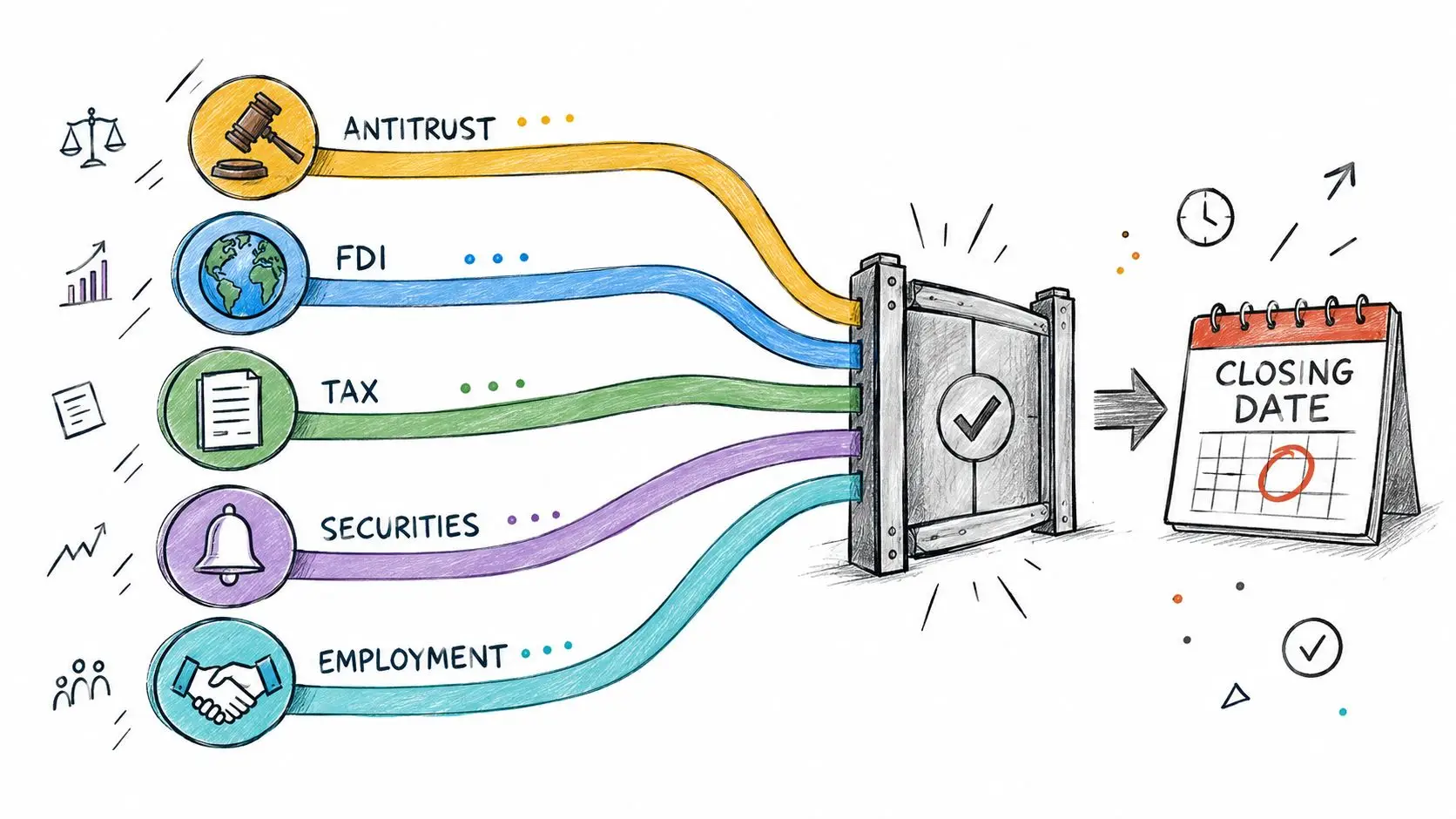
A practical one-page model assigns each track a place on the timeline:
- Antitrust first: Confirm jurisdiction, prepare filings, and protect the standstill.
- FDI in parallel: Test ownership, strategic assets, and mitigation conditions.
- Tax at signing: Lock the structure, allocation, withholding analysis, and ruling strategy.
- Securities near closing: Coordinate announcements, shareholder materials, and listing duties.
- Employment on effectiveness: Complete consultation and transfer obligations before integration.
- Notifications at every milestone: Re-check triggers after signing, restructuring, clearance, and closing.
Post-closing duties can include remedy compliance, foreign-subsidy reporting, FDI governance conditions, and intellectual-property controls. Regulator cooperation and information sharing also make consistent submissions increasingly important. The regulatory file should remain a living record, not a one-time closing binder.
RNC Group advises Israeli companies and foreign multinationals on cross-border M&A, coordinated regulatory filings, transaction agreements, and high-stakes commercial crises. Contact the firm through RNC Group before signing, so counsel can map dependencies, protect the timetable, and reduce avoidable closing risk.
This article provides general information only and doesn’t constitute legal, tax, regulatory, or investment advice. Cross-border merger rules change by jurisdiction and transaction facts, so readers should obtain advice from qualified counsel before relying on any statement or taking action.