
The biggest legal risk in cross border deals in 2026 is often not the choice of law clause. It is whether money, data, and compliance checks can move through the chain at all. The Bank of England notes that cross-border payments can take several days and, in some cases, cost up to 10 times more than equivalent domestic payments, while the Financial Stability Board says only 35% of global cross-border retail payments and 55% of wholesale and remittance payments are credited within one hour of initiation, against a 75% target. Bank of England cross-border payments overview
For Israeli companies, U.S. distributors, European resellers, and multinationals touching Israel, that reality changes drafting discipline. A contract can look clean on paper and still fail when banking chains, sanctions screening, data-transfer limits, or local licensing rules block execution. Good legal work now has to map the deal, the rails, and the records together.
Why Cross Border Transactions Law Now Decides Whether Deals Close
A polished contract no longer guarantees closing. In cross border transactions law, the deal often breaks at the operational layer, not on the signature page. Funds have to move through correspondent banks, local licensing rules, sanctions filters, tax checks, and privacy constraints before anyone argues about remedies.
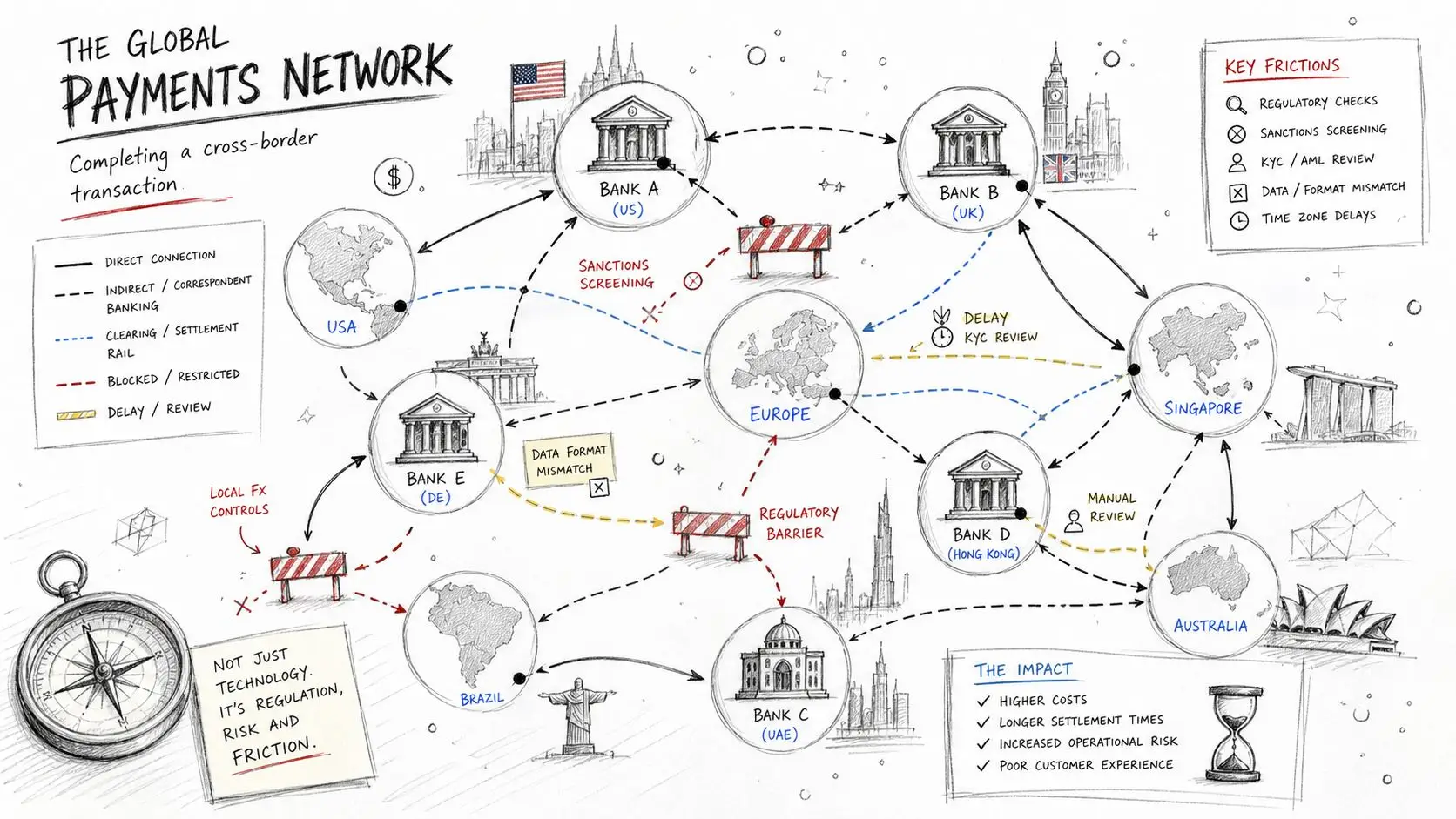
A well-drafted software license can still fail if a royalty payment stalls in the banking chain. That usually happens when beneficiary documentation is incomplete, or when the receiving bank wants more source-of-funds detail than the contract anticipated. The legal question then stops being “Which law governs?” and becomes “Can the payment be processed without triggering a compliance hold?”
Operational design now outruns paper drafting
The Financial Stability Board’s 2025 progress reporting shows how far execution can lag behind contract language. Only 35% of global cross-border retail payments and 55% of wholesale and remittance payments are credited within one hour of initiation, against a 75% target. Delays at that stage can create covenant pressure, FX exposure, and dispute timing problems before the counterparty even sees the money. The Bank of England cross-border payments overview gives the broader payment context, and the Zaro cross border payment guide is useful for teams comparing how different rails create different legal risks.
This is why legal design has to cover more than governing law and arbitration. It has to cover routing, screening, settlement mechanics, and the data needed to satisfy banks and regulators. If the payment chain cannot support the contract’s covenant timing, the buyer can end up in technical breach even where everyone agrees on the commercial price. If the rail also creates FX slippage, the settlement amount may no longer match the margin model the finance team approved.
Practical rule: if the bank cannot verify the flow, the contract’s legal elegance will not save the transaction.
For Israeli businesses entering the U.S. or EU, the risk is often timing. A counterparty may accept the commercial terms, but the flow still fails because local KYC evidence, licensing status, or transfer documentation was not ready at launch. The right approach is to treat payment design as part of the legal deal, not as an afterthought for finance.
Core Concepts of Cross Border Transactions Law
Three concepts shape almost every cross-border dispute. They are jurisdiction, choice of law, and enforcement. Jurisdiction decides who can hear the dispute, choice of law decides which rules govern the contract, and enforcement decides whether a judgment or award can reach assets in another country.
Jurisdiction, choice of law, and enforcement work as a unit
Jurisdiction answers where a claim can be heard. Choice of law answers which legal rules govern the contract. Enforcement answers whether a judgment or award can be turned into practical pressure across borders. In a domestic deal, parties often treat those questions as drafting boilerplate. In a cross-border deal, they allocate real risk.
That difference matters because a party may win on paper and still lose in practice if the selected court has no realistic path to assets. It also matters because legal systems do not treat contractual performance in the same way. Common-law and civil-law systems can differ on implied duties, good faith, interim relief, and available remedies, so Israeli counsel cannot assume a U.S. or English clause will behave the same way in litigation or arbitration.
The Everglow foreign investment review resource is useful context for businesses that face jurisdiction-specific approval regimes. Foreign investment review can change the deal before the contract ever reaches enforcement.
Why the concepts become strategic points
Cross-border parties are really deciding how much friction they are willing to absorb later. A neutral forum can reduce home-court advantage. A clear arbitration seat can improve enforceability. A badly drafted clause can do the opposite, especially if it leaves venue, seat, or interim relief uncertain.
A clause only helps if a court or tribunal can use it when the dispute starts.
These concepts stop being textbook labels and become strategic points once a deal spans multiple legal systems, banks, and asset locations. The more fragmented the transaction, the more the contract has to anticipate where pressure will appear. In practice, that means legal drafting has to sit alongside banking, tax, privacy, data transfer, and regulatory planning from the start. It also means operational design matters just as much as the governing-law clause, because payment rails, data flows, and settlement chains often decide whether the paper deal can be performed at all.
Compliance Layers That Govern Every Cross Border Transaction
Cross-border deal teams often start with price and delivery terms. That focus is understandable, but it leaves out the part that usually decides whether the deal can close. A transaction can still fail if one of the compliance layers blocks settlement, and those layers now shape the legal architecture as much as the commercial bargain.
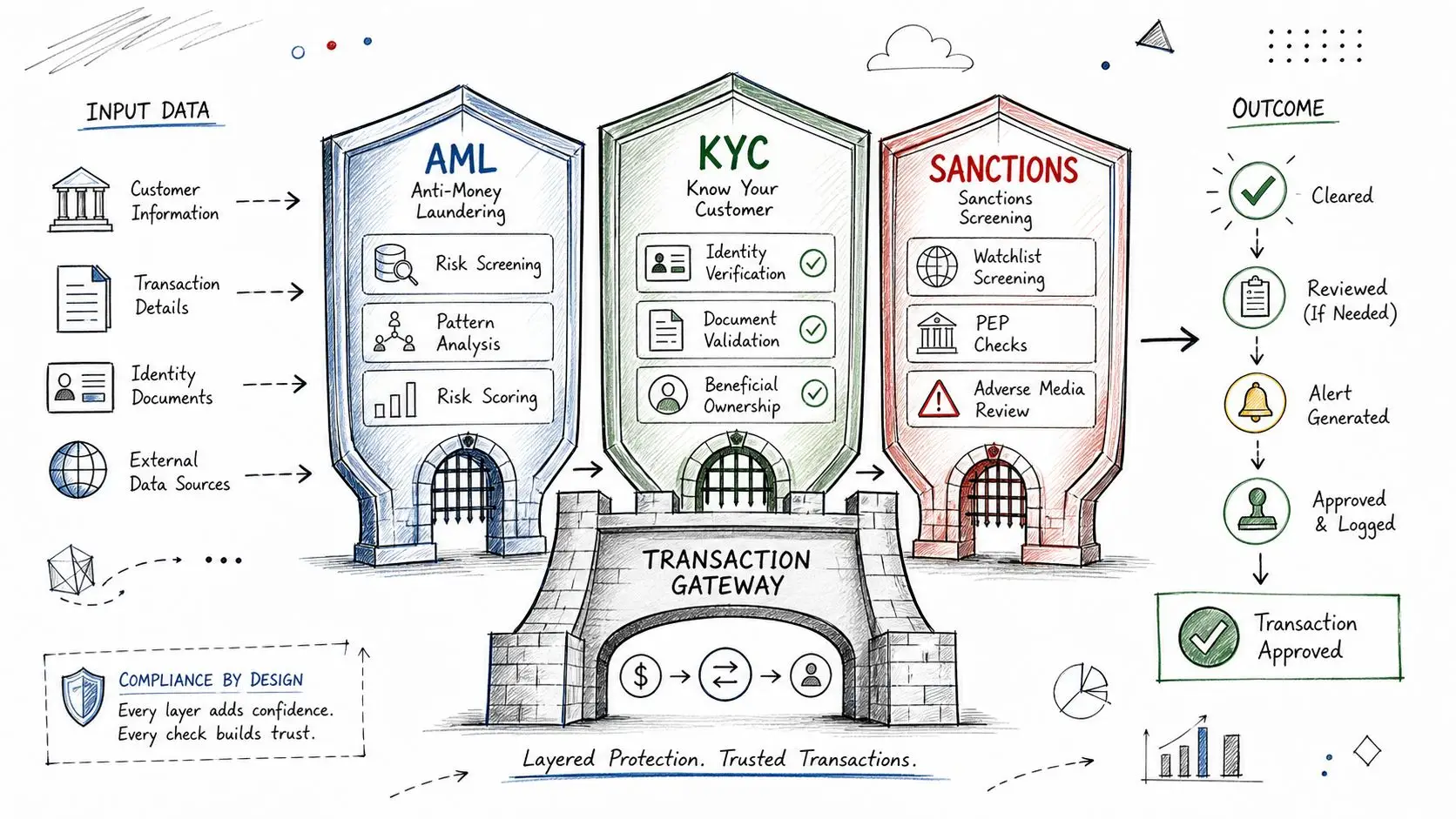
The five tracks that usually decide permissibility
The first track is AML/CFT, because banks need a documented basis to accept the transfer. The cited compliance guidance identifies a written AML/BSA policy, sanctions screening, transaction monitoring, and reporting controls as core program elements, and it says FinCEN requires four minimum pillars, internal policies, an independent audit function, a designated compliance officer, and ongoing employee training. Compliance program minimums
The second track is sanctions screening. A transaction that looks commercially ordinary can still be frozen if a counterparty, intermediary, or beneficial owner triggers a screening hit. The third track is tax, including withholding, treaty eligibility, and transfer-pricing support. The fourth is banking and licensing, because U.S. providers generally register with FinCEN as money services businesses under the Bank Secrecy Act and then obtain state money transmitter licenses where they operate. The fifth is data protection, including GDPR transfer mechanisms and the U.S. DOJ cross-border data transactions rule.
The dual-jurisdiction rule sets the operating standard
Every cross-border payment must satisfy both the sender’s and the recipient’s rules.
That is the practical standard because regulators and banks treat the transfer as a chain of obligations, not a single domestic rail. Longer chains create more screening points, more rejection risk, and more chances for a freeze when source-of-funds, beneficiary, or documentation data is incomplete. For Israeli companies expanding abroad, legal review should happen before launch, because licensing and local mapping decide whether the flow is lawful in the target market. ACI Worldwide guidance on cross-border payment processing
The data side is now especially sensitive. A recent regulatory guide says there is no single federal license for cross-border payment providers in the United States, and that the U.S. DOJ’s cross-border data rule restricts certain transactions involving bulk sensitive personal data or government-related data with countries of concern. The bulk of that rule takes effect on April 8, 2025, and due-diligence, audit, and reporting obligations start on October 6, 2025. Cross-border payment regulations guide DOJ cross-border data restrictions alert
Cross-border settlement also depends on the banking chain and the data path staying aligned. If payment instructions, KYC files, beneficial ownership records, or transfer data move through a jurisdiction with tighter controls, the contract may be fine while execution stalls. That is why the operational design now carries as much weight as the paper terms, and in some deals more. Teams working on structures such as digital bond tokenization see the same problem in sharper form, because settlement, custody, and auditability have to work across systems that do not all follow the same legal assumptions.
Drafting Clauses That Actually Survive a Cross Border Dispute
Good cross-border drafting starts with a hard question, what happens when the payment, the data, or the freeze request lands in a different forum from the one the parties expected? The answer should appear in the contract, not in a crisis memo. The drafting has to manage currency risk, tax leakage, interim relief, and the mechanics of enforcement.
The clause package that usually holds up
A neutral governing law works best when paired with a reputable arbitration seat. That gives the parties a clear procedural base and usually improves enforceability. However, the contract should still carve out interim relief in local courts when IP, asset preservation, or regulatory compliance demands fast action.
Exchange-rate language also matters. Fixing dates, collars, gross-up clauses, tax indemnities, and escrow reduce arguments after volatility or withholding changes the economics of the deal. A well-timed payment clause can stop a simple FX movement from becoming a breach claim.
The digital bond tokenization article from Blocsys Technologies is relevant for teams thinking about settlement mechanics, because tokenized structures put even more pressure on legal clarity around transfer, custody, and auditability.
Model drafting patterns that reduce failure points
Use language that ties payment mechanics to actual banking reality. For example, a clause can require payment “through a mutually agreed correspondent bank channel, subject to completion of reasonable KYC and sanctions checks.” Another can say that if a transfer is rejected for compliance reasons, the paying party must notify the other side promptly and cooperate on a lawful replacement route.
Data clauses now belong in the main agreement. If a party needs to centralize transaction monitoring, the contract should address lawful transfer pathways, retention, audit rights, and local-law limits. Side letters create avoidable drift, and drift causes disputes when regulators ask who approved what.
| Clause | Risk Addressed | Recommended Approach |
|---|---|---|
| Governing law | Forum uncertainty | Use a neutral law that both sides can live with |
| Arbitration seat | Enforcement and procedure | Choose a reputable seat with clear rules |
| Interim relief carve-out | Asset or IP leakage | Preserve access to local courts |
| FX adjustment | Currency volatility | Use fixing dates, collars, or similar mechanics |
| Gross-up and tax indemnity | Withholding surprises | Allocate tax leakage expressly |
| Escrow or staged payment | Banking delay and rejection | Add fallback mechanics and escalation steps |
| Data-transfer language | Centralized compliance risk | Include lawful transfer and audit rights |
A common drafting failure is ambiguity. Another is leaving no escalation path when the bank rejects a wire. Both errors make disputes slower and more expensive than they need to be.
A Cross Border Scenario and How the Law Plays Out
An Israeli software company licenses its platform to a U.S. distributor and a European reseller. The royalties move through a correspondent-banking chain, and the contract looks polished. The governing-law clause is neutral, the arbitration clause is clean, and the commercial terms make sense.
The problem starts after signature
The first payment triggers bank review. KYC is underway, but the receiving bank wants fuller source-of-funds documentation. The distributor forwards some records, yet one set of supporting documents is incomplete, so the bank partially rejects the royalty transfer. Settlement slips. The Israeli company had forecast that cash for payroll and vendor payments.
That delay then creates a second problem. A senior facility contains a covenant threshold tied to incoming cash. The missed receipt risks a covenant issue, and the treasury team starts asking whether the bank account itself could face restriction if more documentation is needed. None of that turns on whether the license is valid. It turns on whether the flow can survive screening and settlement.
Where the draft mattered, and where it didn’t
If the contract had included escrow, staged payments, or a clear replacement channel, the company could have reduced the liquidity shock. If it had also included a sharper gross-up clause, the tax fallout from cross-border withholding might have been easier to allocate. If the data clause had expressly addressed monitoring and audit access, the team would have had a clearer basis to centralize compliance records across jurisdictions.
The hardest part of the dispute is usually not liability, it’s the delay before anyone can prove what happened.
This kind of sequence also shows why dispute clauses must line up with operational reality. A strong arbitration clause helps later, but it won’t resolve a frozen wire. Interim relief language, banking escalation procedures, and data-transfer rights matter at the moment the payment fails. That is where legal design either absorbs the shock or amplifies it.
Pre-Execution Due Diligence Checklist for Cross Border Transactions
Deal teams often ask for a legal sign-off after the commercial terms are set. That’s too late. The safest process runs the legal checks before any wire is sent, before any license goes live, and before any compliance file is left incomplete.
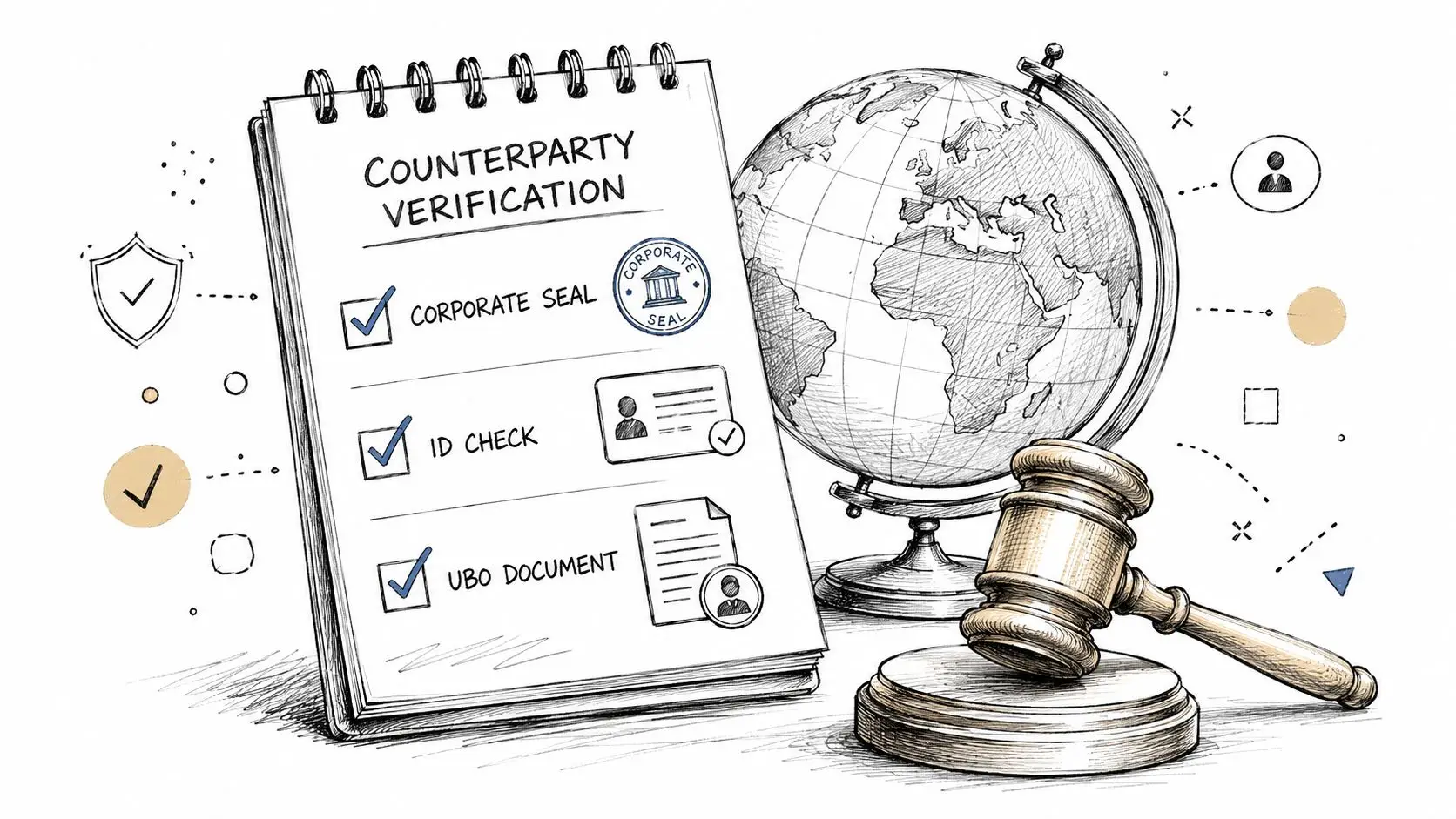
A practical sequence for counsel, finance, and operations
-
Verify the counterparty first. Confirm corporate existence, beneficial ownership, sanctions status, and signing authority. The output should be a clean file that a bank can rely on without chasing gaps.
-
Map the target jurisdiction. Check licensing, data localization, sector-specific restrictions, and any approval regime that can block the deal. The output should be a yes, no, or conditional go-ahead.
-
Test the payment rail early. Confirm bank readiness, correspondent path, fallback currency, and escalation contacts. The output should be a settlement plan, not just an invoice.
-
Document tax mechanics. Confirm treaty relief, withholding procedure, and transfer-pricing support. The output should show who bears leakage and how the payment will be grossed up, if at all.
-
Lock the data pathway. Confirm lawful transfer mechanisms, audit cadence, and reporting duties. The output should show where monitoring data will sit and who can access it.
-
Set the response plan. Identify who calls the bank, who notifies the counterparty, and who approves temporary workarounds. The output should be a live escalation tree.
A legal team can also use a specialist cross-border practice, including RNC Group in Israel, where multilingual correspondence, dispute handling, and international commercial structuring need to move together. That only helps if the instructions arrive before the transaction enters the banking chain.
The cheapest legal step is the one taken before the wire is sent, not after the funds are frozen.
Strategic Posture for 2026 and Common Failure Modes
Cross border transactions law now sits inside operational architecture. The winning design anticipates payment-rail friction, data-localization limits, and sanctions volatility instead of treating them as edge cases. It also assumes that the best clause can still fail if the flow itself is unlawful or unworkable.
The most common failure modes are predictable. Choice of law does not match enforcement reality. Banking terms ignore sanctions screening delays. Contracts move money without a lawful data path. Dispute clauses fail when interim relief is needed first, not after final award.
Standards and infrastructure are still changing. ISO 20022, real-time payment rail interlinkage, CBDCs, and distributed ledger platforms all remain live variables in the legal design. Businesses that draft for today’s bank flow only will probably redraft sooner than they expect.
For Israeli companies and multinationals operating across borders, the better posture is simple. Align the contract with the compliance path, the settlement path, and the evidence path. To avoid costly mistakes, contact RNC Group now.
This article provides general information only. It does not constitute legal advice, and no reader should rely on it without obtaining advice suited to the relevant transaction, jurisdiction, and facts.
A CTA for RNC Group.