
Will your 2026 dispute plan still work when a foreign court demands your email, chat history, cloud records, and executive testimony at once? For international companies, discovery process litigation isn’t a procedural side issue. It is often the moment when legal exposure turns into operational, financial, and reputational risk.
Many executives still treat discovery as a document collection exercise. That view is outdated. In cross-border disputes involving Israel, the United States, and other jurisdictions, discovery often becomes the pressure point where one side tries to exhaust the other side’s budget, time, and internal discipline.
The Discovery Gauntlet for International Firms
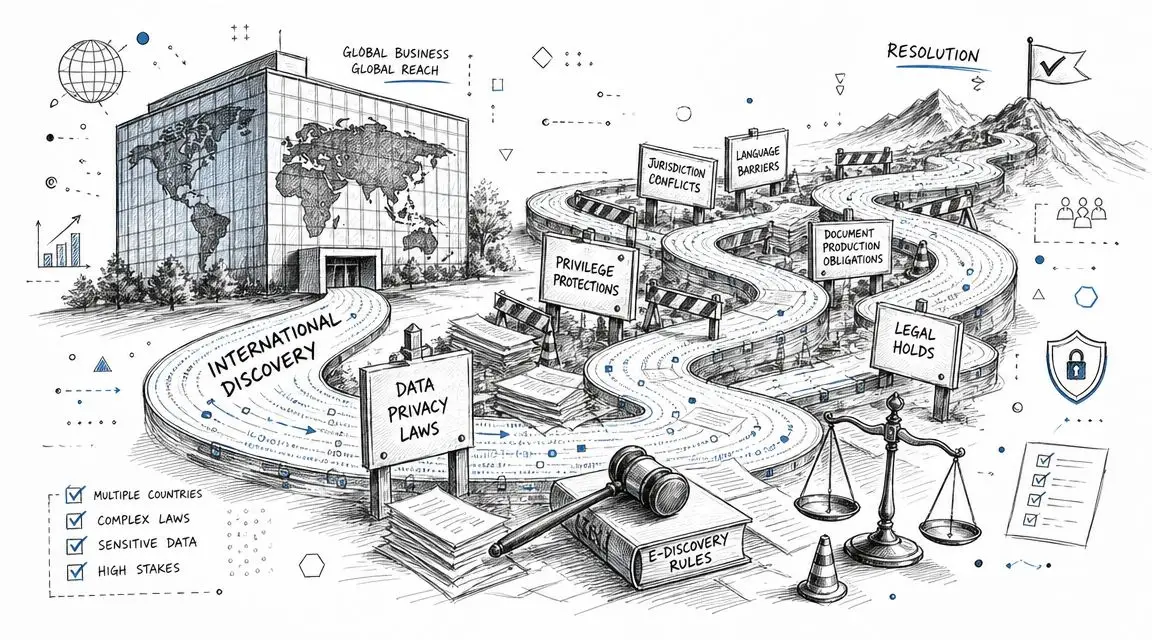
A dangerous assumption still appears in boardrooms. If a claim lacks merit, the company assumes the process will expose that weakness quickly. In practice, discovery can punish even the stronger case if the business enters the fight unprepared.
The problem isn’t theoretical. The U.S. federal court system has itself described civil discovery as “badly dysfunctional”, while also noting that parties often use expansive requests as an abusive tactical weapon to force settlements through cost and pressure, as discussed in the federal judiciary’s reform analysis.
Why international firms get hit harder
A domestic litigant usually knows where its records sit, who holds them, and which communications channels matter. An international company often doesn’t. Relevant material may sit in an Israeli office, a U.S. subsidiary mailbox, a European cloud tenant, a founder’s phone, or a regional manager’s WhatsApp archive.
That fragmentation gives the opponent an advantage. Every unclear data map becomes an argument that the search was inadequate. Every inconsistent retention practice becomes a future sanctions issue. Every delay increases pressure to settle for business reasons instead of legal ones.
Practical rule: Discovery risk starts before the first request arrives. It starts with how the company stores information, controls messaging, and escalates disputes internally.
Discovery as a settlement weapon
Astute opponents don’t always need a trial win. Sometimes they only need to make the process painful enough. Broad requests, demands for multiple custodians, third-party subpoenas, and contested privilege issues can consume management time and pull technical teams into months of reactive work.
For non-Israeli businesses with activity in Israel, that pressure multiplies. Internal teams may assume local procedure will control the pace. Then a related foreign proceeding imposes broader obligations, different timelines, and a much harsher approach to preservation.
Three patterns appear repeatedly:
- Asymmetric burden: One side asks for data categories that are easy to request but expensive to collect and review.
- Executive disruption: Senior managers become witnesses, custodians, or approval bottlenecks.
- Business exposure: Sensitive pricing, internal strategy, and partner communications move closer to disclosure.
The correct response isn’t panic and it isn’t blanket resistance. The correct response is control. Management must treat discovery as a business-risk system that requires legal judgment, technical process, and disciplined internal governance from day one.
Understanding the Battlefield Core Discovery Principles
What, exactly, is the other side trying to accomplish when it serves discovery? Rarely just information. In hard-fought commercial cases, each request is also a pressure tool aimed at forcing commitments, exposing internal weak points, and increasing the cost of defense.
Discovery is the formal process for compelling pretrial disclosure through interrogatories, document requests, requests for admission, depositions, and subpoenas. For international companies, the risk lies less in the label attached to each device and more in how each one can be used against a business that stores data across teams, countries, languages, and systems.
What each device is really used for
Interrogatories force a company to state its position in writing. That matters because early answers often shape the rest of the case. A response drafted too quickly can lock management into an incomplete narrative. A response drafted too broadly can hand the opponent admissions it did not earn.
Requests for production usually create the primary burden. They reach contracts, internal emails, messaging platforms, spreadsheets, board materials, deal files, and system data. Opposing counsel knows that a simple request on paper can trigger weeks of collection, review, translation, and internal debate.
Requests for admission are often underestimated. They are designed to narrow disputed issues, authenticate documents, and isolate points the other side wants to treat as conceded. Used aggressively, they also create a record for fee requests or later arguments that your company denied the obvious.
Depositions test preparation under pressure. They are not information-gathering sessions in any ordinary business sense. They are sworn examinations built to fix testimony, expose inconsistency, and measure how a witness performs when shown documents the company produced months earlier.
That last point matters for corporate groups with regional and global management. The wrong witness can broaden the dispute, create avoidable admissions, or turn a local commercial conflict into a governance problem.
Privilege review is part of case control
Companies often treat responsiveness as the first task and privilege as a cleanup exercise. That is a mistake. Once protected material is produced, the fight can shift from the merits of the dispute to waiver, clawback, and the scope of any further review.
A disciplined process should separate four questions from the start:
- What is responsive
- What is privileged
- What is commercially sensitive but not privileged
- What is misleading without context or a companion document
Fast collection without controlled review usually increases risk, motion practice, and cost.
The pressure is even higher where in-house lawyers are copied on negotiations, operational decisions, and escalation emails. In cross-border businesses, legal and commercial advice often sit in the same thread. Courts do not automatically protect every communication that includes a lawyer. The legal purpose of the exchange still matters.
The same problem appears in contract disputes built around negotiation history and performance. Drafts, side letters, markup chains, and internal comments can become central evidence. In a dispute over leased premises, for example, the drafting history of commercial lease agreements in Israel may show who accepted a repair obligation, who changed exclusivity language, or whether a later operational complaint contradicts the negotiating record. That is why document classification must start early, before business teams begin forwarding old emails and annotated drafts without legal screening.
Sanctions shape behavior before trial
Discovery obligations are enforced, not aspirational. If a court concludes that a party failed to preserve evidence, withheld required material, or obstructed production, the sanctions dispute can begin to drive the case.
Well-run companies respond by centralizing control. They issue clear preservation instructions, restrict ad hoc deletion, define custodians carefully, and make one legal team responsible for collection decisions. Informal chat messages, local device backups, and side-channel communications often become evidence in exactly the disputes executives once assumed would turn only on the contract.
Navigating the Jurisdictional Maze Israeli and Cross-Border Rules
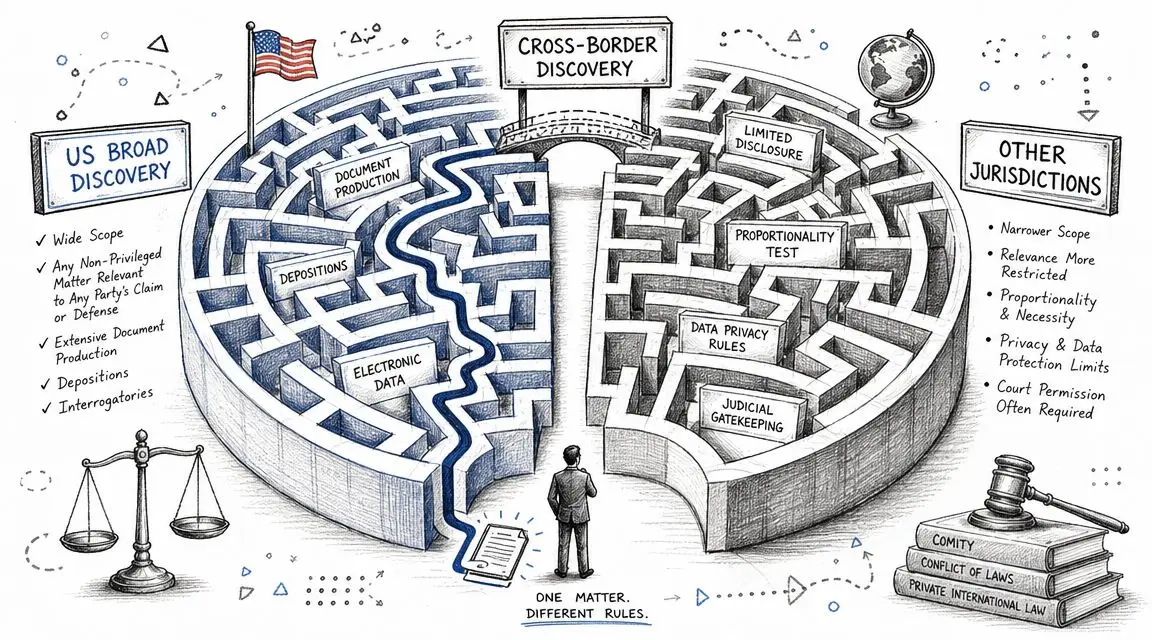
Cross-border disputes rarely fail because the company lacks documents. They fail because the company assumes one procedural culture governs all parts of the conflict. It doesn’t.
U.S.-style discovery is broad and party-driven. Israeli litigation usually feels more controlled and narrower in practice, especially when compared with the expansive disclosure expectations common in major American commercial cases. That difference matters because multinational businesses often build compliance and recordkeeping habits around one system, then face demands from the other.
A practical comparison
| Issue | U.S.-style practice | Israeli and cross-border implication |
|---|---|---|
| Scope expectations | Broad party requests are common | Local teams may underestimate demand breadth |
| Data sources | Opponents often press for email, chat, devices, and nonparty records | Data may sit across entities and countries |
| Case control | Parties often fight scope through motion practice | Local management may expect more court-led restraint |
| Risk posture | Preservation and disclosure failures can reshape the case | Internal inconsistency becomes a cross-border weakness |
The most serious problem appears when legal obligations collide. A parent company may face a broad foreign request, while an affiliate holds records under another country’s privacy, secrecy, employment, or privilege framework. Legal teams then face a three-part problem at once. They must preserve, negotiate scope, and avoid unlawful overproduction.
Why Israel adds strategic complexity
Israel often sits at the intersection of U.S., European, and regional business activity. That makes it common for relevant witnesses, deal documents, technology records, or management communications to touch multiple legal systems at the same time.
A company that acts too slowly may appear obstructive in one forum. A company that produces too quickly may waive protections or create separate regulatory problems elsewhere. The challenge isn’t choosing one rulebook. The challenge is sequencing the response so each move supports the next one.
Jurisdictional conflict isn’t a drafting issue alone. It can become a corporate crisis if regulators, counterparties, and courts start pulling in different directions.
That is why companies often need a crisis framework alongside legal analysis. Jurisdictional disputes can escalate into management paralysis, vendor concern, and shareholder anxiety, especially when allegations spread beyond the courtroom. In that context, a disciplined approach similar to the thinking behind commercial crisis management in Israel becomes relevant long before any final merits decision.
What usually works better
Several approaches consistently perform better than reactive resistance:
- Map the data by jurisdiction: Identify where records sit, who controls them, and which laws may restrict transfer.
- Separate preservation from production: Preserve broadly first. Then negotiate production carefully.
- Use local counsel input early: Assumptions about privacy, secrecy, labor law, and privilege often fail across borders.
- Align internal messaging: Legal, compliance, IT, and management must describe the response in the same terms.
What doesn’t work is improvisation. If the U.S. team promises one thing, the Israeli team does another, and the European affiliate raises privacy concerns later, the company looks disorganized. In discovery process litigation, disorganization invites broader demands.
Managing Digital Risk E-Discovery and Preservation

The critical evidence is often digital, scattered, and partially invisible to management. Email is only the starting point. Relevant material may also sit in Slack, Microsoft Teams, WhatsApp, cloud storage, shared drives, calendar invites, PDFs, call notes, backups, and personal devices used for company business.
That is why electronically stored information, or ESI, sits at the center of modern discovery risk. ESI is discoverable, but courts also recognize limits based on undue burden and proportionality, which makes retention systems and litigation holds central to cost and risk control, as outlined in this discussion of ESI and discovery limits.
Preservation fails in ordinary ways
Most preservation problems don’t start with sabotage. They start with routine corporate habits. Auto-delete settings remain active. A manager changes phones. An employee leaves. A chat workspace gets reorganized. A cloud folder loses context. Nobody means to destroy evidence, but ordinary business activity keeps moving.
For that reason, a litigation hold must be operational, not symbolic. Sending a legal notice alone won’t protect the company if IT systems continue deleting data or if custodians don’t understand what they must preserve.
A defensible preservation response usually requires:
- Custodian identification: Name the people who likely hold relevant records.
- Source mapping: List the systems where those records may exist.
- Process suspension: Pause deletion, overwriting, or routine cleanup where needed.
- Confirmation: Require recipients to acknowledge the hold and ask questions.
- Documentation: Keep a clear record of what was preserved, when, and how.
Modern channels create hidden exposure
Executives often know their email archives. They are less certain about chats, direct messages, and collaborative workspaces. Yet those channels frequently contain the most candid discussions about pricing, contract changes, dispute forecasts, and customer issues.
A practical retention framework should define which tools employees may use for business communication and how those records are retained. Companies reviewing their internal policy architecture can benefit from a technical companion resource such as this guide to file retention best practices, especially when legal and operational teams need a common baseline vocabulary.
The worst preservation posture is partial confidence. The company thinks it preserved the important data, but it never mapped where the important data actually lived.
What a defensible hold looks like
A strong hold process is repeatable. It doesn’t depend on one in-house lawyer remembering which department uses which platform. It should identify owners for legal decisions, technical implementation, and employee communication.
The following questions should be answered early:
| Question | Why it matters |
|---|---|
| Which employees were involved? | They are likely custodians |
| Which systems did they use? | Evidence rarely sits in one location |
| Did anyone use personal devices or personal accounts? | Business records may exist outside company systems |
| Are deletion rules active? | Routine system processes can erase relevant material |
| Are there cross-border transfer limits? | Preservation and production may require different steps |
What doesn’t work is waiting for formal requests before preserving. By then, relevant information may already be altered, lost, or impossible to collect cleanly. The legal team needs technical facts quickly, and the technical team needs legal direction immediately.
The Proportionality Shield Limiting Scope and Burden
Discovery requests often arrive drafted as if every possible source of information must be searched. That isn’t the legal standard. In federal practice, parties may discover any non-privileged matter relevant to a claim or defense and proportional to the needs of the case under Rule 26(b)(1), which makes relevance plus proportionality the central battleground in discovery disputes, as reflected in the Rule 26 overview.
That standard gives companies a real defensive tool. It does not excuse obstruction. However, it allows disciplined resistance to overreach.
Relevance alone doesn’t end the argument
Opposing counsel often frames a request broadly and then argues that anything remotely connected to the dispute is fair game. That position skips the second half of the test. A request may touch the case in some abstract way and still be too burdensome, duplicative, or poorly targeted to justify enforcement.
A strong response usually links burden to specifics, not slogans. General complaints about volume, complexity, or disruption rarely persuade. Courts respond better when counsel can identify narrow custodians, alternative sources, duplicate requests, and the business systems that would need to be searched.
What persuasive proportionality arguments look like
Good objections aren’t theatrical. They are evidence-based and practical.
- Target the mismatch: Explain why the request sweeps beyond the claims or defenses pleaded.
- Show better alternatives: Offer narrower custodians, time periods, or data sources that can answer the same issue.
- Separate hot documents from cold archives: Active files often produce more relevant evidence than expensive legacy systems.
- Identify cumulative demands: If the requesting party already has contracts, emails, and witness testimony on a point, another layer may be excessive.
Courts tend to limit requests more readily when the responding party offers a workable substitute instead of a reflexive refusal.
Fishing expeditions can be contained
The phrase “fishing expedition” only helps if counsel explains why. A useful challenge usually addresses one or more concrete flaws:
- The request is untethered to an actual claim or defense.
- The request demands categories with little likely value.
- The same information is available from a less burdensome source.
- The burden falls heavily on systems that were never designed for litigation retrieval.
- The request threatens disclosure of sensitive material without adequate need.
Preparation determines a party’s strategic advantage. A company that knows its systems, custodians, and data burdens can push back credibly. A company that doesn’t know what it has often overproduces out of fear or underexplains and loses the motion.
Proportionality is not a technical escape hatch. It is a business discipline translated into litigation language. The better the company understands its own information environment, the stronger that shield becomes.
Controlling Costs with Strategic Discovery Planning
How quickly can a manageable dispute turn into a cross-border cost event? In my experience, faster than many international companies expect. Once the other side sets the pace, discovery stops being an information exercise and becomes a pressure tool aimed at budget, management time, and settlement posture.
That risk is sharper for non-Israeli companies. They often enter Israeli or Israel-linked litigation with fragmented data systems, foreign privacy constraints, multiple languages, and business teams that do not yet understand what local procedure can force them to collect, review, and explain. By the time those issues are sorted out, the bill has already grown.
Early planning changes who controls the tempo. The objective is not abstract efficiency. It is to prevent the opposing party from turning broad requests into operational disruption.
Use phased discovery to control the sequence
Phased discovery is one of the few cost controls that also improves litigation position. It forces the case onto the issues that are most important before review expands across every custodian, device, and archive.
In many commercial disputes, the first phase should test the points most likely to move the case. That usually means the core contract record, the few decision-makers who handled the disputed events, and a date range tied to negotiation, performance, notice, payment, or termination. If that first cut answers the main liability questions, the company may avoid a much larger and less useful second round.
The alternative is expensive and familiar. Everything gets collected at once. Outside vendors begin processing broad datasets. Internal staff are pulled into ad hoc searches. Foreign headquarters starts asking why a procedural fight in Israel is consuming executive attention across several business units.
A practical phased plan often includes:
- Issue-first sequencing: Start with the claims or defenses most likely to decide the dispute.
- Small custodian groups: Begin with the employees closest to the events, not every person copied on a chain.
- Tight date limits: Match the time period to the transaction or alleged misconduct.
- Priority systems: Pull first from the platforms most likely to hold relevant material, then test whether expansion is justified.
- Decision gates: Agree that any broader collection will depend on what the first phase reveals.
That last point matters. Without a decision gate, “phased” discovery often becomes full discovery with a brief delay.
Budget control requires legal and technical decisions together
Cost usually turns on a few hidden drivers. Translation. Chat data. Mobile collections. Legacy systems. Duplicate review across business units. Privilege review in mixed legal and commercial communications. International companies feel these pressures more sharply because their records are often spread across jurisdictions, vendors, and retention cultures.
Counsel should therefore budget discovery by workstream, not as one undifferentiated line item. Collection, processing, hosting, review, foreign law analysis, translations, and motion practice each need separate assumptions. That approach exposes critical trade-offs early. For example, narrowing five marginal custodians may save far more than arguing over one broad search term, while collecting from a legacy backup source may cost more than its likely evidentiary value justifies.
A company that treats discovery as a single legal spend category usually loses control of it.
Motion practice should support planning, not replace it
Motions to compel and protective orders remain necessary tools, especially when the other side uses burden itself as a tactic. But a court is more likely to limit discovery when the company presents a disciplined alternative with facts behind it.
That means documenting the burden in operational terms. Which systems must be searched. Who has to do the work. Whether data sits overseas. Whether review requires translation. Whether the request reaches sensitive material or regulated records. General complaints about expense rarely persuade. Specific facts often do.
The strongest position is simple: here is the narrower path, here is what it will produce, and here is what the wider path will cost in time, money, and business disruption.
That record also matters in settlement discussions. A party that can explain discovery burden precisely often has more credibility when it resists inflated demands.
Litigation Hold Initial Action Checklist
| Phase | Action Item | Key Consideration |
|---|---|---|
| Trigger assessment | Decide whether a dispute is reasonably anticipated | Delay creates preservation risk |
| Legal hold launch | Issue a written hold to relevant personnel | Use plain language and require acknowledgment |
| Custodian review | Identify likely fact witnesses and record holders | Include former employees if access remains possible |
| Data mapping | Locate email, chats, drives, devices, and cloud systems | Separate preservation needs from collection needs |
| Technical preservation | Suspend deletion where appropriate | Coordinate legal instructions with IT execution |
| Privilege planning | Define legal review workflow before production | Mixed legal and business communications need care |
| Scope proposal | Draft targeted custodians, dates, and data sources | Negotiation works better with a concrete alternative |
| Budget control | Track review drivers and dispute hotspots | Cost follows scope, not intent |
| Escalation plan | Prepare for motion practice if negotiations fail | Build a factual record before seeking court relief |
Cost control is also a business continuity issue
Discovery spend does not stay inside the legal department. It affects forecasting, management bandwidth, deal timing, lender discussions, and the company’s tolerance for litigation risk. In payment disputes or enforcement-sensitive matters, procedure can become part of the pressure campaign itself. That broader commercial impact often appears in related conflicts, including disputes linked to bank account restrictions and returned checks in Israel.
The practical answer is disciplined sequencing, realistic staffing, and a clear threshold for escalation. If the company waits for the first wave of requests to define the project, the opposing side usually dictates scope, timing, and cost.
Executing Your Defense Actionable Risk Mitigation
A company usually loses control of discovery long before it loses a motion. The loss begins when employees use unmanaged channels, retention rules drift, and no one can answer a simple question about where the records are.
The only reliable response is to build discovery readiness before the dispute matures. That is not a luxury for large public companies alone. It is a necessary operating discipline for any business exposed to cross-border contracts, foreign counterparties, or sensitive digital communications.
The minimum strategic posture
The following steps reduce risk and improve response quality:
- Map your data environment now: Know which systems hold contracts, email, chats, mobile records, and cloud files.
- Define approved business channels: If staff use WhatsApp, Teams, Slack, or personal devices, set written rules and retention expectations.
- Create a repeatable hold protocol: Legal, IT, HR, and management should know who acts first and what gets preserved.
- Classify sensitive communications: Separate legal advice, business advice, trade secrets, and routine operational records.
- Prepare cross-border escalation paths: Local management should know when foreign privacy, secrecy, or labor rules may affect production.
- Train decision-makers: Executives should understand that informal comments, deleted chats, and side-channel messaging can become evidence.
- Document every key step: Courts trust process they can see.
What international companies should avoid
Some reactions create more damage than the original request.
- Don’t improvise custodians. A rushed list often misses the decision-makers.
- Don’t preserve only email. Modern disputes live across several systems.
- Don’t confuse confidentiality with privilege. Sensitive business material may still be producible.
- Don’t let regional teams act independently. One inconsistent response can weaken the whole position.
- Don’t treat broad requests as final. They are often opening demands, not the last word.
In discovery process litigation, the party with the better internal map often gains the better legal position.
Prepared companies don’t eliminate dispute risk. They reduce the chance that procedure will become the opponent’s strongest weapon. They also create better conditions for negotiation, narrower motion practice, and more credible resistance to excess.
Avoid costly mistakes by getting strategic advice before a dispute hardens into a procedural crisis. For complex cross-border commercial conflicts, RNC Group offers experienced counsel grounded in Israeli and international business realities. The recommended next step is to seek a confidential review through the firm’s contact page.
Disclaimer: The articles and information provided in this publication are for informational and educational purposes only and do not constitute legal advice. Reading this article does not create an attorney-client relationship. Readers should consult a qualified attorney for advice on any specific legal matter.