

For any corporate entity operating in Israel’s vibrant market, protecting your core intellectual assets is not merely a priority—it is a strategic imperative. Effective ip litigation in israel transcends simple registration; it is about the power to enforce your rights decisively when those assets are threatened. This guide serves as a playbook for leveraging the formidable legal tools available in Israel to defend your patents, trademarks, and copyrights against infringement.
Protecting Your IP in the Heart of “Startup Nation”

Operating within Israel’s dynamic tech and commercial sectors presents immense opportunities, but it also exposes your intellectual property to significant risk. Innovation moves at an accelerated pace here, and the legal response to violations must be equally swift and potent. To truly shield your assets, one must first grasp the practical implications of intellectual property infringement on the ground.
While some legal systems are notorious for protracted battles where initial relief is elusive, Israel’s framework is engineered to deliver immediate, powerful remedies. The judicial philosophy is fundamentally protective: halt the infringement and prevent irreversible damage before it spirals, rather than merely offering monetary compensation long after the fact.
This proactive approach is a critical advantage for businesses that cannot afford to watch counterfeit products erode their market share or see proprietary trade secrets compromised. The legal framework is designed to empower you, the rights holder, to act with conviction and authority.
The Three Pillars of Israeli IP Enforcement
The Israeli strategy for IP enforcement is built on a foundation of speed, evidence preservation, and meaningful financial recovery. It is less about abstract legal theory and more about a clear, actionable playbook. Three of the most powerful instruments at your disposal are:
- Temporary Injunctions: You can obtain immediate court orders to halt infringing activity in its tracks, protecting your market position and revenue from the outset.
- “Anton Piller” Orders: Through court-authorized search and seizure orders, you can enter an infringer’s premises to secure critical evidence before they have a chance to conceal, alter, or destroy it.
- Statutory Damages: The law permits the pursuit of significant statutory damages, a unique feature allowing you to claim substantial financial awards without the often-insurmountable burden of proving your exact monetary losses.
This strategic trio—injunctions, evidence seizure, and statutory damages—forms the backbone of a muscular IP defense. It reflects a legal system that understands the commercial realities of IP value and provides the necessary mechanisms to defend it rigorously.
This guide will deconstruct each of these enforcement tools, offering a practical manual for navigating the Israeli legal system. Drawing on deep cross-border expertise, we will demonstrate how to ensure your intellectual property is not just registered, but aggressively and effectively defended. Together, these mechanisms create a formidable shield around your most valuable corporate assets, allowing you to operate with confidence in one of the world’s most dynamic innovation centers.
How to Immediately Halt Infringement with Temporary Injunctions
Imagine a competitor is flooding the market with a counterfeit version of your flagship product. Or worse, a former employee has just launched a new venture utilizing your patented technology. Every moment of delay translates into lost revenue and irreparable damage to your brand.
In such high-stakes scenarios, waiting months—or even years—for a final judgment is not a viable option. You require a powerful, immediate tool to stop the financial and reputational bleeding. Right now.

This is where the Israeli legal system offers a critical first line of defense: the temporary injunction, known locally as a Tzav Menia Zmani. Consider it an emergency brake for your business. It is a court order compelling the infringing party to immediately cease all harmful activities until the full lawsuit is resolved. For any business navigating ip litigation in israel, securing this order is a foundational step in protecting your assets from the moment a threat is identified.
The Three-Part Test for Securing an Injunction
Israeli courts do not issue these powerful orders lightly. To succeed, your legal counsel must construct an impeccable application that satisfies a clear, three-pronged test. The court meticulously weighs each factor to ensure the remedy is both justified and equitable.
- A Strong Initial Case: First, you must demonstrate a compelling, arguable case. While you need not prove your entire lawsuit at this preliminary stage, you must present credible evidence indicating a high probability of success at trial.
- The Balance of Convenience: Next, the court assesses the potential harm. It will weigh the damage you will suffer if the injunction is not granted against the harm the defendant will suffer if it is. Your objective is to prove that your potential losses—whether financial, reputational, or strategic—far outweigh the defendant’s inconvenience.
- Good Faith and Fairness: Finally, you must demonstrate that you have acted in good faith. This means you have not delayed unreasonably in asserting your rights, and that granting the injunction aligns with fundamental principles of justice.
Securing a temporary injunction is not just a procedural step; it is a significant strategic victory. It fundamentally alters the power dynamic in negotiations, often compelling the infringer to seek a settlement long before a full trial is even contemplated.
An Injunction in Action: A Pharmaceutical Patent Scenario
Let’s apply this to a real-world context. Imagine your company holds the patent for a groundbreaking new drug. Suddenly, a generic manufacturer begins selling a copycat version in Israel, destroying your pricing structure and eroding your market share with every sale.
This is a textbook scenario for seeking a temporary injunction. Your counsel would immediately file an application with the District Court, arguing:
- Strength of the Case: Presenting the registered patent alongside expert analysis that unequivocally demonstrates the generic product’s infringement.
- Irreparable Harm: Articulating that monetary compensation alone cannot rectify the situation later. You are losing market leadership, brand reputation, and the established price point—damages that are permanent.
- Favorable Balance: Arguing that the harm to your company from unchecked infringement is exponentially greater than the generic company’s loss of profits from a product they had no legal right to sell in the first place.
If successful, the court can issue an order within days or weeks, forcing the competitor to pull their infringing drug from the market immediately. This decisive action freezes the situation, protecting your market position while the main ip litigation in israel proceeds. It is this speed and decisiveness that makes the Israeli legal system such a formidable venue for enforcing IP rights. It understands that in business, timing is everything.
Using “Anton Piller” Orders to Seize and Preserve Evidence
When initiating legal action, a critical fear often looms: what if the infringer destroys the evidence before you can access it? In high-stakes cases involving trade secret theft or software piracy, the most damning proof—source code, client lists, internal communications—can vanish with a few clicks. This risk can undermine an entire case before it properly begins.
The Israeli legal system provides a powerful, proactive solution for this exact problem: the “Anton Piller” order. This is not a standard legal request. It is a court-authorized, ex-parte (one-sided) search and seizure order that grants you the element of surprise, allowing your legal team to enter an infringer’s premises to find, copy, and secure vital proof before they are even aware a lawsuit is underway.

Consider it a surgical legal strike. The objective is not punitive but preservative. This remedy is tailor-made for situations where there is a genuine, demonstrable risk that crucial evidence will be destroyed if the defendant is notified in advance. It is a cornerstone of effective ip litigation in israel, particularly when dealing with bad-faith actors.
The High Bar for a Surprise Search
Because Anton Piller orders are so potent—and executed without the other party present—Israeli courts exercise extreme caution in granting them. This is an exceptional remedy, reserved for the clearest of situations. To obtain one, you must present a compelling, evidence-backed application that meets a very high legal threshold.
Your petition must convincingly prove three key elements:
- An Extremely Strong Prima Facie Case: You must present overwhelming initial evidence of infringement. This is not about mere suspicion; it requires presenting a case so strong that it leaves little doubt about the defendant’s wrongdoing.
- Proof of Serious Potential Damage: You must demonstrate that the defendant’s actions are causing, or are poised to cause, very serious harm to your business.
- A Real Possibility of Evidence Destruction: This is the critical element. You must provide solid evidence that the defendant is likely to destroy incriminating materials if they are notified of the lawsuit through conventional channels.
An “Anton Piller” order fundamentally alters the battlefield. It neutralizes the infringer’s ability to cover their tracks, ensuring that the case is argued on the facts, not on what little evidence remains after a deliberate cleanup.
Executing the Order with Precision
Once granted by the court, the execution is a carefully controlled process, not a chaotic raid. The court appoints an independent officer, typically another attorney, to supervise the entire search and seizure. This ensures the process remains fair and adheres strictly to the terms of the court order.
The typical process unfolds as follows:
- Surprise Arrival: Your legal team, accompanied by the court-appointed officer and often technical experts, arrives at the defendant’s premises unannounced.
- Order Presentation: The defendant is served with the court order, which legally compels them to grant access to specific locations and materials (such as computers, file cabinets, or servers).
- Supervised Search and Seizure: Under the officer’s direct supervision, your team searches for and copies relevant documents, files, and electronic data. Original materials are usually left in place, but secure digital copies are made.
- Reporting to the Court: The court-appointed officer prepares a detailed report of the search. This report is filed with the court, creating a clear, official record of all evidence that was preserved.
In the fast-paced world of ip litigation in israel, where trade secrets can be transmitted globally in seconds, the Anton Piller order is an indispensable tool. It provides a decisive, protective measure that levels the playing field against infringers who might otherwise destroy the very proof needed to hold them accountable.
The Strategic Advantage of Statutory Damages in Israel
One of the greatest challenges in any IP litigation in Israel is quantifying the precise financial loss you have suffered. How do you prove the exact monetary damage from lost sales, a diminished market share, or a tarnished reputation? It can be a complex, expensive, and often frustrating process that can encumber even the strongest cases.
Israeli law provides a powerful and pragmatic solution to this problem: statutory damages. This is a game-changing legal mechanism. It allows courts to award significant compensation to a rights holder without requiring them to undertake the arduous task of proving actual financial harm. It is a tool designed to ensure that infringement carries a real cost, even when the exact dollar amount of the damage is difficult to ascertain.
This legal provision serves as both a potent deterrent and a practical remedy. For international corporations, it dramatically simplifies the recovery process and makes holding infringers financially accountable far more feasible.
How Statutory Damages Work
The framework for statutory damages is particularly robust in copyright and trademark cases. Here, the court can award up to NIS 100,000 (approximately USD 27,000) for each separate act of infringement. In cases of widespread software piracy or counterfeit goods, this “per-act” calculation can rapidly accumulate into a very substantial award.
The court does not arbitrarily assign a figure. When determining the final amount, judges consider several key factors:
- The Scale of the Infringement: Was this an isolated incident or a systematic, large-scale operation?
- The Duration: How long did the infringing activity persist?
- The Severity: Even without precise figures, the court assesses the overall impact on the rights holder’s business and reputation.
- The Infringer’s Intent: Was the infringement accidental, negligent, or a deliberate, malicious act? Blatant disregard for IP rights will almost certainly result in a higher penalty.
- The Infringer’s Gains: Any profits the infringer derived from their illegal activity are taken into account.
Statutory damages fundamentally shift the focus of the litigation. Instead of becoming mired in proving what the rights holder lost, the court’s attention turns to the inherent wrongfulness of the infringer’s conduct. This ensures that even if an infringer made minimal profit, they are still held accountable for violating the law.
To illustrate, the table below summarizes the statutory damages available under Israeli law. The key advantage remains consistent: there is no requirement to prove actual financial loss.
Israeli Statutory Damages for IP Infringement
| Type of Intellectual Property | Governing Law | Statutory Damages (Per Infringement) | Key Consideration |
|---|---|---|---|
| Copyright | Copyright Act, 2007 | Up to NIS 100,000 | No need to prove damages. The court considers the scope, duration, and severity of the infringement. |
| Trademarks | Trademarks Ordinance [New Version], 1972 | Up to NIS 100,000 | No need to prove damages. Applied in cases where a registered trademark is used without permission. |
| Performers’ and Broadcasters’ Rights | Performers’ and Broadcasters’ Rights Law, 1984 | Up to NIS 100,000 | No need to prove damages. Protects the rights of artists and broadcasters against unauthorized use. |
This framework provides a clear and powerful path to compensation, deterring would-be infringers by establishing a significant financial risk for their actions.
A Real-World Example: Software Piracy
Imagine a U.S. software company discovers that an Israeli firm is selling unauthorized copies of its high-end architectural software. The American company knows it is losing revenue, but proving the exact number of illegal copies sold or installed is nearly impossible.
This is where statutory damages become the most potent tool. The company’s lawyers do not need a perfect accounting. They only need to present solid evidence of, for instance, ten separate instances where the Israeli firm sold the pirated software. Each of those sales can be treated by the court as a distinct act of infringement.
If the evidence demonstrates the defendant was operating a deliberate, commercial-scale operation, a judge might decide on an award of NIS 50,000 per act. This would result in a total award of NIS 500,000—a significant victory achieved without having to construct complex economic models or prove a specific decline in the U.S. company’s global revenue. It is a strategy that not only compensates the victim but also makes IP theft a decidedly unprofitable business model for the infringer.
This is a cornerstone of effective IP litigation in Israel, providing a direct path to justice that reinforces the tangible, financial value of intellectual property.
Navigating the Israeli Court System for Your IP Dispute
Winning an intellectual property battle in Israel requires not only a strong case but also mastery of the unique procedural landscape. For any IP litigation in Israel, that journey almost invariably begins and ends in the country’s District Courts, which hold exclusive jurisdiction over these complex, high-stakes disputes.
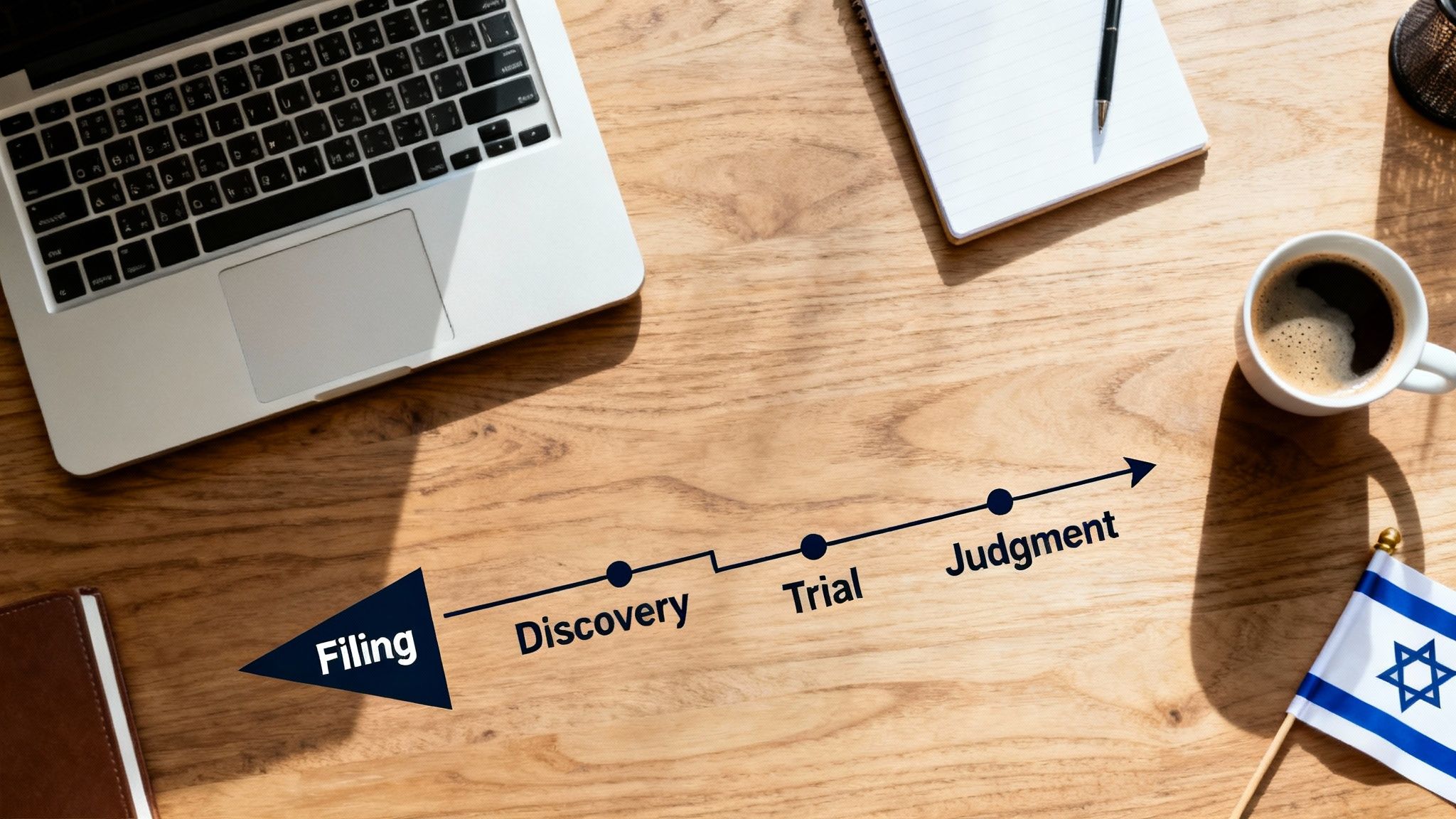
This section outlines the typical stages of an IP lawsuit in Israel. Understanding these local rules—and how they differ from those in other Western jurisdictions—is key to building a successful strategy.
Key Procedural Differences to Note
For those primarily familiar with litigation in the U.S. or the UK, several significant differences in the Israeli system will be apparent. These are not minor quirks; they fundamentally shape case strategy, timelines, and costs.
The three most critical differences are:
- No Jury Trials: All IP cases are decided by a professional judge. Arguments must be legally watertight and technically precise to persuade a seasoned legal expert, rather than appealing to the emotions of a jury.
- Focused Discovery Process: The sprawling and often costly discovery process common in the U.S. is absent here. Discovery in Israel is far more targeted and limited in scope, resulting in a more efficient pre-trial phase.
- Hands-On Judges: Israeli judges actively manage their dockets. They are not passive observers but proactively guide cases, pushing parties toward settlement and ensuring the litigation moves forward without undue delay.
Because every detail matters, precise documentation is critical. Many firms rely on professional legal court transcription services to ensure every word from every hearing is captured flawlessly. These procedural nuances highlight why experienced local counsel is essential to adapt a global strategy to the realities of the Israeli courts.
The Stages of an IP Lawsuit
While no two cases are identical, most IP infringement lawsuits follow a predictable path. Understanding this progression helps in anticipating next steps and managing resources effectively.
- Filing the Statement of Claim: The process begins with the plaintiff filing a detailed document outlining the facts, the legal grounds for the infringement claim, and the specific remedies sought.
- Statement of Defense: The defendant then files a formal response, addressing each of the plaintiff’s allegations and presenting their own counterarguments.
- Preliminary Proceedings: This stage includes the discovery process (exchange of relevant documents), hearings for preliminary injunctions, and other pre-trial motions to resolve issues before the main trial.
- Evidence and Trial: Both sides submit written affidavits from their witnesses and expert witnesses. The trial itself focuses almost entirely on the cross-examination of these individuals before the judge.
- Summations and Judgment: After all evidence has been presented, both parties submit their final written arguments (summations). The judge then reviews the entire case before delivering a final, binding judgment.
A recent landmark case put a global spotlight on the Israeli courts when they asserted jurisdiction over OpenAI. The ruling sent a clear message: international tech companies taking money from Israeli customers can’t just sidestep local litigation. The court system also has a transparent fee structure. Claim fees are 2.5% of the disputed amount up to ILS 25.9 million (~USD 7.21M), paid in two parts.
Armed with this procedural knowledge and deep cross-border expertise, your business is positioned to navigate the Israeli legal system with confidence and strategic foresight, ensuring your IP rights are defended vigorously.
Building a Winning IP Enforcement Strategy in Israel
When protecting intellectual property, a reactive stance is a losing proposition. The most effective defense is a proactive offense. For any foreign corporation entering the Israeli market, a passive posture is insufficient. The most powerful tool in any IP litigation in Israel is a forward-thinking enforcement strategy, built on sharp foresight and meticulous preparation.
This work begins long before a dispute arises. It starts with comprehensive IP registration and disciplined portfolio management. A well-documented portfolio of registered patents, trademarks, and designs is more than a collection of legal documents; it is a clear deterrent. It signals to the market that you are serious about defending your assets and possess the legal firepower to act decisively.
This foundational effort transforms your IP from an abstract concept into a tangible, legally enforceable asset. When your rights are clearly defined and publicly recorded, it dramatically simplifies the process of obtaining immediate judicial relief, such as temporary injunctions, because the basis of your claim is already established.
Litigation vs. ADR: Choosing the Right Battlefield
When an infringement occurs, the instinctive reaction may be to initiate aggressive litigation. However, the most astute strategists pause to consider all available options. While Israeli courts are powerful, litigation is not always the only—or the best—path. Alternative Dispute Resolution (ADR), particularly mediation, offers a compelling alternative.
The key is to align your legal actions with your broader business objectives.
- Litigation: This is your heavy artillery, best reserved for clear-cut, bad-faith infringement where setting a public precedent is necessary. It is the appropriate tool for securing injunctions, seizing evidence, and winning significant damages that send a clear message to the market.
- Mediation: This offers a more collaborative and confidential route. It is often faster, less costly, and ideal for disputes where preserving a business relationship is valuable. Successful mediation can yield creative solutions, such as a new licensing agreement, that a courtroom cannot provide.
Expert cross-border counsel can help you navigate this crucial decision, ensuring the chosen path serves your strategic objectives without wasting time and resources on unnecessary conflict.
Crafting a Cohesive, Forward-Looking Plan
Ultimately, a winning enforcement strategy synthesizes all the elements discussed. It recognizes that while Israel offers a robust legal framework, unlocking its full potential requires expert local guidance and sharp strategic thinking. The goal is to build a cohesive plan that shields your commercial interests throughout the region.
The global market for IP litigation services is booming, projected to hit $25 billion by 2033, with Israel as a key player in the Middle East. A critical detail for investors: Israeli courts are known for awarding significant fee reimbursements in cases before the Israeli Patent and Trademark Office (ILPTO), a stark contrast to the lower recovery rates in district courts. Combined with Israel’s top ranking in the MENA region for property rights protection, it’s clear the nation’s legal framework is built for effectiveness. You can find more details in these intellectual property litigation service trends.
Your strategy must be a living plan, adaptable to market shifts and your company’s growth. By marrying proactive portfolio management with a calculated, clear-eyed approach to dispute resolution, you can secure your most valuable assets and thrive in Israel’s dynamic economy.
Your Burning Questions About Israeli IP Litigation, Answered
Navigating foreign legal systems inevitably raises questions. For any executive managing international business, understanding the realities of IP litigation in Israel is essential for effective risk management.
Here are straightforward answers to the most common questions from our global clients, providing a clear picture of what to expect when enforcing your intellectual property rights in Israel.
How Long Does an IP Lawsuit Actually Take in Israel?
While every case has its own timeline, a standard IP infringement lawsuit in an Israeli District Court generally takes between 18 and 36 months to reach a final judgment.
However, this timeframe does not reflect the speed of initial, critical actions. If you need to stop an infringer immediately, a temporary injunction can often be obtained within a matter of days or weeks. This provides powerful, immediate relief long before the main case concludes.
Are Israeli Court Rulings Actually Enforced?
Absolutely. Israel possesses a robust and highly effective legal enforcement system. Once a judgment is obtained—whether for monetary damages or a permanent injunction—it carries real authority.
Judgments are executed by a dedicated state agency, the Israeli Enforcement and Collection Authority (Hotza’a LaPoal). This body’s sole function is to ensure court orders are carried out. Furthermore, Israel’s legal framework recognizes and enforces certain foreign judgments, making it a reliable jurisdiction for protecting a global IP portfolio.
The true measure of any legal system is the enforceability of its rulings. In Israel, court orders are not merely symbolic; they are backed by a state authority that ensures judgments translate into real-world consequences for infringers.
If I Win My Case, Can I Get My Legal Fees Back?
Yes, this is a distinct possibility. Israeli courts have the discretion to award legal costs and attorney’s fees to the prevailing party. While recovering 100% of your legal expenditure is uncommon, courts frequently award a significant portion to the winner.
This is particularly true in cases of blatant or bad-faith infringement. The final amount awarded is at the judge’s discretion and will be based on factors such as the case’s complexity, the amount of work involved, and the conduct of both parties throughout the litigation. The potential for cost recovery serves as a powerful deterrent, compelling potential infringers to reconsider their actions.
This article does not constitute legal advice and is not a substitute for consulting with a qualified attorney. Do not rely on the contents of this article for taking or refraining from taking any action.