
Executing a corporate real estate transaction in Israel involves more than a standard wire transfer; it is a highly scrutinized process governed by stringent financial regulations. Success hinges on satisfying Israel’s rigorous Anti-Money Laundering (AML) framework. Without meticulous preparation, a multi-million-dollar deal can be halted indefinitely, jeopardizing the entire investment before it even begins.
The High Stakes of Israeli Fund Transfers for Real Estate

For global corporations and institutional investors, acquiring Israeli property is a significant strategic move. The financial component of this endeavor, however, is subject to a legal framework that prioritizes security and transparency above all else. This system is predicated on extreme caution, a direct consequence of global financial integrity initiatives and national security concerns. A transfer that would be routine in other Western jurisdictions can trigger intense scrutiny, causing significant delays or outright rejection if the accompanying documentation is not flawless.
The challenge is rooted in two primary compliance hurdles.
Understanding Core Compliance Hurdles
First, Israel’s Prohibition on Money Laundering Law is not a mere guideline; it is a formidable piece of legislation that places a substantial compliance burden on Israeli financial institutions. Banks function as gatekeepers, tasked with preventing illicit capital from entering the economy. With their licenses and reputations at stake, they adopt a “guilty until proven innocent” posture toward large, inbound foreign transfers.
This leads directly to the second, and most critical, hurdle: proving the Source of Funds. This is a non-negotiable requirement. The transferring entity must provide a clear, documented, and verifiable history of the capital. The documentation must present an unimpeachable narrative detailing the legitimate origin of every shekel.
The burden of proof rests entirely on the entity transferring the funds. A failure to provide a complete and transparent financial history is the single greatest cause of transaction failure, often freezing millions in capital and jeopardizing time-sensitive real estate acquisitions.
The Strategic Solution: A Lawyer’s Escrow Account
A proven strategy exists to mitigate these risks and streamline the process. By channeling the investment through a lawyer’s escrow account (also known as a client trust account), a trusted intermediary is placed between the investor and the bank. A law firm with an established reputation and a pre-existing relationship with the bank can compile and present the source-of-funds documentation in a manner that satisfies the bank’s demanding compliance department.
This approach leverages the law firm’s credibility to create a secure, compliant channel for the investment. It shields the corporate entity from the direct, and often frustrating, interactions with bank compliance officers. What could be an adversarial process is transformed into a structured, professionally managed transaction, ensuring capital arrives safely and on schedule.
The Prohibition on Money Laundering Law: A Game Changer for Investors
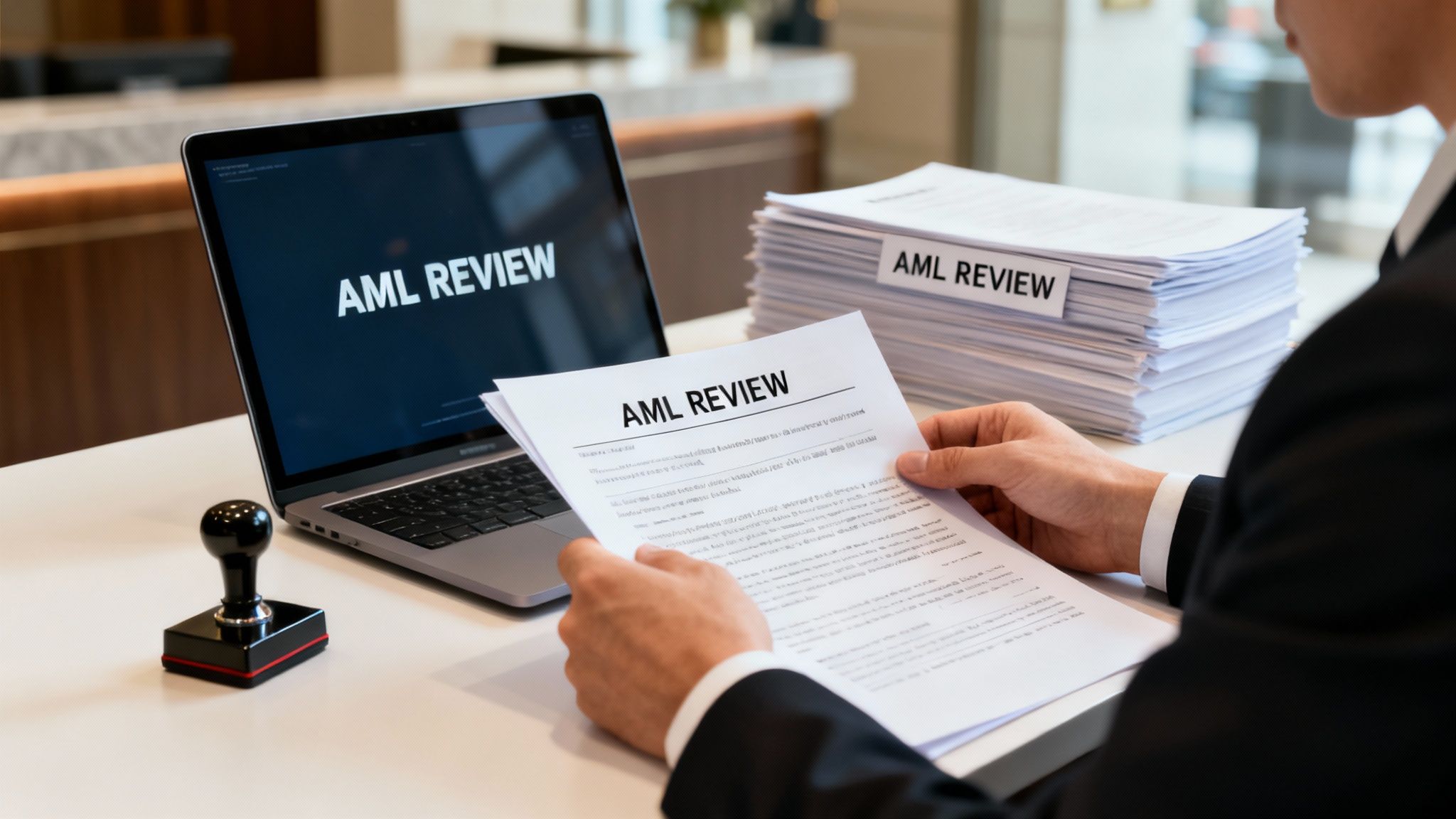
To successfully transfer capital into Israel for a major acquisition, corporate entities must grasp a fundamental reality: Israeli banks are not facilitators; they are gatekeepers. For a foreign company accustomed to more streamlined processes in other Western nations, this distinction is paramount.
The entire financial system operates under the strictures of Israel’s Prohibition on Money Laundering Law. This is not simply another regulation; it is a rigorous legal framework that fundamentally alters the dynamics of international capital flow.
At its core, the law deputizes every financial institution, positioning them as the front line of defense against illicit funds. For the foreign investor, the implications are immediate and severe. The burden to prove that capital is legitimate falls squarely and entirely on your shoulders. Forget jurisdictions where a simple declaration of source may suffice; Israeli banks demand a complete, verifiable, and often exhaustive financial history. They are legally mandated to dissect every large inbound transfer, and their compliance teams operate with a diligence that can feel adversarial if one is unprepared.
The Bank’s Perspective on Inbound Transfers
From the bank’s viewpoint, an undocumented seven or eight-figure transfer from an offshore entity is not an attractive new deposit; it is a significant compliance risk. Financial institutions face severe penalties for any lapse in AML protocols, so their default position is one of extreme caution.
This institutional mindset is precisely why a transaction that would be routine elsewhere gets flagged for an intensive, microscopic review in Israel. A transfer can be frozen for reasons that might seem trivial to an outsider:
- Inconsistent Paperwork: A slight mismatch between the name on the sending corporate account and the name on the property purchase agreement.
- Complex Corporate Structures: Funds arriving from a tangled web of holding companies without a perfectly clear, linear paper trail tracing the money back to its origin.
- Recent Large Deposits: A sudden, massive influx of capital into the sending account right before the transfer, without a clear explanation for where it came from (like a recent asset sale).
The core principle is brutally simple: if the bank’s compliance officer cannot quickly and confidently piece together a legitimate story of your wealth’s origin from the documents you provide, your transfer will be stopped dead in its tracks. It is not their job to investigate for you; it is your obligation to present them with an ironclad case.
This intense scrutiny isn’t just for traditional currency. As digital assets gain ground, the same tough AML principles apply. The guide on Anti Money Laundering (AML) compliance for Bitcoin offers crucial insights for investors dealing with modern financial instruments, highlighting how these global rules are being adapted.
Anticipating Scrutiny: Proving Your Source of Funds
The only way to ensure a smooth transfer is through proactive and obsessive preparation. The single most critical concept you must master is proving your “Source of Funds.” This goes miles beyond providing a simple bank statement.
You must be ready to produce an organized dossier that could include years of corporate tax returns, audited financial statements, dividend distribution records, or fully executed contracts from the sale of other major assets.
Let’s take a real-world scenario. Your funds are coming from the sale of a commercial property in another country. The Israeli bank won’t just want to see the wire confirmation. They will demand the fully executed sale agreement, official proof of tax payment on the capital gain, and bank statements showing the funds entering and then resting in your corporate account for a reasonable period.
This is where so many international investors and companies get stuck. They completely underestimate the depth of verification required, leading to infuriating delays that can kill time-sensitive deals. Without expert guidance, you risk being trapped in an endless cycle of requests for more information, with your capital frozen in limbo.
RNC Group’s cross-border expertise was forged in these exact situations. We structure our clients’ documentation from day one to meet these punishing standards, ensuring there are no surprises when it matters most.
Proving Your Source of Funds: A Definitive Compliance Guide

In the context of Israeli financial compliance, theory and practice are worlds apart. For any corporate entity seeking to acquire property in Israel, success is contingent on one factor: the ability to construct an airtight, evidence-backed narrative proving the legitimate origin of your capital.
This is not a matter of persuasive storytelling; it is a matter of irrefutable documentation.
Israeli banks require a linear, logical paper trail. They must see a clear path illustrating how your company’s capital was generated, accumulated, and is now being deployed for this specific transaction. Ambiguity is the enemy; a single unexplained gap in the financial history can bring the entire transfer to a halt. Preparing this documentation is a detail-oriented, front-loaded endeavor. The objective is to provide the bank’s compliance officer with a dossier so complete and self-explanatory that it can be approved with total confidence and zero follow-up inquiries.
Building Your Evidentiary File
The first step is to classify the origin of the funds, as the required documentation varies significantly depending on how the capital was generated. Banks assess different sources with varying levels of scrutiny, but each requires specific and definitive proof.
Common scenarios for corporate investors include:
- Corporate Profits & Retained Earnings: This is often the most straightforward source to document. It requires several years of audited financial statements, corporate tax returns from the home jurisdiction, and official shareholder resolutions specifically authorizing the capital allocation for the Israeli real estate acquisition.
- Sale of a Major Corporate Asset: If funds originate from the sale of another property, a subsidiary, or significant equipment, the bank will demand the complete, signed sale and purchase agreement. Crucially, they will also require proof of tax payment on any capital gains from that sale, plus bank statements showing the exact proceeds being deposited into the corporate account.
- Loan or Financing: If using borrowed capital, a fully executed loan agreement from a legitimate financial institution is mandatory. The documentation must detail all terms, identify the lender, and prove the loan itself originates from a regulated, verifiable source.
- Inheritance or Gift (for individual investors/shareholders): This scenario requires careful documentation. If funds began as a personal inheritance later injected into the company, a comprehensive file is needed: official probate documents, the will, and court orders from the estate distribution. A clean, legal transfer of those funds from the individual to the corporate entity must then be demonstrated.
The golden rule is: “Show, don’t tell.” A letter stating funds are from “business profits” is insufficient. You must provide official, government-filed, or legally binding documents that prove it. A compliance officer’s job isn’t to trust you; it’s to verify your paper trail.
Providing the right paperwork is critical for demonstrating a legitimate source of funds. Israeli financial institutions have a specific checklist they follow, and any deviation can cause significant delays. Below is a table outlining the most common sources and the documentation you’ll need to prepare.
Required Documentation for Source of Funds Verification
| Source of Funds | Primary Documents Required | Common Pitfalls to Avoid |
|---|---|---|
| Corporate Profits | Audited financial statements (3-5 years), corporate tax returns, board resolution authorizing the investment. | Providing unaudited or internal P&L statements; missing shareholder authorizations. |
| Sale of an Asset | Fully executed sale & purchase agreement, proof of capital gains tax payment, bank statements showing receipt of funds. | An incomplete or unsigned agreement; failing to show the corresponding tax payment. |
| Business Loan | Signed loan agreement from a recognized bank, statement of account showing the loan disbursement. | Using loans from unregulated or private lenders without extensive background documentation. |
| Shareholder Capital | Share purchase agreements, updated corporate registry, shareholder’s personal source of funds for the initial investment. | A murky trail for the shareholder’s original funds; informal capital injection without paperwork. |
| Inheritance | Official probate documents, will, court orders, bank statements showing fund distribution and transfer to the corporate entity. | Missing court seals or certifications; gaps in the timeline from inheritance to corporate investment. |
Having this table handy as you compile your file can save you from the common, and entirely avoidable, mistakes that trip up so many foreign investors.
The Critical Role of Authentication and Translation
Collecting the correct documents is only half the battle. As a foreign entity, your paperwork must meet specific Israeli banking standards.
Any document not in Hebrew or English must be accompanied by a certified, notarized translation. There are no exceptions.
Furthermore, official government records—such as a certificate of incorporation or tax filings—will often require an Apostille. This is an international certification under the Hague Convention that authenticates the document as a legitimate public record from its country of origin. Neglecting proper translation or Apostille certification is a common error that immediately flags a file for rejection, forcing a restart and causing significant delays.
A Tale of Two Transfers: A Case Study
To illustrate the high stakes involved, consider two real-world scenarios involving corporate fund transfers for a property deal.
The Failed Transfer: A European holding company attempted to wire €5 million directly to a seller in Israel. They supplied a one-page letter from their CEO claiming the funds were from “accumulated profits.” When the Israeli bank requested further documentation, the company provided basic, unaudited P&L statements. The transfer was immediately frozen. The bank flagged the transaction for insufficient evidence, citing the lack of third-party audits and official tax returns. The deal ultimately collapsed.
The Successful Transfer: An American corporation, working with our firm, was preparing to transfer the same amount. Before initiating the wire, we constructed a comprehensive compliance package:
- Five years of federally filed corporate tax returns.
- Audited financial statements for the same five-year period, signed by a Big Four accounting firm.
- A notarized Board of Directors resolution explicitly authorizing the real estate purchase in Israel.
- The corporate certificate of good standing, apostilled by the Secretary of State.
We submitted this complete package through our firm’s escrow account. Our bank reviewed and approved the source of funds in under 48 hours. The funds were transferred to the seller at closing, and the property was secured without a single impediment. This proactive, structured, and bulletproof approach is the only viable method for such transactions.
The Lawyer’s Escrow Account: Your Key to a Smooth Transfer

Navigating the stringent realities of Israel’s Anti-Money Laundering laws can be a formidable challenge. When a bank’s compliance department demands an exhaustive paper trail to prove your source of funds, the process can feel like a minefield where one misstep leads to endless delays or outright rejection.
A superior, strategic solution exists to insulate corporate investors from this friction: the lawyer’s escrow account.
This is not merely a procedural formality; it is the single most effective strategy for securing fund transfer approval. Utilizing a client trust account held by a reputable Israeli law firm completely transforms the transaction’s dynamic. Instead of a foreign company attempting to justify a complex financial history to a skeptical bank, a trusted local intermediary vouches for the funds’ legitimacy.
How the Escrow Account Streamlines Compliance
When you channel your investment through a law firm’s pre-vetted client account, you are effectively leveraging the firm’s established credibility. Israeli banks maintain long-standing relationships with major law firms specializing in international commercial law. These trust accounts are subject to constant scrutiny and are known to operate at the highest compliance standards.
Consequently, when funds arrive in our escrow account, the bank’s initial risk assessment plummets. The compliance burden effectively shifts from you to us. Our role is to meticulously assemble your source-of-funds documentation into a clear, compelling package that anticipates and answers every potential question from the bank before the transfer is initiated.
We convert a potentially adversarial process into a professionally managed transaction, shielding your company from the frustrating and often confusing demands of compliance officers. This adds a layer of professional validation that provides the bank with the confidence required to approve a large inbound transfer efficiently.
The Mechanics of a Strategically Facilitated Transfer
Engaging a firm for this purpose is not just about hiring a lawyer; it is about securing a strategic facilitation service. The entire process is designed to eliminate ambiguity and build an ironclad case for your capital. Here’s how it works:
- Pre-Transfer Due Diligence: Before any capital is moved, we conduct a rigorous internal audit of your source-of-funds documentation. We mirror the bank’s own scrutiny to identify and rectify any weaknesses, gaps, or inconsistencies in the financial narrative.
- Compliance Package Assembly: We take your audited financials, tax returns, sale agreements, and other evidence and organize them into a standardized format that Israeli banks know and trust. This includes managing certified translations and ensuring all documents are properly apostilled.
- Liaison and Representation: We become your direct representative to the bank’s compliance department. Backed by RNC Group’s cross-border expertise, we present the case, handle any technical queries, and ensure the entire process is perfectly aligned with Israeli financial regulations.
This method is all about control and predictability. By placing a credible legal intermediary between your capital and the bank, you remove the element of chance. The transfer is no longer a matter of hope but a structured, managed event with a significantly higher probability of success.
This strategy becomes absolutely critical for complex corporate structures or when your investment funds come from multiple sources. A law firm can consolidate these streams and present a unified financial story that would be nearly impossible for a foreign entity to articulate on its own.
Mitigating Risk and Ensuring Transactional Security
The primary benefit of this approach is risk mitigation. A failed direct bank-to-bank transfer is not a neutral event. It can result in your funds being frozen for an extended period and may even lead to your company being blacklisted by that institution, making future attempts exponentially more difficult.
Using a lawyer’s trust account sidesteps this risk entirely. The funds are first cleared into an account the bank already deems compliant. From there, they can be seamlessly transferred to the seller or used for other deal-related expenses at closing.
Consider the alternative: a multi-million-dollar deal contingent upon a compliance officer you have never met, in a country whose banking regulations you do not fully understand. The escrow strategy replaces that uncertainty with professional oversight and established credibility. It is the difference between attempting to navigate a storm alone and having an experienced local pilot guide you safely into port.
Finalizing Your Property Purchase: Key Strategic Considerations
Successfully transferring funds into Israel for a property acquisition is not merely a wire transfer; it is the final, critical maneuver in a complex strategic operation. Success at this stage depends on a disciplined approach founded on three pillars: ironclad Anti-Money Laundering (AML) compliance, flawless source-of-funds documentation, and the tactical use of a lawyer’s escrow account. Mastering these elements transforms a high-risk process into a predictable, secure transaction.
This is the culmination of meticulous preparation. The groundwork laid to prove the legitimate origin of your capital, combined with the credibility of your law firm, is about to be tested. However, before any funds are moved, two additional variables demand full attention: currency exchange risk and the precise timing of the transfer.
Navigating Currency Exchange and Transaction Timing
For a corporate entity dealing in dollars, euros, or any other foreign currency, the exchange rate is a significant variable that can alter the final cost of an investment by tens of thousands of dollars. Securing a favorable FX rate is a matter of proactive strategy, not luck. Waiting until the last minute to convert funds is a gamble that exposes your capital to pure market volatility.
It is absolutely critical to consult with financial experts and establish a currency strategy well in advance of the closing date. This may involve using forward contracts or other financial instruments to hedge against adverse rate fluctuations. The goal is to protect your capital and ensure your budget remains intact.
Equally important is timing. Your funds must be liquid and ready for deployment at the exact moment the property contract is signed. Transferring the money too early creates unnecessary risk; transferring it too late could result in a breach of contract, leading to serious financial penalties or the collapse of the entire deal. This delicate coordination is best managed by a legal team that can perfectly synchronize capital movement with contractual deadlines.
The Decisive Action Plan For Your Transfer
To ensure your Israeli real estate investment closes smoothly and securely, a clear, final action plan is essential. View the transfer not as a simple final step, but as the culmination of a demanding compliance marathon. Before initiating any wire, triple-check that every component of your strategy is in place.
- Final Documentation Review: Conduct one last, thorough audit of your entire source-of-funds package. Ensure every document is certified, translated, and apostilled as required. Leave absolutely no room for the bank to raise questions.
- Escrow Account Coordination: Confer with your legal counsel. Confirm the escrow account is prepared and ready to receive the funds. Your law firm must be on standby to engage the bank’s compliance department the moment the transfer arrives.
- FX and Timing Strategy: Finalize your currency exchange plan. Set a precise, non-negotiable timeline for the transfer that aligns perfectly with the property contract signing date.
Moving significant capital across borders for a high-value asset acquisition is a zero-error endeavor. The stringency of Israeli banking regulations means that attempting to navigate this process without expert legal oversight constitutes an enormous and unnecessary risk. For more insights into international payment solutions, you might find resources from leading payment experts helpful.
Ultimately, the success of your investment hinges on the quality of the counsel you receive. RNC Group’s cross-border expertise is built to handle these exact complexities, ensuring your transaction is not just compliant but executed with strategic precision. Contact our team to secure your investment and navigate the process with confidence.
Top Questions on Israeli Fund Transfers Answered
When moving significant funds into Israel for a corporate property deal, numerous questions and anxieties can arise. Here are direct answers to the most common concerns we hear from foreign entities, based on our extensive experience.
How Long Will This Actually Take?
There is no fixed timeline; it is entirely dependent on the quality and completeness of your documentation. We have seen direct bank-to-bank transfers frozen for months while the bank issues vague, piecemeal requests for more information.
The decisive factor is the use of a law firm’s escrow account with a pre-vetted compliance package. Once we submit a meticulously prepared file, approval often occurs within a few business days. The key is to ensure everything is correct before initiating the transfer, rather than attempting to resolve issues after the fact.
What’s the Big Deal With a Direct Bank-to-Bank Transfer?
Attempting to wire funds directly from your foreign bank to an Israeli bank without local legal oversight is a significant gamble. The most immediate risk is that the transfer is rejected outright or your funds are frozen indefinitely. This can completely derail your property transaction and trigger serious contractual penalties.
Furthermore, a single failed transfer can flag your company within that bank’s compliance system, making any future attempts exponentially more difficult. You effectively cede control of a multi-million-dollar transaction to a compliance officer whose professional mandate is to be suspicious of it.
The greatest risk is not just financial—it is the loss of momentum and credibility. When a transfer is delayed, a seller can lose patience and withdraw, causing the collapse of a deal that took months, or even years, to construct.
What Happens If My Paperwork Is Rejected?
If an Israeli bank rejects your source-of-funds documentation, the transfer is halted immediately. The bank will issue a formal request for more information, but these requests are often frustratingly vague and nearly impossible for a foreign company to interpret correctly on its own.
This initiates a protracted cycle of back-and-forth communication. Weeks can pass with each submission and review, placing enormous pressure on your closing date and creating a climate of uncertainty for all parties. This is precisely the high-stakes scenario that our lawyer-led escrow strategy is designed to prevent.
For more perspectives on international payment solutions, you can find valuable information from leading payment experts.
A Quick Note Before We Dive In
The information you’re about to read is based on our extensive, hands-on experience navigating the complexities of fund transfers, AML compliance, and corporate structuring for international clients moving capital into Israel. We’ve packed this guide with practical insights to give you a clear, high-level map of the financial and legal terrain.
However, please treat this as what it is: a guide for general informational purposes, not binding legal advice.
The world of international finance is anything but one-size-fits-all. The specific documentation you’ll need, the questions the banks will ask, and the optimal corporate structure all hinge on the unique facts of your situation—your company’s jurisdiction, the exact origin of your funds, and the nature of your investment here in Israel.
Every transaction is its own unique case. It demands a tailored strategy developed with a qualified attorney who can dig into the specifics of your circumstances.
So, please don’t make any financial moves or decisions based solely on what you read here. Acting on this information without first consulting with professional legal counsel is a risk you shouldn’t take. Israeli banking and commercial laws have their own distinct logic, and navigating them successfully requires personalized guidance.
The scenarios we discuss are drawn from real-world situations, but they’re here to illustrate the process, not to guarantee a specific outcome. Think of this as your starting point for a much more detailed conversation.
Navigating Israel’s intricate legal and financial systems requires seasoned expertise. For strategic counsel on your real estate investment or commercial ventures, contact RNC Group to ensure your transaction is secure, compliant, and successful. Learn more at https://www.rnc.co.il.
This article does not constitute legal advice and is not a substitute for consulting with a qualified attorney. Do not rely on the contents of this article for taking or refraining from taking any action.