
A shipment can clear customs and still fail a tax audit. That counterintuitive risk defines modern export documentation requirements, because customs, tax, transport, and product regulators often accept different evidence.
The old checklist, invoice, packing list, and certificate, no longer provides sufficient control. Exporters now need a jurisdiction-specific data map showing which fields, formats, signatures, and physical records each authority accepts.
The WTO Trade Facilitation Agreement established an important baseline. Adopted in 2013 and effective since 22 February 2017, it requires members to review and simplify import, export, and transit formalities, while accepting paper or electronic copies where appropriate. The WTO framework explained by UNCTAD also prevents an importing state from demanding an export declaration already submitted to another government.
Why Your Export Documentation Checklist Is Already Outdated
The most dangerous assumption is that a complete paper file equals a compliant export. It doesn’t. A shipment can contain every familiar form and still lack the electronic data or alternative evidence required by a specific authority.
Traditional checklists treat documents as universal objects. Modern systems treat them as structured evidence, with defined data elements, formats, filing channels, and validation rules.
The legal shift toward usable evidence
Article 10.7 of the WTO framework requires common customs procedures and uniform documentation requirements throughout a member’s territory. However, it also allows risk-based controls and electronic processing.
That combination changes the practical question. Exporters shouldn’t ask only, “Which documents does this shipment need?” They should ask:
- Which data fields apply: Do descriptions, values, weights, classifications, and parties match across filings?
- Which format is accepted: Can the authority receive an electronic copy, or must someone present an original?
- Which agency controls the proof: Does customs evidence also satisfy tax, licensing, or product-regulation rules?
- Which party files: Does the exporter, carrier, broker, or authorized agent submit the electronic record?
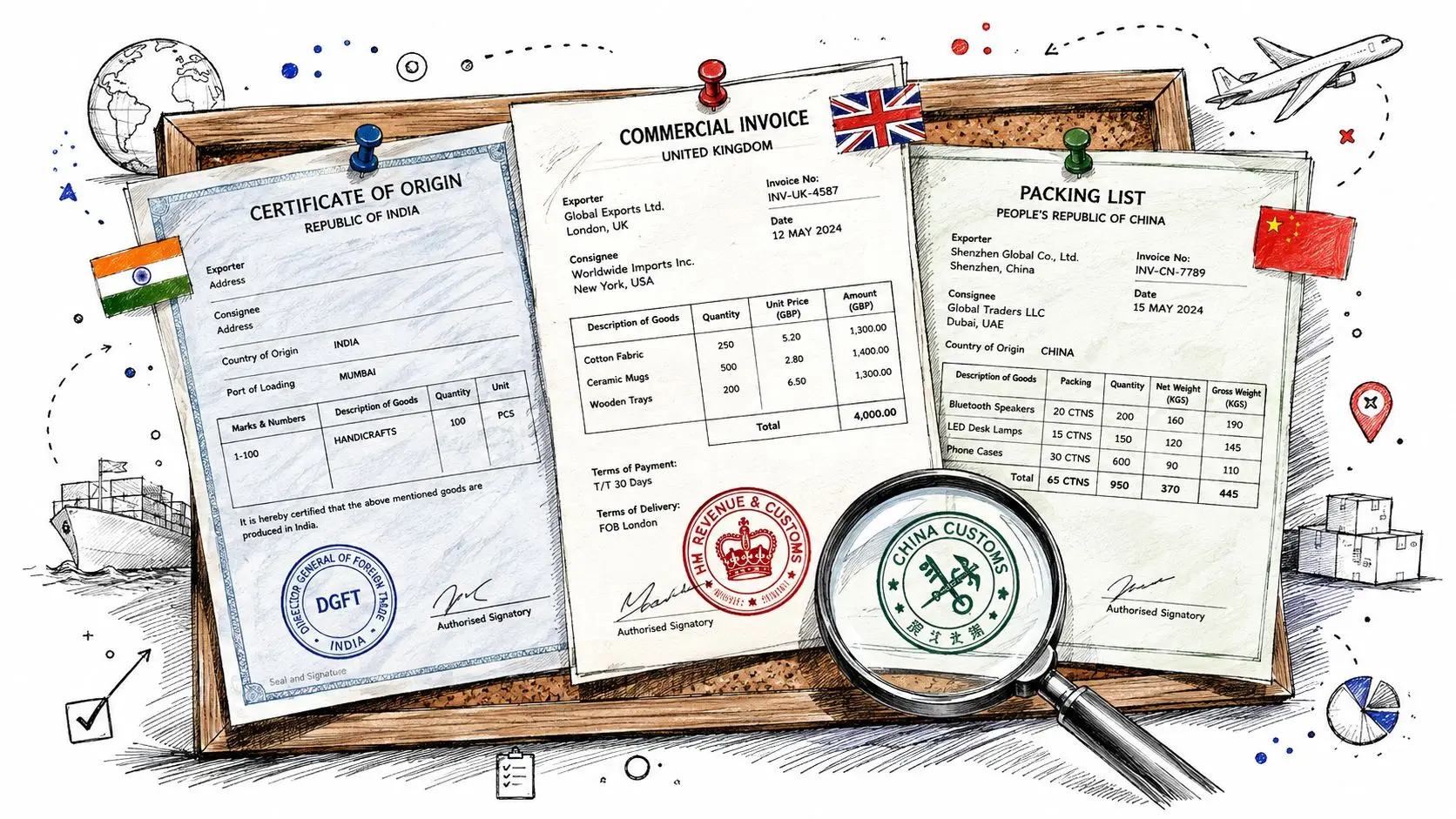
The WTO documentation structure recognizes core export records, including declarations, commercial invoices, packing lists, certificates of origin, and bills of lading. The practical direction is clear, standardised, digital, and interoperable documentation.
Why longer files don’t solve the problem
More paperwork can create more contradictions. An invoice may show one product description, while a customs declaration uses another, and a transport document records different weights.
Tax authorities may also demand proof that customs never requested. Germany’s guidance updated in July 2025 broadened acceptable evidence for VAT-free exports, including certain government confirmations, tax-privilege settlement notes, and customs documents from other jurisdictions. Foreign-language documents generally require German translation unless they appear in English. The German VAT documentation update illustrates the point.
Practical rule: Design the evidence package around every relevant authority, not only the border crossing.
A reliable compliance process therefore maps each trade corridor separately. It records required fields, accepted formats, translation rules, signature requirements, retention expectations, and fallback evidence.
Core Export Documents and Their Legal Functions
Export documents don’t perform the same legal job. Treating them as interchangeable creates avoidable risk, especially when a broker or carrier relies on one form to compensate for a missing record.
The commercial invoice establishes the commercial foundation. Customs uses it to identify the parties, goods, and transaction value. The invoice should also state the commodity description, exporter of record, declared value, Incoterms, and applicable HS code where available. FedEx’s export clearance guidance highlights these practical invoice fields and expects completion in English.
The packing list serves a different purpose. It lets customs officers and carriers reconcile the physical cargo against the declared shipment. The U.S. International Trade Administration identifies seller, buyer, shipper, invoice number, shipment date, transport mode, carrier, item counts, package types, net and gross weight, and dimensions as relevant packing-list details. The ITA guide to common export documents provides the operational reference.
Core Export Documents Reference
| Document Type | Key Data Fields | Legal Function | Issuing Party |
|---|---|---|---|
| Commercial invoice | Parties, description, value, Incoterms, classification | Supports valuation and transaction identification | Exporter or seller |
| Packing list | Package counts, marks, weights, dimensions | Supports inspection and freight reconciliation | Exporter or shipper |
| Bill of lading or airway bill | Consignor, consignee, route, cargo, carrier terms | Records carriage and transport instructions | Carrier or freight forwarder |
| Certificate of origin | Origin details, goods, certifying information | Supports origin claims and tariff treatment | Exporter, chamber, or authorised body |
| Customs declaration | Goods, value, classification, parties, procedure | Requests export release and records customs data | Exporter or authorised representative |
| Permit or licence | Controlled goods, scope, validity, conditions | Authorises regulated export activity | Competent government authority |
The bill of lading or airway bill connects the shipment to its transport contract. It may support cargo release, routing, and carrier instructions, but it doesn’t replace customs or tax evidence.
A certificate of origin supports an origin claim. It can affect preferential treatment, but exporters must verify the applicable origin rule and certification method for the destination.
For a practical review of invoice construction, the AUSFF commercial invoice guide offers a useful comparison point. The important lesson remains functional: every field should serve valuation, identification, classification, transport, origin, or regulatory proof.
Jurisdiction-Specific Requirements That Catch Exporters Off Guard
Export documentation requirements diverge most sharply when customs, tax, and product regulators examine the same shipment separately. A universal checklist cannot capture those differences.
The European Union example
For EU exports, a customs export declaration generally applies to goods leaving the customs territory. Three stated exemptions cover goods valued at €3,000 or less, non-commercial transport, and private individuals exporting personal goods. When customs value exceeds €20,000, the exporter should also file a customs value declaration, known as DV1. The Brussels export-document guide sets out these triggers.
These thresholds don’t answer every tax question. An exporter may obtain customs release while lacking the proof needed to defend a VAT exemption or an audit position.
The EU is also moving toward machine-readable export data under AES. Some exit processes accept readable barcode presentation, but exporters must confirm the applicable system and presentation method for each movement.
The United States example
The United States requires Electronic Export Information filing through AES for qualifying exports. The exporter must therefore manage an electronic filing obligation alongside commercial and transport records.
The filing data must align with the invoice, classification, consignee, and transport details. A freight forwarder can submit information, but the exporter still owns the responsibility for reviewing accuracy and preserving evidence of the filing.
Classification and route controls
Classification affects duty, licensing, and reporting. A carrier or customs representative may also request an HTS code even when another system uses a different classification structure. A guide for hauliers on HTS codes can help logistics teams understand the classification context, but it doesn’t replace jurisdiction-specific legal review.
Germany shows another divergence. Alternative VAT evidence may satisfy a tax authority, while customs may prefer standard export records. Conversely, a customs document may support an export event without proving every tax condition.
The same cargo needs one controlled data record, but it may need different evidence presentations.
Exporters should build a route matrix covering origin customs, destination customs, tax authorities, carriers, licensing agencies, and product regulators. That matrix should identify the responsible filer and the accepted electronic or physical format for each obligation.
Building Your Export Documentation Package Step by Step
A reliable export file starts before document production. The exporter should first analyse the transaction, then build the documents from a controlled data record.
Step one, classify the transaction
Record the goods, parties, destination, transport mode, value, Incoterms, origin, and intended customs procedure. Then identify whether the goods require permits, licences, origin evidence, sanitary documents, or technical records.
Don’t begin by copying a prior shipment. Similar products may follow different rules because the destination, customer, valuation, or regulatory status changed.
Step two, create the source record
Use one verified record for product descriptions, quantities, package information, weights, values, classifications, and parties. Then generate the invoice, packing list, customs data, and transport instructions from that record where possible.
This approach reduces re-keying. It also makes later corrections easier because the team can identify the controlling value instead of editing disconnected documents.
Step three, reconcile every document
Run a field-by-field comparison before submission:
- Descriptions: Match commercial wording to the customs classification and product identity.
- Quantities: Reconcile invoice quantities with package contents and transport records.
- Weights: Compare net and gross figures against the physical shipment.
- References: Match invoice numbers, shipment identifiers, licences, and filing references.
- Parties: Confirm exporter, consignee, buyer, notify party, and carrier details.
- Origin: Ensure origin statements match the supporting certification or evidence.
Step four, confirm presentation rules
Separate electronic filing from physical presentation. A customs portal may accept a digital copy, while a carrier, tax authority, or destination agency may still require a readable original or specific barcode.
Record the required file type, signature method, language, submission deadline, and retention location. Then assign responsibility to a named employee or authorised agent.
Step five, validate before handover
The final check should compare documents against the actual cargo. It should also confirm licences, permits, dates, and destination restrictions.
Pre-submission test: If an officer sees only one document, can that document point clearly to the complete evidence trail?
That test catches incomplete descriptions, obsolete templates, inconsistent values, and missing supporting records before the cargo reaches the carrier.
The Electronic Documentation Shift and Mixed Workflows
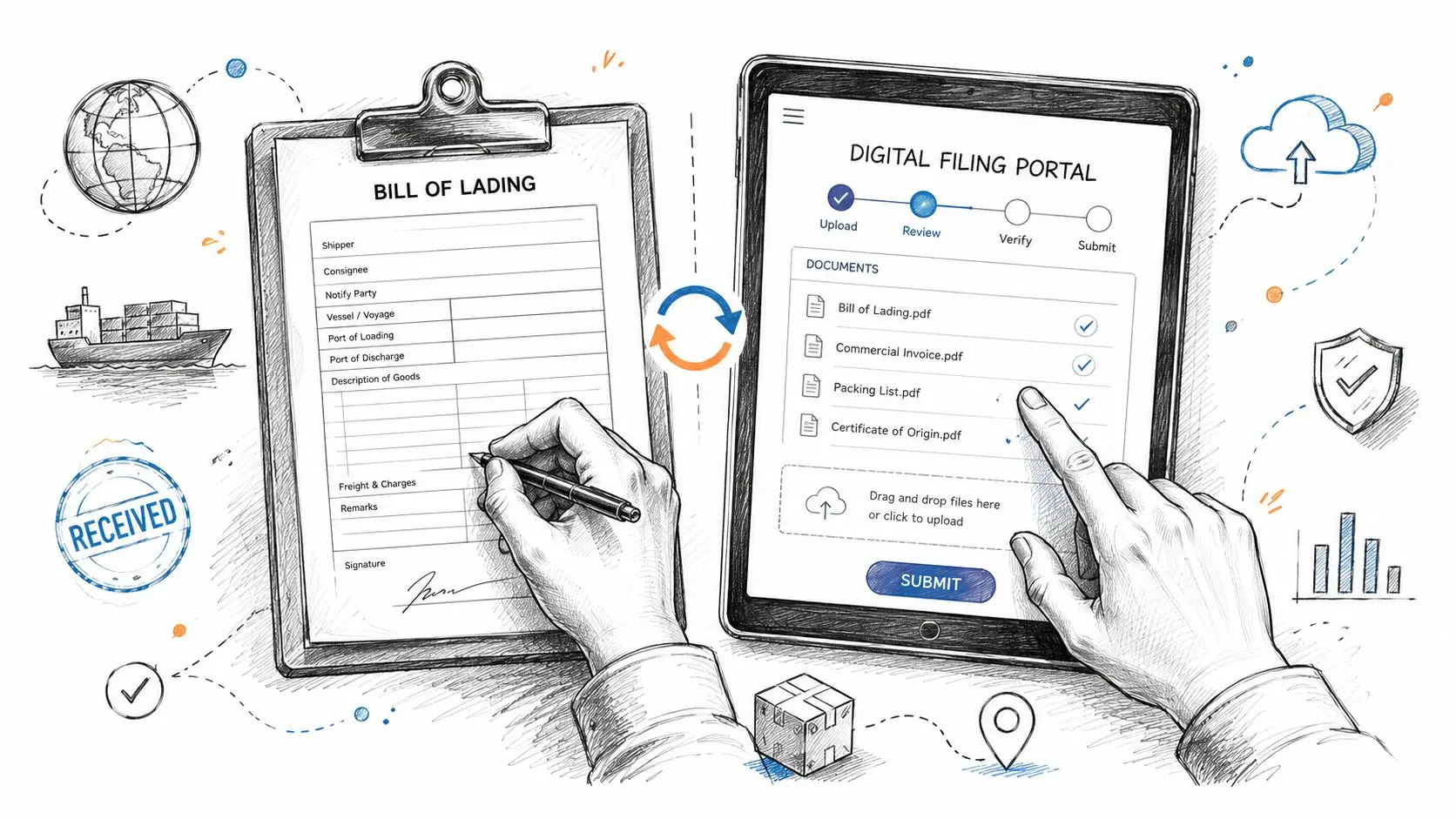
Paperless trade doesn’t eliminate compliance work. It moves that work into data design, system compatibility, electronic signatures, and exception management.
OECD research identifies four connected requirements for paperless trade: digitised documents, digitalised processes, standardised data elements, and enabling regulation. It also estimates that a 10% improvement in automating border procedures, streamlining documentation, and strengthening inter-agency cooperation could boost global goods exports by up to 18%. The OECD analysis of digital trade documents supports the broader direction, but exporters still need practical controls.
Control the data before choosing the format
An electronic record can reproduce a bad invoice faster than a paper process. The exporter should therefore establish a master data set first, then determine how each authority receives it.
Keep the following fields identical across paper and electronic versions:
- Commercial identity: Seller, buyer, exporter, consignee, and notify party.
- Cargo identity: Description, quantity, package type, marks, and classification.
- Financial data: Currency, value, charges, and Incoterms.
- Movement data: Carrier, route, port, transport mode, and shipment date.
- Regulatory references: Licences, certificates, declarations, and filing numbers.
Manage mixed workflows deliberately
A mixed workflow needs a rule for the controlling version. If a customs portal receives an electronic declaration and the carrier holds a paper invoice, both versions must derive from the same approved record.
Electronic signatures require separate validation. The exporter should confirm whether the destination authority recognises the signature type, certificate issuer, timestamp, and document integrity. If uncertainty remains, preserve the signed electronic file and the applicable paper alternative.
Retain the minimum complete evidentiary package, including system confirmations, submission receipts, version history, and any physically presented document.
Common Documentation Failures and Their Consequences
Export failures usually begin with an assumption that looked reasonable at order entry. The consequences appear later, often after the goods leave the warehouse.
A certificate of origin may be missing because the team treated it as optional. Customs then holds the shipment while the exporter seeks certification, and the importer may lose access to expected tariff treatment.
A second failure occurs when customs proof and tax proof diverge. The customs declaration confirms export, but the tax file lacks the evidence needed for a VAT-free treatment. The exporter then faces an audit dispute even though the shipment crossed the border lawfully.
Three recurring breakdowns
- Classification gaps: An invoice omits the preferred HS code or uses a vague description. The broker applies a different classification, which can create duty, licensing, or inspection questions.
- Physical inconsistencies: The packing list shows different weights or package counts from the bill of lading. The carrier or customs officer flags the mismatch and delays release.
- Validity failures: A permit expired before dispatch, or a certificate covered a different shipment. The remaining documents cannot cure that defect.
Another common problem involves delegated filing. The exporter assumes the forwarder checked the data, while the forwarder relies on the exporter’s commercial description. Neither party verifies the final electronic submission.
The cure is not another generic checklist. The cure is ownership. One person should approve the source data, one party should confirm the filing, and the file should preserve the submission evidence.
Audit reality: Completeness means proving the transaction, not merely producing a stack of familiar forms.
Strategic Documentation Design for Cross-Border Trade
Defensive over-documentation often feels safer, but it can increase contradiction risk. The stronger strategy selects the minimum evidentiary package that withstands customs, tax, transport, and regulatory review.
That package begins with a requirements map. The exporter identifies each authority, then records the document or data element that satisfies its rule. The map should also show which record serves multiple purposes and which evidence only supports a narrow claim.
Design for the entire transaction
A commercial invoice may support customs valuation and tax analysis. A packing list may support inspection and carrier reconciliation. A certificate of origin may support tariff treatment, but it won’t automatically prove every product or tax condition.
Translations require the same discipline. A translated document should preserve identifiers, quantities, dates, legal names, and certification details. For regulated transactions, certified notarised translation and apostille handling may become relevant, particularly when foreign authorities require formal proof rather than an informal translation.
RNC Group offers legal analysis, multilingual document support, and guidance on Israeli import documentation, including import legality certificates and technical documentation such as specifications, manufacturer declarations, quality reports, and international certifications. The firm can also coordinate cross-border legal execution when Israeli and foreign requirements overlap.
Use the WTO baseline intelligently
The WTO framework supports simplified and electronic documentation, but it doesn’t create one universal export file. Exporters still need to test the destination’s actual portal, agency practice, tax evidence rules, and product controls.
The recommended strategic path is:
- Map the corridor: List every origin and destination obligation.
- Control the data: Establish one approved source record.
- Separate functions: Distinguish customs, tax, transport, origin, and product evidence.
- Confirm formats: Record electronic, paper, signature, language, and presentation rules.
- Test exceptions: Verify alternative evidence before relying on it.
- Preserve the trail: Retain submissions, acknowledgements, versions, and approvals.
This approach avoids both careless minimalism and needless paperwork. It gives the exporter a file that works at the border and remains defensible during later review.
RNC Group advises Israeli companies and international businesses on cross-border documentation, regulatory evidence, multilingual execution, and commercial risk. To avoid costly mismatches between customs clearance and tax proof, visit RNC Group or contact the firm directly now.
This article provides general information only and doesn’t constitute legal, tax, customs, or regulatory advice. Requirements vary by goods, jurisdictions, agencies, and transaction facts, so readers should obtain qualified advice before relying on any documentation process.