
For anyone venturing into Israel’s energetic tech scene, the real starting point isn’t the first line of code or the final business plan. It’s a crucial legal document. A founders agreement in Israel is the strategic pact that aligns partner relations, locks down intellectual property, and lays the groundwork for future investment and serious growth.
Building Your Startup on Bedrock, Not Sand
That blank page feeling of a new venture is a mix of pure excitement and sheer terror. For founders, the very first blueprint you draw up together is the founders’ agreement. Think of it less as a legal chore and more as the constitution for your partnership. It’s what defines how you’ll work together, protects your most valuable assets, and smooths the path for bringing investors on board later.

This guide is specifically for international founders, corporate VCs, and local entrepreneurs who are navigating that unique space where Silicon Valley ambition meets Israeli legal reality. Our goal is simple: to break down the core components of a solid agreement so you can sidestep the common disputes that sink even the most promising startups.
Getting Everyone Pointing in the Same Direction
Long before you’re debating product features, you need to agree on the fundamentals of your partnership. A well-thought-out agreement forces these tough conversations right at the start, ensuring you’re all aligned on what truly matters. It’s about turning potential blow-ups down the road into clear understandings today.
Here are the big questions you need to tackle early:
- Equity Split: How are we slicing the ownership pie, and what’s the logic behind it?
- Roles & Responsibilities: Who has the final say on tech? On marketing? On finance?
- Commitment: What are the real expectations for everyone’s time and effort? Is this a full-time gig for everyone?
- What If…?: What’s the plan if a founder wants out, or if we get an acquisition offer?
Creating an Investor-Ready Structure
Let’s be blunt: investors comb through a company’s legal paperwork before they even think about writing a check. If you’re missing a founders’ agreement or have a flimsy one, it’s a massive red flag. It screams internal instability and future legal headaches. A strong agreement, on the other hand, shows you’re professional, serious, and have your act together.
To get this done efficiently, you might even look at modern tools that help streamline the process, like platforms offering AI for drafting founders’ agreements.
A founders’ agreement isn’t about planning to fail; it’s about building a structure that’s strong enough to succeed. It ensures your company can handle rapid growth and unexpected bumps, making you a much safer—and more attractive—bet for investors.
Ultimately, this document is the cornerstone of your entire venture. It’s where you clarify who does what, secure your IP, and set up vesting schedules. These aren’t just details; they’re the essential building blocks for a durable business ready to compete in Israel and on the world stage. That initial investment in legal clarity will pay for itself time and time again.
Defining Who Does What to Avoid Future Conflicts
One of the fastest ways for a promising startup to implode is ambiguity over roles. The initial “we all do everything” energy is great, but it’s a recipe for disaster down the line. A solid founders agreement in Israel goes way beyond slapping ‘CEO’ and ‘CTO’ titles on business cards; it creates a clear charter of duties and defines the separation of roles between key partners.

This isn’t about creating corporate bureaucracy. It’s about strategic clarity. It forces you to have those structured conversations early on to determine who has the final say—the CEO on business strategy or the CTO on the technical roadmap. This process turns handshake agreements into legally binding clauses, building a foundation strong enough to withstand the high-pressure moments every startup faces.
Getting these roles clearly defined isn’t just for internal peace; it’s a critical piece of corporate governance that investors will absolutely scrutinize before writing you a check.
From Titles to a Charter of Duties
A title is not a job description. Sure, the ‘CEO’ might be the visionary and chief fundraiser, and the ‘CTO’ leads the tech team. But who has the final word on the product roadmap? Who can sign off on expenses over a certain amount? Who hires and fires key people? These aren’t minor details—they’re the very gears of your company.
Your founders’ agreement needs to answer these questions head-on. Think of it as creating a “decision-making matrix” for all the core functions of your business.
This charter should clearly spell out:
- Domain Ownership: Pinpoint which founder is the ultimate authority for specific areas like technology (CTO), sales (CEO), marketing, finance, and operations.
- Spending Authority: Set clear financial limits. For example, any founder can approve expenses up to $5,000, but anything more requires a majority or even unanimous vote.
- Hiring and Firing Power: Outline who makes hiring decisions for different teams and what level of agreement is needed for executive roles or terminations.
- Strategic Direction: Decide how you’ll handle major strategic pivots, like entering a new market or overhauling the business model.
By putting this down on paper, you’re not just defining roles; you’re building a practical, actionable governance structure. This foresight is what stops power struggles and decision-making gridlock when the stakes are highest.
The Investor Perspective on Defined Roles
When investors perform due diligence, they aren’t just betting on your tech or market size; they are investing in you—the founding team. An agreement with clearly defined roles signals that you’re a mature, professional team that has already thought through potential friction points.
Investors look for a clear chain of command. Ambiguity is a massive red flag, suggesting a high risk of internal disputes that could easily derail the company. A founders agreement that shows exactly who is accountable for what—from the CEO to the CTO—gives them the confidence that your company has a stable foundation, can execute its plan, and can manage their capital effectively. This documented clarity can make or break a funding decision.
Ultimately, this exercise isn’t about restricting founders. It’s about empowering them. When everyone knows their exact responsibilities and the boundaries of their authority, they can move fast and with confidence. This clarity is the bedrock of an efficient, scalable, and resilient company ready for the challenges ahead.
Securing Your Startup’s Most Valuable Asset
Imagine pouring your life savings into building a skyscraper, only to find out you don’t actually own the land it’s built on. It sounds absurd, but that’s precisely what happens when founders skip over the Intellectual Property (IP) assignment clause. This part of your founders agreement in Israel isn’t just another legal formality; it is the strategic mechanism that ensures the company, not the individual founder, owns the code and IP that constitute its entire valuation.
Without it, you’re building on borrowed ground.

This issue stems from a critical default in Israeli law that can be fatal for early-stage startups. Unless you have an explicit, written agreement stating otherwise, any IP a founder creates before the company is officially incorporated remains their personal property. This includes every line of early code, the initial business plan, product designs, and any proprietary concepts developed when the venture was just an idea.
A well-drafted IP assignment clause is the legal instrument that fixes this. It acts as an irrevocable deed, transferring all relevant innovations and trade secrets—both past and future—from the individual founders to the company itself. For any founder, especially those dealing with international investors, this is non-negotiable. It creates the clean “chain of title” that every serious angel investor and VC will demand to see.
The Default Ownership Trap in Israeli Law
In some countries, work done “in anticipation” of forming a company might automatically belong to that future company. Not in Israel. The law here is far more formal, creating a dangerous trap for unwary founders.
Let’s say your CTO writes the initial 50,000 lines of code for your core product on their personal laptop before the company is legally registered. Under Israeli law, that code belongs to them, not the startup. This single point creates a catastrophic vulnerability.
The company might operate for months or even years, building its entire business on that foundational code, only to discover it doesn’t legally own its most critical asset. This ticking time bomb almost always explodes during due diligence for an investment round or an acquisition, bringing the deal to a screeching halt. No investor will put a single shekel into a company that doesn’t unequivocally own its core technology.
A founders’ agreement retroactively and prospectively corrects this. It ensures that all work related to the venture, from the first brainstorm to the latest software update, is legally owned by the corporate entity, securing its value for all shareholders.
Crafting an Ironclad IP Assignment Clause
An effective IP assignment clause has to be airtight. Simply saying “all IP belongs to the company” won’t cut it. To meet Israeli legal standards and eliminate any gray areas, the clause must explicitly cover several key areas.
- Pre-existing IP: It must clearly state that any intellectual property created by any founder related to the company’s business before its official incorporation date is hereby assigned to the company. This closes the most dangerous loophole.
- Future IP: The clause also needs to cover all future IP created by founders during their time with the company. This ensures a continuous and unbroken chain of ownership as the company grows.
- Moral Rights Waiver: In Israel, creators have certain “moral rights” (like the right to be credited for their work) which are distinct from economic ownership. The agreement should include a waiver of these rights, as far as the law allows, to prevent a departing founder from making future claims that could disrupt how the company uses its own IP.
What Must Be Assigned to the Company
To truly protect your venture, the agreement must be specific about what counts as “Intellectual Property.” A vague definition leaves the door open for future fights.
A clear founders’ agreement creates a night-and-day difference in who owns the company’s core assets. The table below illustrates just how critical this shift is.
IP Ownership Before and After Your Founders Agreement
| Scenario | Without a Founders’ Agreement | With a Proper Founders’ Agreement |
|---|---|---|
| Pre-Incorporation Code | The founder personally owns the code, essentially licensing it (perhaps unintentionally) to the company. This is a massive risk. | The code is irrevocably transferred to the company, establishing a clean and defensible title from day one. |
| Business Plans & Strategy | Considered the personal work product of the individual founder. This could be disputed or even taken by a departing founder. | All strategic documents and business plans related to the venture become the exclusive property of the company. |
| Domain Names & Trademarks | Often registered in a founder’s personal name, creating ownership ambiguity and the potential for a “hostage” situation later. | Ownership is formally assigned to the corporate entity, ensuring the company—not an individual—controls all brand assets. |
| Future Innovations | Ownership of new ideas or product improvements can become a point of contention, especially if a founder leaves on bad terms. | All future work created by a founder within the scope of the business is automatically and legally owned by the company. |
For international investors and potential acquirers, a pristine IP record isn’t a “nice-to-have”—it’s a requirement. A meticulously drafted founders agreement is the only way to deliver this certainty. It transforms your startup’s most valuable ideas from personal assets into corporate bedrock, ready to support massive growth and investment.
Understanding Reverse Vesting in the Israeli Tech Scene
If you’re a founder coming from Europe or parts of Asia, the term “reverse vesting” might sound a bit backward. But in Israel, just like in Silicon Valley, it’s not just common—it’s the absolute standard for nearly every serious founders agreement. This mechanism acts as a powerful insurance policy for your startup, ensuring long-term commitment from every partner and protecting the company from a catastrophic problem known as “dead equity.”
It works differently from the vesting you might be used to. Instead of earning shares over time, founders are granted all their shares on day one. The “reverse” part is the company’s right to buy back a portion of those shares if a founder decides to leave the venture too early. It’s a strategic safeguard that keeps everyone’s interests aligned for the long haul.
The Standard Israeli Vesting Schedule
So, what does this look like in practice? The most common setup you’ll see is a four-year vesting schedule with a one-year “cliff.” Let’s break that down.
- Four-Year Vesting Period: Over four years, the company’s right to repurchase your shares gradually disappears. After the first year, this usually happens on a monthly or quarterly basis.
- One-Year Cliff: This is the make-or-break milestone. For the first 12 months, none of your shares are truly “safe.” If you leave before your one-year anniversary, the company can buy back 100% of your shares, often for the tiny price you initially paid. Once you hit the one-year mark, boom—25% of your total equity is officially yours, free and clear from the company’s buyback right.
This structure is a powerful incentive. It pushes founders to stick together through that chaotic first year, ensuring that someone who bails after just a few months doesn’t walk away with a huge chunk of a company they are no longer building.
Preventing the “Dead Equity” Problem
The real strategic genius behind reverse vesting is that it solves the “dead equity” nightmare. Picture this: two founders each own 50% of a company. One of them leaves after six months. Without a vesting schedule, they still own half the company.
Suddenly, the startup is paralyzed.
- Future Fundraising: No investor in their right mind will pour money into a company where a ghost founder, who adds zero value, holds a massive equity stake.
- Attracting Talent: The company’s equity pool is now crippled. How can you possibly attract a new co-founder or a top-tier executive when there’s no meaningful equity left to offer?
Reverse vesting is the surgical solution. It allows the company to reclaim unvested shares from the departing founder, cleaning up the cap table and freeing up that precious equity to fuel future growth.
Key Negotiation Points in Vesting Clauses
While the four-year schedule with a one-year cliff is standard, the devil is in the details. These terms are negotiable and need careful thought when drafting your founders agreement in Israel. One of the most critical points to hammer out is the “acceleration” clause.
An acceleration clause determines what happens to your unvested shares if the company gets acquired (a “change of control” event). There are two main flavors:
- Single-Trigger Acceleration: The moment the company is sold, all your unvested shares vest immediately. This is obviously fantastic for founders, but it’s become less common. Why? Because acquirers want the founding team to stick around, and immediate vesting reduces that incentive.
- Double-Trigger Acceleration: This is the current market standard and what you should push for. Your vesting only accelerates if two things happen: (1) the company gets acquired, AND (2) you are terminated without cause (or you resign for a “good reason,” like a massive pay cut) within a set period, usually 12 months after the deal closes. This protects you from being acquired and then immediately fired by a new owner who just wants your equity back.
In today’s volatile market, these protections are more important than ever. In 2023, data showed a sharp drop in up-rounds for Israeli tech, with non-up rounds approaching 50% when you factor in unreported SAFEs. In this climate, a solid founders agreement in Israel isn’t just a formality; it’s a defensive shield. Provisions like acceleration clauses become non-negotiable lifelines. You can find more on these market trends in Calcalistech’s analysis of S Cube/IBI and Mitar data.
At the end of the day, reverse vesting isn’t about punishing anyone. It’s a vital governance tool that protects the company, the founders who stay, and the investors who will join later. It contractually ensures that significant ownership is tied directly to sustained contribution—keeping the venture agile, investable, and ready for success.
Why Do So Many Israeli Startups Incorporate in Delaware?
If you’re an international founder or investor looking at Israel’s tech scene, you’ll quickly notice a curious trend. A company might have its entire world-class R&D team in Tel Aviv, but its legal parent company is officially based thousands of miles away in Delaware, USA. This isn’t just a quirk; it’s a calculated, strategic play designed to perfectly align the startup with the expectations of global capital markets, especially in the United States.
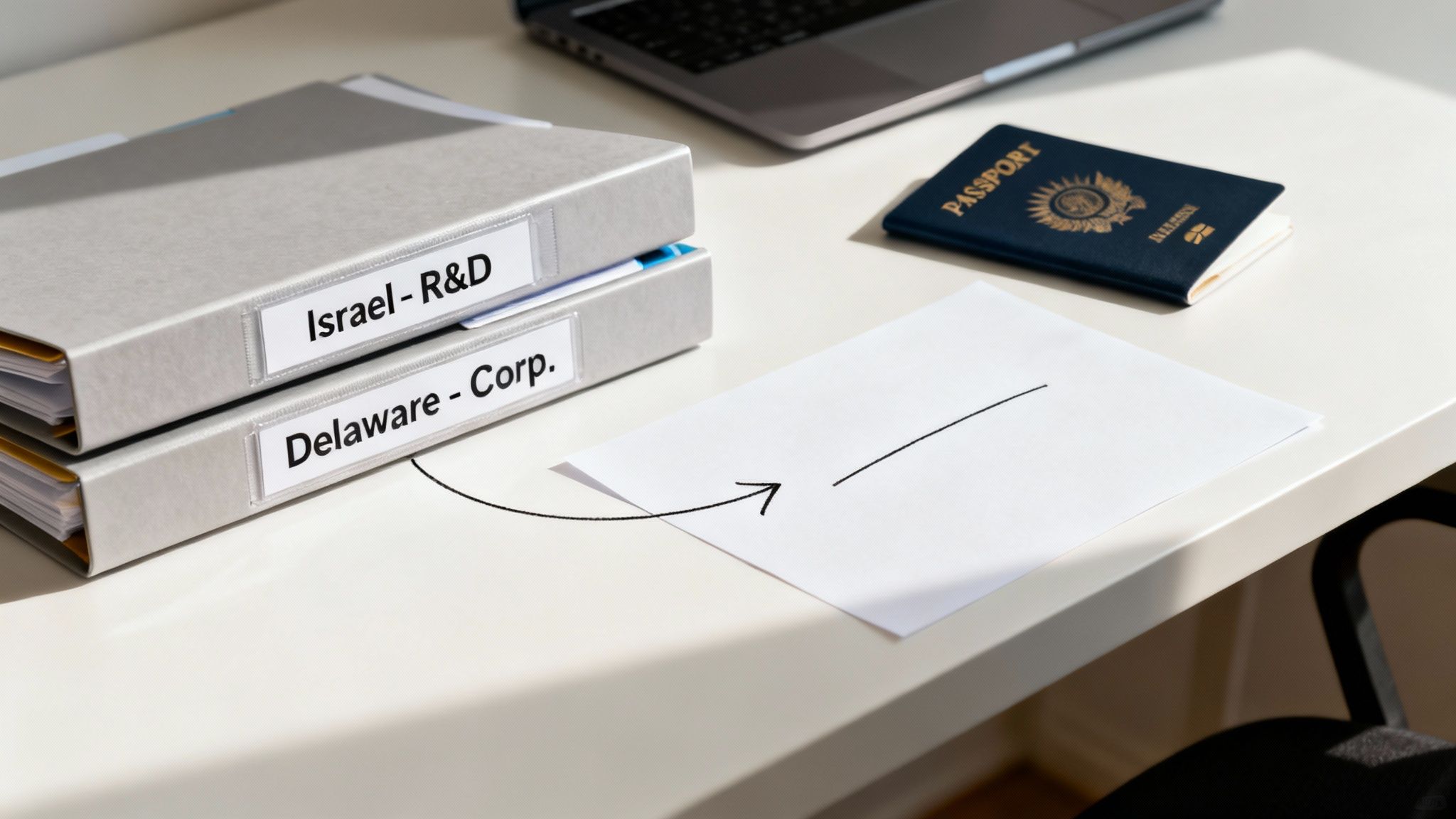
This dual-jurisdiction setup comes down to one core driver: investor comfort. American venture capital funds, a massive source of capital for Israeli startups, know Delaware corporate law inside and out. Its predictability, flexibility, and deep well of legal precedent create a stable, familiar playground for investment, governance, and future exits like an IPO or acquisition.
The Allure of Delaware Law for VCs
Delaware’s legal framework is practically built for the complex, fast-moving world of high-growth, venture-backed companies. For investors, it’s the gold standard. It simplifies their due diligence and standardizes the mechanics of putting money into a company.
This preference bleeds directly into fundraising itself. Think about popular fundraising tools like the Simple Agreement for Future Equity (SAFE), pioneered by Silicon Valley’s own Y Combinator. SAFEs are built on the bedrock of Delaware law. While you can adapt them for an Israeli company, they operate most smoothly in their native habitat—a Delaware C-Corporation. For startups, this means a far more fluid and less complicated fundraising process.
Choosing to incorporate in Delaware is often a strategic decision to speak the native language of international venture capital. It removes potential friction points in fundraising and signals to US investors that the company is built from day one for global scale and a potential US market exit.
This isn’t just a niche strategy; it’s becoming the norm. A 2023 study by Fusion VC dropped a bombshell statistic: a staggering 80% of the 900 new startups in Israel chose to incorporate in Delaware. This data points to a clear and deliberate pivot. It means that for any foreign executive or investor, the founders agreement israel is now almost always a hybrid document from the very beginning, one that must balance Delaware corporate governance with Israeli operational laws. You can read more about these findings in this Globes article.
Harmonizing Two Legal Worlds in One Agreement
This structure creates a fascinating legal puzzle that your founders’ agreement is tasked with solving. The document essentially becomes a bridge, harmonizing two completely different legal systems. The Delaware parent company handles the big corporate picture—stock issuance, board structure, shareholder rights. Meanwhile, the Israeli subsidiary deals with the on-the-ground reality.
This means your agreement needs to be surgically precise in addressing:
- Corporate Governance: Clauses covering share issuance, vesting schedules, and board control must fall squarely within the lines of Delaware General Corporation Law.
- Employment and IP: On the other hand, all founder employment terms, and critically, the intellectual property assignment clauses, must be rock-solid under Israeli labor and contract law to be enforceable.
Pulling this off requires specialized legal expertise. The goal is a seamless corporate entity that runs efficiently in Israel but is perfectly polished for investment and growth on the global stage. For Israeli founders heading down this path, this comprehensive guide on opening foreign subsidiary companies in the USA offers some essential insights into the process.
Ultimately, getting your head around this Delaware-Israel structure is a must for any international founder or investor who wants to build a scalable, investment-ready global company powered by Israeli innovation.
From Handshake to Blueprint: Why Your Agreement is More Than Just Paper
Let’s be honest. The real magic of a founders’ agreement in Israel isn’t buried in legal jargon. Its true power lies in the process itself. This is your first, and arguably most important, strategic planning session—the moment you and your co-founders sit down and turn abstract ideas into a concrete game plan.
Think of it as the blueprint for the entire venture. This process forces you to have the tough, “what-if” conversations before they spiral into full-blown crises. It’s where you translate the excitement of a new idea into a resilient operational charter. By defining roles, you ditch ambiguity. By assigning IP, you protect the company’s crown jewels from day one. And with a fair vesting schedule, you make sure everyone is buckled in for the long haul.
A Living Document, Not a Dusty File
One of the biggest mistakes founders make is treating this agreement as a one-and-done task. File it away and forget it, right? Wrong. Your founders’ agreement should be a living document that grows with your company.
As your startup hits new milestones—launching a product, entering a new market, or raising that first round of funding—this agreement is the stable governance structure that lets you navigate those changes without derailing the whole operation. It also gets you ready for the sharp realities of Israel’s funding scene. Investors today expect a level of maturity that was once reserved for later-stage companies.
Consider this: In 2024, the median pre-seed round in Israel climbed to $825K. Even more telling, 51% of those VC-led deals were structured as pure SAFEs—a big leap from 42% in 2023. This shows investors want to minimize early dilution, but it also signals they expect a rock-solid corporate foundation right out of the gate.
A well-crafted founders’ agreement is your proof of that maturity. It shows you’ve anticipated what investors will demand long before you’ve even built your first pitch deck. You can get a deeper look into these funding dynamics in the full pre-seed stage report from Fusion VC.
Don’t Just Hire a Lawyer—Partner with a Strategist
Finally, remember that the success of this blueprint hinges on who helps you build it. You don’t just need a lawyer who knows Israeli regulations; you need a strategic partner who gets the startup grind.
Your legal counsel should be a facilitator, guiding you through the uncomfortable but critical conversations and ensuring the final document is a true reflection of your shared vision. This isn’t just an expense; it’s a strategic investment in clarity. It’s what ensures your partnership is built not just on a brilliant idea, but on a foundation of mutual trust and legal certainty, ready for whatever comes next.
Common Questions We Hear About Israeli Founders Agreements
When you’re launching a new venture, the legal paperwork can feel overwhelming. For founders coming from abroad to tap into the Israeli tech scene, getting clear, straightforward answers is everything. Here are some of the most frequent (and critical) questions we get about crafting a founders agreement in Israel.
What Happens If We Don’t Have a Founders Agreement in Israel?
Trying to run a startup without a founders agreement is like setting sail in a storm without a map. It’s a high-risk gamble that leaves your company legally exposed. Without a specific contract spelling things out, you’re automatically governed by Israel’s general partnership or corporate laws—laws that were never designed for the fast-paced, high-stakes world of a tech startup.
This immediately creates some massive blind spots:
- Who owns the IP? Without a written agreement, the ownership of the code, designs, and core ideas developed before the company was even formed becomes a legal grey area. This puts your most valuable assets at risk.
- What’s the equity split? Handshake deals on who owns what percentage are notoriously difficult to enforce. This ambiguity is a recipe for future disputes over ownership and who really calls the shots.
- What if a founder leaves? If a co-founder decides to walk away, the absence of a clear plan can throw the entire company into chaos, creating a leadership vacuum and a messy cap table that will scare off any serious investor.
Ultimately, a company without this foundational document is virtually un-investable. Sophisticated investors won’t put a single dollar into a venture until they see a clean, well-documented corporate structure.
Can We Just Use a Standard US Template for Our Israeli Company?
This is a classic mistake we see all the time. Grabbing a generic US template off the internet and applying it to your Israeli company without expert legal input is a recipe for disaster. While it might seem like a quick fix, these documents are completely ignorant of the specific nuances of Israeli corporate, employment, and intellectual property laws.
A perfect example is IP assignment. To be enforceable in Israel, the clauses that transfer IP from the founders to the company must be worded in a very specific way that complies with Israeli contract law. Similarly, any rules about a founder’s salary or role must align with local labor regulations, which look very different from their US counterparts.
For a Delaware C-Corp with its main operations in Israel—a very common setup—the only smart move is a hybrid approach. You need a lawyer with genuine cross-border experience who can draft a custom founders agreement that perfectly syncs up both legal systems.
When Is the Best Time to Create a Founders Agreement?
The answer is simple: right at the very beginning. Do it before you’ve written a single line of code, before you’ve developed any significant IP, and absolutely before you start talking to investors.
Drafting the agreement on day one forces the founding team to have those crucial, sometimes uncomfortable, conversations when everyone is still on the same page and excited about the future. Getting clarity on equity splits, roles, commitments, and what happens if someone leaves is the best way to prevent blow-ups down the road. Waiting until an investor is ready to write a check or a fight has already broken out creates toxic power dynamics and can sink the entire company before it even gets started.
This article does not constitute legal advice and is not a substitute for consulting with a qualified attorney. Do not rely on the contents of this article for taking or refraining from taking any action.