
A franchise agreement termination rarely fails because nobody found a breach. It fails because the parties used the wrong clause, served defective notice, miscalculated the cure period, or ignored the wind-down rules. The foundational study of 68 franchise systems recorded 315 terminations during the period from 1995 to 1998, with franchisors initiating 37%, franchisees initiating 29%, and both sides initiating 34% of exits (franchise termination study). Termination therefore operates as both an enforcement device and a negotiated commercial exit.
For a foreign franchisor or franchisee, the decisive question isn’t merely whether someone breached the agreement. The key question is whether the party sequenced clause, notice, cure, enforcement, and wind-down in the correct jurisdiction.
The Hidden Anatomy of Franchise Agreement Termination in 2026
Most cross-border franchisors lose termination fights during the cure window, not during the final hearing. A court often examines the procedural record before it decides whether the underlying default justified ending the relationship.
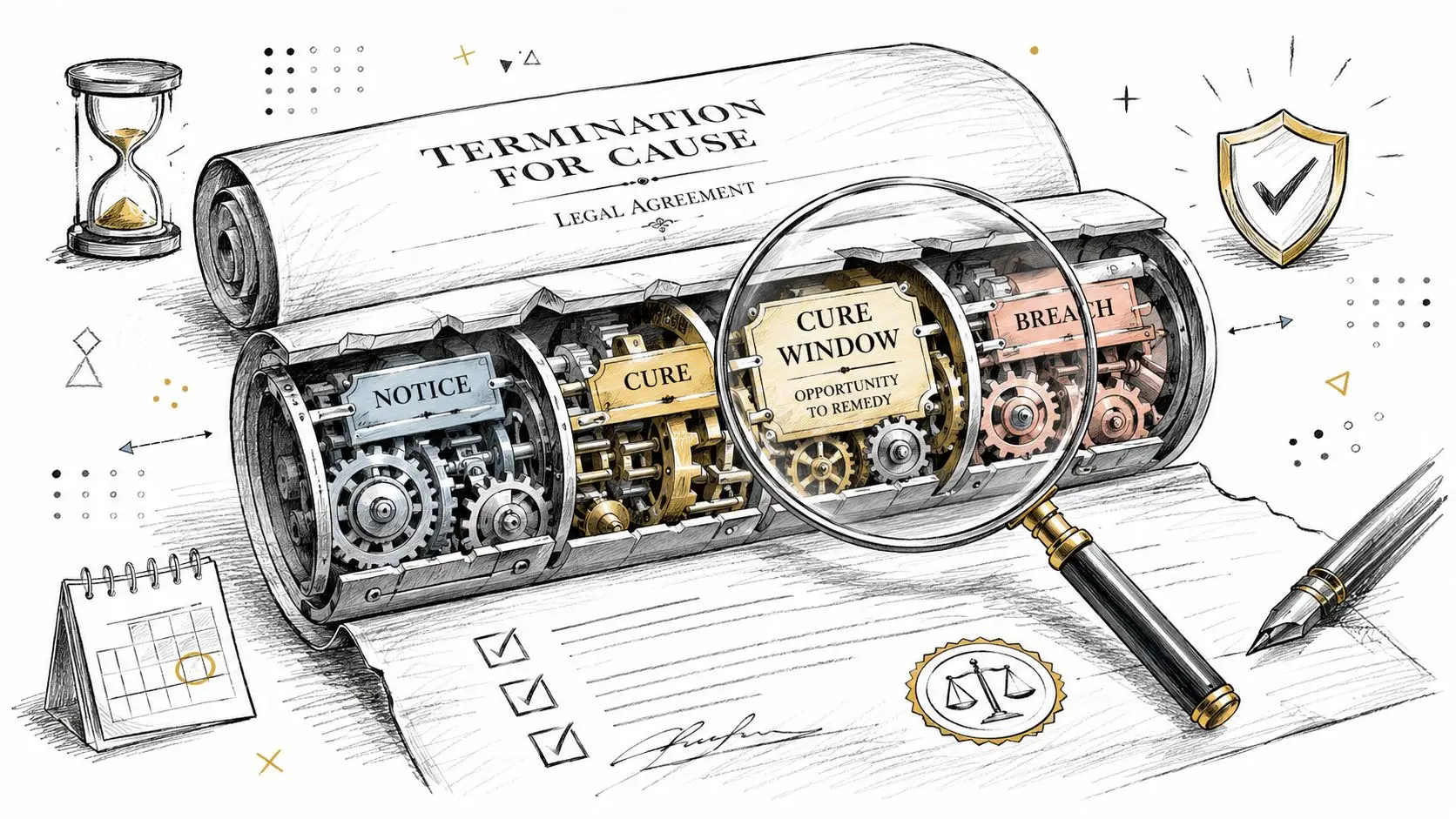
The five stages that control leverage
The first stage is clause design. The agreement must identify defaults, cure rights, immediate termination events, renewal conditions, notice addresses, governing law, and post-termination duties. Vague drafting gives the opposing party room to argue that the alleged default falls outside the termination mechanism.
The second stage is notice mechanics. The sender must use the contractual service channel and satisfy mandatory statutory requirements. A notice that proves misconduct but fails to state the cause, identify the clause, or provide the required cure opportunity may still fail.
The third stage is cure compliance. The recipient needs a clear account of what must change, while the sender must avoid moving the target. Courts often assess whether the notice allowed a realistic remedy rather than merely announcing an inevitable exit.
Practical rule: Treat the notice as a litigation document, not as an angry business letter.
The fourth stage is enforcement posture. A franchisor may seek an injunction, suspend access to systems, demand brand removal, or commence arbitration. A franchisee may seek continued operation, preserve customer access, or challenge the termination before the effective date.
The fifth stage is wind-down execution. The parties must address trademarks, signage, inventory, data, confidential materials, employees, suppliers, and customer communications. A valid termination can still produce avoidable liability if the parties mishandle these steps.
Why foreign parties misread the framework
Cross-border clients often assume that a strong contractual termination clause controls everything. It doesn’t. The Federal Petroleum Marketing Practices Act illustrates the layered approach in the United States, where federal notice rules can interact with state franchise protections and the agreement itself.
Post-2025 reforms also narrow the value of broad post-termination restraints. Virginia will prohibit franchise agreements from restricting a franchisee’s right to operate after termination or expiration, effective July 1, 2026 (Virginia franchise law amendments). The strategic map now favors precise brand protection over blanket restraints.
Grounds for Ending a Franchise Relationship
Termination is a sequence, not a single breach event. The analysis starts with the legal ground, then tests the clause, notice, cure, enforceability, and eventual wind-down. Four grounds recur in international franchise disputes, but courts apply them through different statutory rules, contract principles, and insolvency regimes.
Contractual termination rights
A franchise agreement may permit termination after an ownership change, loss of approved premises, unauthorized transfer, missed performance thresholds, or repeated reporting failures. The franchisor must connect the event to the exact clause and prove every required trigger. A general termination provision rarely substitutes for the specific default provision that governs the conduct.
A foreign franchisee should examine the agreement for corresponding exit rights after franchisor failure. Persistent supply interruption, failure to protect intellectual property, or material misrepresentation may support termination if the contract and governing law allow it. The same document may give the parties different notice periods, cure opportunities, and evidentiary burdens, so the analysis must be bilateral rather than franchisor-focused.
Material breach
Some legal systems ask whether the breach substantially undermined the bargain. Others give greater weight to enumerated defaults and the parties’ agreed procedures. Payment failure, unauthorized use of marks, inaccurate sales reporting, and failure to follow operating standards usually create the clearest factual record.
A legal analysis of 342 franchise termination disputes identified failure to pay and failure to comply with the franchise agreement as recurring grounds. It reported that 30.7% of disputes involved breach of contract, performance standards, or agreement noncompliance, while 14.3% involved another broad termination category (analysis of franchise termination disputes). The analysis also found courts were more than 12% more likely to reach a good-faith or good-cause outcome in failure-to-pay cases. Those figures do not replace a clause-by-clause review, but they show why payment records and compliance reports often decide the factual narrative.
Insolvency
Insolvency clauses create a separate problem because the franchisor may seek immediate control over the brand, premises, and customer relationships while bankruptcy law restricts enforcement based solely on insolvency, particularly during reorganization.
The practical question is whether termination depends only on the filing or rests on independent defaults, such as unpaid fees, abandonment, or unauthorized operational control. That distinction affects both timing and enforceability. European jurisdictions may also treat pre-pack restructuring differently, so a multinational network should obtain local advice before issuing a default notice or relying on an insolvency trigger.
Frustration of purpose
Frustration arguments arise when an external event destroys the commercial purpose of the arrangement. A regulatory ban on the product category may qualify in some systems. A force-majeure event may instead suspend performance without automatically ending the franchise.
Pandemic-era disputes continue to illustrate the difference between temporary hardship and permanent impossibility. The party seeking termination must connect the event to the contract’s allocation of risk, its duration, and the affected performance obligations. Courts may also examine whether the agreement provides a specific suspension, hardship, or renegotiation mechanism before accepting termination.
| Grounds | US | England | France | Germany | Singapore |
|---|---|---|---|---|---|
| Contractual right | Courts focus on the agreement and applicable franchise statutes. | Courts examine contractual construction and repudiatory breach principles. | Mandatory rules may restrict contractual freedom. | Good-faith principles can affect enforcement. | Courts examine the agreement alongside statutory and equitable principles. |
| Material breach | Payment and compliance defaults often provide the clearest record. | Serious breach usually matters more than minor noncompliance. | Contractual and statutory protections may require careful sequencing. | Proportionality and good faith can influence termination. | The agreement and commercial context remain central. |
| Insolvency | Bankruptcy protections can limit termination based solely on insolvency. | Insolvency consequences depend on the restructuring context. | Restructuring rules may affect enforcement. | Insolvency law can reshape contractual remedies. | Local insolvency rules may affect termination and enforcement. |
| Frustration | Contract language and statutory rules allocate the risk. | Frustration requires a fundamental change, not ordinary difficulty. | Force-majeure and hardship concepts may apply differently. | Impossibility and disruption doctrines require close analysis. | The court examines whether the purpose became impossible or radically different. |
Notice and Cure Mechanics That Decide the Outcome
A termination fight is usually decided before the termination date. The sequence is clause, notice, cure, enforcement, and wind-down. A valid breach can still produce an unenforceable termination if the franchisor identifies the wrong clause, misses a statutory period, or serves an incomplete notice.

Build the notice around five questions
A defensible default notice should answer:
- What happened? Identify the conduct, relevant dates, locations, and supporting records.
- Which clause applies? Cite each contractual provision, including any notice, cure, audit, or immediate-termination language.
- Which statute applies? Check franchise, petroleum, commercial, insolvency, and local notice rules before setting the deadline.
- What cure is required? State the payment, documents, training, operational change, or other corrective action required.
- When does the period end? Explain the calculation method and state the proposed effective date.
Use the agreement’s service clause exactly. Email may be fast, while the contract may require courier delivery, registered mail, personal service, or delivery to a named address. Preserve delivery evidence, receipt confirmations, translations, and every attachment. In a cross-border dispute, an untranslated notice or defective service can become the first issue the court decides.
Statutory floors override casual drafting
United States termination rights often combine the agreement with mandatory statutory notice and cure rules. The Petroleum Marketing Practices Act generally requires at least 90 days’ notice before termination or nonrenewal, and 180 days’ notice for certain motor-fuel withdrawals (federal termination notice requirements).
State laws may impose cure or wind-down periods ranging from 60 to 90 days, and some can override the contract (state franchise termination survey). California generally requires 60 days’ advance notice plus a cure period generally not shorter than 60 days. Connecticut generally requires 60 days’ written notice stating cause, subject to narrow exceptions.
Connecticut treats nonrenewal separately. Nonrenewal may require six months’ notice, while voluntary abandonment may permit 15 days’ notice. Qualifying criminal convictions may support immediate notice (Connecticut franchise statute). Indiana generally requires 90 days’ notice for termination or nonrenewal unless the agreement provides otherwise (Indiana franchise statute).
Cure offers change the record
A franchisee should respond with a defined cure, not a general promise. Partial payment, a supervised remediation plan, or documented operational corrections can show performance and good faith. The franchisor should test the cure against the clause and statutory requirement, then document acceptance or rejection. Rejecting a compliant cure merely because termination is preferred can weaken the later enforcement record.
Fixed-Term Versus Condition-Precedent Structures
A fixed-term franchise and a condition-based franchise create different termination risks. The distinction often determines whether a party can exit early or must wait for expiry.
A fixed-term agreement normally continues until its stated end date. Early termination usually requires a valid contractual ground, such as material breach or an expressly defined immediate termination event. Courts generally read termination rights restrictively, so the franchisor must prove both the breach and the clause’s procedural activation.
A condition-precedent structure makes continuation depend on a specified event. Renewal may depend on performance benchmarks, approval, payment status, or satisfaction of a defined condition. If the condition never occurs, the relationship may end through nonrenewal rather than termination for cause.
Recent legal commentary highlights the difference between a fixed-term contract and a condition-precedent structure. A fixed-term contract generally cannot end merely through ordinary notice, while a condition-based arrangement may remain terminable until the condition occurs (commercial franchise law commentary).
| Feature | Fixed-Term | Condition-Precedent |
|---|---|---|
| Continuation | Runs until the stated expiry date. | Depends on specified conditions. |
| Early exit | Usually requires breach or express termination right. | Failure of the condition may prevent continuation. |
| Main dispute | Whether a termination trigger occurred. | Whether the condition existed, occurred, or was waived. |
| Renewal | Often requires a separate renewal decision. | May depend on performance or approval conditions. |
| Course of dealing | Can support waiver or modification arguments. | Can show that the franchisor tolerated noncompliance. |
| Best strategy | Use nonrenewal where the term is ending and the law permits it. | Define each condition objectively and document every decision. |
“Time is of the essence” language rarely removes every equitable argument. A franchisee may argue waiver if the franchisor repeatedly accepted late performance, approved deviations, or acted as though a condition had already been satisfied.
Injunctive Relief, Damages, and the Duty to Mitigate
Termination litigation usually begins with an urgent application, not a damages trial. The applicant must show a credible right, serious harm, and a remedy that justifies immediate intervention.
Interim relief
A franchisor may seek an order stopping trademark use, protecting confidential systems, or preventing continued representation as an authorized outlet. A franchisee may seek continued operation until the court or tribunal decides whether the termination took effect lawfully.
Courts commonly examine irreparable harm, the balance of equities, and the applicant’s conduct. Brand dilution can support urgent relief, while lost royalties often look like a money claim that requires later quantification. The applicant’s clean hands matter, especially where the notice process contains defects.
Security can shape the outcome. A court may require an undertaking or other protection before granting an injunction, particularly where the order disrupts an operating business.
Financial recovery
The claimant must identify the proper damages theory. Expectation damages seek the value of the promised bargain. Reliance damages address expenditure made in reliance on the agreement. Restitution focuses on benefits retained by the other party.
Liquidated damages clauses require careful review. A clause that reasonably estimates difficult-to-measure loss may assist recovery, while a punitive amount may face penalty objections. The drafter should connect the amount to a defensible loss model rather than treating the clause as automatic.
Mitigation remains active
A terminated franchisee should document reasonable efforts to redeploy staff, premises, equipment, and inventory. Failure to pursue available alternatives can reduce a lost-profit claim.
A franchisor also must address mitigation. If it refuses to sell, reassign, or develop available territory without a commercial reason, the defendant may argue that the franchisor increased its own losses. The strongest process usually follows this sequence:
- Seek interim relief where brand or confidential information faces immediate risk.
- Offer appropriate security and preserve the operational record.
- Quantify loss through financial records and expert analysis.
- Set a defined settlement window before litigation costs expand.
Post-Termination Obligations in a Shifting Legal Landscape
Termination doesn’t end every obligation. It changes the parties’ relationship from operation to controlled wind-down.
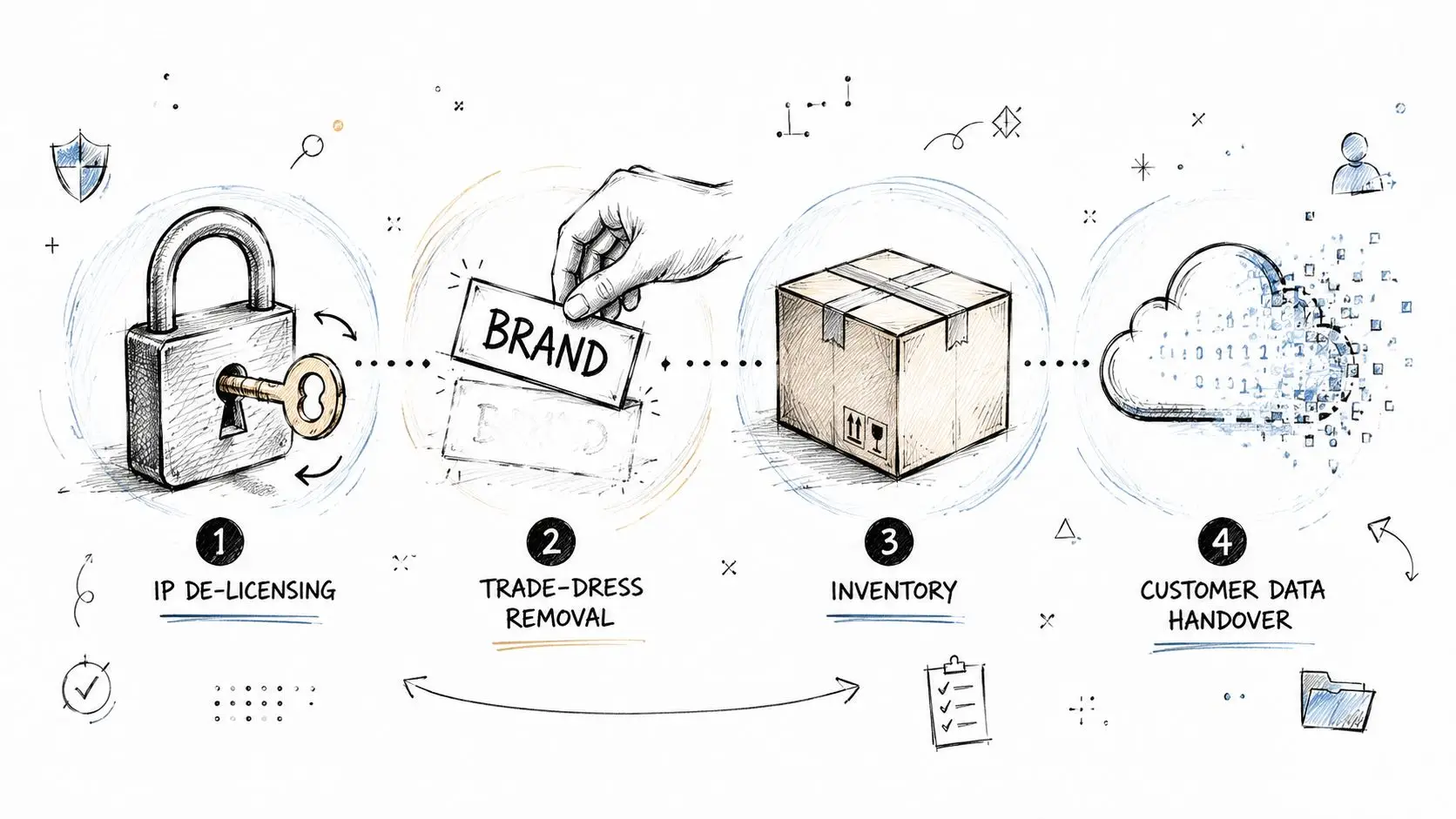
Separate brand protection from restraint
The franchisor usually needs immediate cessation of trademark use, removal of signage, deletion of branded digital content, and return or destruction of confidential manuals. These duties protect the public from confusion and protect the network’s operating information.
A broad non-compete raises a different issue. Post-2025 reforms increasingly scrutinize restrictions that prevent a franchisee or principal from operating in a lawful business after termination. Virginia’s law will prohibit franchise agreements from restricting a franchisee’s right to operate after termination or expiration, effective July 1, 2026 (Virginia post-termination restrictions).
The drafting response is precision. A franchisor should protect marks, confidential systems, recipes, customer information, and genuine trade secrets without automatically imposing a sweeping territorial restraint.
Clause-by-clause wind-down review
| Obligation | Usually survives? | Main risk |
|---|---|---|
| Trademark and trade-dress removal | Yes, where clearly drafted. | Delay can create confusion and infringement exposure. |
| Confidentiality | Often survives. | Overbroad definitions may create enforcement problems. |
| Inventory handling | Depends on the agreement and local law. | Buy-back pricing and obsolete stock can trigger disputes. |
| Customer data handover | Requires privacy compliance. | Transfer may breach data protection rules. |
| Non-solicitation | Sometimes survives narrowly. | Blanket customer restrictions may be viewed as excessive. |
| Non-compete | Highly jurisdiction-sensitive. | Local law may invalidate or narrow the restraint. |
The franchisor should also address domain names, social accounts, online reviews, supplier accounts, employee communications, and customer notifications. A termination protocol should assign each task, deadline, evidence requirement, and responsible person.
Cross-Border Enforcement and Negotiation Strategy
Cross-border termination is a sequence, not a single breach event. Forum and asset location may matter more than the merits. A franchisor with a strong award but no reachable assets may win legally and still fail to recover.
Before notice, test four issues:
- Governing law: Does it control substance, procedure, or both?
- Forum: Can the chosen court grant effective interim relief?
- Arbitration: Does the clause cover termination, urgent relief, and related tort claims?
- Assets: Where are cash, inventory, receivables, or intellectual property located?
The New York Convention may support recognition of qualifying arbitral awards, but service delays, public policy, asset tracing, and arbitration carve-outs create friction. Prepare the enforcement route before filing, including translations, local counsel, evidence, and asset information.
Negotiation positioning usually peaks between notice and filing.
A franchisor may use renewal timing, trademark de-registration steps, supply arrangements, or escrow demands. A franchisee may rely on continuity value, customer relationships, operational records, or a credible challenge to notice validity. Preserve these positions without making threats that could later weaken a request for equitable relief.
| Stage | Primary Positioning | Enforcement Tool | Typical Friction |
|---|---|---|---|
| Before notice | Contract and asset information | Reservation of rights | Incomplete records |
| Notice | Procedural validity | Formal service and evidence preservation | Wrong channel or defective content |
| Cure period | Remediation and continuity | Cure plan or interim application | Disagreement over completion |
| Filing | Forum and urgency | Court injunction or arbitration | Service and jurisdiction challenges |
| Wind-down | IP and operational control | Orders, escrow, or negotiated protocol | Inventory, data, and customer disputes |
The practical order is clause, notice, cure, enforce, then wind-down. A jurisdiction-specific notice matrix should track service method, language, address, cure period, forum, and available interim relief. That sequence gives negotiation a defensible structure while protecting the record for court or arbitration.
Risk-Mitigation Checklist for Licensors and Franchisees
A termination audit should begin before the relationship becomes hostile. Each side needs a separate file containing the agreement, amendments, notices, performance records, payment history, and relevant communications.
For franchisors
- Audit notice clauses: Confirm service channels, language requirements, addresses, and statutory overlays.
- Map cure periods: Compare contractual periods with every applicable local requirement.
- Preserve breach evidence: Record inspections, payment defaults, warnings, and remediation failures contemporaneously.
- Review intellectual property: Confirm trademark registrations, licenses, signage controls, and digital assets.
- Plan enforcement: Identify forums, interim remedies, security, and reachable assets.
For franchisees
- Preserve performance records: Keep payment confirmations, inspection results, approvals, and operational correspondence.
- Monitor renewal triggers: Calendar expiry, renewal windows, conditions, and nonrenewal deadlines.
- Evaluate disputed fees: Obtain advice before withholding payment, and consider controlled escrow where appropriate.
- Review cure proposals: Make every remediation commitment specific, measurable, and documented.
- Avoid admissions: Don’t sign a termination acknowledgment or release without legal review.
The three priority reviews are a notice audit, an IP audit, and an asset-trace review. Together, they show whether the dispute will turn on procedural validity, brand control, or collectability.
RNC Group advises international companies on franchise agreement drafting, termination sequencing, multilingual legal correspondence, negotiation, and cross-border commercial litigation. The recommended strategic path is to conduct the notice, IP, and enforcement audit before a breach escalates, then contact RNC Group to avoid costly termination mistakes.
This article provides general information only and doesn’t constitute legal advice. Franchise termination rights depend on the agreement, governing law, mandatory statutes, procedural history, and facts, so readers should obtain advice from qualified counsel before acting.