
Most cross-border franchise disputes don’t fail on contract language first. They fail because the board underestimated procedure, forum, and enforcement risk under the 2026 regulatory environment.
A non-Israeli franchisor entering Israel, or an Israeli operator expanding abroad, can’t treat a franchise dispute as a standard commercial disagreement. The actual pressure points sit elsewhere. Discovery scope expands unevenly. Governing law clauses collide with local public policy. Termination rights that look clean on paper become unstable once multiple jurisdictions touch notice, good faith, disclosure, and post-termination restraints.
The New Landscape of International Franchise Disputes
What happens when a franchise agreement looks enforceable in one country, but the dispute unfolds through another country’s procedural lens in 2026?
That question exposes the core weakness in most board-level planning. Many executives still frame franchise conflict as a narrow contract issue. In practice, cross-border franchise litigation often turns on procedural asymmetry, document control, interim relief, and forum pressure long before a tribunal reaches the merits.
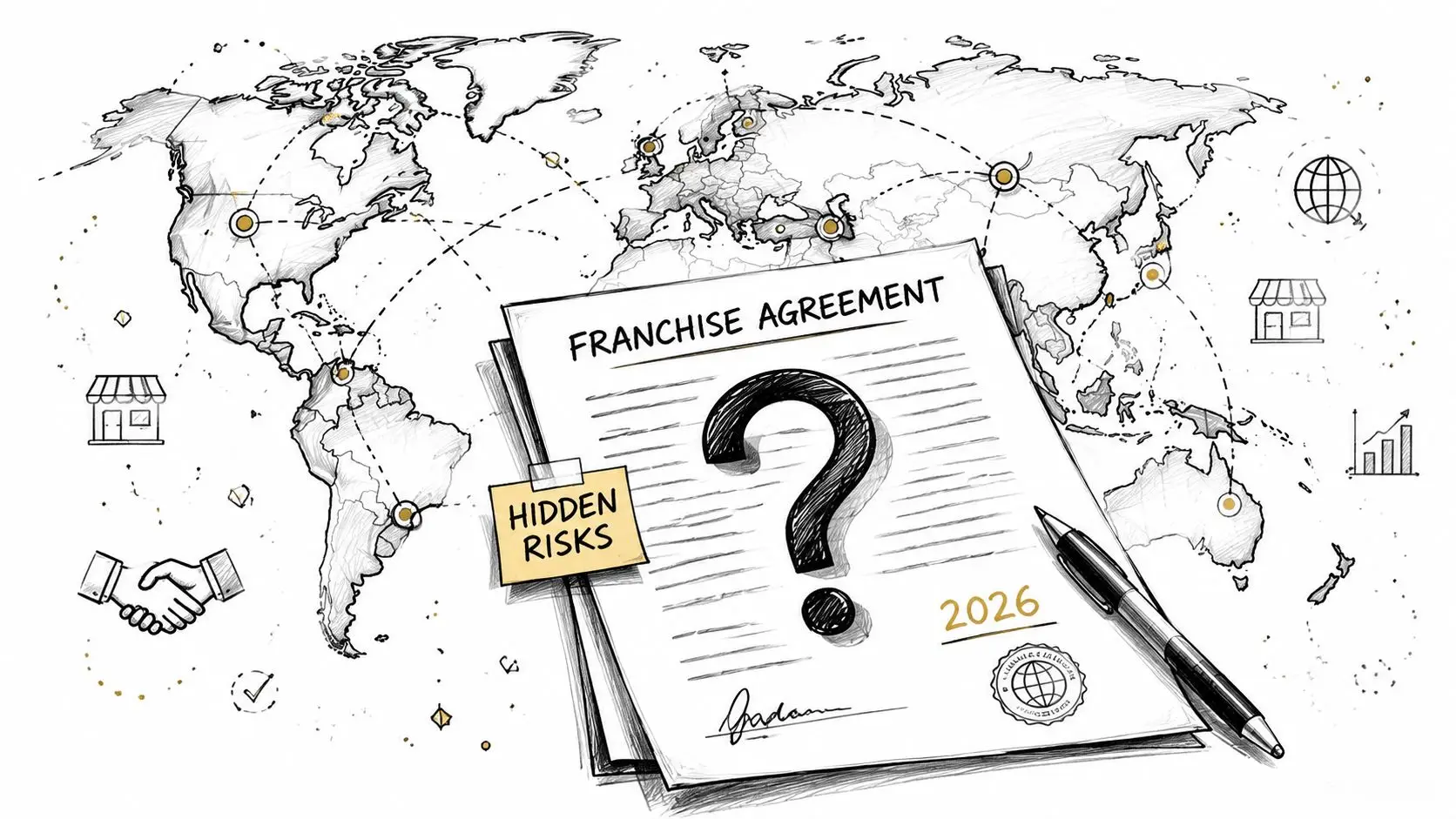
Procedure often decides leverage
Existing commentary often misses a critical point. Franchisors can carry a heavier discovery burden in litigation, and that imbalance can shape the entire dispute strategy. The same legal analysis also notes a recent trend in cross-border disputes. Franchisees increasingly invoke state-level “Little FTC Acts” and good faith doctrines where specific franchise relationship laws are absent, as discussed in Miller Nash’s analysis of franchise relationship disputes.
That matters for multinational boards. The party that controls manuals, compliance records, pricing directives, approval trails, audits, and brand standards usually produces more documents. Therefore, the franchisor often enters the case with more exposure points, more preservation duties, and more opportunities for inconsistency.
Practical rule: The side with the broader document universe usually faces the earlier strategic test.
A strong franchise dispute lawyer doesn’t start with abstract doctrine. Counsel starts with the evidence map. Who holds the emails. Who approved deviations. Which entity issued notices. Which affiliate controlled trademarks, software, supply channels, or local operating policies. In cross-border matters involving Israel, that mapping also needs to track language, translation accuracy, and whether conduct by a regional manager can be imputed to the contracting entity.
Domestic assumptions break down fast
Standard domestic playbooks don’t travel well. A termination clause may be valid under the chosen governing law yet still trigger arguments grounded in local fairness doctrines, disclosure issues, or public policy. Likewise, a franchisor may expect arbitration to suppress operational fallout, while the franchisee may use pre-arbitral pressure through regulators, counterparties, suppliers, or local courts.
Boards should also watch the information gap inside their own organization. U.S., European, and Israeli business teams often manage the same network through different reporting lines. That fragmentation weakens privilege control and creates inconsistent factual narratives. It also turns routine correspondence into exhibit material.
For operators monitoring broader market thinking, Franchise Foundry’s blog is a useful industry reference point because it tracks practical franchise developments beyond narrow legal doctrine.
The strategic lens non-Israeli entities need
Cross-border franchise disputes involving Israel rarely stay confined to one issue. They tend to combine contract enforcement, trademark control, payment disputes, operational restrictions, and reputation management. Therefore, the legal response must integrate commercial reality from day one.
Three questions usually matter most:
- Where can effective pressure be applied: Forum selection only matters if orders can be enforced where assets, operators, and decision-makers sit.
- Who bears the discovery burden: The answer affects timing, cost, and settlement posture.
- Which legal theory travels best: Pure contract claims may underperform where broader good faith or unfair conduct arguments resonate more strongly.
A board that sees only breach misses the actual battlefield.
Understanding Common Franchise Conflict Triggers
Most franchise disputes don’t begin with a lawsuit. They begin with a pattern that leadership ignored because local teams described it as an operational issue.
Breach starts small, then hardens
The first trigger is ordinary breach of contract, but cross-border settings distort it. A local operator changes suppliers, pricing, territory practices, or reporting methods. Headquarters treats the deviation as a technical breach. The local market treats it as necessary adaptation.
That gap widens when the agreement centralizes control but local practice tolerated exceptions. Once tolerance exists, enforcement becomes harder. The other side argues waiver, selective enforcement, or bad faith.
Cross-border franchise disputes often turn on what the parties actually permitted, not only on what the document prohibited.
Termination disputes are rarely just about notice
Wrongful termination claims arise when one side moves too quickly, too broadly, or without a clean evidentiary trail. A notice may satisfy the contract yet still trigger challenge if the cure opportunity was unclear, the alleged default was inconsistent with prior conduct, or the terminating party acted through the wrong entity.
International structures make this worse. The contracting franchisor may sit in one country, the IP owner in another, and the operating support team in a third. If those roles blur, the franchisee gains room to argue defective notice, mixed authority, or abusive conduct.
Money disputes expose system weaknesses
Royalty and fee disputes are often less about arithmetic than governance. The arguments usually center on what counts as gross revenue, which discounts are permitted, whether digital sales belong to the unit, and whether required technology or marketing charges were imposed consistently.
These disputes escalate fast when the franchisor introduced new sales channels. Mobile ordering, central delivery platforms, marketplace integrations, and affiliate promotions can all reframe the revenue base. If the agreement and manuals don’t align, each monthly report becomes a potential claim file.
A board should test these questions early:
- Revenue definitions: Do they clearly address online, app-based, and affiliate-driven sales?
- Audit rights: Can the franchisor prove underreporting without overreaching?
- Fee authority: Did the agreement authorize the disputed charge, or did practice drift beyond the text?
IP misuse and non-compete fights carry local complications
Trademark and know-how misuse becomes acute at the end of the relationship. A former franchisee may continue using marks, recipes, software, customer databases, or look-and-feel elements after termination. In some markets, that conduct is obvious infringement. In others, the dispute becomes entangled with local exhaustion doctrines, passing off standards, or arguments over ownership of localized materials.
Non-competition clauses create a separate flashpoint. A restriction that appears commercially reasonable in one jurisdiction may face stricter scrutiny elsewhere. Duration, territory, scope, and the protected business interest all matter. In practice, judges and arbitrators often react to the clause in context. If the franchisor overreached during the relationship, enforcement becomes harder.
Five recurring triggers boards should audit now
- Contract drift. Field teams approved practices the contract never allowed.
- Termination misfires. Notices lacked a clean factual and corporate chain.
- Royalty ambiguity. New sales channels changed the economics without updated drafting.
- Brand leakage. Local operators retained IP, customer goodwill, or post-exit market identity.
- Overbroad restraints. Non-compete language outran what the forum would likely enforce.
A capable franchise dispute lawyer reads these triggers as connected, not isolated. That approach usually produces stronger standing before formal proceedings begin.
Choosing Your Strategic Resolution Path
The dispute forum isn’t a procedural detail. It’s a financial decision.
Boards often ask whether arbitration is faster or whether litigation offers greater power. Those questions matter, but the sharper question is this: which forum fits the company’s evidence profile, enforcement needs, confidentiality concerns, and appetite for precedent?
The numbers change the analysis
Financial outcomes in franchise disputes vary sharply by resolution method. Average verdicts against franchisors in jury trials reached $814,194, while the average award against losing franchisors in arbitration was $136,325, and the average award secured by franchisors in arbitration was only $23,300, according to Wiggin’s analysis of franchise dispute outcomes.
Those figures don’t tell the whole story, but they do show a hard truth. Forum selection changes exposure. It can also change bargaining behavior before the hearing starts.
A board-level comparison
| Path | Average Cost | Typical Speed | Confidentiality | Cross-Border Enforceability |
|---|---|---|---|---|
| Negotiation | Lower than formal proceedings in many cases | Often fastest if both sides still want the relationship | Usually high if managed carefully | Depends on settlement drafting and local enforcement |
| Mediation | Added professional cost, but often contained compared with full proceedings | Usually faster than arbitration or litigation | Generally strong | Depends on converting terms into an enforceable agreement |
| Arbitration | Legal spend plus forum costs. Outcome data and fee structures can materially affect strategy | Often structured, but document-heavy cases still take time | Usually stronger than court litigation | Often advantageous internationally if the award is enforceable where assets sit |
| Litigation | Can expand sharply with discovery, motions, and local procedural fights | Often slower, especially across jurisdictions | Usually lower than private processes | Depends on judgments, reciprocal enforcement rules, and local court posture |
When each path works, and when it doesn’t
Negotiation works when the parties still value continuity. It fails when one side needs precedent, urgent injunctive relief, or a public signal to other operators.
Mediation works when both sides need a business solution that a tribunal won’t craft. It fails when one side only wants delay, document access, or bargaining power without compromise.
Arbitration works when confidentiality, technical decision-making, and international enforceability matter. It can disappoint when the case requires extensive third-party evidence, emergency public remedies, or pressure on non-signatories.
Litigation works when a party needs broad procedural tools, public orders, coercive discovery, or a market-facing message. It can become dangerous when the company hasn’t prepared its document architecture, witness discipline, or jurisdictional theory.
Choose the forum that fits your evidence, not your preference.
The hidden trade-offs in cross-border matters
Confidentiality often pushes parties toward arbitration. However, confidentiality alone doesn’t solve enforcement. If assets, trademarks, inventory, bank flows, or operating entities sit across several jurisdictions, enforceability must drive the choice.
Likewise, speed is often overstated. A rushed filing in the wrong forum can create parallel proceedings, anti-suit disputes, and satellite fights over jurisdiction or governing law. That doesn’t save time. It multiplies cost and weakens settlement positioning.
The recommended strategic path is sequential. First, assess where immediate commercial harm sits. Second, test which forum can restrain it. Third, measure what evidence the chosen forum will force your side to produce. Only then should the company commit to a formal route.
Engaging Counsel for Cross-Border Disputes
The first days of a franchise dispute usually matter more than the filing date. Early errors are expensive, and many can’t be reversed.

The engagement should begin with evidence control
A serious franchise dispute lawyer starts by freezing the factual record. That means preserving emails, notices, manuals, platform access logs, audit files, board minutes, payment reports, and communications with local consultants or master franchise intermediaries.
The legal spend can become material quickly. Contentious franchise terminations can cost $3,000 to over $100,000 in legal fees, while mandatory arbitration can add $8,000 to $20,000 in filing and arbitrator fees alone, according to Lopes Law’s franchise law statistics summary. The same source notes a projected 851,000 franchise establishments in the U.S. by the end of 2025, which underscores how large and active this dispute environment has become.
That cost profile changes board behavior. Smaller claims can become irrational to litigate if counsel enters late, facts are fragmented, and the internal file is chaotic.
What multinational clients should assemble immediately
The most efficient clients don’t send conclusions first. They send records.
- Core contracts: Franchise agreement, amendments, side letters, guaranties, and any territorial or development schedules.
- Disclosure material: FDD versions, acknowledgments, renewal documents, and negotiated markups.
- Operational records: Manuals, audit reports, training records, pricing directives, approval emails, and supply chain notices.
- Payment evidence: Royalty statements, chargeback records, marketing fund demands, and disputed invoice support.
- Exit and enforcement file: Default notices, cure correspondence, termination notices, de-branding demands, and post-termination screenshots.
The phases clients should expect
Most cross-border matters move through a recognizable pattern, even when the forum changes.
Phase one is containment
Counsel tests immediate risk. Can the other side keep trading under the brand. Are confidential materials still accessible. Has someone contacted suppliers, landlords, or regulators. If the answer is yes, delay becomes dangerous.
Phase two is position-building
Counsel aligns facts, legal theories, and commercial objectives. A board may want damages, but the stronger path may be a negotiated exit, IP injunction, territory reset, or fee restructuring. Good strategy doesn’t chase every claim. It chooses the pressure points that alter the other side’s incentives.
Phase three is formal escalation
This phase includes demand letters, emergency applications, arbitration filings, jurisdictional objections, discovery planning, witness preparation, and settlement windows. In cross-border matters, translation quality and document sequencing can affect credibility as much as legal argument.
The first mandate for counsel is discipline, not aggression.
Fee structure matters more than many boards admit
Hourly billing may fit volatile disputes. Flat fees can work for defined tasks such as early assessment, FDD review, or a demand package. Success-linked structures require careful handling because incentives can distort tactical choices if the client hasn’t defined the fundamental business objective.
Multinational clients should also ask one operational question early. Who owns communication flow across headquarters, local management, and outside counsel. If that chain is loose, the dispute broadens before counsel can narrow it.
For related Israeli commercial risk areas, boards often benefit from reviewing commercial litigation strategy in Israel, commercial contract drafting and enforcement in Israel, and multilingual legal correspondence for cross-border disputes.
Selecting the Right International Franchise Lawyer
A generic commercial litigator may manage a contract dispute. That isn’t enough for a franchise network under cross-border stress.

Specialization isn’t a marketing slogan
An effective franchise dispute lawyer should devote at least 80% of practice to franchise law and understand the 23 mandatory items in the FDD, according to Wagbar’s guide to hiring a franchise attorney. The same source states that attorneys with experience representing both franchisors and franchisees achieve 30% higher settlement success rates.
Those figures matter because franchise disputes combine disclosure, operations, branding, payments, and termination mechanics. A lawyer who mostly handles general commercial work may miss the significance of disclosure language, system standards, territorial creep, or post-termination trademark misuse until the case has already narrowed badly.
The selection test for international clients
A multinational board should pressure-test counsel against real conditions, not polished biographies.
Cross-border coordination
Can counsel manage parallel legal issues in Israel and abroad without losing factual consistency. Can the firm coordinate local counsel while keeping one strategic narrative. Cross-border disputes fail when each jurisdiction runs on a different theory.
Language discipline
If correspondence, manuals, notices, and witness records exist in multiple languages, counsel must control translation risk. Meaning shifts in commercial Hebrew, English, and local market communications can alter notice validity, intent, and scope of obligation.
Crisis judgment
The best international franchise lawyer knows when not to litigate immediately. Some matters require a hard filing. Others require controlled escalation, supplier management, brand containment, and pressure through contractual dependencies rather than public proceedings.
A technically correct argument can still be strategically weak if it triggers the wrong commercial consequences.
What strong counsel usually has that weaker counsel lacks
- Dual-side exposure: Lawyers who have seen both franchisor and franchisee tactics assess strategic positions more accurately.
- Network reach: International disputes need reliable partner firms, not ad hoc referrals.
- Document rigor: Counsel must separate decisive records from noise quickly.
- Board fluency: The lawyer should explain options in terms of exposure, timing, enforceability, and business continuity.
A firm advising on Israeli-facing franchise risk should also understand adjacent areas. Those include corporate formation and structuring in Israel and intellectual property enforcement in commercial disputes. Franchise litigation rarely stays inside one doctrinal box.
Questions worth asking before appointment
Ask for examples of cross-border coordination without demanding confidential client specifics. Ask how the firm handles privilege across languages and affiliates. Ask who will draft the notices, manage the evidence record, and supervise local counsel.
Then ask the hardest question. How does the firm decide whether to preserve the relationship, force an exit, or restructure the network after the dispute ends. An insightful answer usually reveals whether counsel sees the matter as a lawsuit or as a business-risk event.
Actionable Risk Mitigation and Strategic Next Steps
A board doesn’t reduce franchise risk by waiting for a breach notice. It reduces risk by tightening the system before the first hostile letter arrives.
What franchisors should do now
- Rebuild the paper trail: Align the agreement, FDD, manuals, and actual operating practice. If field teams tolerate deviations, document the policy and its limits.
- Map control points: Identify who owns approvals, pricing exceptions, software access, audit rights, and termination authority across the group structure.
- Stress-test enforcement: Review which remedies can be enforced where assets, inventory, trademarks, and operators sit.
- Prepare the exit file: Draft clean notice templates, de-branding steps, evidence preservation instructions, and post-termination IP protocols before conflict starts.
For teams reviewing disclosure discipline, essential FDD insights for franchisors can help frame what requires close attention at the document level.
What franchisees and local operators should do now
Franchisees need a different posture. They should preserve all approval emails, marketing instructions, territory communications, and revenue treatment discussions. Those records often determine whether a dispute is framed as breach, waiver, selective enforcement, or unfair conduct.
Local operators should also test the operational assumptions behind the contract. If the franchisor imposed channel changes, supply obligations, technology costs, or reporting demands that shifted the economics, the operator should document when that happened and under whose authority.
The recommended strategic path
Start with a legal risk audit tied to real documents, not executive summaries. Then identify the likely forum, the discovery burden, and the enforceability route. After that, prepare a phased escalation plan that covers negotiation, interim remedies, formal proceedings, and post-dispute network repair.
Many companies still make the same mistake. They instruct counsel after positions harden, records scatter, and internal narratives diverge. By then, the legal task is damage control rather than risk prevention.
A disciplined franchise dispute lawyer gives the board something more useful than legal definitions. Counsel gives the board advantage, timing, and options.
Avoid costly mistakes before they harden into litigation exposure. Contact RNC Group through its contact page for a strategic assessment of cross-border franchise risk involving Israel, international enforcement, and high-stakes commercial disputes.
This article provides general information only. It doesn’t create an attorney-client relationship, and it shouldn’t replace legal advice suited for specific facts, jurisdictions, contracts, or regulatory requirements.