
A fraud program that still treats incidents as isolated exceptions is already behind. The U.S. Government Accountability Office estimated that the federal government loses between $233 billion and $521 billion annually to fraud, based on fiscal years 2018 through 2022, or roughly 3% to 7% of average annual federal obligations during that period, which reframes fraud as a systems problem rather than a compliance footnote (GAO fraud estimates).
For Israeli and cross-border companies, that reframing matters. Many operate across currencies, agents, marketplaces, distributors, and overseas contractors. Therefore, fraud prevention strategies can’t sit in one policy binder. They have to connect legal design, payment operations, internal controls, evidence preservation, and crisis response.
Why Fraud Prevention Is Now a Board-Level Risk
Fraud is now large enough, fast enough, and disruptive enough to sit with cyber, sanctions, and liquidity on the board agenda. The U.S. Government Accountability Office estimated annual federal fraud losses at $233 billion to $521 billion over fiscal years 2018 to 2022, a useful benchmark for how expensive weak control chains become at scale (GAO analysis).
For boards, the question is not whether fraud can happen. It is whether management can show, under pressure, how the company prevents, detects, freezes, and investigates it across legal, finance, procurement, HR, and treasury. If that answer depends on a policy document and a few manual approvals, the company is exposed.
I have seen the same pattern in Israeli and multinational groups. The incident looks like a payment problem at first. Within days it becomes a governance problem, an evidence problem, an insurance problem, and sometimes a disclosure problem.
Board test: If management cannot identify who can change payment instructions, who independently verifies the change, and who has authority to suspend a transfer path, the control framework is incomplete.
Why boards of Israeli and cross-border companies should treat this differently
Israeli companies often internationalize early, sometimes before control architecture catches up with commercial growth. They use foreign distributors, local agents, outsourced development teams, cloud vendors, and banking rails across several jurisdictions. That model supports growth, but it also creates room for fraud to hide inside ordinary business activity.
The board-level risk usually appears in four places:
- Authority risk. Local teams and intermediaries act quickly, but head office may have limited visibility into who approved a commitment or changed account details.
- Jurisdiction risk. A recovery step that is straightforward in one country can become slow and expensive once funds, records, or suspects sit abroad.
- Speed risk. Treasury teams are under pressure to streamline cross-border treasury operations, but faster payment execution narrows the window to stop a fraudulent transfer.
- Attribution risk. In a real dispute, the company must prove what happened, who knew what, and when controls failed. That requires records that many businesses do not preserve well enough in the first 24 hours.
These are board issues because they affect cash preservation, lender discussions, audit sign-off, and transaction readiness.
The 2026 board perspective
The 2026 environment raises the standard. Real-time payments reduce reversal options. Agentic AI makes impersonation, workflow manipulation, and synthetic approval trails more credible. UK and EU control expectations also continue to push companies toward earlier intervention, better monitoring, and clearer accountability for third-party risk.
The practical implication is simple. Fraud prevention is no longer a narrow compliance workstream. It is a multi-track legal and operational discipline. The sequence matters: prevent where possible, detect quickly, freeze decisively, preserve evidence immediately, and make privileged decisions early enough to protect recovery options.
Boards do not need to run investigations themselves. They do need to insist on a system that will hold up when a real incident hits on a Thursday night, funds have already moved, and three jurisdictions are involved.
Mapping the Fraud Landscape Facing Israeli Companies
A useful fraud map doesn’t start with theory. It starts with how money, authority, and identity move through the business. Israeli companies usually face recurring patterns, and each pattern leaves a different evidence trail.

Vendor and procurement fraud
Procurement fraud often hides inside ordinary paperwork. A local agent introduces a supplier. Pricing looks plausible. Then the company pays inflated invoices, duplicate invoices, or invoices from an affiliate that wasn’t disclosed.
Common pressure points include:
- Shell suppliers created to receive payments for goods or services that were never fully delivered.
- Commission leakage through intermediaries who route part of the payment back to an employee or related party.
- Contract drift where purchase orders no longer match negotiated terms, but accounts payable still processes them.
These matters become harder when the underlying deal spans several jurisdictions. Sanctions screening, export controls, and foreign bank compliance checks can delay tracing even when the fraud is obvious.
Payment and invoice fraud
This is the category that most often creates an immediate cash crisis. The legal issue usually begins as an operational one. Someone changes bank details, sends fake remittance advice, or inserts themselves into a settlement chain.
Israeli exporters and SaaS businesses are particularly exposed when they collect in USD or EUR, then reconcile locally. Dual-currency settlements can mask anomalies because teams focus on exchange impact rather than beneficiary identity. By the time finance spots the inconsistency, funds may already have moved through multiple accounts.
Payment diversion cases are rarely solved by proving the email was fake. They are solved by proving the company followed, or failed to follow, an approval and verification protocol.
Identity and onboarding fraud
Marketplace onboarding, reseller appointments, and remote contractor recruitment create a separate risk set. A synthetic director, forged corporate document, or deepfake KYC interaction can open the door before any payment event occurs. Once the account or commercial relationship exists, the fraudster gains legitimacy.
Typology mapping becomes practical. If the main risk is identity fraud at onboarding, the business needs preserved onboarding records, verification logs, and authority checks. If the main risk is invoice diversion, the evidence focus shifts to mail headers, call-back records, payment approval logs, and bank communication.
Internal fraud and misuse
Internal fraud is often less dramatic and more persistent. Payroll ghosting, manipulated expenses, card misuse by travelling staff, and override abuse usually exploit trust and weak segregation of duties.
Israeli companies with lean finance teams face a common issue. The same trusted employee may approve vendors, release payments, and reconcile statements. That isn’t misconduct by itself. However, it creates a structure where misconduct can continue longer and remain harder to prove.
Building a Fraud Risk Assessment That Holds Up
A workable fraud assessment doesn’t begin with a generic questionnaire. It begins with process mapping. General counsel, CFOs, and controllers need a quarterly view of where authority, money, and data intersect.
Start with where money actually moves
The core processes are usually straightforward:
- Order-to-cash for customer onboarding, invoicing, credits, and refunds.
- Procure-to-pay for vendor creation, purchase approval, invoice matching, and disbursement.
- Payroll and contractors for onboarding, rate changes, and payment release.
- Intercompany settlements for management fees, recharges, and shared services.
- Treasury for bank access, FX execution, and emergency payment instructions.
For each process, management should map three vectors. First comes counterparty risk, including jurisdiction, ownership opacity, and screening issues. Second comes transaction risk, including unusual payment rails, off-cycle requests, and deviations from contract logic. Third comes human risk, including access rights, override powers, and weak segregation.
Use red flags that teams can actually test
The best assessments use detection triggers that operations teams can review without waiting for a major forensic event.
| Process | Counterparty Risk | Transaction Risk | Human Risk | Detection Trigger |
|---|---|---|---|---|
| Order-to-cash | New customer with unclear ownership | Unusual refund destination | Sales override of finance hold | Credit note inconsistent with contract |
| Procure-to-pay | Vendor introduced by agent | Round-amount invoice or urgent bank-detail change | Same user sets up and approves vendor | Duplicate payee or weekend approval |
| Payroll | Overseas contractor with limited documentation | Off-cycle payment request | HR and finance permissions overlap | Multiple payments to related bank details |
| Intercompany settlements | Affiliate in higher-risk corridor | Manual recharge outside standard cycle | Treasury override without second reviewer | Amount diverges from established allocation |
| Treasury | New beneficiary bank instruction | Fast transfer outside normal workflow | Single signer releases funds | Callback record missing or incomplete |
Score for action, not for appearance
Risk scoring should answer one question. Which issue needs control ownership now? A practical model uses likelihood, impact, and detectability. If a risk is hard to detect and easy to execute, it needs immediate attention even before a major loss occurs.
Benchmarking research also supports caution in how teams evaluate detection models. A 2024 benchmark paper highlighted the lack of standardized customer-level fraud datasets, and related work notes that public fraud datasets are fragmented, which is why fraud models should be tested on representative, imbalanced data rather than judged by raw accuracy alone (fraud benchmark discussion). In practice, that means legal and finance teams should ask vendors what the model was trained to catch, what false negatives look like, and how recall is monitored.
A colorful heatmap doesn’t reduce risk. Named owners, dates, escalation triggers, and preserved evidence do.
The assessment only holds up if every high-risk point has an accountable owner, a remediation deadline, and a trigger for legal escalation.
Governance, Policy, and Detection Tools Working Together
Fraud losses rarely come from one failed control. They come from delay between warning, authority, and action. For Israeli companies operating across banks, distributors, affiliates, and overseas counterparties, that delay often sits in the handoff between legal, finance, compliance, and operations.
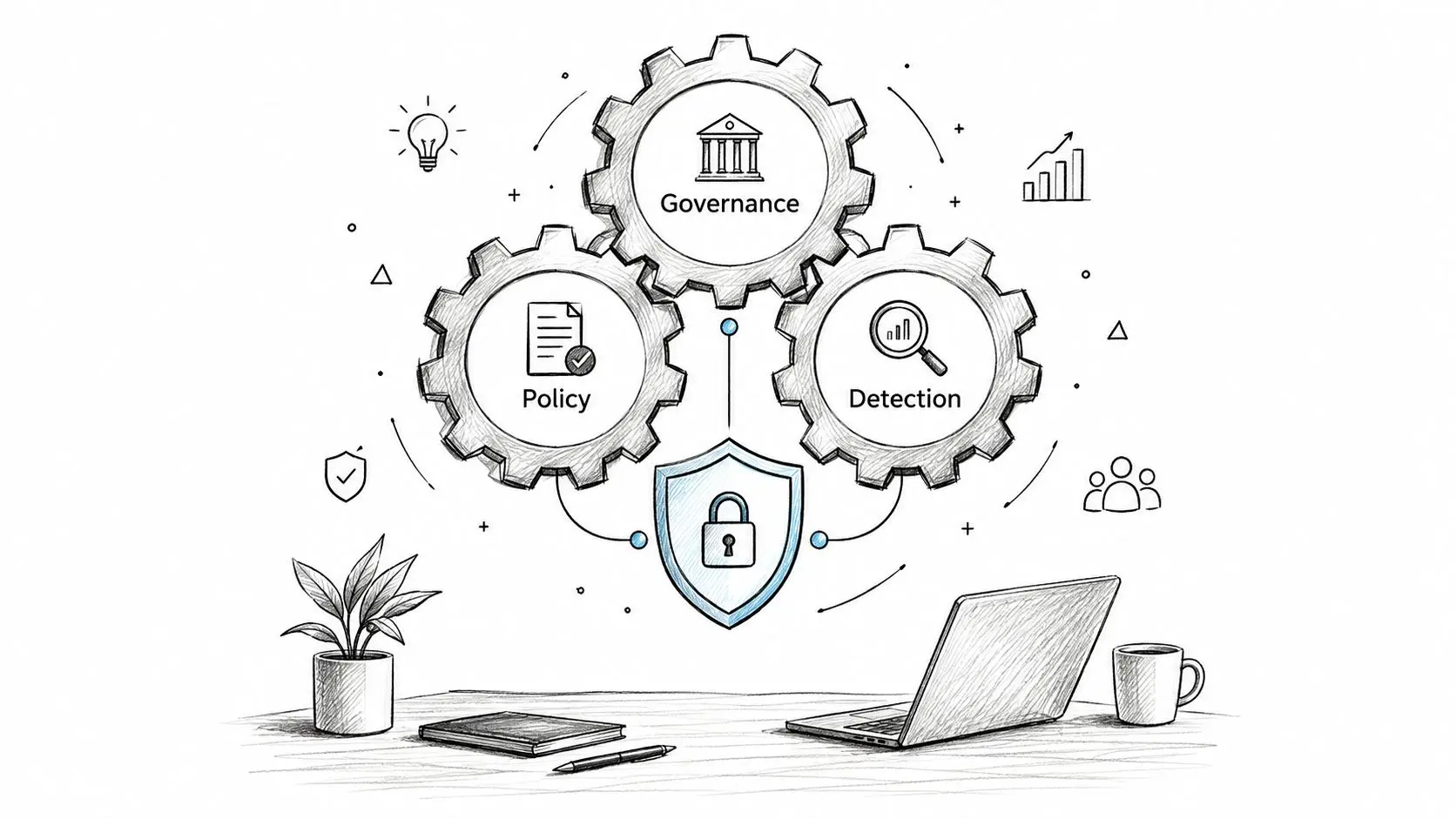
Governance sets authority and consequence
Governance answers a practical question before an incident occurs. Who can stop a transaction, who must be told, and who decides whether the issue is an operational exception, a disciplinary matter, or a legal event requiring evidence preservation.
That sounds basic. In practice, it is where many control programs break down.
Historical banking supervision moved from reactive case handling toward embedded prevention, including conduct and oversight principles tied to anti-money-laundering controls (Basel Committee historical context). Corporate fraud prevention requires the same discipline. Detection software can flag an anomaly, but it cannot resolve an internal dispute about signing authority, privilege, or whether the bank should receive a hold request within the hour.
A workable model usually assigns:
- Control ownership across finance, legal, operations, IT, and procurement for specific fraud points.
- Escalation triggers for payment instruction changes, onboarding irregularities, override requests, and access abuse.
- Board or audit committee reporting on incidents, repeat control failures, and overdue remediation.
For 2026, boards also need visibility into where delegated authority sits with automated systems, external service providers, and AI-enabled workflows. If no one owns those edges, the company will discover the gap during a live incident.
Policy translates governance into repeatable decisions
A fraud policy should help staff make the right call at speed. It should specify approved verification channels, dual-approval requirements, retention rules, freeze-and-escalate steps, and the sequence for engaging banks, insurers, outside counsel, and forensic teams.
Cross-border Israeli groups usually need more detail than domestic businesses. Payment release timing, callback language, local holidays, distributor documentation, and evidence retention across jurisdictions all affect whether a response works. I have seen companies with decent payment controls still lose recovery options because logs were overwritten, chat records were not preserved, or the first internal investigation compromised privilege.
External support can be part of that response structure. RNC Group publishes practical material on white collar fraud response, including KYC, dual authorization, and bank recall steps, which can be useful for teams refining incident procedures without overengineering them.
Detection tools need legal and operational design around them
Detection tools are only useful if they produce action that staff can execute within the transaction window. In instant-payment and high-volume environments, that means setting thresholds, evidence capture rules, and clear routes for manual intervention.
The European Payments Council recommends real-time analysis and immediate related actions for instant credit transfers, along with secure communication channels, mutual authentication, DDoS protections, tokenisation, PCI DSS-aligned handling, minimized card-data storage, and KYC at onboarding (EPC fraud guidance). The point is operational, not theoretical. Screening has to connect to authorization, case routing, and rapid hold decisions.
That creates a real trade-off. Tight thresholds catch more suspicious activity, but they can also interrupt revenue, delay supplier payments, and swamp a lean team with false positives. Loose thresholds preserve flow but leave the company arguing after the money has gone. The right answer is usually segmented. Higher-friction review for changed beneficiary details, unusual corridor activity, or AI-assisted instruction anomalies. Lower-friction monitoring for known low-risk patterns.
For teams dealing with newer payment rails, even a technical guide for crypto payment teams can help frame operational questions about settlement speed, wallet exposure, and reconciliation discipline. The legal point remains the same. A useful alert is one tied to authority, evidence, and a response clock.
Agentic AI and Real-Time Payments Are Changing the Threat
Legacy checkout controls assumed a human user, a visible session, and at least some time to review suspicious activity. Those assumptions don’t hold consistently anymore. Agentic AI and instant payments compress the timeline between instruction and loss.
Why checkout friction no longer solves enough
A newer fraud question has entered the market. Is the actor a legitimate customer, a legitimate software agent, or a malicious impostor using a convincing signal chain? Recent industry coverage argues that fraud systems must identify legitimate agents, verify authorization, and test whether the agent acts within the customer’s true intent before payment occurs (agentic AI fraud discussion)).
That changes control design. Checkout-only friction doesn’t inspect delegated authority very well. It may stop some attacks, but it won’t reliably answer whether the agent should have initiated the transaction at all.
Real-time rails change the response sequence
The UK’s 2026 to 2029 Fraud Strategy emphasizes real-time disruption, online crime infrastructure, and stronger fraud monitoring. The same policy discussion also highlights a 180% year-over-year rise in identity-fraud attacks reported by Sumsub, and notes the expanding role of OTP interception and digital-wallet-enabled fraud in card-not-present exposure (UK Fraud Strategy 2026 to 2029).
For legal and operational teams, the implication is direct. If the payment rail settles quickly, response must start before settlement, not after it. Therefore, stronger checkout friction is only one lever, and often not the decisive one.
| Control Layer | Agentic AI Threat | Instant Payment Threat | Residual Risk |
|---|---|---|---|
| Pre-transaction identity checks | Delegated agent exceeds authority | False beneficiary inserted early | Authority records may still be forged |
| Behavioral monitoring | Scripted but abnormal action chain | Rapid payment sequence masks review | Sophisticated mimicry can pass |
| Device or agent attestation | Fake assistant or automated workflow | Session takeover before release | Shared devices blur accountability |
| Real-time interdiction | Transaction paused before release | Suspicious payment blocked pre-settlement | Delay can frustrate genuine users |
| Post-event trace protocol | Preserves evidence on source action | Immediate bank notice may improve recovery | Funds may still move too fast |
The strongest control is often earlier than checkout. It sits at onboarding, authority validation, or behavior monitoring.
What an updated control stack looks like
A current stack usually combines several layers:
- Continuous identity re-verification when account behavior changes.
- Behavioral analytics that compare current actions to the user’s or account’s normal pattern.
- Agent attestation and authority checks for delegated actions.
- Fast trace and preservation protocols the moment a payment looks compromised.
The trade-off is commercial. More friction can reduce fraud, but it can also damage conversion, strain customer trust, and interrupt valid urgent payments. Good fraud prevention strategies don’t eliminate friction. They trigger it selectively, where the risk signal justifies the interruption.
Contractual and Transactional Safeguards That Reduce Exposure
Fraud losses become much harder to recover when the contract stack is loose. Controls at the transaction design stage determine whether the company can trace authority, suspend performance, demand cooperation, or shift liability after a fraud event.
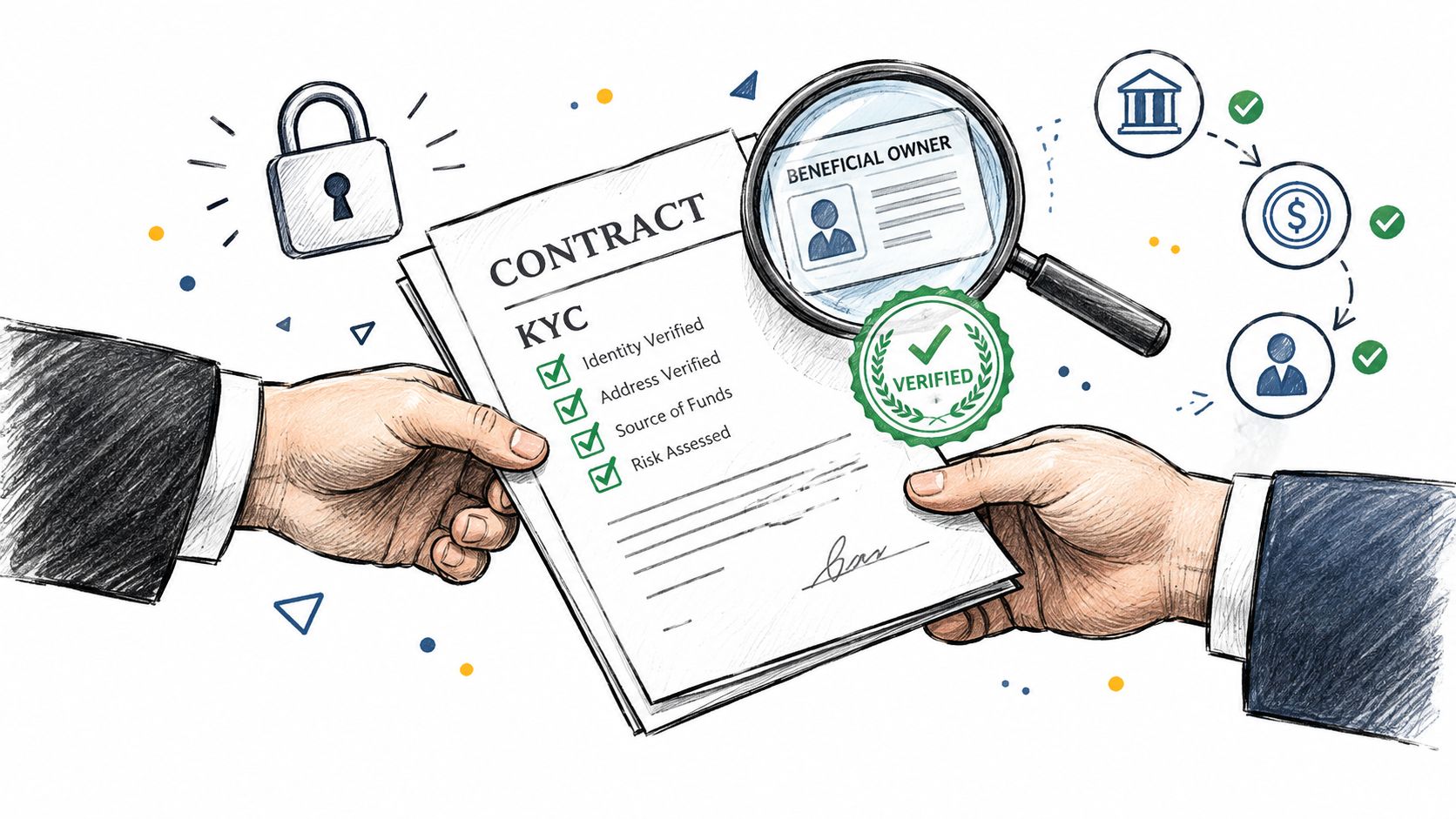
Onboarding clauses matter more than most parties think
Counterparty onboarding should connect legal drafting with operational verification. That means beneficial owner disclosure, authority confirmation, notice mechanics for bank-detail changes, and cooperation duties if fraud is suspected. If those points remain vague, the innocent party may discover too late that it lacks a contractual basis to demand records or suspend disbursement.
Useful safeguards often include:
- Verified authority language that names who may issue payment instructions.
- Change-control clauses requiring secure, pre-agreed procedures for account changes.
- Information cooperation duties after suspicious activity, including prompt document production.
- Audit or inspection rights where agents, resellers, or service intermediaries handle funds.
Transaction design should match the risk profile
Not every deal needs escrow, and not every counterparty justifies restrictive routing. However, transaction design should reflect actual exposure, not optimism.
A side-by-side view helps:
- Escrow or milestone payments reduce exposure where performance verification is difficult.
- Segregated disbursement accounts limit the blast radius if one payment channel is compromised.
- Indemnities and liability allocation improve recovery posture, but they only matter if the counterparty remains reachable and solvent.
- Jurisdiction and dispute clauses shape whether urgent relief is realistic after a diversion event.
Israeli banking practice adds another layer. Banks may impose friction around certain transfers, holdbacks, or higher-risk corridors. That means contractual drafting can’t assume every payment path will remain available on demand.
Israeli banking restrictions can intensify downstream disputes
There is also a domestic reminder that banks and payment discipline intersect in legally significant ways. In Israel, a bank account becomes restricted for one year when ten or more checks are returned for insufficient funds within a 12-month period, and the restriction begins only after the bank’s notice date, which must be at least 15 days after the notice is sent (Bank of Israel guide on restricted accounts). In addition, the Bank of Israel requires a warning after five returned checks, and that warning must state that ten returned checks within 12 months can trigger restriction (Bank of Israel consumer information).
Those rules don’t govern every fraud event. Still, they show why treasury controls, payment discipline, and dispute prevention belong in the same conversation. A company already under payment stress has fewer options when fraud or diversion hits.
A 30-60-90 Day Implementation and Crisis Response Playbook
Most companies don’t need another fraud memo. They need a sequence. The right sequence ties prevention, response, and legal remedies into one operating plan.

Days 0 to 30
The first month is diagnostic and defensive. Management should refresh the fraud risk assessment across order-to-cash, procure-to-pay, payroll, treasury, and intercompany flows. At the same time, the company should identify one fraud-response coordinator with authority to convene finance, legal, IT, and management immediately.
The legal deliverables in this phase are basic but decisive:
- Evidence preservation protocol for email, approvals, bank messages, chat logs, and onboarding records.
- Escalation map for changed payment instructions, suspicious account activity, and onboarding anomalies.
- Counterparty review list covering agents, resellers, high-risk vendors, and bank-detail exceptions.
If a cross-border dispute later follows, the preserved evidence will often determine whether urgent relief is available. In Israel, commercial disputes commonly proceed in the Magistrates’ Courts and District Courts, while specialized forums also handle some matters, including Labor Courts, the Restrictive Trade Practices Court, and the Standard Contracts Tribunal (overview of commercial litigation forums in Israel).
Days 31 to 60
The second month is the build stage. Policies need final wording, but process design matters more than stylistic precision. Vendor onboarding, bank-detail changes, approval overrides, and reconciliation timing should all move into documented workflows.
A disciplined month-two agenda usually includes:
- Policy finalization with named approvers, dual-control points, and callback procedures.
- KYC and KYB tightening for Israeli and foreign counterparties before account activation or contract signature.
- Bank and vendor reconciliations with exception reporting that someone reviews.
- Crisis runbook covering who contacts the bank, who preserves evidence, who speaks to management, and who decides on external reporting.
Speed matters after a confirmed diversion. The first calls usually go to the bank, internal response lead, and counsel responsible for preservation and relief strategy.
Days 61 to 90
The third month is where serious programs separate from paper programs. The company should run a tabletop exercise based on a payment-diversion or fake-vendor scenario. That exercise should force real decisions about account freezing, customer communication, executive notification, and authority to suspend a transaction stream.
Month three should also include:
- Contract clause audit for payment-change procedures, authority language, indemnities, and cooperation duties.
- Insurance review for crime, fidelity, cyber, and D&O notice triggers.
- Audit committee reporting line so incidents and remediation don’t disappear into operations.
- Post-incident remedy sequence including preservation letters, account-freeze requests where available, and cross-border coordination with local counsel.
A strong playbook avoids a common mistake. Companies often separate prevention from litigation strategy. That is inefficient. The better model designs controls with future proof in mind, because the same logs, approvals, and notices that prevent a loss also support freezing relief, coverage arguments, and recovery claims if prevention fails.
RNC Group advises Israeli companies and multinationals on the legal and operational architecture behind fraud prevention, cross-border payment incidents, bank restrictions, and emergency commercial disputes. The recommended strategic path is to address the risk before the first urgent transfer recall or injunction becomes necessary, and readers who want that analysis can visit RNC Group.
To avoid costly mistakes, contact the firm now through the RNC contact page. Early legal structuring often decides whether a fraud event remains manageable or turns into a liquidity, banking, and litigation crisis.
This article provides general information only. It does not constitute legal advice, does not create an attorney-client relationship, and should not be relied on as a substitute for case-specific legal analysis under Israeli or any other applicable law.