
A goodwill impairment charge can expose a failed acquisition, weaken covenant compliance, and create evidence for a later dispute. In 2024, 8,134 U.S. companies wrote down $96 billion of goodwill, according to the SEC filing data.
That evidence challenges the usual description of goodwill impairment as a harmless, non-cash accounting entry. Boards, CFOs, and general counsel should treat it as a potential warning of integration failure, execution drift, portfolio mistakes, or governance breakdown.
The defensive priorities are clear. Management must understand the applicable rules, identify triggers before the auditor does, and protect the company against disclosure disputes, covenant pressure, and M&A claims.
Why Goodwill Impairment Is the Most Misunderstood Balance-Sheet Risk
Goodwill impairment is rarely just an accounting event. It can expose failed synergies, a changed strategy, weak integration, or an acquired business that no longer supports the price paid. For counsel, the write-down also creates litigation, covenant, and disclosure risk.
The charge does not directly consume cash, but it reduces earnings and equity. Lenders, investors, regulators, and counterparties may reassess the acquisition, management’s forecasts, or the company’s compliance position.
Practical rule: Treat every material impairment indicator as a governance event, not merely a reporting task.
Because IFRS Accounting Standards and U.S. GAAP prohibit goodwill amortization, companies cannot gradually expense the acquisition premium. They must test goodwill at least annually and sooner when indicators arise. The result is a concentrated loss that can arrive after operational problems have already developed.
The warning appears late
A large academic study of IFRS reporters found goodwill impairment in 16.5% of non-financial firm-years and 23.4% of financial firm-years, with mean charges of 35.0 million euro for non-financial companies and 74.1 million euro for financial companies, according to KPMG’s comparison of IFRS and U.S. GAAP. The same study found charges representing 16.8% of total goodwill for non-financial firms and 26.4% for financial firms.
The implication is practical. A write-down can be large enough to affect negotiations, disclosures, and the credibility of earlier acquisition assumptions.
Counsel should preserve board minutes, acquisition models, integration reports, covenant correspondence, revised forecasts, and valuation instructions before the audit process narrows the record. Interim 2025 disclosures should be reviewed for weakening forecasts, market pressure, integration setbacks, or language that may later conflict with the impairment analysis.
The real question for decision-makers
The key issue is whether the write-down reflects temporary market volatility or deeper operational and governance failure. That distinction can shape post-acquisition warranty claims, earn-out disputes, indemnification demands, shareholder allegations, and lender negotiations.
A company that waits for the audit meeting gives up control over the narrative. Management should identify the trigger, document the judgment, align disclosures with valuation assumptions, and assess covenant and dispute consequences before recording the charge.
How Goodwill Is Created and Why It Cannot Be Amortized
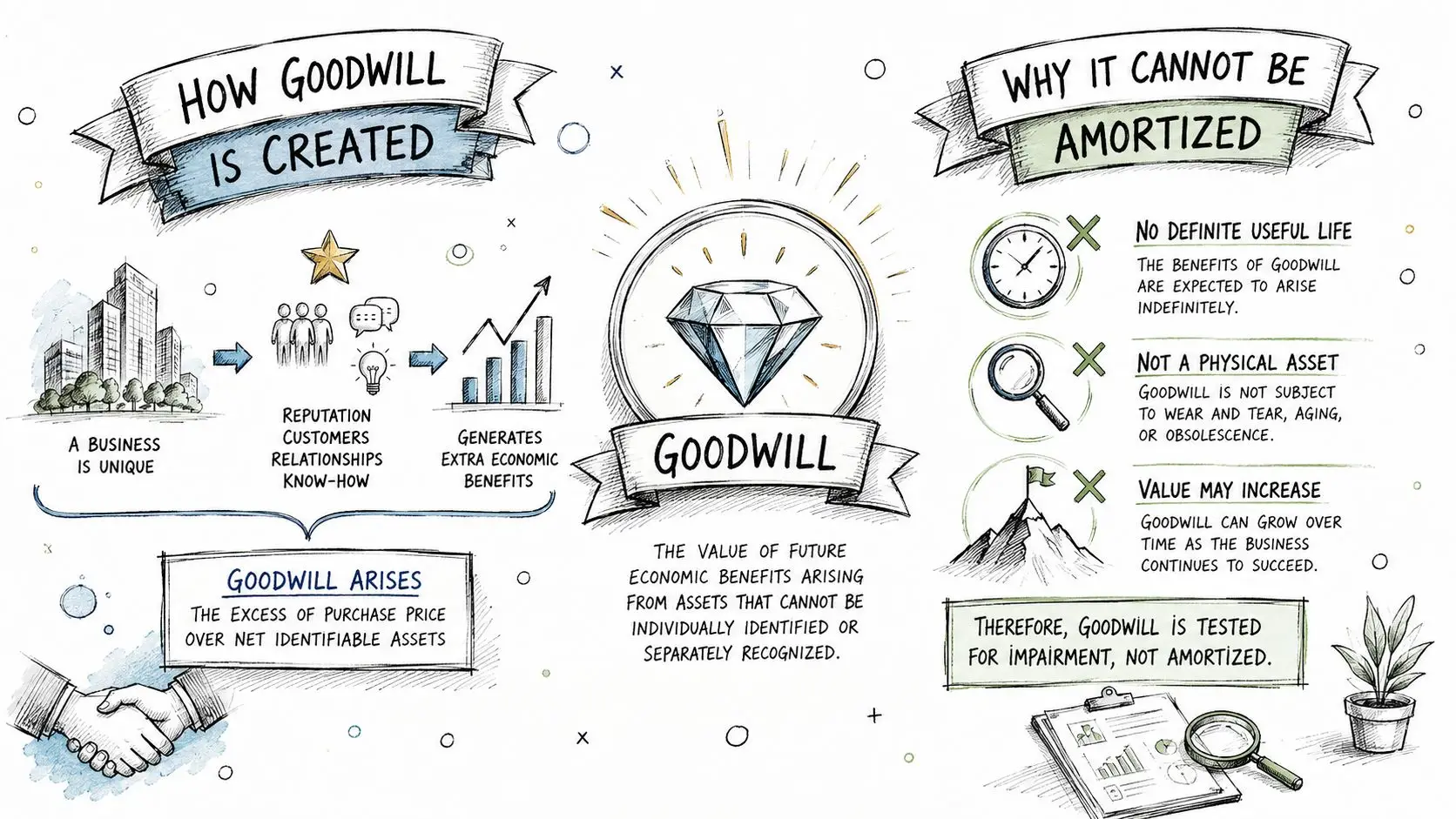
A buyer creates goodwill when the purchase price exceeds the fair value of the acquired business’s identifiable net assets. Purchase accounting separately recognizes assets and liabilities such as contracts, technology, customer relationships, and obligations. The remaining excess is recorded as goodwill.
Goodwill is therefore a residual acquisition premium. It can capture expected synergies, an assembled workforce, market access, reputation, and other benefits that accounting rules do not recognize as separate identifiable assets.
Why the standards reject routine amortization
Under both IFRS Accounting Standards and U.S. GAAP, goodwill is not amortized. Companies test it for impairment at least annually and whenever impairment indicators arise, as noted earlier.
The reason is goodwill’s uncertain useful life. Management cannot reliably establish how long the acquired benefits will continue. A fixed annual expense could misstate the timing and scale of any decline in those benefits.
That sharpens the risk. Deteriorating cash flows, weaker forecasts, or failed integration can surface as a concentrated write-down in one reporting period rather than as a gradual expense. Counsel should treat the underlying assumptions as potential evidence in covenant disputes, shareholder claims, and challenges to acquisition diligence.
What remains at risk
Goodwill is tested within the operating business that is expected to benefit from the acquisition. IFRS allocates it to a cash-generating unit, while U.S. GAAP assigns it to a reporting unit. The analysis therefore depends on the performance and valuation of the broader unit, not on goodwill viewed as an independent asset.
The assigned unit’s carrying value, forecasts, integration results, and valuation inputs determine whether the recorded premium remains supportable. Management should preserve acquisition models, board materials, integration reports, revised forecasts, and valuation instructions before an audit or dispute narrows the record.
Executives should describe goodwill plainly: it is the accounting record of an acquisition premium, supported only while the assigned business can justify its carrying value. Disclosures should align with that conclusion and avoid language that later conflicts with impairment assumptions.
IFRS versus US GAAP Testing Frameworks
The frameworks share the same central rule, but they produce different workflows. IFRS uses a one-step test at the cash-generating unit level, while U.S. GAAP uses a reporting-unit framework and permits an initial qualitative screen.
Under IAS 36, management allocates goodwill to a cash-generating unit, or group of units, expected to benefit from the combination. The company compares the carrying amount, including goodwill, with recoverable amount. If carrying amount exceeds recoverable amount, the company recognizes the loss.
IAS 36 requires annual testing for goodwill, indefinite-life intangible assets, and intangible assets not yet available for use. The company must also test whenever indicators arise. The IFRS Foundation’s IAS 36 standard sets out that unit-level approach.
U.S. GAAP offers a different decision gate. Under ASC 350, management may first perform a qualitative assessment using a “more likely than not” threshold. If management concludes that a greater-than-50% chance doesn’t exist that fair value falls below carrying amount, it may avoid the quantitative test.
If the threshold is met, or if the analysis remains inconclusive, the company proceeds to quantitative testing. The U.S. framework limits any goodwill loss to the carrying amount of goodwill assigned to the reporting unit.
A multinational group should maintain separate jurisdictional analyses, then reconcile them in its consolidation package. Teams seeking a practical orientation to evolving standards can consult this founder’s guide to standards updates.
| Feature | IFRS (IAS 36) | US GAAP (ASC 350) |
|---|---|---|
| Testing level | Cash-generating unit | Reporting unit |
| Annual goodwill test | Mandatory quantitative test | Annual test, with a qualitative option first |
| Core comparison | Carrying amount against recoverable amount | Carrying amount against fair value |
| Recoverable amount | Higher of fair value less costs of disposal and value in use | Fair value |
| Loss limitation | Applied within the CGU allocation process | Limited to assigned goodwill |
| Interim testing | Required when indicators arise | Required when indicators arise |
| Reversal of goodwill loss | Prohibited | Prohibited |
The distinction affects timing, valuation, and disclosure. Two subsidiaries may operate the same business, yet reach different interim procedures under their respective frameworks.
Triggers That Force Interim Impairment Tests in 2026
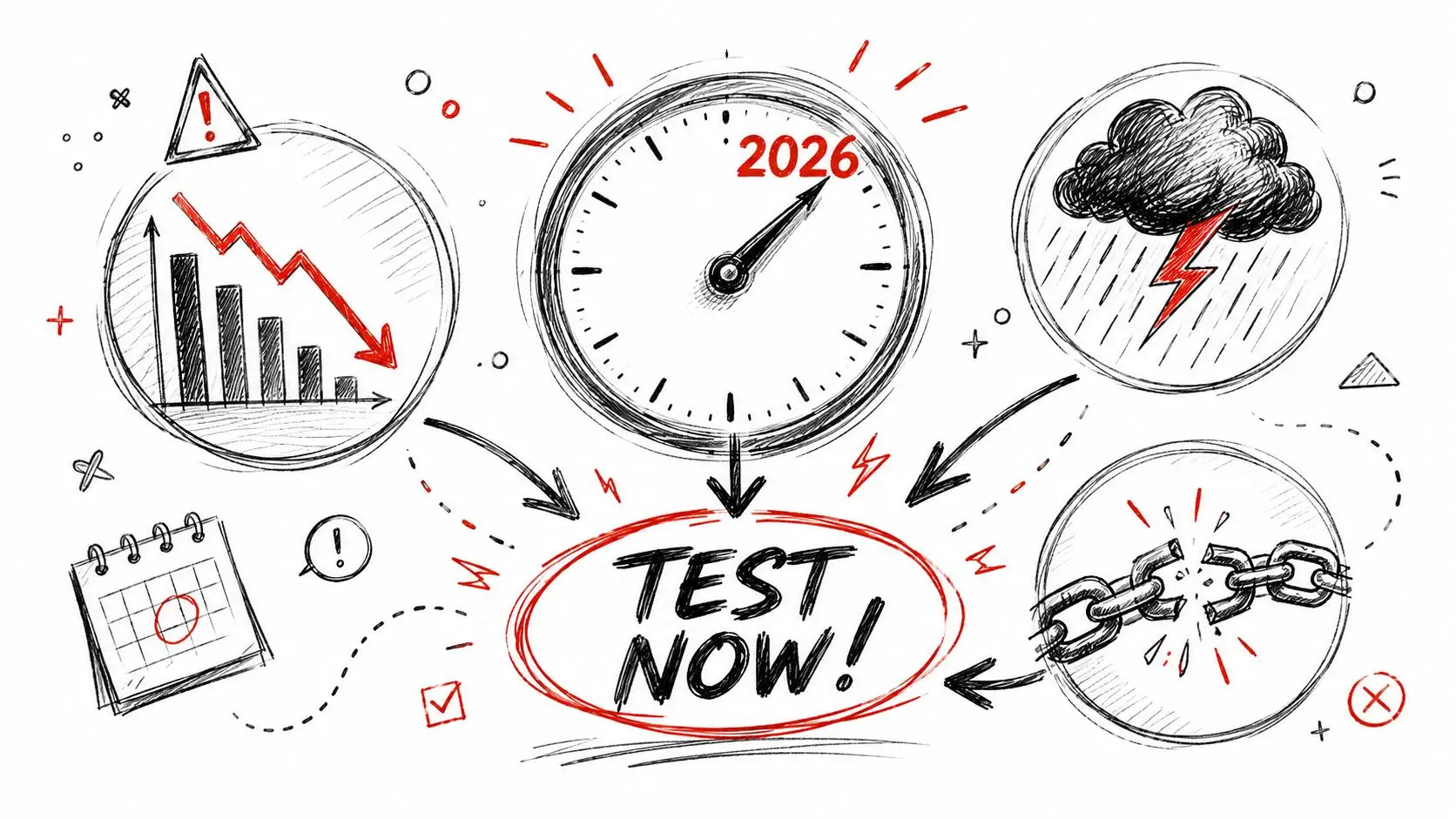
年度測試是固定的日程義務, interim triggers 則是實際的風險暴露。只要事實顯示商譽可能在年度日期前已減損,公司就應立即啟動評估,而不是等到年末補做文件。
近期申報揭示了幾種典型路徑。一家公司在股價持續下跌後認列 $396.3 million 損失;另一家公司因修訂 2025 outlook 認列 $258.1 million 損失;第三家公司則因市值大幅低於帳面價值,認列 $398.0 million 的非現金損失。這些事項載於相關公司的 SEC filing disclosures。對法律團隊而言,重點是保留觸發事件的時間線,並讓董事會、貸款方與公開披露使用同一套事實。
正確閱讀 trigger log
trigger log 應記錄事件、日期、受影響單位、決策者、支持文件與會計處理,並標明事件是否改變預測、估值輸入、契約計算或公開披露。以下事項應立即升級:
- Market decline: 持續股價下跌可能削弱分攤至 reporting unit 的價值。
- Forecast revision: 下調展望會直接削弱 value in use 所依賴的現金流假設。
- Strategic change: 出售、重組或 held-for-sale 決定可能改變測試單位。
- Operational deterioration: 客戶流失、利潤率壓縮或整合失敗,會降低預期未來現金流。
- Financing pressure: 契約違約或違約威脅,可能迫使管理層重估預測及披露時點。
- Regulatory disruption: 新規則、調查或限制可能減少收購帶來的預期利益。
披露時鐘隨事實變化
interim trigger 可能同時影響風險因素、管理層討論、貸款通知、董事會報告及交易披露。律師應在減損金額確定前,先核對這些義務與文件版本,避免會計結論、契約通知和市場訊息互相矛盾。
KPMG 在 Valuation Newsletter, 16th Edition 中指出,S&P 500 Europe index 有 123 companies 認列商譽減損,較 2019 年高 46.4%,較 2018 年高 78.3%,詳見其 valuation newsletter。因此,審計委員會應把 interim impairment review 列為固定議程,並要求管理層在觸發事件出現時即時報告,而非等候年度測試。
Valuation Mechanics Behind Recoverable Amount
IAS 36 defines recoverable amount as the higher of fair value less costs of disposal and value in use, according to the IFRS Foundation’s IAS 36 requirements.
Think of recoverable amount as two independent appraisals. Management recognizes impairment only when the carrying amount exceeds the stronger of those two measurements.

Fair value less costs of disposal
This measurement asks what market participants would pay, less directly attributable disposal costs. Management should support the analysis with market evidence, comparable transactions, sector conditions, and assumptions that an informed buyer could reasonably adopt.
The model must not reproduce management’s preferred strategic plan. It should reflect a defensible market-participant perspective.
Value in use
Value in use measures the present value of future net cash flows expected from using the asset or cash-generating unit. That calculation requires management to translate operational expectations into cash flows, then discount them to present value.
The four inputs deserve direct challenge:
- Growth: Does the forecast reflect documented market demand and realistic integration progress?
- Margins: Do operating margins reconcile with current performance and approved budgets?
- Discount rate: Does the rate reflect the relevant risk and valuation date?
- Forecast horizon: Does the projection period have a defensible connection to the unit’s economics?
Terminal value assumptions can dominate the conclusion. Therefore, the valuation file should show how management tested adverse changes and reconciled the result with external evidence.
Counsel should preserve the versions of forecasts used in the analysis. A later dispute may focus less on the formula than on when management knew that the assumptions no longer matched operational reality.
Common Pitfalls That Invite Auditor and Litigation Scrutiny
An orderly impairment file can still create serious audit, covenant, and litigation exposure. A signed memo and polished valuation model do not cure weak unit definitions, abandoned forecasts, or inconsistent evidence. Counsel should test the process before publication, when management can still correct it.
Four recurring landmines
Premature qualitative conclusions create the first problem under U.S. GAAP. Management may decide that a quantitative test is unnecessary without documenting market, operational, and reporting-unit evidence supporting that threshold. That conclusion should be challenged before approval.
Poor unit allocation creates the second. Under IFRS, assigning goodwill to an overly broad CGU can let profitable operations mask an underperforming acquisition. Under U.S. GAAP, an improperly defined reporting unit can produce the same distortion. The allocation should match actual oversight and expected cash-flow benefits.
Optimistic synergy assumptions create the third. Acquisition models frequently preserve synergies that later operating reports no longer support. Management should reconcile them with integration milestones, customer retention, staffing, and revised budgets. Unexplained gaps become evidence in disputes over earn-outs, purchase-price representations, and management conduct.
Consolidation mismatches create the fourth. The goodwill subledger, local statutory accounts, group consolidation pack, and valuation memo must tell the same story. Differences invite auditor questions and give opposing counsel a clear inconsistency to present to a court or regulator.
Board minutes, internal forecasts, and emails can expose these failures. Missed targets, integration delays, strategic reversals, or pressure to avoid a charge may show that management knew more than the final memo admits.
The write-down cannot be repaired later
Both IFRS and U.S. GAAP prohibit reversing a recognized goodwill impairment. The charge permanently affects earnings and equity rather than operating as a temporary valuation adjustment. That permanence also changes the legal strategy: counsel should challenge weak assumptions before approval, not after publication.
A defensible file explains the conclusion, the rejected alternatives, and the evidence available when management made the decision.
Before the auditor receives the package, management should verify that it contains:
- Unit map: The allocation reflects actual management oversight and cash-flow benefits.
- Forecast trail: The model reconciles with approved budgets and operating reports.
- Trigger record: Interim events received documented review.
- Sensitivity analysis: Decision-makers understand which assumptions could eliminate headroom.
- Narrative consistency: Board materials, MD&A, lender reports, and financial statements do not contradict one another.
Those checks also protect covenant and disclosure analysis. A non-cash charge may still reduce equity or affect financial maintenance tests, depending on the facility documents. Counsel should review definitions, add-backs, equity cure mechanics, waiver conditions, and notice deadlines before management releases the conclusion.
Cross-Border M&A, Disputes, and What Counsel Should Do Next
Goodwill impairment often becomes legally important because it connects acquisition value with later conduct. A buyer may allege that the seller overstated synergies or concealed operational risks. A seller may argue that the buyer caused the deterioration through poor integration or strategic mismanagement.
Earn-out disputes create a similar problem. The impairment charge may not prove a contractual breach, but the surrounding forecasts, integration decisions, and valuation judgments can become relevant evidence.
Covenant analysis requires equal discipline. A non-cash loss may still reduce equity or affect financial maintenance tests, depending on the facility documents. Counsel should review definitions, add-backs, equity cure mechanics, waiver conditions, and notice deadlines before management releases the impairment conclusion.
The next 30 days
A cross-border group should complete the following work immediately:
- Build the trigger log. Record market, operational, strategic, regulatory, and financing events by date.
- Refresh the CGU and reporting-unit map. Confirm each allocation against actual oversight and expected benefits.
- Commission valuation sensitivity work. Test growth, margins, discount rates, forecast horizons, and terminal assumptions.
- Brief the audit committee. Present the accounting conclusion alongside disclosure, covenant, and dispute consequences.
- Reconcile the disclosure package. Align financial statements, management commentary, lender communications, and transaction records.
- Prepare a litigation hold. Preserve forecasts, valuation instructions, board materials, integration records, and relevant communications.
The annual test should form part of a broader governance discipline. Companies that maintain trigger monitoring and document decisions early can defend the accounting conclusion more effectively when auditors, lenders, regulators, or litigants challenge it.
Cross-border groups also need jurisdiction-specific coordination. IFRS and U.S. GAAP can differ in testing level, measurement, timing, and disclosure, even when both systems address the same acquisition.
RNC Group offers cross-border commercial counsel for M&A disputes, covenant pressure, corporate crisis management, and strategic legal correspondence. Companies facing a potential goodwill impairment should visit RNC Group for a specialized review before the write-down creates avoidable legal exposure.
This article provides general information, not legal, accounting, valuation, or tax advice. Readers should obtain advice from qualified Israeli and foreign counsel, accountants, and valuation professionals before relying on it or taking action.