
A partnership rarely fails at the moment trust breaks. It fails when the exit lacks structure, filings, and control under tightening 2026 compliance expectations across banks, tax authorities, and cross-border regulators.
That is the counterintuitive point. The end of a business relationship is not proof that the venture was defective. It is proof that the original documents, decision rules, and enforcement plan are now under stress.
Anyone searching for how to dissolve a business partnership should start there. Dissolution is not one conversation, one filing, or one signature. It is a legal shutdown, a financial negotiation, and in international matters, a coordinated risk-containment exercise.
The End is a Test Not a Failure
Many founders treat dissolution as an emotional event. That approach usually produces the worst legal outcomes.
A better view is operational. The end of a partnership tests whether the business was designed to survive conflict, value assets correctly, and stop future liability when interests diverge.
That matters because partnership breakdowns are common. An estimated 50% to 80% of business partnerships dissolve, according to analysis cited in Ronkin Law’s discussion of partnership dissolution.
The practical lesson is not pessimism. The practical lesson is drafting and execution.
A disciplined dissolution protects four things at once:
- Authority: It stops a former partner from binding the business after the relationship ends.
- Value: It prevents distressed sales, rushed appraisals, and avoidable concessions.
- Liability control: It addresses debts, taxes, guarantees, and post-closing claims.
- Reputation: It manages employees, customers, suppliers, and lenders before rumor gives them an advantage.
Key takeaway: A clean separation is not an act of retreat. It is a controlled transfer of risk.
Domestic dissolutions already require precision. International dissolutions raise the stakes further.
Israeli companies with foreign counterparties often face conflicting governing laws, different filing standards, banking scrutiny, and disputes over where assets, IP, or receivables reside. Standard domestic checklists do not solve those issues.
The strategic path is therefore simple in principle and demanding in practice. Assess first. Negotiate second. Wind up formally. Escalate carefully. Close every operational loose end.
Your Dissolution Blueprint Initial Assessment and Strategy
Control is usually won or lost before the first notice is sent. In cross-border partnership breakups, one careless email can trigger the wrong forum, alert the bank, or hand the other side time to move receivables, revoke access, or lock records.
Start with the full document file, not the dispute story. Collect the partnership agreement, amendments, side letters, loan documents, guarantees, founder arrangements, leases, employment terms, IP assignments, banking mandates, tax registrations, and any document that allocates authority across jurisdictions. For Israeli businesses, add foreign investment approvals, outbound service agreements, transfer pricing files, and local counsel opinions if they exist. Those papers often decide what can be done quickly and what requires consent, filings, or court relief.

Read the agreement like opposing counsel
Read for control, exposure, and enforcement. Intent matters far less than wording once relations collapse.
The review should isolate who can trigger dissolution, what notice method is valid, whether consent must be unanimous, whether a partner can force a sale or buyout, and which acts require board, shareholder, or manager approval. In international structures, check whether the operating entity, the IP holder, and the revenue-collecting entity are even the same company. Many are not.
A disciplined review usually focuses on:
- Trigger events: Death, withdrawal, bankruptcy, illegality, deadlock, expiry of term, sanctions exposure, or a defined business failure event.
- Exit mechanics: Buy-sell rights, rights of first refusal, drag or tag rights, mandatory offers, lock-up periods, and call or put options.
- Valuation language: Formula clauses, expert determination clauses, appraisal rights, or silence that invites dispute.
- Authority clauses: Signing power, banking authority, access to books and records, and who controls local subsidiaries.
- Restrictive covenants: Confidentiality, non-solicit terms, non-compete limits, and ownership of know-how, code, customer data, and trademarks.
- Dispute architecture: Governing law, venue, arbitration rules, emergency relief rights, and service of process across borders.
If the drafting is thin, default law fills the gaps. That result is rarely favorable in a stressed breakup, especially where one partner assumed Israeli law controls but the contract points elsewhere, or says nothing useful at all.
Identify the legal route before you frame the first move
The legal path drives the strategy. A consensual exit, a statutory dissolution event, and a court-supervised breakup require different evidence, timing, and communications discipline.
| Dissolution path | Common trigger | Immediate risk |
|---|---|---|
| Voluntary | Agreed exit or use of a contractual clause | Parties relax too early and leave guarantees, taxes, or authority unresolved |
| Statutory | A trigger under applicable partnership or company law | One side misreads local default rules and gives away bargaining power |
| Court-ordered | Deadlock, misconduct, impossibility, oppression, or illegality | Public filings, cost, delay, and loss of commercial control |
Cross-border structures add another layer. A dissolution may be valid in one jurisdiction while bank signatories, tax accounts, or IP registrations remain untouched in another. That gap is where bank account freezes, payroll failures, and asset diversion claims begin.
Build the factual record before negotiations start
Legal rights without evidence produce weak outcomes. Build a working file that can survive scrutiny from the other side, the bank, tax authorities, and, if necessary, a tribunal.
The factual map should cover cash position, receivables aging, debt, guarantees, unpaid taxes, employee obligations, customer concentration, supplier dependence, pending disputes, regulatory exposure, and digital access. Include source code repositories, domain names, cloud accounts, payment processors, CRM access, and beneficial ownership records. In Israeli-linked businesses, I also want to know where export revenues land, whether VAT filings match the contract structure, and whether any foreign affiliate is using IP that was never formally assigned.
For the finance side, a disciplined process similar to financial due diligence helps separate assumptions from liabilities that can be proved. That matters when a partner claims the company is cash-poor but receivables are sitting offshore, or insists the tax position is clean without support.
Practical rule: If an item could turn into a post-exit claim, preserve the document trail before notice goes out.
Pressure-test the points that fail outside the contract
The contract is only part of the problem. In practice, exits are often disrupted by third-party controls that neither partner has thought about for years.
Review these dependencies early:
-
Banking control
Confirm who can move funds, change signatories, close accounts, or place restrictions. In international matters, ask the bank what documents it will require before recognizing a management change. Do not assume a signed settlement will be enough. -
Guaranteed obligations
Personal guarantees, parent guarantees, and standby commitments survive the relationship unless they are expressly released. A partner who exits without a written release may remain exposed long after operations stop. -
Tax and reporting exposure
Unfiled returns, withholding errors, VAT disputes, customs issues, and transfer pricing mismatches can derail a settlement late. Multi-jurisdictional groups need a filing calendar, not a vague assurance that the accountant will handle it. -
Intellectual property chain of title
If key IP sits with a founder personally, a foreign affiliate, or a contractor, the business may not own the asset it is trying to divide or sell. That problem becomes acute when software was developed in Israel and licensed informally abroad. -
Cross-border enforcement hooks
Overseas receivables, foreign subsidiaries, local licensing rules, and assets held by payment processors may require separate action in each jurisdiction. A right that cannot be enforced quickly has limited strategic value.
Set the objective before issuing notice
The first formal communication should match a defined end state. That may be a negotiated buyout, a managed wind-up, a sale of the business, a split of assets by territory, or an application for interim relief.
Good notices are short, accurate, and timed for maximum control. They cite the legal basis, preserve rights, and avoid accusations that create defamation risk or harden positions without benefit. In high-risk international matters, I often delay notice until access is secured, records are preserved, local filing requirements are checked, and the banking position is understood. Speed matters. Uncontrolled speed is expensive.
A disciplined initial assessment does one job above all. It prevents the breakup from becoming a multi-jurisdictional loss of control.
Negotiating the Exit Buyouts Valuations and Timelines
Most dissolutions do not collapse over principle. They collapse over price, timing, and fear of hidden liabilities.
The negotiation should therefore split those issues. First agree on the method. Then address the number. Then allocate risk after closing.

Start with valuation methodology, not the payout fight
Here, many parties lose control. They argue over the price before agreeing how value will be measured.
That usually hardens positions. It also turns every spreadsheet into a political statement.
As Miller Law explains in its discussion of dissolving a partnership without an agreement, dissolution agreements need precise treatment of business valuation methodology, asset distribution allocation, and post-dissolution indemnification structures, and disputes often arise when no valuation mechanism was set in advance.
Three common valuation approaches appear in practice:
| Method | Best used when | Core limitation |
|---|---|---|
| Asset-based | Asset-heavy businesses, distressed exits, liquidation scenarios | Often undervalues goodwill and future earnings |
| Income-based | Stable businesses with predictable earnings | Heavily affected by assumptions |
| Market-comparable | Sectors with enough comparable deals | Comparable transactions may not provide valid comparisons. |
The strategic move is to negotiate the methodology first and record it in writing. Only after that should the parties discuss the resulting value.
Use phased negotiation to reduce friction
A strong exit negotiation often follows a staged sequence:
- Phase one: Confirm the trigger for dissolution and authority to negotiate.
- Phase two: Freeze the valuation date and accounting assumptions.
- Phase three: Select the valuation method and, if needed, the appraiser.
- Phase four: Negotiate asset allocation and payment mechanics.
- Phase five: Finalize indemnities, releases, and future conduct restrictions.
This sequence works because it narrows the argument. It also exposes whether the dispute concerns economics, control, or distrust.
Tip: Never let valuation, asset split, and indemnity discussions merge into one undifferentiated fight. Separate tracks produce cleaner outcomes.
Structure the buyout around risk, not optimism
A buyout is not just a number. It is a package of money, timing, security, and legal separation.
A lump-sum payment creates finality. However, it may be unrealistic if liquidity is tight or if the continuing business depends on short-term working capital.
A structured payout can preserve operations. However, it keeps the parties financially connected after the breakup, which is often the very problem dissolution was meant to end.
The trade-offs usually look like this:
-
Lump sum
- Better for clean exits
- Better where trust is low
- Harder if the buyer lacks financing
-
Installments
- More flexible for cash flow
- Higher enforcement risk
- Requires security, default clauses, and acceleration terms
-
Earn-out style elements
- Useful when value depends on future performance
- Dangerous when the departing partner no longer controls operations
Where trust is damaged, deferred payments need protective mechanics. Those may include escrow holdbacks, set-off rights, representations and warranties, or collateral linked to specific assets.
Negotiate liabilities with precision
Many weak dissolution agreements state that each side will be responsible for “their share” of liabilities. That phrase solves nothing.
The agreement should identify which debts are paid before closing, which survive, who controls creditor discussions, and how claims are handled if a third party pursues the departing partner later. Lease exposure, tax exposure, and guarantees require separate treatment.
A workable liability section usually addresses:
-
Known debts
Vendor balances, taxes, payroll, loans, and contract termination costs. -
Contingent claims
Pending disputes, threatened claims, warranty exposure, and regulatory inquiries. -
Third-party enforcement risk
What happens if a bank, landlord, or creditor ignores the internal allocation. -
Indemnity mechanics
Notice rules, defense control, payment timing, and caps if the parties agree on them.
Clarify what each side keeps using after the split
Actual value may sit in softer assets. Customer relationships, software access, brand use, confidential know-how, and personal introductions often matter more than office furniture.
Address those rights explicitly. If one side may continue trading under a modified brand or continue using certain customer contracts, the documents should say so clearly.
A concise negotiation checklist helps:
- Valuation date
- Valuation method
- Who appoints the appraiser
- Payment terms
- Security package
- Debt assumption
- IP ownership and license-back, if any
- Client transition rules
- Mutual releases
- Dispute forum for post-closing claims
Critically, memorialize the timeline. Ambiguity about when control changes hands creates immediate conflict over bank access, staff instructions, and communications with clients.
Executing the Wind-Up Legal Procedures and Compliance
A signed breakup agreement does not shut down legal exposure. The exposure ends only when the entity, its registrations, its tax footprint, and its banking authority are closed.
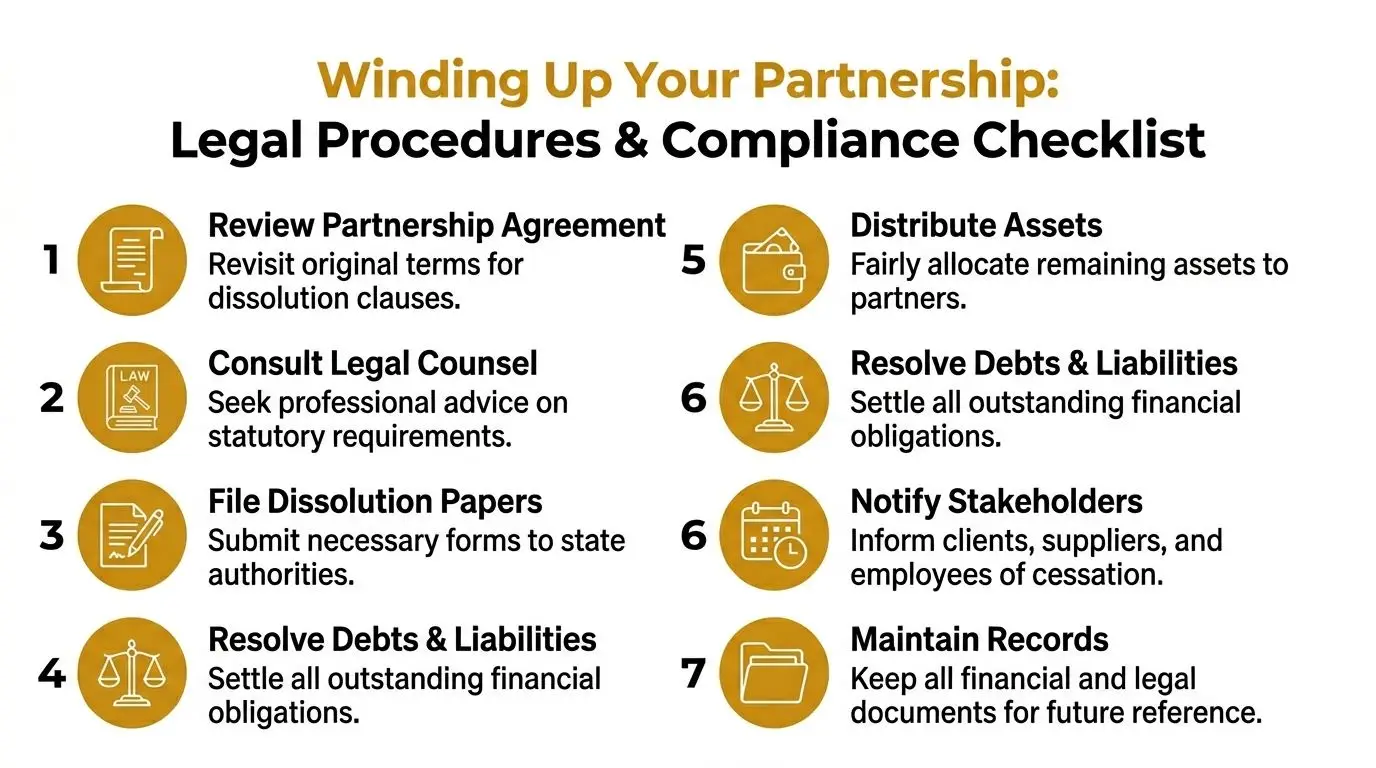
This stage is procedural, but the risk is operational. In cross-border matters, especially where an Israeli company has foreign subsidiaries, UAE trading activity, or accounts that require dual signatories, poor execution can trigger tax notices, rejected remittances, and temporary bank freezes. I have seen settlements collapse at this point because the parties treated filing as the job and ignored the controls around it.
Follow the legal sequence with banking and tax in mind
Order matters. If the sequence is wrong, one filing can cut across another and create unnecessary friction with regulators, counterparties, or the bank handling the operating account.
A disciplined wind-up usually covers these actions:
-
Fix one dissolution date
Use the same effective date across the settlement, board or partner resolutions, regulator filings, tax submissions, and notices to counterparties. -
Approve the shutdown formally
Record the internal authority for the wind-up. In international groups, that may require partner resolutions, board approvals, shareholder approvals, or notarized powers of attorney. -
File the required dissolution or cancellation documents
The filing name changes by jurisdiction. The function does not. It puts the registry on notice that the business is being closed or struck off. -
Lock down authority before funds start moving
Revoke obsolete signing powers, online banking credentials, procurement authority, and local agency authority. Avoidable bank disruption often starts at this point. -
Notify creditors, customers, landlords, and key contract counterparties
Written notice creates a record. In some jurisdictions, it also starts limitation periods or claims procedures. -
Collect receivables and preserve books and communications
Keep accounting records, tax files, contracts, customs documents, and payment approvals in one controlled archive. -
Pay or reserve for liabilities in the order local law requires
Do not distribute value early. Priority rules can override the partners’ private deal. -
Complete final tax, VAT, payroll, and social insurance filings
International partnerships often miss local indirect tax deregistration even after corporate closure documents are filed. -
Cancel licenses, permits, trade names, and foreign registrations
A dormant registration can still generate filing duties, penalties, and service-of-process risk. -
Close, convert, or ring-fence bank accounts
Match the bank instructions to the dissolution documents and signatory matrix. If one partner is being bought out, the mandate change should be coordinated before the relationship manager sees conflicting instructions. -
Distribute residual assets only after reserves are set
The cleanest closings hold back a reserve for tail liabilities, then release it on a defined date.
Cross-border wind-ups fail at the edges
Domestic guidance usually stops at the registry filing. International dissolutions do not.
An Israeli business closing a partnership with activity in Europe or the Gulf may need to deal with foreign tax numbers, local nominee arrangements, customs registrations, employee termination filings, and banks that will not act without apostilled or consularized documents. If the structure touches the UAE, local entity rules can affect who has authority to approve the shutdown and what supporting documents the registrar or bank will accept. The UAE Commercial Companies Law is a useful reference point for understanding why a wind-up that looks simple on paper can stall in practice.
The bank account deserves separate attention.
Banks do not care that the partners have reached a private compromise. They care about mandate authority, sanctions screening, beneficial ownership records, source of funds, and documentary consistency. If one side sends closure instructions while the registry still shows old officers, or if the Israeli parent and the foreign operating entity submit mismatched forms, the account may be restricted pending review. That can freeze payroll, block customer refunds, and trap settlement funds in exactly the week the parties need a clean exit.
Practical warning: Tax authorities, banks, landlords, and regulators are not bound by the settlement document unless the matching formal steps are completed correctly.
Run the process from a compliance ledger
Use a live ledger, not a loose email trail. In a contested or cross-border dissolution, the ledger becomes the evidence file showing what was done, by whom, on what date, and with which supporting document.
| Item | Responsible person | Status |
|—|—|
| Dissolution filing | External counsel or company secretary | Pending or filed |
| Final tax returns and deregistration | Accountant or tax adviser | In progress |
| Creditor and counterparty notices | Finance and legal | Sent |
| License and permit cancellations | Operations or compliance | Pending |
| Bank mandate change or account closure | Finance | Confirmed |
| Record archive and retention schedule | Management | Complete |
Keep copies of courier receipts, regulator confirmations, bank acknowledgments, and tax clearance submissions with that ledger. If a dispute reappears a year later, that file often decides whether the matter ends quickly or becomes expensive.
The objective is control. A proper wind-up closes the entity, closes the authority, closes the tax account, and closes the banking channels in the same sequence. Anything less leaves a live risk surface behind.
Navigating Conflict and Cross-Border Complexities
Domestic advice usually assumes the parties sit in one jurisdiction, hold assets in one banking system, and answer to one court framework. International dissolutions break that assumption immediately.
The primary difficulty is not just legal. It is tactical.

For Israeli firms working across borders, the pressure has intensified. In networks like ADVOC spanning 73 countries, reported data shows a 25% rise in cross-border M&A disputes, with 40% involving partnership breakdowns, while mediation fails in 60% of these cases without phased escalation plans and bank restrictions occur in 30% of Israeli-involved disputes, according to the cited analysis at AllLaw.
Why reactive litigation often fails
Litigation has its place. However, filing first and planning later is usually a mistake in cross-border matters.
A judgment in one country may be difficult to enforce in another. A freezing application may provoke retaliation. A letter sent in the wrong language or to the wrong legal entity may trigger banking or regulatory alarms before the sender has secured records and access.
A better approach uses escalation in phases:
| Phase | Purpose | Typical tool |
|---|---|---|
| Containment | Preserve assets and communications control | Formal notices, document preservation, authority review |
| Structured negotiation | Test commercial resolution without giving away their negotiating advantage | Counsel-led proposals, valuation protocols, limited standstill terms |
| Adjudicative pressure | Force compliance or interim protection | Arbitration filing, court relief, injunction requests |
| Enforcement coordination | Convert paper rights into real control | Local counsel action, bank engagement, judgment recognition work |
This phased model reduces self-inflicted damage. It also allows business leaders to decide when publicity, court filings, or regulator contact serves the objective.
Choose the forum by outcome, not habit
Mediation, arbitration, and litigation are tools. None is automatically superior.
Mediation works best when both sides still want privacy and retain enough trust to exchange information. It fails when one side uses the process to delay, hide assets, or gather intelligence.
Arbitration can help where the agreement already contains a strong clause, confidentiality matters, and the dispute requires specialized commercial decision-makers. It can still become slow if interim relief is needed in several countries.
Litigation is often necessary when urgent injunctions, fraud allegations, or coercive disclosure tools matter more than privacy. It also becomes unavoidable when no enforceable arbitration clause exists.
Decision rule: Choose the forum that can control assets, evidence, and counterparties fastest. Do not choose the forum that merely looks familiar.
Cross-border dissolution raises three recurring fault lines
The first is governing law versus asset location. A contract may point to one legal system while the money, IP, staff, or inventory sits somewhere elsewhere.
The second is tax and reporting asymmetry. One side may assume the commercial settlement ends the matter, while tax authorities still require local filings, payroll closeout, or indirect tax treatment.
The third is bank intervention. Banks respond to inconsistency, adverse media, sanction sensitivity, KYC gaps, and internal authority disputes. Once a bank freezes activity, the commercial dispute becomes a liquidity crisis.
Israeli-linked matters deserve extra care here. Banks may react not only to the dispute itself but also to incomplete explanations of beneficial ownership, changing control, or foreign legal proceedings.
Prevent bank account freezes before they start
A freeze often arrives after a badly timed notice, not after a court order. Prevention is therefore procedural.
The recommended path usually includes:
-
Prepare the authority file first
Gather constitutional documents, signatory records, settlement drafts, and current corporate extracts. -
Align narratives across jurisdictions
Contradictory letters from different lawyers create suspicion. -
Control multilingual communications
A translated notice that changes legal meaning can trigger avoidable escalation. -
Separate internal conflict from banking instructions
Do not ask the bank to decide who is right in the partnership dispute. -
Engage local counsel where the account sits
Domestic assumptions often fail in foreign banking practice.
Use coordinated local execution
Cross-border dissolutions require more than one good lawyer. They require one command structure.
When assets, subsidiaries, or counterparties span several jurisdictions, someone must align filings, notices, negotiation posture, and emergency applications. Otherwise, one local action can undermine another.
This is especially important where an Israeli entity operates through distributors, franchise partners, or joint ventures abroad. Local employment rules, franchise protections, data obligations, and court procedures can distort what looked like a standard exit.
The common failure pattern is fragmentation. Tax advisers speak to tax issues. Local litigators file protective claims. Commercial counsel negotiates principal terms. Nobody owns sequence.
The superior path is controlled escalation with one factual record, one risk map, and one decision chain.
The Final Steps Asset Allocation and Stakeholder Transitions
The final phase looks administrative. It is not.
Here, loose ends become future claims. Assets get misallocated, staff receive mixed instructions, customers lose confidence, and digital control slips away.
Allocate assets with documentary precision
Physical assets are usually the easy part. Inventory, equipment, vehicles, and office furniture can be sold, transferred, or divided.
The harder assets are often intangible. Those include trademarks, source code, customer data, websites, cloud accounts, social media access, and know-how embedded in specific people or workflows.
A reliable closing file should identify:
- What is transferred by exact description
- What is retained by exact description
- What is licensed and on what terms
- What is deleted or returned
- Who controls each account on the effective date
If intellectual property contributed by a founder was never formally assigned, resolve that point expressly. Silence creates an advantage after dissolution.
Manage employees and contractors carefully
Employees judge the process by clarity. So do contractors.
The business should issue one coherent internal communication, one payroll closeout process, and one instruction chain for equipment return, benefits, accrued entitlements, and confidentiality obligations. If one partner privately gives different instructions, the dispute can spill into labor, data, and client-service problems.
A focused transition plan should address:
- Final payroll and benefits
- Outstanding reimbursements
- Return of devices and access credentials
- New reporting lines, if part of the business continues
- Reminder of post-employment obligations
Protect the customer relationship, even if the partnership ends
Customers do not need the full dispute history. They need continuity, clear contacts, and confidence that contracts remain managed.
That usually means preparing approved messaging for key clients, suppliers, insurers, and lenders. The language should be accurate, restrained, and consistent with the legal documents already signed.
Key takeaway: The best stakeholder notice answers three questions only. Who is now responsible, what changes operationally, and whom should the recipient contact next.
Where one side continues the business, transition letters should address service continuity without inviting debate about fault. Where the business closes entirely, the notice should explain timing, outstanding obligations, and practical next steps.
Close the digital perimeter
Many post-dissolution disputes now arise from digital residue rather than paper records.
Change access to email admin panels, cloud storage, accounting systems, CRM platforms, payment gateways, messaging tools, and website registrars. Archive what must be retained. Remove what should no longer be accessible.
A practical closeout list often includes:
- Email administration rights
- Cloud storage ownership
- Accounting platform access
- Customer database permissions
- Website and domain registrar control
- E-signature platform rights
- Social platform administration
- Shared device inventories
Keep a final record set
Each former partner should retain the executed dissolution documents, filings, tax submissions, notices, payment records, and closing correspondence. If a future creditor, regulator, or counterparty appears, those records become the defense.
A clean ending is visible in the paperwork. It shows a defined end date, a documented asset path, completed notices, and no ambiguity about who owns what or owes what.
That is the complete answer to how to dissolve a business partnership. The process ends well when the documents, the money, the tax position, the banking arrangements, and the operational handover all tell the same story.
For Israeli companies, multinational groups, and founders handling high-stakes domestic or cross-border separation, the recommended strategic path is to obtain a coordinated legal analysis before notice, valuation, or bank communications begin. RNC Group focuses on international commercial law, crisis management, cross-border disputes, and partnership breakdowns requiring disciplined escalation, multilingual execution, and control across jurisdictions. Contact us NOW to find out how to do things right.
Disclaimer: The information provided in this strategic analysis is for educational and general informational purposes only and does not constitute legal, financial, or professional advice. Business partnership dissolution involves complex statutory requirements, cross-border regulatory compliance, and significant tax implications that vary by jurisdiction and specific contractual terms. Readers should not act upon this information without seeking formal legal counsel to address the particular facts of their situation, especially regarding banking mandates, liability releases, and the enforcement of international governing laws.