
Mediation doesn’t usually fail because someone gave a weak opening speech. It fails because the file is incomplete, the numbers are soft, or the person who can settle the case isn’t authorized to do it. In 2026, the practical question is not whether a party can talk well. It is whether that party can trade with confidence, with authority, and with evidence that survives pressure in the room.
For cross-border commercial disputes, that distinction matters even more. A mediator can’t create settlement authority, and a polished narrative can’t repair a bad decision tree. The parties who settle tend to do the unglamorous work early, they align facts, pre-clear authority, and build a package that helps the neutral move the case instead of merely manage the conversation.
Why Most Mediations Stall
Many still treat mediation as a speaking contest. That mindset misses the practical point. The session rewards preparation that starts weeks earlier, because the strongest files give the mediator time to narrow disputed facts, test the gaps in the record, and frame a settlement range that both sides can use.
The preparation gap starts before anyone walks in
A well-known mediation-preparation benchmark recommends exchanging the written position statement and supporting bundle at least 1 week, and preferably 2 weeks, before the session, and the U.S. Fourth Circuit mediation guidance says parties should understand the issues, the strengths and weaknesses of the case, and the client’s settlement authority before mediation day Independent Mediators guidance. That lead time matters because mediation is rarely a same-day event in any real sense. It is usually the product of what has already been organized, reviewed, and cleared.
Practical rule: If the other side sees your position for the first time in the room, you arrived late.
That is why conflict-ready businesses benefit from the kind of structured thinking used in conflict resolution for acquisition entrepreneurs. The dispute has to be translated into a settlement posture the other side can answer, and that requires more than a polished opening.
Settlement usually happens inside the mediation window
One published summary reports a 92% aggregate settlement rate, with 72% settling on the day and another 20% shortly afterward mediation settlement summary. Another published practice report found about 95% settlement in one employment-mediation practice. Those figures justify serious prep because they show the session is often the climax of a broader negotiation, not an isolated event.
For commercial clients, the work is defensive and strategic. Build the file, test the exposure, and make sure the right person can say yes. If authority is split across jurisdictions or corporate layers, settle that before the room fills up. Otherwise the mediation becomes a delay mechanism, not a settlement forum.
Building the Pre-Mediation Timeline and Brief
Start from the mediation date and work backward. The file should be in circulation early enough for the mediator to read it with care and for the other side to absorb it without feeling ambushed. In practice, that means the submission should be concise, organized, and aimed at settlement choices, not drafted like a trial brief.
What the brief should contain
The brief should tell the mediator the procedural posture, the main legal issues, the key documents, and the current stage of the dispute JAMS brief guidance. That format fits commercial mediations because it ties the contract, the correspondence trail, and the litigation or arbitration posture into one readable package. If the dispute crosses borders or requires notarized records, include official document translation for UAE courts where the forum or the documents make that necessary.

A useful mediation brief usually answers five questions. What is the dispute about, what facts are agreed, what facts are disputed, what has already been tried, and what outcome is sought. That structure works because it strips out noise and gives the neutral a decision-ready summary. A clear brief should also explain where the strongest concession points sit, because that tells the mediator where settlement pressure can move.
A working timeline that holds up under pressure
A disciplined timeline prevents the common mistake of finishing the brief without a plan for the session itself. Circulate drafts early, choose exhibits with purpose, and confirm that the mediator has what they need before the session begins. A short written chronology is often more useful than a stack of advocacy.
- Confirm the submission date: lock the brief deadline first, then work backward to gather exhibits and approve language.
- Select the core documents: use the contract, the main emails, the relevant financial records, and any critical transcript excerpts.
- Trim the file: remove duplicates and side issues that distract from the settlement variables.
- Pre-agree the basics: try to narrow fundamental facts and damage components before the session begins Boston Bar Journal guidance.
A concise submission beats a document dump. The brief should help the mediator get to the right documents fast, not force them to sort through a hard drive’s worth of material.
Assembling the Evidence File Around a Settlement Range
A mediation evidence file should do more than collect documents. It should let counsel and the mediator test concessions against a settlement range without wading through clutter. Contracts, emails, financial records, and key transcript excerpts belong in a file that is organized to show where pressure can move and where it cannot.
Build for retrieval, not storage
The practical question is what the mediator can find in seconds. A clean folder structure answers that question better than a polished cover memo, because the neutral needs evidence that is easy to point to, quote, and compare. A brief file that can be opened, checked, and used in caucus will do more work than a large attachment set that looks complete but slows the room down.
| Evidence File Structure for Commercial Mediation | |||
|---|---|---|---|
| Folder | Contents | Purpose in Caucus | Retrieval Trigger |
| Contract set | Master agreement, amendments, key clauses | Shows the governing terms | When the deal language is disputed |
| Correspondence | Emails, notices, reminders, settlement exchanges | Proves the timeline and positions | When intent or notice is contested |
| Financial records | Invoices, payment history, ledgers, reconciliation files | Supports damage analysis | When the number changes |
| Transcript extracts | Relevant testimony and admissions | Locks down weak points | When factual disputes widen |
| Summary sheet | One-page chronology and issue map | Guides the mediator to the core gap | When the mediator needs the short version |
That structure matters even more when documents cross languages or jurisdictions. For disputes involving foreign-language records, official document translation for UAE courts is a useful reminder that translation quality is part of the evidentiary record, not a cosmetic add-on. If the translation is loose, the file loses force before the settlement discussion even starts.
Tie the file to a realistic settlement range
The point of gathering evidence is not to build a bloated record. It is to support a risk-adjusted value that reflects litigation exposure, cost, and uncertainty. The file should show how the number was reached, what assumptions sit behind it, and where the concession room begins and ends.
Practitioner guidance also supports a file built around the likely settlement position, not around advocacy for its own sake, including reviewing pleadings for concessions, culling the strongest evidence, estimating the full litigation budget through trial and appeal, and calculating case value before mediation Ohio Supreme Court dispute-resolution guidance.
If the file cannot quickly answer the disputed facts and the cost exposure, it has not been prepared for settlement.
That is why the most useful working file stays short and pointed. It gives the negotiator a document-backed range, not a pile of material that still needs to be sorted under pressure.
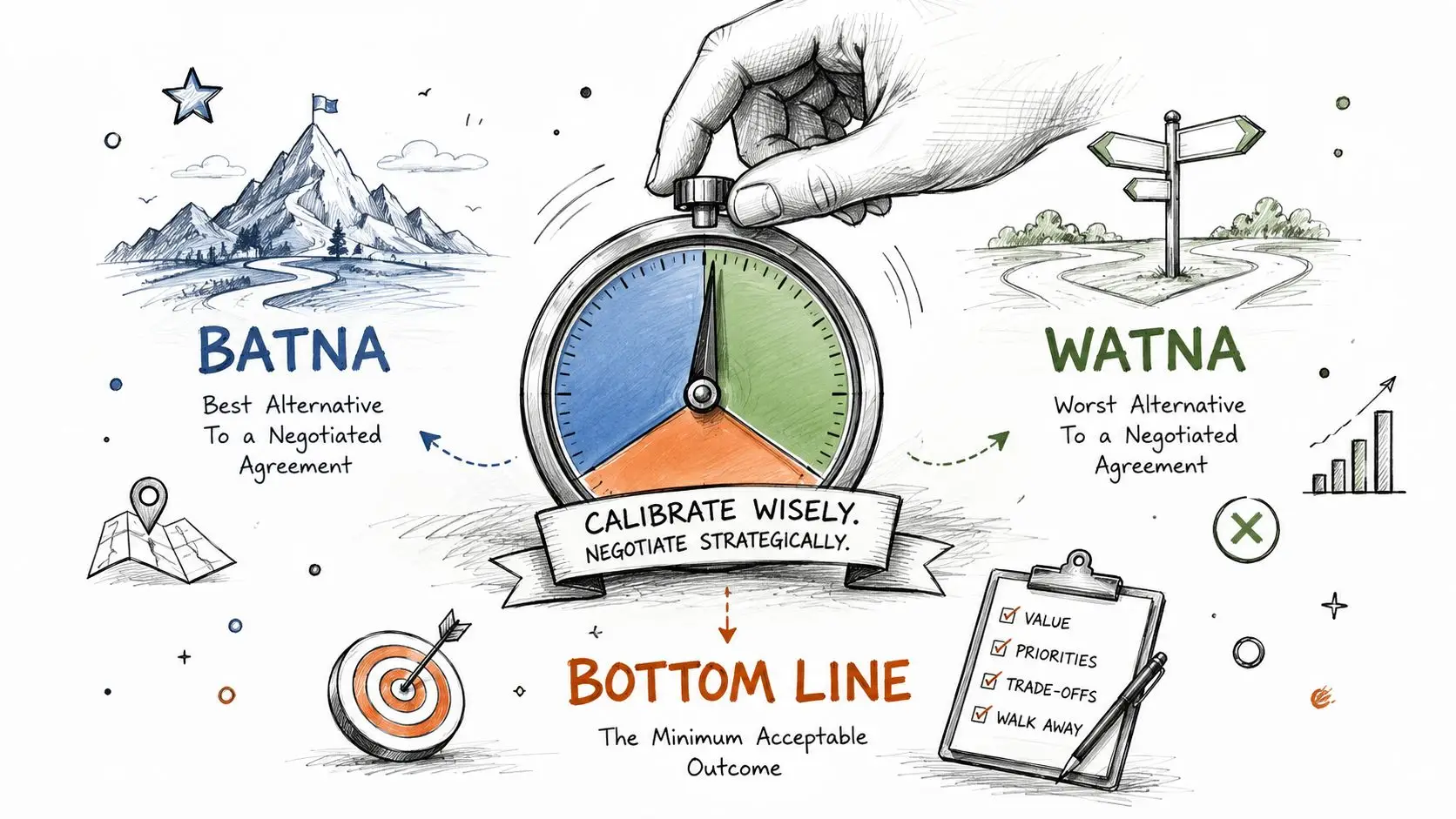
Calibrating BATNA, WATNA, and the Bottom Line
Every disputed issue needs a cost and risk threshold. Otherwise the room becomes a guessing game. BATNA, WATNA, and the absolute bottom line force that discipline.
Turn exposure into a decision tree
Start with the Best Alternative to a Negotiated Agreement, the Worst Alternative to a Negotiated Agreement, and the lowest number or term the client can accept. Then map each disputed issue to its legal and commercial risk, including the cost of carrying the case forward Five-Step Mediation Preparation Tool. The Fourth Circuit guidance also directs parties to assess litigation costs and prospects realistically Fourth Circuit mediation guidance.
A practical worksheet should ask three questions for each issue.
- What happens if the case continues?
- What does that path cost in money, time, and management attention?
- Where does that cost make a concession rational?
That is the decision tree. It tells the negotiator when to trade, when to pause, and when to walk away.
Design concessions before the offer lands
The best concession strategy starts with sequence. Give away the least valuable term first, then move toward the more sensitive ones only if the other side moves too. That keeps the floor intact while still showing momentum.
The most dangerous mistake is offering a bottom line too early. A bottom line should guide internal judgment, not invite the other side to anchor against it. The file needs enough structure so the team can answer an offer immediately, without improvising under heat.
Securing Authority When the Decision-Maker Is Not in the Room
Cross-border mediations often stall for one reason: the negotiator understands the merits, but the board, insurer, parent company, or overseas principal holds the actual authority. If that authority is not pre-cleared, the session turns into polite delay.
Pre-clear the range, not just the number
Authority has to cover more than a settlement figure. It should include the range, the fallback terms, the non-monetary concessions, and the escalation path if the room moves outside the approved band. That matters even more when legal, finance, and commercial teams sit in different jurisdictions.
A useful internal authority matrix should answer who can approve money, who can approve non-monetary terms, what must be escalated, and how quickly the response will come back. Without that structure, the negotiator ends up asking for permission after every turn.
Practical rule: If the person in the room cannot commit, the other side will usually treat the session as provisional.
The governance problem is often harder than the legal problem. A senior-leadership communication playbook can help with the human side of that escalation, especially when the approving body is remote or cautious high-stakes talk playbook.
Keep the approver live, but not chaotic
Real-time communication helps, but it needs discipline. The approver should know the likely swing points before the session starts, and the negotiator should know which calls require immediate escalation. That prevents silence from being read as resistance.
For international matters, the safer course is to brief the actual approver before mediation day, circulate the authority range in writing, and define what happens if the mediator pushes beyond it. The team that does this can respond quickly without improvising its position in the room.
Drafting the Settlement Framework and Communications Plan
A mediation goes better when counsel arrives with a deal structure already mapped out. Waiting until the last hour to decide on terms creates avoidable friction, especially where confidentiality, non-monetary relief, payment timing, or approval mechanics matter. The room moves faster when the framework is already on paper and the negotiator is not improvising under pressure.
Prepare the term sheet before the first caucus
The term sheet should set out the opening language, the fallback language, and the walk-away language. It should also separate monetary concessions from non-monetary ones, because a release, a joint statement, a revised performance date, or other non-cash terms can close gaps that money alone will not solve.
Use that structure to control momentum and to protect authority. If the other side pushes for a concession outside the approved band, the negotiator should know whether that point can be traded, whether it must be escalated, or whether it ends the discussion.
- Opening position: State the commercial result the client wants and why it can be defended.
- Fallback position: Set out the next-best package if the opening range does not land.
- Walk-away position: Identify the line the client cannot cross.
- Communication rule: Decide who speaks, who drafts, and what gets written during caucus.
That framework keeps the negotiation disciplined when the mediator moves between rooms. It also reduces avoidable confusion, because each side knows who can commit, who can only recommend, and what can be confirmed in writing before anything leaves the room.
Keep the language practical
Settlement language should read like a working document, not a speech. It should say what gets paid, when it gets paid, what happens if payment is late, and how the parties will describe the resolution outside the room. If the dispute carries regulatory, press, or customer-facing risk, the communications plan needs to handle that before anyone signs.
The plan should also fit the approval chain. If the decision-maker is remote, the draft should be short enough to review quickly, clear enough to compare against the authority range, and specific enough to avoid a second round of explanation after caucus. That is where many settlements lose time. The mediator may have the right commercial answer, but the team still has to get it through internal review without reopening points that were already accepted.
A good opening statement ties the evidence file to the BATNA worksheet, but it does not try to carry the whole negotiation. It should explain the dispute in business terms, show that the speaker understands risk, and leave room for movement without sounding tentative. That combination usually works better than a long recital of grievances, because the work in mediation is not persuasion alone. It is converting the case into a concession plan the other side can price and the client can approve.
A Cross-Border Scenario and the Post-Mediation Follow-Up
A U.S. distributor and an Israeli supplier go into mediation in Tel Aviv after a missed shipment and a payment dispute. The file turns on contract language, email notice, financial exposure, and a shipping delay that each side describes differently. The week before mediation becomes a sequencing exercise, not a speech-writing exercise.
How the week should look in practice
By the first day, the team has a chronology, the core documents, and the mediator brief ready. By the second day, it has a summary sheet that separates agreed facts, disputed facts, prior settlement attempts, and the result the client can live with. By the third day, counsel has cut the file down to the documents that move value.
By the fourth day, the team has pressure-tested BATNA, WATNA, and the bottom line, then mapped likely concessions. By the fifth day, the Israeli and foreign decision-makers have already approved the settlement band, the escalation path, and the fallback terms. The negotiator walks into the session with a real answer set, not a hope.
The harder work is often the approval chain. If the person with authority is in another jurisdiction, the draft has to be short enough to review quickly, clear enough to compare against the authority range, and specific enough to avoid a second round of explanation after caucus.
What happens after the room closes
If the parties reach agreement, the written settlement should follow immediately. Payment timing, currency mechanics, tax issues, privilege protection, and compliance with both Israeli and foreign counsel should all be sequenced before the final signatures go out. Silence after the session creates avoidable risk.
The same discipline applies after a partial deal. If some terms are fixed and others need later documentation, the agreed points should be written down before anyone leaves, with responsibility assigned for the open items and a short route for confirmation. Otherwise, the gap between the oral understanding and the final paper gives both sides room to revisit points that should already be closed.
A final checklist keeps the file honest.
- No document dump: The mediator needed a targeted bundle, not a warehouse.
- No uncalibrated authority: The room must be able to commit, or at least escalate fast.
- No post-session drift: Written terms should follow the deal, not the other way around.
- No hidden issue: Currency, tax, and enforcement mechanics need early attention.
That is the full preparation arc. The dispute settles more cleanly when the brief is short, the evidence file is tight, the authority is real, and the settlement framework is ready before anyone crosses the threshold.
For tailored legal guidance and comprehensive solutions, please feel free to contact our firm.
Disclaimer: The information in this publication is for general information only and does not constitute legal advice. This content may contain errors or omissions and may not be up to date. No attorney-client relationship is created by reading this article