
Purchasing property in Israel represents a significant strategic investment, yet for foreign nationals and corporate entities, securing a mortgage involves a distinct and rigorous process. The Israeli banking system operates under a unique regulatory framework, starkly different from North American or European standards. Success is not contingent on flexible lending but on a meticulous understanding of strict, non-negotiable requirements, demanding substantial upfront capital, specific local insurance, and crucial preliminary approvals before any purchase agreement is signed.
Navigating these fundamentals is not merely advisable—it is essential for mitigating risk and ensuring a successful acquisition.
Core Financing Rules for Foreign Investors
When an Israeli bank evaluates a mortgage application from a foreign national, its primary objective is risk mitigation. Consequently, local banking regulations are rigid and form the bedrock of any foreign investor’s strategy.
For our international and business clients, comprehending these differences is the critical first step. This process should be viewed less as a simple transaction and more as a strategic financial operation. A successful outcome hinges on three core pillars: Loan-to-Value (LTV) limits, mandatory life insurance, and the indispensable “Approval in Principle.”
1. Loan-to-Value (LTV) Limits: A 50% Cap
The most significant financial constraint for any non-resident is the Loan-to-Value (LTV) ratio, which is firmly capped at 50% by the Bank of Israel.
In practical terms, this regulation mandates a down payment of at least 50% of the property’s appraised value from your personal capital. This presents a substantial financial hurdle compared to the terms available to Israeli first-time buyers, who can often secure financing up to 75% LTV. This means a foreign investor requires double the liquid capital for the same property.
Furthermore, this 50% LTV represents a best-case scenario. Many banks adopt an even more conservative stance with foreign clients, often offering LTVs closer to 40-45%, particularly for applicants without an established financial history in Israel. This reality necessitates a comprehensive financial strategy well in advance of property selection. For more on this, you can discover more insights about Tel Aviv real estate for foreigners on sandsofwealth.com.

2. Mandatory Life Insurance in Israel
A frequently overlooked yet critical requirement is that every mortgage in Israel must be secured by a local life insurance policy. This is not an optional add-on but a mandatory condition of the loan. The policy must cover the full mortgage amount, and the lending bank must be designated as the sole beneficiary, serving as its ultimate collateral.
This requirement can present significant obstacles, especially for older investors or those with pre-existing health conditions. Applicants may face prohibitive premiums or a challenging underwriting process, which can delay or even terminate the mortgage approval. Age limits for securing such policies are common, making early assessment of this requirement vital.

3. “Approval in Principle” (Ishur Ekroni) Before Signing
In Israel’s dynamic property market, executing a purchase contract without secured financing is a critical error. The Ishur Ekroni, or “Approval in Principle,” is a preliminary, conditional commitment from a bank to grant a mortgage up to a specified amount.
Securing this document before entering into any legally binding agreement is a non-negotiable component of a sound investment strategy. It provides sellers with proof of your credibility as a buyer and establishes a clear, actionable budget. Proceeding without an Ishur Ekroni exposes you to significant financial risk, including the potential forfeiture of your deposit if financing is ultimately denied.

Key Mortgage Parameters: Foreigner Vs. Israeli Resident
| Parameter | Foreign Resident | Israeli Resident (First-Time Buyer) |
|---|---|---|
| Maximum LTV | Capped at 50% (often lower in practice) | Up to 75% |
| Down Payment | Minimum 50% required | Minimum 25% required |
| Approval Process | More rigorous scrutiny of foreign income and assets | More streamlined process with local income verification |
| Documentation | Requires notarized and apostilled foreign documents | Primarily local documentation (pay stubs, bank statements) |
| Interest Rate Risk | Higher exposure if linked to foreign currency | Primarily linked to the Israeli Shekel and local indices |
As the comparison demonstrates, the regulatory landscape is fundamentally different. Foreign investors face a higher barrier to entry, requiring greater capital reserves and a more complex approval pathway. The market is also active; you can review the recent surge in foreign property investment in Israel on Globes.
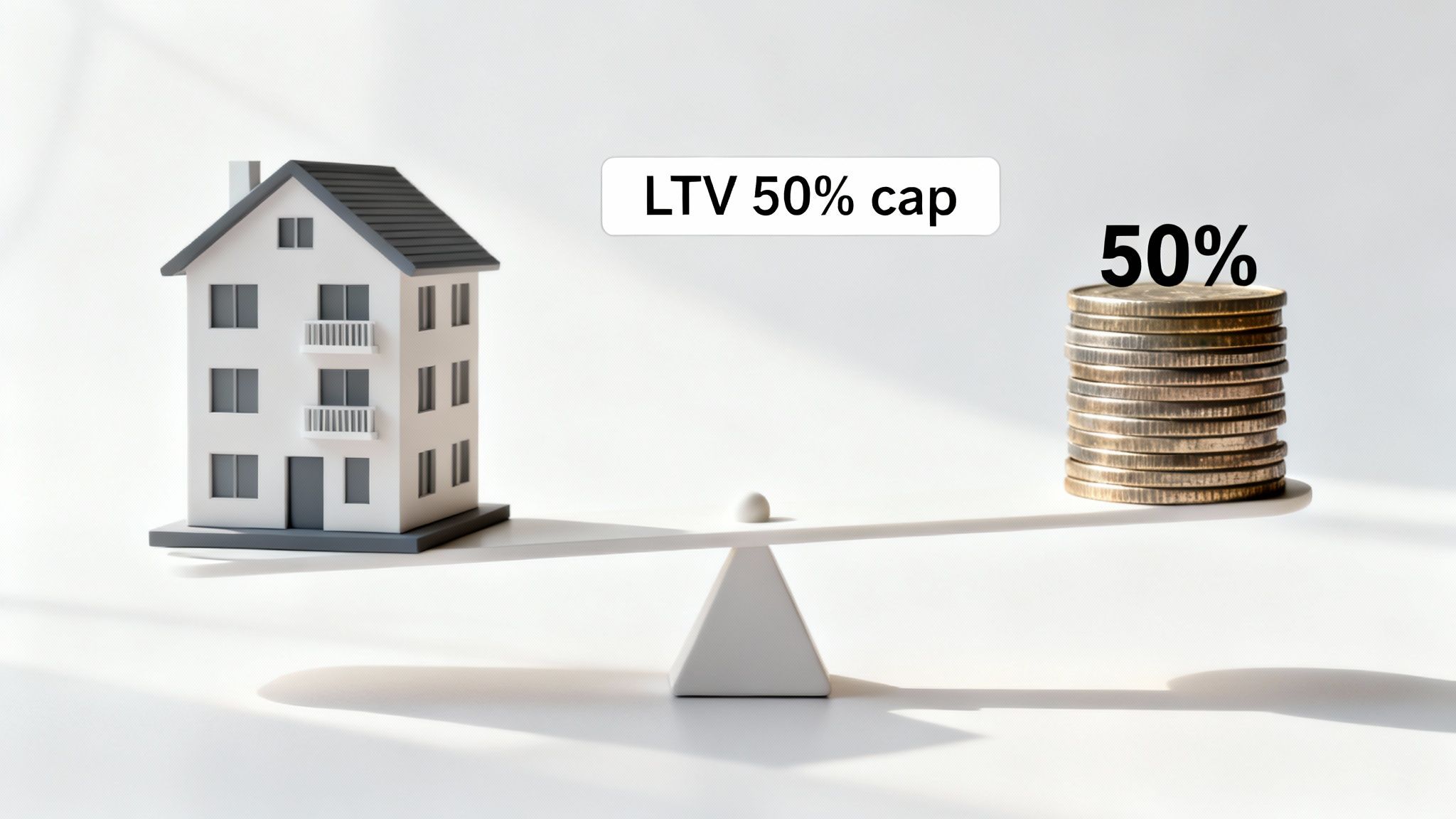
The 50 Percent LTV Cap Explained
For high-net-worth individuals or corporate entities accustomed to leveraging significant capital in Western markets, Israel’s approach to foreign mortgages can appear restrictive. The cornerstone of the country’s regulatory framework is the Loan-to-Value (LTV) ratio, which the Bank of Israel has firmly capped at 50% for all non-resident borrowers.
This is a hard limit, not a guideline, designed to manage the risks associated with international capital flows. It fundamentally reshapes any property acquisition strategy, demanding a much higher level of upfront liquidity than is common in other markets. This 50% cap means a foreign investor must contribute at least half of the property’s appraised value in cash, a stark contrast to the financing available to local buyers.
A Practical Illustration of Capital Requirements
Consider a high-value apartment in a prime Tel Aviv location, valued at $2,000,000 USD.
- An Israeli first-time buyer could potentially secure a mortgage for $1,500,000 (75% LTV), requiring a $500,000 down payment.
- As a foreign investor, you are limited to a maximum mortgage of $1,000,000 (50% LTV).
The conclusion is unambiguous: you must inject $1,000,000 of your own capital as a down payment—double the amount required from a local resident for the identical property. This figure does not include additional closing costs, such as Purchase Tax, which can add another 8-10% to the total cash outlay. Securing an Israeli mortgage as a foreigner is, by design, a capital-intensive undertaking.
Furthermore, the 50% figure is a ceiling, not a guarantee. Individual banks retain the discretion to offer lower LTV ratios based on their internal risk assessments. Factors such as your country of residence, the complexity of your income streams, and the absence of an Israeli credit history can all influence a lender to propose a more conservative LTV, sometimes as low as 40-45%.
A crucial takeaway for any foreign investor is to view the 50% LTV not as a target, but as the absolute best-case scenario. Prudent financial planning should account for the possibility of a more demanding capital requirement from the lender.
Strategic Approaches to the LTV Hurdle
While the 50% cap is non-negotiable, strategic planning can create a more favorable financing environment. Success depends on building lender confidence through a meticulously prepared application that clearly documents your source of funds and showcases a strong, stable international income profile. It is also critical to engage with banks that have established international client desks, as they are better equipped to process complex foreign financial documents.
The single most important element in navigating this landscape is expert legal counsel. An experienced legal team specializing in cross-border transactions provides invaluable guidance, including:
- Structuring the Purchase: Advising on the optimal legal structure for the acquisition—whether through a trust, a foreign corporation, or as an individual—which can significantly influence a bank’s perception of the transaction’s stability.
- Bank Negotiations: Leveraging established relationships with key figures in Israeli banks to present your financial profile in the most compelling manner possible.
- Financial Vetting: Assisting in the preparation and certification of all necessary financial documents to meet the stringent anti-money laundering (AML) and compliance standards required by Israeli banks.
Successfully navigating the rigid LTV requirements for an israeli mortgage foreigner is not about finding loopholes; it is about strategic positioning. This demands a clear-eyed understanding of the regulations, substantial liquid capital, and the support of seasoned professionals who can bridge the gap between international financial norms and the realities of Israeli banking. You can analyze historical mortgage trends in Israel from global property data.
For expert assistance with your property acquisition in Israel, contact us for a consultation.
This article does not constitute legal advice and is not a substitute for consulting with a qualified attorney. Do not rely on the contents of this article for taking or refraining from taking any action.