
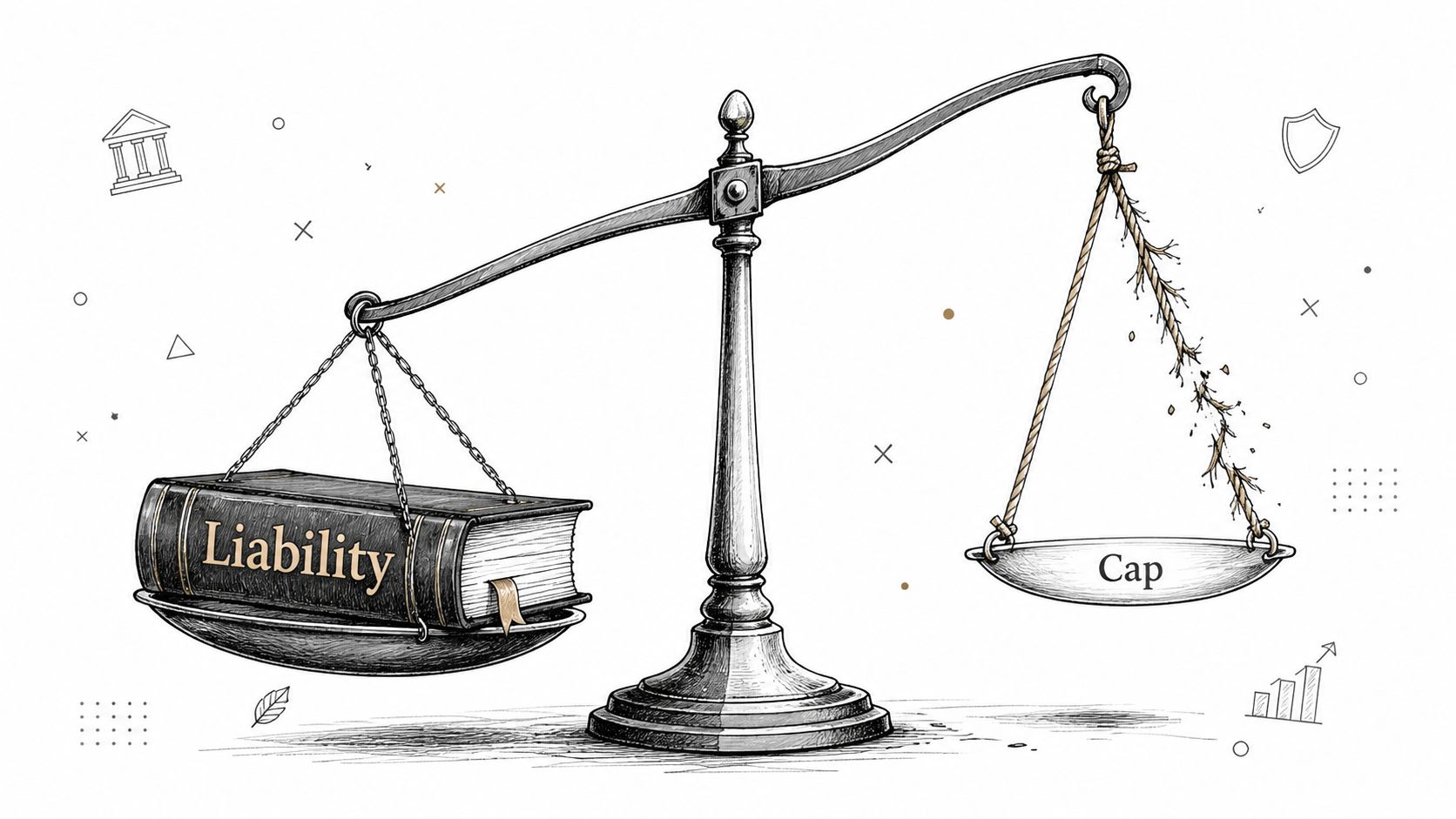
A multinational supplier has delivered a defective system. The contract contains a prominent limitation of liability clause, apparently restricting recovery to fees paid under the agreement. Then a customer alleges a data breach, an affiliate brings an intellectual-property claim, and a regulator investigates conduct connected with an automated system. The negotiated cap may protect only the least serious failure.
That result isn’t unusual. A liability provision works only when its wording, governing law, remedies, insurance, indemnities, and operational risks fit together. For Israeli companies contracting abroad, the difficult question isn’t whether the contract contains a cap. It’s which claims the cap covers, whether mandatory law overrides it, and whether the promised remedy remains usable when the breach occurs.
Table of Contents
- Understanding Limitation of Liability Clauses
- Core Components of Liability Caps and Exclusions
- Israeli Law and Cross-Border Enforceability
- Common Enforcement Failures and Typical Scenarios
- Insurance and Risk Allocation Interplay
- Practical Contract Review Checklist
Understanding Limitation of Liability Clauses
A limitation of liability clause should be read through three lenses: enforceability, commercial purpose, and cross-border compatibility. A fixed ceiling can restrict recovery for ordinary service failures while leaving intellectual-property infringement, confidentiality breaches, personal-data incidents, indemnities, or regulatory exposure outside the cap. The heading has little value if the operative language creates those gaps.
Start with the legal mechanism
The first question is whether the clause limits liability, excludes a category of damages, creates an exclusive remedy, or combines all three. Those mechanisms don’t perform the same function.
A monetary cap limits the amount recoverable within its scope. A damages exclusion removes specified categories, such as consequential or incidental loss. An exclusive remedy replaces ordinary remedies with a particular solution, such as repair, replacement, or refund. Under U.S. sales law, Uniform Commercial Code § 2-719 recognizes those arrangements, but an exclusive or limited remedy can fail if circumstances deprive it of its essential purpose. The same provision permits consequential-damages exclusions unless they are unconscionable, with special treatment for personal injury in consumer-goods transactions. UCC § 2-719
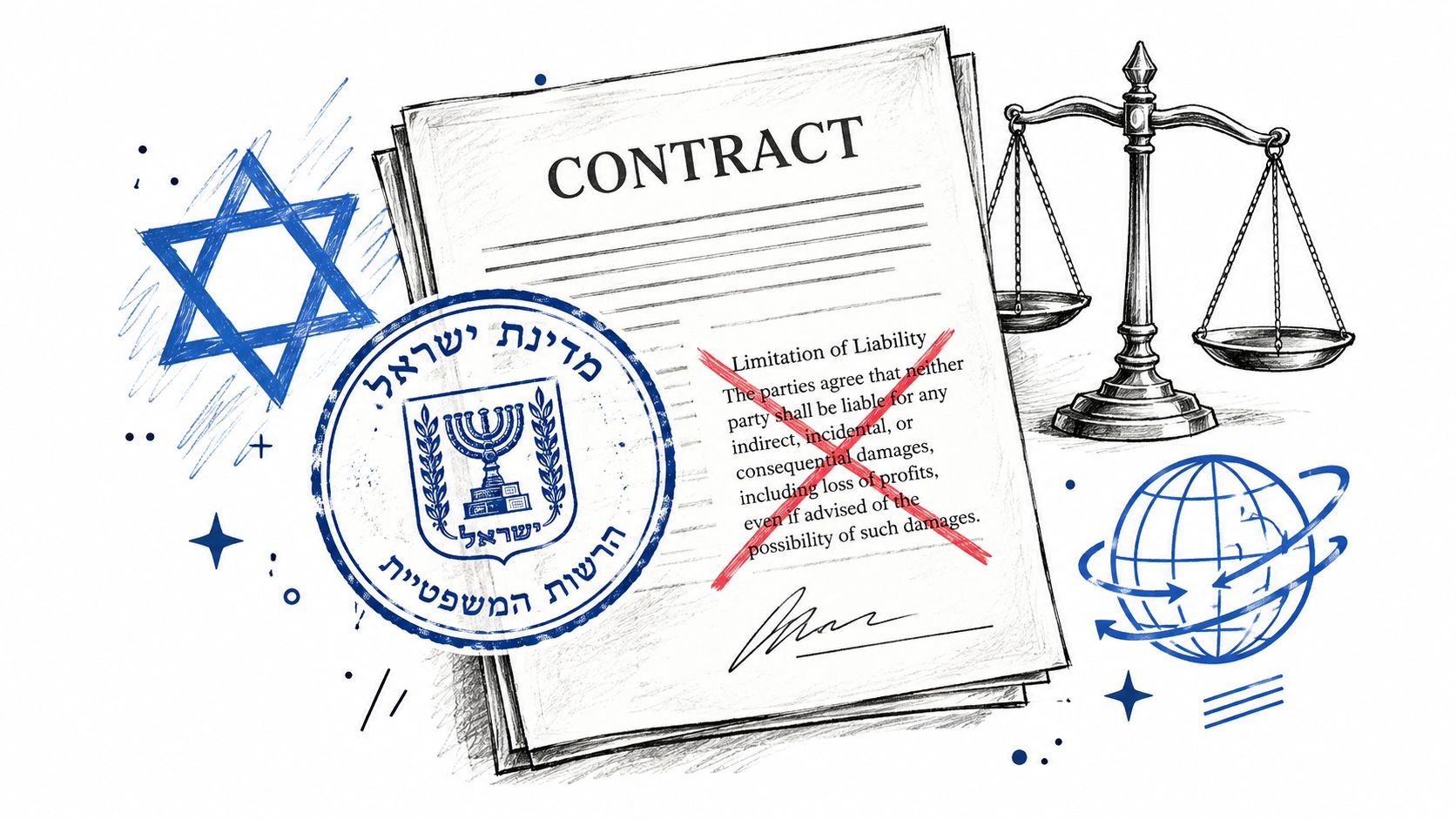
Israeli businesses should avoid assuming that a chosen foreign law will answer every issue. Mandatory rules, public policy, consumer protections, data regulation, product-liability rules, and the law of the forum may affect enforcement even where the contract selects another governing law.
Test the clause against the bargain
A useful review asks what each party priced, controlled, insured, and could reasonably prevent. A cap based only on contract fees may be commercially defensible for routine performance issues, but it may be disconnected from the exposure created by access to sensitive data, control over production systems, or use of an AI model in consequential decisions.
Practical rule: A cap should follow the risk allocation, not merely the invoice.
The contract should also state whether it covers claims arising from or relating to the agreement, including tort, statute, negligence, strict liability, and restitution theories where legally permissible. Narrow wording can allow a claimant to avoid the negotiated allocation by pleading a different cause of action.
Check the supporting documents
Liability language rarely stands alone. The agreement’s warranty, service-level, indemnity, insurance, termination, confidentiality, and data-processing provisions may alter the practical result. Even a document described as platform terms and conditions should be reviewed as part of the entire contractual arrangement, not treated as a substitute for transaction-specific risk analysis.
The recommended strategic path is to create a claim map before signing. For each foreseeable loss, identify the responsible party, available remedy, applicable cap, excluded category, insurance response, and governing law. If the answer is unclear, the clause is not yet protective.
Core Components of Liability Caps and Exclusions
A strong provision has several moving parts. The headline amount attracts attention, but scope, exceptions, timing, and definitions usually determine the commercial outcome.
Monetary caps
An aggregate cap limits total recovery across covered claims. A per-claim cap applies separately to each qualifying claim. The difference becomes critical when repeated service failures occur or when a low-severity dispute precedes a high-severity event.
A cap based on fees paid can also create timing problems. Early in a relationship, the recoverable amount may be modest even though the supplier already has access to systems, data, or intellectual property. The drafting should state the measurement period and explain how renewals, extensions, affiliates, and multiple statements of work affect the calculation.
Carve-outs and exclusions
Carve-outs remove specified risks from the general cap or place them under a separate limit. Common categories include fraud, wilful misconduct, gross negligence, confidentiality, personal data, intellectual-property infringement, payment obligations, bodily injury, property damage, and third-party indemnities.
The clause should say whether a carve-out creates unlimited liability, a higher sub-cap, or only an exception to a damages exclusion. Those outcomes aren’t interchangeable. A reference to “indemnified claims” may also be too broad if the indemnity covers both third-party claims and direct losses between the contracting parties.
Baskets and deductibles
A basket requires losses to reach a threshold before recovery begins. A deductible reduces the amount recoverable from the first dollar. The contract should specify whether the threshold is a tipping basket, where all losses become recoverable once reached, or a deductible basket, where only excess losses are recoverable.
The commercial effect can be significant even without a large headline cap. A threshold may eliminate practical recovery for recurring small failures, while a deductible may preserve a claim but shift initial loss to the injured party.
Loss categories
Direct, incidental, consequential, special, indirect, lost-profit, revenue, business-interruption, data-restoration, and reputational losses shouldn’t be left to labels alone. Courts may classify the same kind of financial harm differently depending on the contract and the factual cause.
The clause should identify the intended treatment of specific losses and explain how the categories interact with the cap. It should also address whether the parties intend to exclude loss of profits even where those profits are direct under the applicable law.
| Structure Type | Definition | Typical Use Case | Enforcement Risk |
|---|---|---|---|
| Aggregate cap | A total ceiling for covered claims | General commercial services | Exposure may be exhausted by early claims |
| Per-claim cap | A ceiling applied to each covered claim | Repeated orders or separate work packages | “Claim” may be disputed |
| Separate sub-cap | A distinct ceiling for a defined risk | Data, confidentiality, or IP exposure | Poor definitions can create overlap |
| Damages exclusion | Removes named categories from recovery | Consequential loss or lost profits | Labels may not match legal classification |
| Exclusive remedy | Makes a stated remedy the sole contractual remedy | Repair, replacement, credit, or refund | Remedy may fail of its essential purpose |
Different industries illustrate why classification matters. A review of California security guard liability may focus on bodily injury, property damage, and third-party claims, while a technology agreement may need separate treatment for data loss, model output, and intellectual-property allegations. The drafting method is the same: identify the event, the claimant, the recoverable loss, and the remedy that must remain available.
Israeli Law and Cross-Border Enforceability
Israeli companies shouldn’t treat a foreign template as neutral. Under Israeli contract principles, interpretation, good faith, public policy, mandatory statutory protections, and the parties’ circumstances can affect how a limitation provision operates. The precise outcome depends on the transaction, the parties, the wording, the chosen law, and the forum.
The Israeli starting point
The first task is to identify whether the transaction is genuinely commercial and negotiated or whether mandatory protections may apply. Consumer-facing arrangements, employment-related obligations, personal-injury exposure, regulated activities, data processing, and conduct contrary to public policy require particular caution. A clause that appears commercially efficient may not control every statutory or non-contractual claim.
Israeli counsel should also examine whether the clause attempts to exclude responsibility for conduct that the applicable law treats as non-excludable. The safer structure distinguishes ordinary performance risk from fraud, wilful misconduct, serious fault, bodily injury, and other categories that may receive heightened judicial scrutiny.
U.S. comparison
For sales of goods, UCC § 2-719 allows parties to modify or limit remedies and to exclude consequential damages unless the exclusion is unconscionable. A remedy stated to be exclusive becomes the sole remedy when the contract clearly says so, but a failed essential purpose can restore otherwise available remedies. The Cornell Law School text of UCC § 2-719 also distinguishes commercial losses from personal injury in consumer-goods transactions.
The rule isn’t universal for every U.S. agreement. Article 2 concerns sales of goods, state enactments can vary, and a services contract may be analyzed under different principles. The contract should therefore classify the transaction and state whether the cap applies to contract, tort, statutory, and other claims to the extent permitted.
English-law comparison
Under the UK Unfair Contract Terms Act 1977, negligence-related exclusions and caps in business contracts are subject to reasonableness requirements, while liability for death or personal injury caused by negligence cannot be excluded or restricted. The statute directs attention to circumstances known or reasonably contemplated when the contract was formed, including resources and available insurance when a monetary cap is assessed. The Act’s limits also do not apply to certain international supply contracts for goods (section 26), so its scope has to be checked first. The statutory text should be reviewed for the transaction and wording at issue.
A cap that cannot be explained by price, control, bargaining conditions, financial capacity, or insurance is harder to defend as a rational allocation of risk.
International sales and product risk
Where the CISG applies, Article 74 generally measures damages by the loss suffered, including lost profit, subject to foreseeability. Article 77 requires reasonable mitigation, with a corresponding reduction where the injured party fails to reduce avoidable loss. The agreement should state whether the CISG applies and coordinate any negotiated cap with foreseeability, mitigation, direct loss, and consequential-loss provisions. UNCITRAL’s CISG text provides the primary reference.
Cross-border drafting should use a hierarchy rather than one universal ceiling. Separate treatment may be appropriate for confidentiality, personal data, IP, payment, indemnities, bodily injury, fraud, regulatory fines, and AI-related losses. The cap should also specify whether affiliates, subcontractors, agents, and implementation partners can rely on it. Under the UK Contracts (Rights of Third Parties) Act 1999, a contract can confer enforcement rights for an exclusion or limitation on specified third parties, including agents or subcontractors, if the statutory conditions are met. The Act’s explanatory material illustrates why third-party rights must be addressed expressly.
Common Enforcement Failures and Typical Scenarios
A useful way to test drafting is to follow the claim after the breach. The following are representative scenarios, not descriptions of particular reported cases.
The failed exclusive remedy
A distributor purchases equipment under a contract stating that repair or replacement is the buyer’s exclusive remedy. The supplier repeatedly attempts repairs, but the equipment cannot perform the function that justified the transaction. The buyer then seeks losses caused by the failure.
Under U.S. sales-law principles, the central issue isn’t whether the contract used the word “exclusive.” The question is whether circumstances caused the limited remedy to fail of its essential purpose. If so, the buyer may pursue remedies otherwise available under the UCC. A separate exclusion of consequential damages may still require independent analysis, including unconscionability and the nature of the loss.
The drafting failure is structural. The agreement treated remedy exclusivity and damages exclusion as if one automatically enforced the other. A better clause states the relationship between repair, replacement, refund, direct damages, consequential damages, service credits, termination, and any failure of the exclusive remedy.
The AI service that the cap didn’t describe
An Israeli company licenses an AI-enabled system for customer communications. The system generates inaccurate output, takes an automated action outside the approved workflow, and uses training material that allegedly infringes a third party’s rights. The contract contains a general cap tied to fees and excludes consequential loss.
The cap may not answer the central questions. Is the output error a service failure, product defect, negligence issue, or indemnified third-party claim? Does the data allegation fall under confidentiality, IP, or a separate indemnity? Does the exclusion cover remediation, customer notifications, or regulatory response? The answer depends on the agreement and applicable law.
The EU Product Liability Directive 2024/2853 expressly treats software, including software not embedded in hardware, as a product, and Member States must transpose it by 9 December 2026. The source also notes that AI-related product liability can arise without proving fault. The analysis of AI contract risks and the directive supports a separate review of model defects, autonomous actions, training-data claims, updates, cybersecurity, and statutory exposure.
A generic software cap doesn’t become AI-ready merely because the contract calls the system a service.
The preventive drafting change is a risk matrix. Each AI function should have an owner, approval boundary, audit obligation, warranty, update control, indemnity position, and remedy. The contract should also say which provisions survive termination and whether any indemnity sits inside, outside, or under a separate cap.
Insurance and Risk Allocation Interplay
Insurance and contractual liability answer different questions. The contract allocates responsibility between the parties. The policy may provide a source of funds, subject to its terms, exclusions, retentions, conditions, timing rules, and available limits. A certificate alone doesn’t establish the coverage granted.
Coordinate the three instruments
The review should place the cap, indemnity, and policy side by side. If the supplier promises an uncapped indemnity for data or IP claims but its policy excludes the relevant event, the supplier may face an obligation it can’t fund. If the indemnity is inside the general cap, the customer may discover that ordinary service claims have consumed the amount before a serious third-party claim arises.
The recommended strategic path is to define:
- The contractual limit: whether the cap is aggregate, per claim, or divided into risk-specific sub-caps.
- The indemnity scope: whether it covers defense, settlement, judgments, direct losses, third-party claims, and regulatory exposure.
- The insurance response: which policy category is expected to respond and whether defense costs reduce the available limit.
- The residual risk: which exclusions remain with the party best able to prevent or price them.
Avoid false comfort from policy limits
Professional-liability and cyber policies may contain contractual-liability, intellectual-property, intentional-conduct, regulatory-fine, or data-event exclusions. Coverage can also depend on claims-made timing and notice requirements. The contractual cap should therefore be calibrated against the actual policy wording and the insured party’s financial capacity, not merely an insurance schedule.
A single aggregate cap can be efficient for low-risk services, but it may be unsuitable where confidentiality, IP, data, and AI failures have different severity profiles. Separate caps or carefully drafted priority rules can preserve protection for a high-severity risk without making every ordinary claim unlimited.
The same analysis applies to Israeli companies buying international services. A customer request for uncapped data or regulatory indemnity may be negotiable, but the negotiation should distinguish prohibited conduct, third-party claims, defense obligations, remediation costs, and fines that applicable law may not permit a party to transfer.
Practical Contract Review Checklist
A busy executive can identify most structural problems by reviewing the clause in a fixed order. The purpose isn’t to predict every dispute. It’s to ensure that the agreement doesn’t promise protection that another provision silently removes.
Red flags to resolve before signing
-
Find the scope. Confirm whether the clause covers claims arising from or relating to the agreement, including permitted tort, statutory, and indemnity claims. A reference only to “breach of contract” may be too narrow.
-
Separate the mechanisms. Mark the monetary cap, damages exclusions, exclusive remedies, baskets, deductibles, and carve-outs in different colors. If the contract treats them as one concept, request separate operative language.
-
Classify the risks. List confidentiality, personal data, IP, payment, bodily injury, property damage, fraud, wilful misconduct, gross negligence, regulatory exposure, and third-party claims. For each, record the cap, exclusion, indemnity, and survival period.
-
Test AI functions. Where software generates output or takes action, request language covering data sources, human approval, update control, security incidents, model defects, hallucination-driven losses, autonomous actions, and training-data claims. The exact treatment depends on the service and applicable law.
Yellow flags that often cause later disputes
- Per claim versus aggregate: Define “claim,” “event,” and related claims. State whether multiple allegations from one incident share a limit.
- Loss definitions: Identify whether lost profits, revenue, business interruption, data restoration, reputational harm, and regulatory response are included or excluded.
- Indemnity priority: State expressly whether the indemnity is inside the general cap, subject to a separate sub-cap, or excluded from it.
- Third-party reliance: Specify whether affiliates, subcontractors, agents, and implementation partners may invoke the limitation. A general reference to policy quote terms explained can help clarify why commercial terms and risk assumptions must be read together, but it doesn’t replace review of the actual contract.
- Insurance alignment: Match the negotiated allocation to policy terms, deductibles, exclusions, defense costs, and notice requirements.
- Governing law and forum: Confirm the selected law, dispute forum, mandatory rules, and potential enforcement jurisdictions. A foreign governing-law clause doesn’t eliminate every mandatory rule elsewhere.
- Commercial rationale: Preserve the pricing, bargaining, control, and insurance logic behind the cap. That record can support interpretation and reasonableness arguments where the law permits them.
The final check should be operational. Ask what happens on the day of the breach, who pays for immediate containment, whether the remedy can be delivered, whether termination remains available, and which claims survive. If the answer depends on several undefined terms, the clause needs revision before execution.
In our experience, limitation clauses fail less often because the cap is too low than because nobody checked what it covers. A short claim map agreed before signing, listing each foreseeable loss, the cap that applies and the insurance behind it, usually settles most of the later argument.
RNC Group drafts, negotiates, and finalizes cross-border commercial agreements, including limitation structures, indemnities, confidentiality, data, IP, insurance, and dispute provisions. Businesses facing a proposed cap or an AI-related allocation should contact RNC Group now to test the clause against Israeli law, the chosen foreign law, and the operational risks before signing.
Capping liability? A wrong number or carve-out can void the whole clause.
Limitation clauses fail on caps, carve-outs, consequential-loss wording and mandatory law. Generic wording rarely survives the dispute it was written for.
We draft and stress-test liability clauses for your contracts. Reach us on WhatsApp or by email.
This article is for general information only and does not constitute legal advice. Laws and their application depend on the facts and jurisdiction and may change. Although we aim to keep this information accurate and current, we do not guarantee that it is complete or up to date. The article may contain omissions or errors. Reading this article does not create an attorney-client relationship with RNC Group. Before making a decision or taking action, seek advice from a qualified lawyer in the relevant jurisdiction.