
Most M&A failures don’t start with a bad contract. They start with a bad assumption that legal, financial, and integration risks can wait until after signing. That assumption destroys value fast.
A historical review of 40,000 mergers and acquisitions found that 70–75% of acquisitions fail to achieve their stated objectives, driven by overpayment, inadequate due diligence, and poor integration, according to this historical M&A failure analysis. In Israeli transactions, that failure risk rises when buyers also miss local filing triggers, timing traps, and shareholder mechanics.
Foreign buyers often underestimate Israel for the wrong reason. The market looks compact, but the legal execution isn’t simple. A minority stake can trigger merger control issues. A public-company structure can delay closing. A premature step can create criminal exposure.
Introduction to M&A Risk Management
M&A risk management in Israel requires more than a diligence checklist. It requires a disciplined sequence of legal, operational, and governance decisions before price discussions harden.
The strongest acquirers treat risk management as a pricing tool, not a compliance exercise. They identify what can break the deal, quantify what can be tolerated, and document what must shift back to the seller.
Three mistakes appear repeatedly in troubled deals:
- Overpaying early: Buyers let momentum outrun evidence.
- Checking only financials: Teams ignore IT, compliance, talent, and customer concentration.
- Delaying integration planning: Management waits until closing to decide who owns Day 1.
That pattern is especially dangerous in cross-border Israeli deals. The legal triggers can be technical, but the consequences are practical. Delays affect financing, approvals, employee retention, and disclosure strategy.
Practical rule: If the buyer can’t explain its regulatory path, integration path, and claim path before signing, the buyer isn’t ready to sign.
A serious framework starts with five workstreams running in parallel. Legal, regulatory, commercial, operational, and integration leads must all report into one decision structure. If those streams remain siloed, the buyer will see the problem only after value slips.
Non-Israeli clients also need a local filter. Israeli law can attach significance to turnover in Israel, market share, minority holdings, tender offer mechanics, and shareholder squeeze-out conditions. Generic global playbooks miss those issues because they assume thresholds and sequencing from other jurisdictions.
That’s why effective M&A risk management in Israeli transactions should follow a strict order. First, identify and rank risks. Next, test the filing and structuring consequences. Then lock in contractual protection. After that, prepare Day 1 and the first post-close wave. Finally, create an escalation system before the first dispute appears.
Pre-Deal Risk Assessment and Due Diligence
The buyer should map risk before it negotiates certainty. Price comes later. First, the team needs a risk picture that is broad enough to catch hidden liabilities and precise enough to support a walk-away decision.
A useful methodology combines the Fishbone Method for risk identification with Fuzzy-AHP for quantification, using two core steps and weighted factor levels, as described in this structured M&A risk methodology. That approach works because it forces management to stop arguing in generalities.

Build the fishbone before reviewing the data room
Start with causes, not documents. The fishbone should branch into financial, tax, legal, regulatory, IT, cybersecurity, compliance, HR, supply chain, customer, and integration categories. Then assign owners to each branch.
That first workshop should include deal leadership, operating management, finance, legal counsel, and the integration lead. If the integration lead joins later, the buyer will miss practical friction that won’t appear in a spreadsheet.
A disciplined pre-deal map should test these questions:
- Commercial fragility: Does revenue depend on a few customers, founders, or distributors?
- Operational dependence: Do key processes rely on one plant, one system, or one person?
- Compliance exposure: Are anti-bribery, privacy, sanctions, and industry-specific controls documented and tested?
- IT inheritance: Can the buyer identify outdated systems, unsupported software, and access-control failures?
- Management resilience: Will middle managers absorb change, or will they resist execution after closing?
For leadership continuity, some buyers also review organizational succession pressure early. A practical companion resource is Synopsix leadership planning, especially when the target depends too heavily on one executive or founder.
Quantify risk instead of debating it
After the team identifies risks, it should weight them. Fuzzy-AHP helps because not every risk is binary. Some issues are uncertain, but still severe. Others are likely, but manageable through contract language or post-close planning.
The point isn’t mathematical elegance. The point is decision discipline.
Use a simple internal scoring grid tied to deal consequences:
- Value impact: Could this issue affect price, earnings quality, or the business case?
- Closing impact: Could it delay approval, financing, or transaction mechanics?
- Containment difficulty: Can the issue be fixed quickly after closing?
- Proof quality: Does the buyer have evidence, assumptions, or only management comfort?
Buyers should treat management reassurance as unverified input, not due diligence.
Demand deliverables, not summaries
Every workstream should produce a short red-flag memo. Long memos waste time. The useful output is a decision paper with issue, evidence, consequence, and recommendation.
The buyer should also require direct testing outside the data room:
- Interviews: Speak with management below the executive layer.
- Site visits: Observe operations, inventory controls, and physical continuity risks.
- Third-party checks: Review key suppliers, distributors, and dependency points.
- Document tracing: Match board approvals, contracts, policies, and real execution.
If the target lacks a dynamic enterprise risk process, the review must become more intrusive. That point matters. A company that can’t show how it identifies risk internally usually discovers risk only after damage appears.
Legal and Regulatory Safeguards
Israeli deal risk often turns on thresholds and definitions that foreign buyers don’t expect. A buyer can trigger filing obligations through structure alone, even before control looks obvious in commercial terms.
That is why the legal analysis must begin with jurisdictional triggers, not with signing mechanics. In Israel, sequence matters.
Where filings become mandatory
Under Israeli merger control rules, prior approval from the Israel Competition Authority can be required if the combined annual sales turnover in Israel of the merging companies exceeds NIS 414,010,000, and at least two parties each exceed NIS 22,510,000, as summarized in this Israel merger control guide. Implementing a merger before approval is a criminal offense and may also expose the parties to administrative fines under the same guide.
That issue catches foreign acquirers because they often focus on global turnover first. Israeli turnover can independently create the filing problem.
A second trigger sits in the definition of a merger itself. An acquisition that results in a minority interest of more than 25% of rights in the acquired party can qualify as a merger of companies if turnover thresholds are met, according to this Israeli merger filing overview. The same source notes that a monopoly is defined by over 50% market share in a defined Israeli market, and the reporting consequences can arise even in a market unrelated to the transaction.
Key Israeli M&A Filing Thresholds
| Requirement | Threshold | Consequence |
|---|---|---|
| ICA turnover filing threshold | Combined annual sales turnover in Israel exceeds NIS 414,010,000, and at least two parties each exceed NIS 22,510,000 | Prior ICA approval may be required before implementation |
| Minority interest trigger | Acquisition results in more than 25% of rights in the acquired party | Mandatory ICA filing can be triggered if turnover thresholds are met |
| Monopoly threshold | Over 50% market share in a defined Israeli market | Advance reporting and approval issues may arise |
| Private company squeeze-out | Holders of at least 80% of each class and series agree to sell | Remaining holders can be forced to sell |
| Public special tender offer trigger | Buyer seeks more than 45% of voting rights | Buyer must acquire at least 5% of voting rights through the offer itself |
| Reverse triangular merger timing for Israeli public company | Mandatory 35-day shareholder notice period plus minimum 65-day post-execution completion window | Completion may take up to 100 days |
Structure drives timing
For private companies, Israeli law permits a squeeze-out if holders of at least 80% of each class and series agree to sell, allowing remaining shareholders to be forced out, as noted in this Israeli private M&A comparison guide. That can simplify post-signing cleanup, but only if the deal documents and cap table review are exact.
Public deals create a different risk profile. A special tender offer that gives the buyer more than 45% of voting rights requires the purchaser to acquire at least 5% of voting rights through the offer itself, and reverse triangular mergers involving Israeli public companies may take up to 100 days because of a 35-day notice period plus a minimum 65-day post-execution window, according to this overview of Israeli public M&A mechanics.
The safest path is to test structure, filing, and timetable together. A legally elegant structure that misses the commercial deadline is still a bad structure.
A better regulatory playbook
A serious buyer runs a pre-signing legal grid addressing these points:
- Threshold testing: Confirm Israeli turnover, voting rights, market share issues, and minority stake implications.
- Approval sequencing: Align ICA, board, shareholder, and foreign approvals in one timetable.
- Interim conduct controls: Restrict premature integration, data sharing, and operational influence before clearance.
- Cap table verification: Check class rights, drag mechanics, and squeeze-out conditions before term sheet certainty.
- Public deal timeline planning: Build the statutory waiting periods into financing and disclosure plans.
Foreign clients need local precision here. Israeli M&A law doesn’t reward assumptions imported from Delaware, London, or continental Europe. The filing trigger, the control concept, and the completion path can all differ in ways that affect bargaining power at signing and closing certainty.
For readers dealing with broader cross-border contract architecture, articles from the firm on commercial agreements in Israel, international commercial litigation, and partnership agreements provide useful context on how transaction risk often migrates into post-signing disputes.
Contractual Protections and Insurance Structures
Contracts should absorb uncertainty before the buyer pays for it. If a risk can be priced, it should be allocated. If it can’t be allocated cleanly, the buyer should consider whether the deal should proceed at all.
That is where many transactions fail. Parties negotiate valuation intensely, but they draft risk allocation loosely.
Draft for proof, not for ceremony
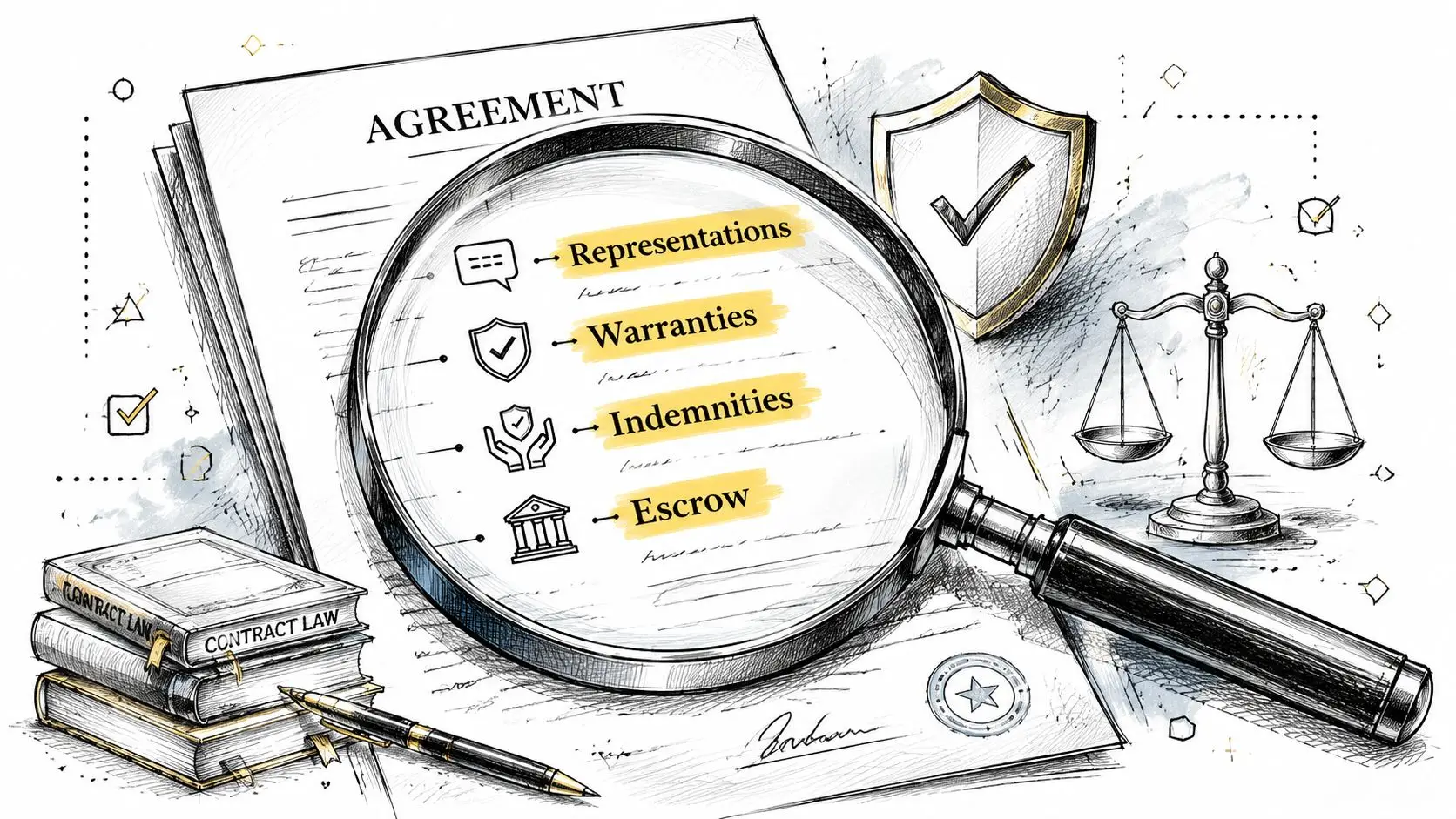
The acquisition agreement should link each major diligence finding to one of four tools. Representation, indemnity, price adjustment, or walk-away right. Anything else usually creates false comfort.
A practical drafting sequence looks like this:
- Representations and warranties: Cover internal controls, compliance systems, financial accuracy, tax status, sanctions, anti-bribery, and data governance.
- Specific indemnities: Isolate known issues such as tax audits, misclassification claims, licensing gaps, or regulatory investigations.
- Escrow or holdback: Preserve a real payment source for likely claims.
- Closing conditions and outs: Let the buyer stop if a pre-closing risk materializes or disclosure changes materially.
The SSRN methodology cited earlier also points to contingent earn-outs, pre-closing price-adjustment features, and representations covering internal controls and compliance as practical legal tools within M&A risk management. Those protections matter because they force the parties to define who bears the cost of uncertainty.
Insurance should support the contract, not replace it
Transactional risk insurance has become a strong market signal that buyers are treating downside risk more formally. Global limits placed reached US$91.6 billion in 2025, up 34% from 2024, according to this report on transactional risk insurance growth.
That growth doesn’t mean insurance solves bad drafting. It doesn’t. It means astute buyers now layer risk transfer on top of better contracts.
Use insurance when the deal has one or more of these features:
- Seller distribution pressure: The seller wants clean exit proceeds and resists large escrows.
- Competitive auction dynamics: The buyer needs a cleaner bid structure.
- Cross-border uncertainty: Enforcement against sellers may become difficult after closing.
- Complex compliance perimeter: The buyer sees risk, but not enough certainty for a full retrade.
A useful reference for clients comparing ordinary operating coverage with transaction-specific risk transfer is this overview of essential BOP coverages for businesses. The comparison is instructive because ordinary business insurance and M&A insurance solve different problems.
Insurance should cover residual uncertainty after diligence and drafting. It shouldn’t excuse weak diligence.
Clause design that reduces disputes
Strong clauses are operational, not decorative. They define evidence, timing, and calculation mechanics in plain terms.
Use these drafting habits:
- Fix the accounting basis for price adjustments and earn-outs.
- Define compliance standards by reference to existing internal controls and reporting lines.
- State notice and cure procedures for indemnity claims with precision.
- Separate known risks from general indemnity baskets.
- Attach disclosure schedules that management thoroughly reviewed line by line.
Buyers should also set a walk-away price before negotiation momentum takes over. That discipline prevents contractual creativity from becoming a substitute for valuation discipline.
Operational Integration and Financial Planning
A buyer that starts integration planning after signing is already late. Most guides still treat integration as an implementation issue. That is a mistake.
A distinct Integration Due Diligence framework should begin before signing because 70% of deals fail to achieve expected synergies without early planning targeting middle-management resilience, according to this analysis of merger integration risk. In practice, middle managers carry the operating load, absorb the reporting burden, and translate strategy into action. If they burn out, the integration drifts.

What Day 1 must accomplish
Day 1 isn’t the day to unveil transformation. It is the day to preserve continuity. Customers, employees, regulators, lenders, and vendors all judge the buyer immediately.
The Day 1 plan should lock down:
- Decision rights: Who approves operational, legal, HR, and communications issues.
- Critical systems access: Email, finance, HRIS, procurement, and customer support continuity.
- Customer contact protocol: Which accounts receive immediate outreach and by whom.
- Cash and payment control: Treasury authority, invoice flows, and delegated approvals.
- Workforce messaging: What managers say, when they say it, and what they don’t speculate about.
The first 100 days decide whether the story survives
The first post-close phase should focus on execution density, not volume. Too many initiatives create change fatigue. Too little structure creates drift.
A practical 100-day matrix should assign owners for these workstreams:
| Workstream | Immediate objective | Common failure point |
|---|---|---|
| IT integration | Stabilize access and security | Legacy systems remain live without clear ownership |
| HR and retention | Keep key managers engaged | Buyers overload middle management with parallel changes |
| Customer continuity | Protect top accounts and service levels | Communication gaps trigger avoidable churn |
| Supply chain | Secure vendors and transition approvals | Informal dependencies emerge after closing |
| Finance and reporting | Standardize controls and close process | Teams reconcile numbers too late |
Integration should move in waves. First continuity, then control, then optimization.
Use conservative synergy discipline
Cross-border acquirers often model upside too aggressively. The better approach is conservative staging. One source in the background material recommends reducing projected synergy estimates by half in pressured conditions. Even without restating that tactic numerically here, the principle is sound. Buyers should haircut synergy assumptions hard, then force each assumption through operational ownership.
Financial planning should also test customer concentration, key-person dependence, tax friction, and supplier transfers before closing. Those issues don’t belong in a post-close surprise file. They belong in the investment committee memo.
A good integration plan also names the escalation path for stalled workstreams. If no one owns delay resolution, the buyer gets status updates instead of decisions.
Reputation and Crisis Preparedness
Deals fail in the market before they fail in court. A rumor about layoffs, a leaked regulator question, or a founder dispute can destabilize customers and employees within hours.
That is why crisis preparation belongs inside M&A risk management, not beside it. Legal, management, and communications teams should align before signing on who speaks, what gets disclosed, and how privilege is preserved.
Build the response tree before trouble appears
A serious escalation tree identifies stakeholders in order of legal sensitivity. Regulators come first when disclosure duties apply. Contract counterparties may come next. Press handling comes after legal sequencing, not before it.
The response file should include:
- Holding statements: Short approved statements for media, customers, and employees.
- Privilege rules: Clear separation between legal analysis and business messaging.
- Spokesperson protocol: One lead voice and one backup.
- Monitoring list: Journalists, counterparties, key customers, and social channels worth watching.
- Document preservation steps: Immediate instructions when a controversy emerges.
Preserve consistency across borders
Cross-border deals create messaging conflicts. Headquarters may want speed. Local counsel may insist on sequencing. The Israeli side often requires tighter handling because regulatory interactions, shareholder sensitivities, and timing issues can overlap quickly.
That means management should avoid freelance reassurance. Executives often create evidence against themselves by trying to sound calm before they know the facts.
Say less, verify faster, and record who approved each external statement.
Coordinate legal risk with insurance risk
Poor communications can also damage coverage positions. If someone admits fault publicly, promises compensation early, or misstates the timeline, insurers may scrutinize notice and cooperation issues more closely.
The practical answer is simple. Use one crisis log. Record the issue, who learned it, what was said, and what decision followed. Then route legal, insurance, and board notifications through the same command structure.
Reputation planning is not public relations polish. It is transaction defense. In contested or high-visibility deals, disciplined messaging protects bargaining power, preserves optionality, and reduces unforced error.
Post-Close Monitoring and Escalation Playbook
Closing isn’t the finish line. It is the point when hidden risk starts demanding proof.
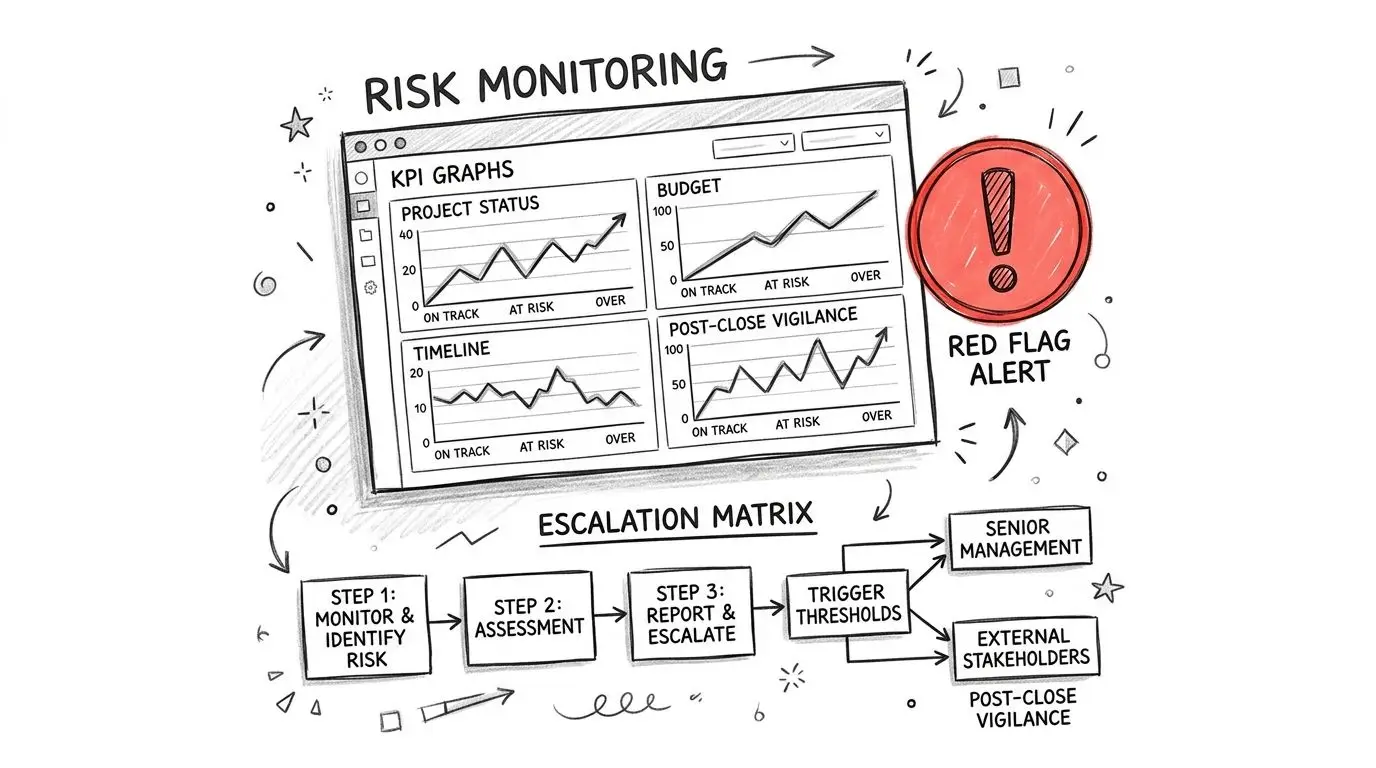
The buyer needs a monitoring system that does three things well. It spots deviation early, escalates without politics, and preserves evidence for legal remedies or insurance recovery.
What to monitor each quarter
Post-close reviews should be disciplined and brief. If the dashboard is too broad, management ignores it. If it is too thin, problems hide in plain sight.
Track at least these categories:
- Covenant compliance: Integration obligations, transition services, and seller cooperation commitments.
- Claims posture: Potential indemnity claims, notice deadlines, and evidence collection status.
- Control migration: Finance, HR, procurement, and compliance functions transferred.
- Operational drift: Customer complaints, service interruptions, and unresolved system dependencies.
- People risk: Departures in key roles, manager overload, and blocked decision points.
Use a defined escalation matrix
Every red flag needs a pre-assigned destination. Management delay usually comes from uncertainty about who owns the next step.
A practical matrix should work like this:
- Workstream lead review for routine variance.
- Integration steering review when variance affects continuity, cost, or timeline.
- General counsel review when the issue touches claims, disclosures, or approval conditions.
- Board or committee notice when the issue threatens value, control, or public-facing risk.
- Insurance notice decision when facts could support covered loss or policy response.
Keep the audit file live
Quarterly risk audits should compare three things. Original assumptions, current conditions, and unresolved deviations. That simple comparison exposes where the deal thesis no longer matches reality.
Use a short audit template with these headings:
| Audit item | Key question |
|---|---|
| Deal thesis | Does the original rationale still hold? |
| Integration milestones | Which commitments were met, delayed, or abandoned? |
| Legal exposure | Have new facts triggered notice, claim, or disclosure duties? |
| Financial assumptions | Do actual results still support the purchase case? |
| Leadership stability | Are the intended owners of change still in place? |
A disciplined post-close playbook does more than detect trouble. It creates a factual record. That record matters when the buyer needs to enforce an indemnity, notify insurers, defend board decisions, or explain performance deterioration to stakeholders.
Conclusion and Next Steps
Strong M&A risk management in Israel depends on six disciplines. Early risk mapping, precise Israeli regulatory analysis, hard-edged contract drafting, structured insurance use, pre-signing integration diligence, and post-close escalation control.
Buyers should assemble a deal file before signing that includes the regulatory threshold analysis, structure memo, red-flag diligence reports, integration ownership matrix, claims protocol, and crisis communications plan. That file prevents expensive improvisation later.
Cross-border buyers and Israeli companies alike can avoid costly mistakes by getting transaction structure, filings, risk allocation, and escalation planning right at the start. The recommended strategic path is to engage seasoned counsel before signing and pressure-test the full deal architecture with RNC Group through its contact page.
In M&A, the risks you do not price are the ones you buy.
Due diligence findings only matter when they become price adjustments, indemnities or walk-away decisions. Managing deal risk is a negotiation discipline, not a checklist.
We manage legal risk in M&A transactions from LOI to closing. Reach us on WhatsApp or by email.
This article provides general information only and does not constitute legal advice, a legal opinion, or a substitute for transaction-specific counsel. Reliance on any point discussed here without a full review of the facts, documents, jurisdictions, and regulatory posture of a specific deal may create legal and commercial risk.