
A master franchise agreement can look like a shortcut to scale. In reality, it’s a cross-border control transfer with a long fuse and expensive consequences if drafted badly.
That point matters more in 2026, not less. Boards now face tighter compliance expectations, tougher banking scrutiny, and less tolerance for expansion plans that treat legal architecture as paperwork instead of core strategy.
For companies entering Israel, and for Israeli companies expanding abroad, master franchise agreements deserve board-level attention. A weak structure doesn’t just slow growth. It can lock the brand into the wrong territory partner, distort revenue expectations, and trigger disputes that are far harder to unwind once sub-franchisees enter the chain.
The 2026 High-Stakes Expansion Model
The old pitch for master franchising was simple. Expand faster, spend less capital, and let a local operator build the market.
That pitch is incomplete. Today, a master franchise agreement functions less like a standard commercial contract and more like a delegated market-entry system. It allocates territory, brand control, training obligations, local compliance duties, fee-sharing, and enforcement rights across multiple parties in different jurisdictions.
Why CEOs misread the risk
The first mistake is treating the master franchisee like a distributor with branding rights. That’s wrong. The master franchisee usually sits between the brand owner and the local unit operators, which means it influences recruitment, training, support, collections, and quality control.
The second mistake is assuming speed solves market-entry uncertainty. Speed only helps if the local platform is strong enough to absorb it. If the local partner lacks legal discipline, unit economics, or operational systems, the brand scales disorder instead of revenue.
Practical rule: If the agreement lets another party build your network, that party must prove franchisor-level capability before signing.
A third mistake appears in property and rollout planning. Retail and service brands often negotiate the master deal before they understand site strategy, local leasing conditions, or regional footprint logic. For businesses mapping territorial rollout in Europe, even practical market context like UK retail property expansion tips can sharpen assumptions that would otherwise stay dangerously abstract.
The real instrument on the table
A master franchise agreement isn’t just a license. It is a territorial delegation of brand expansion authority.
That changes the governance question. The issue isn’t whether the brand can enter a market. The issue is whether it should enter through a structure that gives one local party the power to recruit downstream operators and shape customer experience in that territory for years.
Executives should therefore stop asking, “Can this partner open units?” They should ask tougher questions:
- Can this partner recruit qualified sub-franchisees without lowering standards?
- Can this partner carry the cost of local setup before royalties mature?
- Can this partner survive regulatory friction and still support the network?
- Can the brand recover the territory if performance drops?
If those answers aren’t clear before signature, the expansion model isn’t ready.
Decoding Master Franchising Vs Other Growth Models
Confusion usually starts with labels. Many executives use master franchising, direct franchising, and area development as if they were interchangeable. They aren’t.
A master franchise agreement gives one party the right to develop a territory and sub-franchise the brand inside that territory. According to Frannet’s explanation of master franchise agreements, the master franchisee acts like a local franchisor. It recruits, trains, and supports sub-franchisees. The agreement also usually defines exclusivity, territory, and development milestones, and missed targets may trigger penalties or termination.
The key commercial difference
Direct franchising preserves the most control. The franchisor contracts directly with each local franchisee and keeps the support relationship in-house.
Area development sits in the middle. The developer opens multiple units in a territory, but doesn’t sub-franchise. The brand still deals directly with the operator.
Master franchising moves furthest from direct control. That’s why it works best when the target market is large, unfamiliar, or hard to manage from abroad. It also creates the greatest execution risk if the local partner underperforms.
Expansion Model Comparison
| Factor | Master Franchise Agreement | Direct Franchising | Area Development Agreement |
|---|---|---|---|
| Control | Lower direct control over local unit recruitment and support | Highest control | Moderate control |
| Speed | Usually faster in large territories | Often slower | Faster than single-unit growth, slower than master franchising |
| Capital burden on franchisor | Lower local build-out burden | Higher support and infrastructure burden | Moderate |
| Right to sub-franchise | Yes | No | No |
| Local operating responsibility | Master franchisee handles network building | Franchisor handles franchise network directly | Developer opens and operates agreed units |
| Main risk | Brand dilution and weak local governance | Heavy management burden | Overreliance on one multi-unit operator |
| Best fit | Cross-border expansion into complex territories | Markets where the brand wants tight oversight | Markets where one operator can build several units directly |
The wrong model can still produce signed units. It just won’t produce a stable network.
A blunt recommendation
Choose master franchising only when the territory requires a genuine local franchisor function. If the market is manageable through direct supervision, don’t surrender an entire layer of control.
Choose area development when the candidate is a strong operator but not a credible sub-franchisor.
Choose direct franchising when brand consistency matters more than rollout speed.
For most boards, the practical test is simple. If the local partner cannot train, monitor, document, and enforce standards at franchise-network level, master franchising is the wrong tool.
Anatomy of a Bulletproof Master Franchise Agreement
Most failed master franchise relationships don’t collapse because the concept was wrong. They collapse because the agreement left critical pressure points vague.
The commercial stakes are obvious. VF Franchise Consulting’s overview of master franchise agreements notes that these contracts are typically 10 to 20 years, the upfront master franchise fee can range from $100,000 to over $2 million, and the master franchisee commonly retains 50% to 60% of the royalty stream while remitting the balance to the franchisor. That means one bad drafting decision can contaminate a very long investment cycle.
A useful way to read the contract is to identify the clauses that decide who controls growth, cash, and exit.
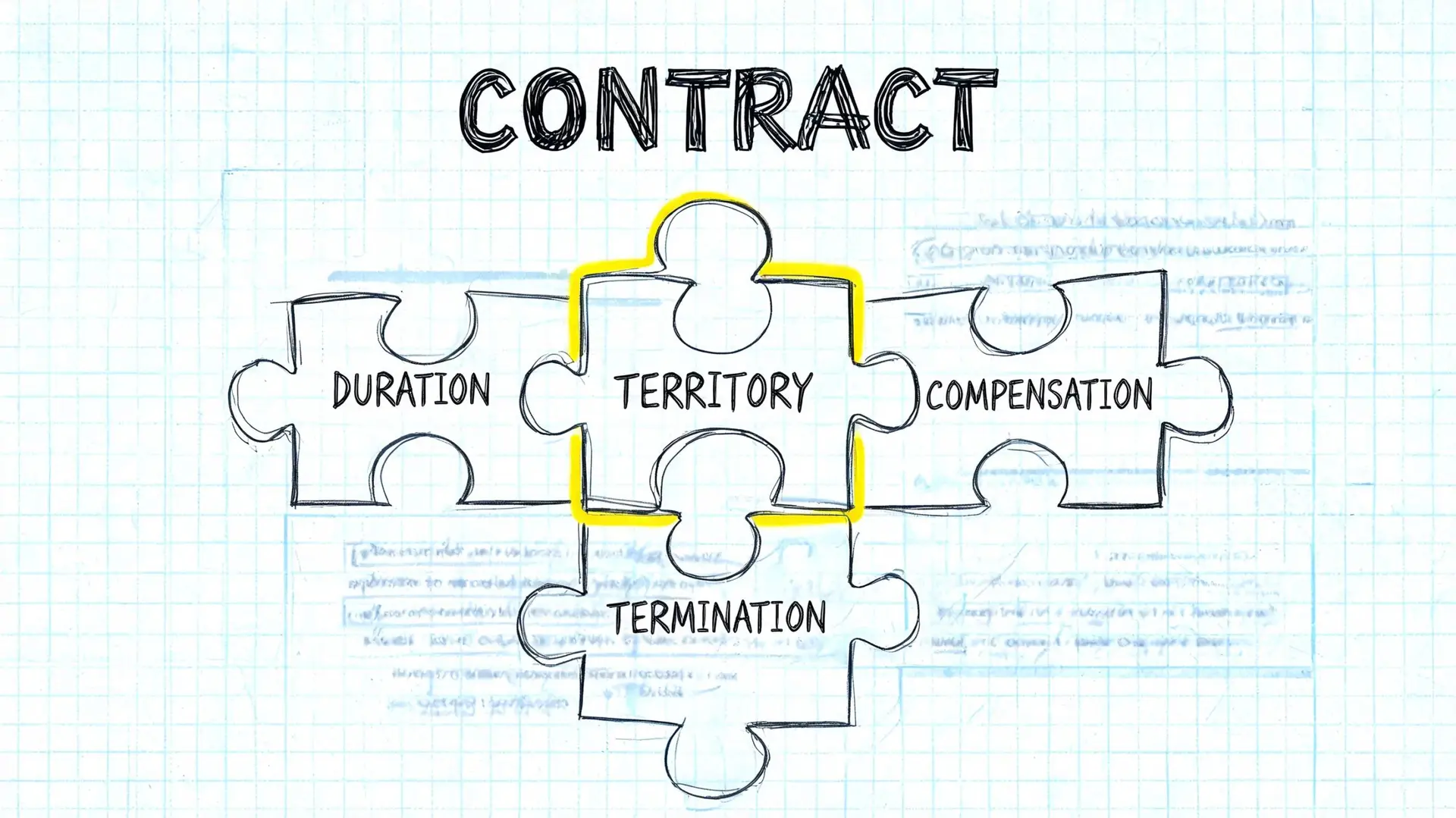
Territory and exclusivity
Territory language must do more than name a country. It must define the actual grant, reserved rights, online sales treatment, cross-border customer servicing, and the consequences of underdevelopment.
Exclusivity without carve-outs is dangerous. If the brand reserves no rights for key accounts, digital channels, airport locations, defense-sector customers, or strategic partnerships, it may discover too late that it gave away more than intended.
A disciplined clause should address:
- Geographic scope with no ambiguity on borders or sub-territories
- Exclusive rights and any franchisor reservations
- Encroachment rules for online or adjacent-market sales
- Reduction mechanisms if milestones fail
Fees and royalty architecture
The headline fee never tells the whole story. The central issue is whether the agreement aligns incentives during the period before downstream royalties mature.
Some deals front-load too much cash for the franchisor and starve the local platform. Others give the master franchisee wide economics but weak reporting duties, which invites dispute over remittances, credits, refunds, and local marketing deductions.
The agreement should state, in plain drafting:
- What the upfront fee buys
- How initial franchise fees are shared
- How ongoing royalties are calculated and remitted
- Whether product markups, technology charges, or marketing fees exist
- What records support audit rights
If the money-flow clause can’t be explained on one page to a CFO, it isn’t finished.
Intellectual property and brand control
The brand owner must license its marks, systems, manuals, and know-how with precision. Yet many agreements still use loose language that treats all IP as one bundle.
That’s careless. Trademark ownership, local trademark registration, know-how confidentiality, translated manuals, domain usage, and social media control should never sit in a generic paragraph. The master franchisee will localize the brand. The agreement must decide how far that localization can go before the brand stops being the brand.
A territory can recover from a slow launch. It rarely recovers from unmanaged local brand drift.
Training, standards, and reporting
Operational clauses often look routine, but they decide whether the franchisor can detect deterioration before customers do.
The contract should define the initial training package, ongoing support obligations, field visits, inspection rights, reporting cadence, system updates, and remedial procedures for non-compliance. It should also state whether the master franchisee may modify local training content and under what approval process.
Weak reporting clauses create blind spots. Strong ones create an advantage.
Milestones, default, and termination
Many negotiations become artificially polite at this stage. They shouldn’t.
Development milestones decide whether the territory has real value. If the master franchisee misses targets, the franchisor needs graded remedies. Those may include cure periods, narrowed exclusivity, reduced territory, step-in rights, suspension of new sub-franchise sales, or termination.
The master franchisee also needs protection against impossible targets caused by regulatory delay, import barriers, permit issues, or franchisor failure to deliver core support.
Transfer and exit rights
No board should sign an MFA without a clear exit map.
The agreement must address assignment, change of control, death or incapacity of key principals, sale of the master rights, buy-back options, and post-termination handling of sub-franchisees. If those points stay unresolved, an eventual dispute will shift from performance to salvage.
The Cross-Border Minefield Israel-Specific Considerations
Israel attracts brands that want highly discerning consumers, strong entrepreneurship, and a commercially agile local market. It also punishes lazy structuring.
Historically, master franchising developed as a foreign-market entry device because local legal and operational expertise matters. This academic discussion of master franchising as foreign market entry captures that core point well. The model gives a local sub-franchisor the right to develop the business and grant rights onward to sub-franchisees.
What foreign franchisors entering Israel should check first
Israel doesn’t fit every offshore template. A non-Israeli franchisor should review the full operating chain, not just the franchise grant.
That review should cover:
- Entity structure: Decide whether the market should operate through a local company, a foreign entity with local contracts, or a mixed structure.
- Tax treatment: Cross-border royalty streams, management fees, and service allocations must be reviewed before execution, not after the first remittance fails.
- Trademark position: Local registration strategy should match the actual operating model and local language use.
- Banking practicality: Incoming and outgoing payments need documents and timing discipline, especially when the bank asks for the commercial rationale behind transfers.
For businesses worried about operational disruption from banking friction, it also helps to understand how bank account restrictions in Israel can disrupt commercial activity before the network starts moving funds through local accounts.
What Israeli brands expanding abroad often underestimate
Israeli companies often negotiate strong commercial terms and still miss one structural issue. A master franchisee abroad is not just a sales partner. It is a local compliance machine or a local compliance failure.
That matters in several areas:
- Sub-franchise documentation: Local franchise disclosure, registration, and language rules may apply.
- Employment spillover: Staff engaged by the local platform may create practical exposure if the operating model blurs managerial control.
- Currency and remittance mechanics: Contract language should match the actual way money will move.
- Enforcement planning: A governing-law clause means little if interim relief, evidence gathering, or award enforcement become difficult on the ground.
The Israeli angle that changes negotiation style
Israel-connected deals benefit from practical drafting, not ornamental drafting. Commercial parties move quickly, but banks, tax authorities, and courts still care about precision.
That is why the safer path is to localize the agreement early. One option some companies use is a coordinated review involving franchise counsel, tax advisers, and a firm with cross-border commercial and dispute capability such as RNC Group’s commercial law practice. The point isn’t to create paper. The point is to make the structure operable in Israel and enforceable outside it.
The Strategic Due Diligence and Negotiation Checklist
Due diligence for master franchise agreements should behave like an acquisition review, not a template exercise. The buyer of the territory and the owner of the brand both need proof that the business model survives pressure.
The economics alone justify that discipline. Stratus Clean’s discussion of master franchise agreement structure notes that the master franchisee may earn from initial fees, ongoing royalties, and sometimes corporate-owned units, while also carrying burdens such as preparing sub-franchisee agreements, managing collections, maintaining brand standards, and handling local disclosure and registration compliance over a 10 to 20 year horizon. That combination creates complexity that standard franchise due diligence won’t catch.

The non-negotiable checklist
Start with the operating assumptions. Then attack them.
-
Model the fee stack
Build a territory model that includes upfront fees, royalty sharing, support costs, legal setup, staff, training, localization, and collections lag. If the model only works in an ideal rollout, reject it. -
Test support capacity Ask what the franchisor will deliver in the first operating phase. Manuals, onboarding, field support, software access, marketing assets, and operational approvals should all appear in a deliverables schedule.
-
Audit the IP chain
Confirm who owns the trademarks, manuals, operating system, and translated materials. Then verify whether local registrations and license permissions match the target territory. -
Stress-test milestones
Development targets should survive realistic delay. Site search, permits, hiring, import issues, financing, and local legal approvals all affect timing.
Negotiation lens: Any milestone that can trigger default should be linked to assumptions both sides can verify.
Questions that expose weak deals
Good due diligence asks irritating questions. That’s the point.
- Who controls sub-franchise documentation and local legal updates?
- Who collects and reconciles royalties, and how often?
- What happens if one flagship site underperforms early?
- Can the franchisor step in without destroying the local relationship?
- Can the master franchisee survive the pre-royalty period without shortcuts?
A large number of disputes start because nobody tested working capital honestly. The master franchisee funds local development before income stabilizes. That pressure changes behavior. Training gets reduced. Support gets delayed. Recruitment standards fall.
Downstream costs often hide in the property layer
Many expansion models underestimate premises risk. Site obligations, fit-out timing, landlord approvals, and rent exposure can break an otherwise plausible territory plan.
That’s why lease analysis belongs inside franchise due diligence. For Israel-connected projects, commercial lease risk in Israel should be reviewed alongside the franchise structure, not after the first location is identified.
When Disputes Arise Resolution and Enforcement Strategies
Most master franchise disputes follow a familiar pattern. The parties argue about missed openings, underfunded support, brand standards, or unpaid royalties. Then they discover the agreement says less than they assumed.
The deeper risk is structural. Franchise Business Review’s discussion of sub-franchising pressure points highlights the danger of becoming a “mini-franchisor” without the operational maturity to carry the role. It also notes that these contracts often run 10 to 20 years and may impose aggressive development goals with penalties or termination if targets are missed. In practice, that creates a financial strain because the master franchisee must fund development before royalties ramp up.
The three dispute tracks
Mediation works when the relationship still has value. It can preserve the territory and fix operational failures fast, but it fails if one side needs urgent coercive relief.
Arbitration usually fits cross-border master franchise agreements better than court litigation. It offers confidentiality, specialist decision-makers, and a cleaner enforcement path in many international settings. However, poor clause drafting can still create fights over seat, language, scope, and interim remedies.
Litigation may be necessary when injunctive relief, fraud issues, or local enforcement steps require court power. Yet cross-border litigation often becomes expensive before it becomes useful.
Draft for enforcement, not elegance
The dispute clause should answer practical questions:
- Which law governs the agreement
- Where proceedings will occur
- Which language controls
- Whether urgent injunctive relief is available in court
- How notices, audits, and default evidence will be handled
If the clause can’t manage an emergency injunction, it can’t manage a real franchise crisis.
For escalated matters involving market disruption, brand damage, or payment paralysis, strategic coordination between dispute counsel and commercial counsel matters. Businesses dealing with that kind of pressure often need a structured response such as cross-border crisis management and commercial litigation support, not just a claim form.
Frequently Asked Strategic Questions
What royalty split is commercially fair
There isn’t one universal answer. The fair split depends on how much of the local franchisor function the master franchisee performs. If the local party carries recruitment, support, compliance, and collections, the split must reflect those burdens. If the franchisor keeps heavy control and support duties, the master shouldn’t receive economics designed for a full sub-franchisor role.
Can a master franchisee sell its rights later
Yes, if the agreement allows transfer and the franchisor approves the buyer or the transaction structure. The contract should regulate assignment, change of control, valuation logic, and what happens to existing sub-franchisees after a sale.
How should the agreement deal with franchisor insolvency
The agreement should protect continued local operations, use of trademarks during transition, access to manuals and systems, and communication with sub-franchisees. A strong clause also addresses escrow, step-in rights, and continuity planning for critical IP and operating materials.
What’s the smartest negotiation priority
Don’t start with headline economics. Start with control of failure scenarios. Territory reduction, cure rights, reporting access, audit power, transfer limits, and sub-franchise continuity matter more than a superficially attractive fee split.
A costly mistake in a master franchise agreement usually starts as a small drafting compromise. It ends as a territorial dispute, a blocked payment chain, or a damaged brand. The recommended next step is a full legal and commercial review before signature, especially where Israel sits anywhere in the structure. To avoid preventable exposure, contact RNC Group now.
This article provides general information only and does not constitute legal advice, tax advice, or a legal opinion on any specific transaction, dispute, or jurisdiction. Any reliance on it without specific professional review of the relevant facts, contracts, regulatory environment, and enforcement context creates avoidable risk.