
As a real estate litigator with over thirty years of experience navigating the complexities of Israeli property law, I’ve seen countless foreign investors blindsided by a threat they never saw coming. It isn’t market volatility or geopolitical risk; it’s a seemingly minor issue—unpaid municipal taxes, known as Arnona—that spirals into a full-blown property lien on the Tabu (Israel’s Land Registry).
This isn’t merely a financial penalty. It’s a legal handcuff on your asset, and for an absentee owner, it’s a catastrophic blind spot.
Unpacking Israeli Property Liens for Foreign Owners

Unseen municipal debts can place a digital lock on your Israeli property. Understanding the Tabu lien system is the first step to securing your investment.
The path from a missed municipal debt for foreigners to a registered Tabu lien is shockingly swift. My entire practice is built on one core principle: “We identify and clear liens before they escalate into lawsuits.” This guide is designed to give you that same proactive mindset, focusing on the “why” and the “how” to protect your interests. We will dissect the most severe pitfalls, detail upcoming 2026 compliance rules, and outline the expert strategies required to shield your property from seizure and forced sale.
The Top 5 Risks of Ignoring Your Israeli Property
Ignoring a notice about unpaid municipal taxes is one of the costliest mistakes an international investor can make. The consequences extend far beyond simple late fees; they can fundamentally threaten your ownership rights and entangle you in cross-border legal battles that take years to resolve.
Here are the five critical dangers we’re about to dissect in this risk-prevention list:
- The Fast Track to a Tabu Lien: How a simple municipal bill becomes a powerful legal encumbrance registered directly against your property title, freezing the asset instantly.
- The Slippery Slope to a Forced Sale: The terrifyingly methodical process by which an ignored lien empowers the municipality to foreclose and auction your property—often for a fraction of its value.
- Cross-Border Financial Paralysis: How these debts can lead to frozen Israeli bank accounts, restricted business activities, and debt collection efforts in your home country.
- Acquiring Someone Else’s Problem: The hidden danger of inheriting liens when purchasing property—a risk often missed in standard due diligence that can turn a great investment into a legal nightmare.
- The Nightmare of a Remote Dispute: Why challenging incorrect charges from abroad without expert local representation is a battle you are almost guaranteed to lose.
Understanding this framework is the first, non-negotiable step toward securing your investment.
Risk 1: The Fast Track from Unpaid Arnona to a Tabu Property Lien
For a foreign investor, the single most dangerous blind spot isn’t market fluctuation—it’s an unassuming municipal tax bill called Arnona. Many overseas owners mentally classify it as a minor local tax, similar to what they might pay back home. This is a catastrophic miscalculation.
In Israel, Arnona isn’t a minor fee; it’s the financial lifeblood of a municipality, often funding over 80% of all local services. When you ignore an Arnona bill, you aren’t just accumulating late fees. You are triggering a powerful legal mechanism that allows the municipality to place a property lien directly on your title in the Tabu (Israel Land Registry).
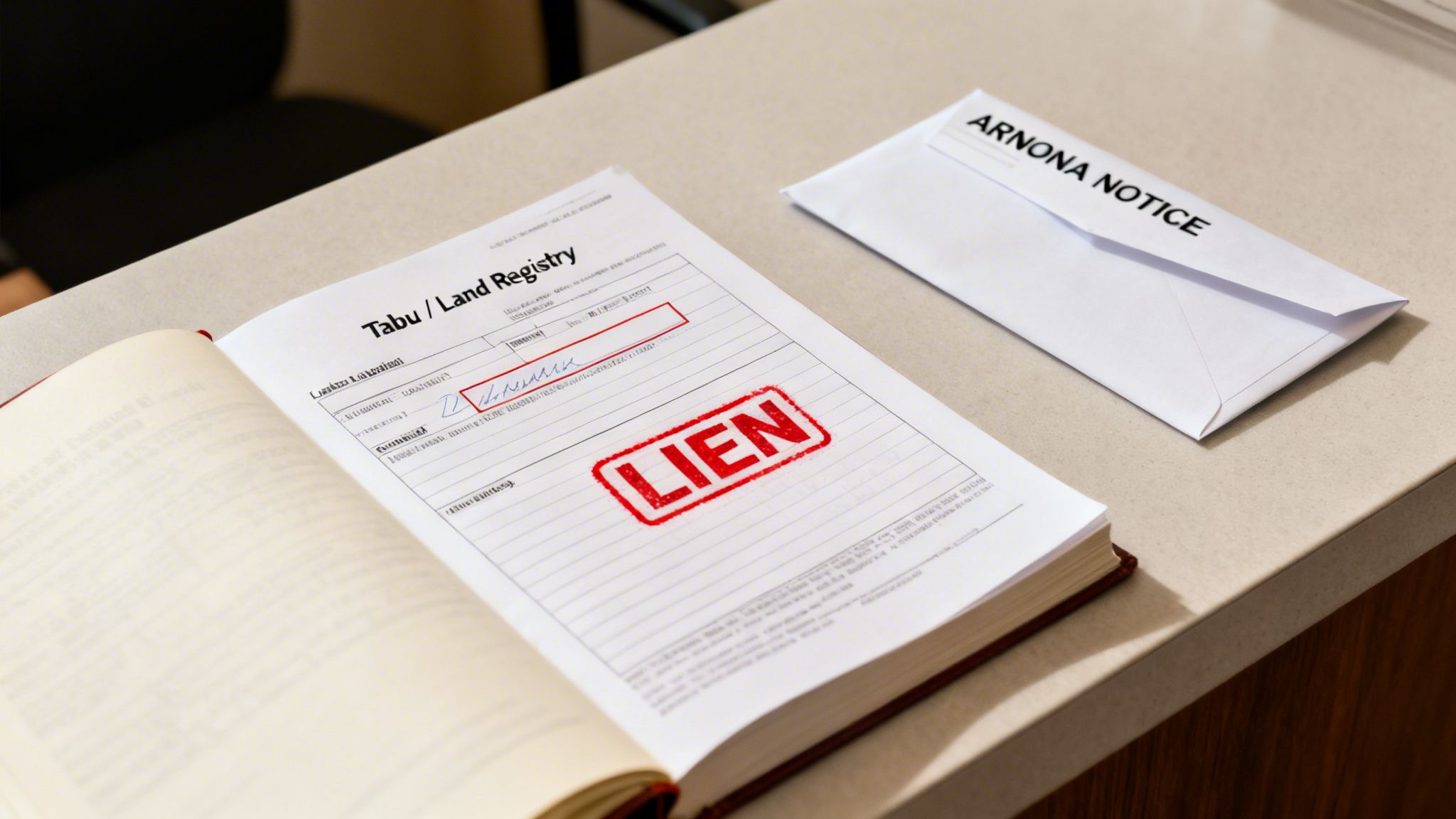
This isn’t an abstract legal theory. Over three decades in the courtroom, I have seen multimillion-dollar deals implode at the closing table. The cause? A last-minute title search unearthing an Arnona lien, sometimes for just a few thousand shekels. The foreign owner’s reaction is always a mix of shock and disbelief: “How could they do this without suing me? Without a court order?”
The answer is a harsh reality of Israeli administrative law. Municipalities possess an extraordinary power: they do not need to go to court to secure their debts. They have a legal “fast-track” to register a lien, effectively freezing your most valuable asset.
How a Simple Bill Paralyzes Your Property
The journey from an unpaid bill to a crippling lien is alarmingly swift and automated. Once an Arnona account is flagged as overdue, the municipality has the direct authority to file a claim against the property’s title in the Tabu. This isn’t just a note in a file; it’s a public, legally binding encumbrance with immediate and severe consequences.
For a foreign owner, this means your asset is instantly neutralized:
- You Cannot Sell or Transfer It: The Tabu will block any attempt to sell, gift, or otherwise transfer the property. No deal can close until you present a clearance certificate from the municipality, which they will only issue once the debt, penalties, and interest are paid in full.
- You Cannot Secure Financing: No bank in Israel will issue a new mortgage or refinance an existing one on a property with a lien. The asset becomes completely illiquid.
- The Debt Snowballs: The original amount owed grows, compounded by high interest rates and linkage to the consumer price index, often ballooning into a much larger sum than the owner ever imagined.
As a litigator, my message to international clients is blunt: an Arnona lien isn’t a starting point for negotiation. It’s a legal stranglehold. It gives the municipality a superior claim that often puts them ahead of all other creditors, making swift, full payment the only way out.
The Broader Picture: 2026 Compliance and Economic Pressures
Things are only getting stricter. New compliance regulations set for 2026 are designed to improve data sharing between municipalities and national tax authorities. In the near future, an unpaid municipal debt in Israel for foreigners could trigger much wider financial problems, potentially affecting your other banking and tax affairs in the country.
This aggressive collection policy makes sense when you look at the national economy. As of September 2025, Israel’s external debt was $160,385.5 million USD, a very manageable 27.2% of its GDP. This economic stability is a major draw for foreign investment. However, it also creates immense pressure on the government and its municipalities to ensure efficient revenue collection.
According to the OECD, Arnona accounts for over 36% of all local government revenue, making it their primary collection tool. You can explore detailed Israeli economic data to grasp the full fiscal context. This heavy reliance means collection is highly efficient and unforgiving, frequently catching absentee owners who are “out of sight, out of mind.”
This is precisely why a property lien in the Israel Tabu is the default weapon. The system is built for the municipality’s efficiency, not the owner’s convenience. For corporate entities, a lien can be even more disastrous, freezing M&A deals or demanding a complex Commercial Litigation battle to untangle. The best defense begins with a proper, compliant corporate structure, often established through a service like Company Registration Israel, to manage these risks from day one.
Risk 2: How a Silent Lien Can Lead to a Forced Property Sale
An unnoticed property lien in the Israel Tabu is more than just a bureaucratic headache; it’s a ticking time bomb. For an absentee owner, particularly a foreigner, the risk moves quickly beyond a “frozen” asset. It can spiral into the ultimate nightmare: a forced sale of your property, often for a fraction of its market value.
This isn’t a theoretical risk. It’s a very real enforcement power granted to Israeli municipalities. After decades spent in real estate litigation, I’ve seen international investors lose everything over debts that started as just a few thousand shekels. The process is methodical and completely legal, and for those who miss the warnings, the outcome is devastating.

The Legal Timeline From Lien to Foreclosure
Once a lien for unpaid Arnona is officially registered on your property’s title, the clock starts ticking. While the lien itself stops you from selling the property, the municipality won’t just sit and wait. They can, and often will, move to actively collect the debt by forcing a sale.
The exact timeline can vary between municipalities, but the legal framework follows a predictable path:
- Accrual of Debt and Penalties: The initial Arnona debt begins to snowball. It accumulates high-interest penalties and is linked to inflation, causing the amount owed to swell dramatically over time.
- Official Warnings Issued: The municipality sends official demand letters to the last known address on file. For foreign owners who haven’t updated their contact details or appointed a local representative, these critical notices are often lost or simply sent to the property itself, where they go unread.
- Appointment of a Receiver (Kones Nechasim): After a statutory period of non-payment, the municipality petitions the court or the Execution Office (Hotza’a Lapoal) to appoint a receiver. This is the point of no return. The receiver is an officer of the court empowered to seize the asset with the sole purpose of selling it to pay off the debt.
- Forced Sale Proceedings: From there, the receiver initiates foreclosure proceedings. This process culminates in a public auction of your property.
The Catastrophe of a Public Auction
The goal of a municipal auction isn’t to get you fair market value; it’s to recover the debt as quickly as possible. Properties sold under these circumstances are frequently snapped up by opportunistic investors for far less than they’re actually worth.
A forced sale represents the total destruction of your investment equity. Not only do you lose the property itself, but the sale price might barely cover the inflated municipal debt and legal fees, leaving you with absolutely nothing. It is the most severe consequence of ignoring municipal debt in Israel as a foreigner.
The financial and psychological toll is immense. An asset you thought was secure and appreciating is suddenly sold from under you, all because official notices were missed and a manageable debt spiraled out of control.
Expert Intervention Strategies at Every Stage
While this process is daunting, it is not unstoppable—provided you act decisively. As legal professionals, our intervention strategy depends entirely on how far the proceedings have advanced. Our first goal is always to identify and clear liens before they escalate into a full-blown crisis.
- Stage 1 (Post-Lien, Pre-Receiver): This is the ideal time to intervene. We can negotiate directly with the municipality to settle the debt, often securing a reduction in penalties and interest. This stops the appointment of a receiver and avoids the high legal costs that come with it.
- Stage 2 (Post-Receiver Appointment): Once a receiver is involved, the situation becomes more critical and expensive. Immediate legal action is required to halt the sale process. This might involve challenging the debt’s validity or negotiating a payment plan with the receiver, but their fees are now part of the total you owe.
- Stage 3 (Auction Scheduled): At this late stage, your options are severely limited. The only way to stop the auction is typically to pay the entire debt—including all accumulated interest, penalties, and the receiver’s substantial fees—in full before the sale date.
Engaging legal counsel the moment you discover a property lien on the Tabu is non-negotiable. Every single day of delay increases the cost and weakens your leverage. The path from a silent lien to a public auction is a well-trodden one, and without an expert guide, foreign owners are the most likely to get lost on it.
Risk 3: Navigating Cross-Border Issues and Restricted Bank Accounts
For a foreign national or an international company, the fallout from an unresolved municipal debt in Israel doesn’t just stay at the property line. As a litigator who has handled cross-border disputes for over three decades, I can tell you that the financial and legal shockwaves can follow you home.
More alarmingly, they can paralyze your entire Israeli operation. The risk goes far beyond just losing an asset; it threatens your very ability to conduct business in the country.
Many foreign investors mistakenly believe municipal debts are a purely local affair. But Israeli authorities, through bilateral agreements and international legal channels, absolutely can and do pursue significant debts across borders. While less common for small Arnona bills, municipalities will engage international collection agencies or even pursue judgments in your home court for substantial liabilities, especially those tied to commercial properties.
The Financial Paralyzer: A Restricted Bank Account
The most immediate and devastating consequence, however, happens right here in Israel. An outstanding municipal debt, particularly one that has led to a property lien on the Israel Tabu, can empower authorities to freeze your Israeli bank accounts. This action designates your account as a “Restricted Bank Account” (Heshbon Mugbal), a status that effectively cuts off your financial oxygen.
Once an account is restricted, the fallout is swift and crippling:
- No Outgoing Payments: You cannot issue checks, make wire transfers, or pay employees and suppliers. Your business operations grind to a halt.
- Reputational Damage: Getting flagged with a restricted account shatters your creditworthiness and reputation with both banks and business partners.
- Skyrocketing Legal Costs: Unfreezing the account demands immediate legal intervention and a full settlement of the original debt, piling significant legal fees on top of the initial problem.
2026 AML Protocols and Increased Scrutiny
This financial environment is only getting tougher. The upcoming 2026 anti-money laundering (AML) and tax compliance protocols are forcing Israeli financial institutions to be more vigilant than ever. Banks are under immense pressure to identify and flag any accounts linked to outstanding government debt, which includes municipal liabilities.
For a bank, an unpaid Arnona bill that escalates to a Tabu lien is a massive red flag under these new, stricter compliance regimes. It signals a potential disregard for local financial obligations, prompting banks to act preemptively and freeze accounts to mitigate their own regulatory risk. This is where a real estate problem dangerously transforms into a full-blown banking crisis.
The broader economic context only amplifies this risk. While deep international investment in instruments like Israel Bonds—a highly successful sovereign debt program—shows confidence in the state’s fiscal health, it also underscores the system’s reliance on strict debt collection at every level. According to OECD data, Arnona makes up over 80% of municipal tax revenue, making its collection an absolute top priority. You can read the full OECD review of Israeli local government finance to understand this deep dependency.
Expert Pro-Tip: The single most effective strategy to shield your global assets and maintain operational freedom in Israel is to compartmentalize liability. Never hold Israeli real estate under your personal name or through a foreign parent company.
Instead, you must establish a distinct Israeli legal entity. A formal Company Registration in Israel creates a “firewall.” This structure ensures that any property-related liabilities, like a lien or a debt that triggers a restricted account, are contained within that local entity. It’s a critical move for any serious investor, preventing the debt from contaminating your personal finances or the balance sheets of your international operations.
Risk 4: Avoiding Hidden Liens in Property Acquisitions and M&A
I’ve lost count of the number of sophisticated investors I’ve seen get blindsided during a property acquisition or corporate merger. The fourth major risk—inheriting hidden municipal debt in Israel as a foreigner—is a particularly nasty surprise because it’s a liability that standard due diligence almost always misses.
Most buyers, and even many lawyers, believe a basic title search at the Tabu (the Israeli Land Registry) is enough. This is a critical, and often costly, mistake. A standard search confirms who owns the property and what mortgages are registered, but it will not show you municipal debts that are piling up but haven’t yet been officially recorded as a lien. This creates a dangerous blind spot where you could close a deal on a property that comes with a ticking financial time bomb.
Beyond the Tabu: The Non-Negotiable Municipal Certificate
The only way to truly see what’s happening behind the scenes is by getting a specific document directly from the municipality, known as an Ishur L’Tabu (Certificate for the Land Registry). Think of this certificate as the gold standard of pre-purchase protection. It’s a formal declaration from the local authority confirming that there are no outstanding debts for Arnona (municipal tax), water, or other local charges tied to that exact property.
An Ishur L’Tabu isn’t a “nice-to-have”; it is a non-negotiable prerequisite for any safe property transfer in Israel. Without it, you’re buying blind. The seller’s unresolved financial problems instantly become your legal and financial burden the moment the ink on the contract is dry.
To avoid the shock of discovering a hidden property lien in the Israel Tabu post-acquisition, your due diligence has to be relentless. While a generic ultimate real estate due diligence checklist is a good starting point, our firm’s process is far more rigorous, designed to uncover liabilities that others miss.
Expert Due Diligence for Israeli Property
A standard approach leaves you exposed to significant risk. Our expert-level approach provides a comprehensive shield against inheriting someone else’s financial mess.
| Checklist Item | Standard Due Diligence (High Risk) | Expert-Level Diligence (Risk Mitigation) |
|---|---|---|
| Land Registry (Tabu) Check | Confirms ownership and registered mortgages. | Confirms ownership and checks for existing liens, attachments, and court orders. |
| Municipal Certificate (Ishur L’Tabu) | Often requested late in the process, if at all. | Mandatory upfront. Verifies zero Arnona and other municipal debts. Checks for illegal construction fines. |
| Planning & Building Committee Check | Not typically performed. | Verifies no outstanding ‘Betterment Levies’ (Heitel Hashbacha) which can become a lien. |
| Water Corporation Check | Ignored. Assumed to be minor. | Verifies no outstanding water/sewage debts, which can also lead to liens. |
| Seller’s Financial Status Review | Not performed for property-only deals. | For corporate deals, investigates for signs of financial distress that could lead to last-minute liens. |
This table highlights why a surface-level review is insufficient. Each “expert” item closes a specific loophole that could otherwise cost a new owner dearly, making the difference between a secure investment and a financial disaster.
Contractual Safeguards and Escrow Accounts
Even with these deep-dive checks, we build in extra layers of protection directly into the contract. We draft specific clauses into the purchase agreement that make it crystal clear: the seller is responsible for every single shekel of debt accrued up to the date of transfer.
But we don’t just take their word for it. Critically, we insist that a portion of the purchase price is held back in a lawyer’s escrow account. These funds are only released to the seller after they have presented a clean Ishur L’Tabu and all other necessary clearance certificates. This creates a powerful financial incentive for the seller to settle their debts promptly, ensuring our client is never left holding the bag.
Risk 5: The Nightmare of Disputing a Charge from Abroad
This final risk is often the most infuriating. As a litigator, I’ve seen international property owners get completely steamrolled by a municipal bill that is just flat-out wrong, only to find themselves entangled in a bureaucratic nightmare they can’t possibly solve from another country.
Let’s be clear: Israeli municipalities make mistakes. Constantly. Common errors include:
- Incorrect property measurements that lead to massively inflated Arnona bills.
- Wrongly classifying a residential apartment as a commercial space, which triggers a much higher tax rate.
- Failing to apply a legitimate discount, like the one for a vacant property (neches reik).
From thousands of miles away, these look like simple clerical errors you could fix with an email. But on the ground in Israel, trying to correct them is a full-blown legal battle against a ticking clock.

Why You Can’t Fight City Hall by Phone or Email
If you’re a foreign owner dealing with municipal debt in Israel, any attempt to manage an appeal from abroad is doomed. The system simply isn’t built for it. The departments are notoriously siloed, communication is almost exclusively in Hebrew, and frankly, they have little incentive to make it easy for you.
More importantly, there’s a strict, unforgiving legal process for challenging an Arnona assessment. The formal objection, known as an Hashaga, is governed by a rigid deadline. You generally have just 90 days from receiving the annual tax notice to file a formal, evidence-backed appeal.
Missing that window is catastrophic. The moment that deadline passes, the charge is considered final and legally binding. It’s no longer a disputed bill; it’s an admitted debt—one that gives the municipality the power to slap a property lien on the Israel Tabu.
The Right Way to Challenge a Municipal Charge
Fighting an incorrect charge isn’t about making a phone call; it’s about initiating a formal legal proceeding. It demands hard evidence, precise legal arguments, and a legally empowered representative who can act for you on the ground—immediately and decisively.
Here’s the battle plan our firm executes for clients:
- Secure Power of Attorney: The first step is executing a notarized and apostilled Power of Attorney. This is the key that unlocks the whole process, giving us the legal authority to represent you before the municipality and any appeals committee.
- Gather Hard Evidence: We don’t argue; we prove. This isn’t a negotiation based on what’s “fair.” We commission an independent, certified surveyor to produce official architectural plans and measurements that definitively prove the municipality’s error.
- File the Formal Hashaga: With the evidence in hand, our team drafts and submits the formal appeal in Hebrew. We lay out the legal and factual basis for the dispute, attaching all certified proof, always well within the crucial 90-day window.
- Represent You in Person: We then attend the necessary meetings with the municipal Arnona department and, if needed, escalate and argue the case before the official Appeals Committee (Va’adat Arar).
In Israel’s administrative system, an unchallenged charge is an admitted debt. The burden of proof is 100% on the property owner. If you don’t proactively fight a billing mistake with a team on the ground, it will inevitably become a final, enforceable debt that puts your asset at risk.
This is precisely why having an expert monitoring your property is not a luxury—it’s essential. We serve as your eyes and ears, ensuring that a simple billing mistake is caught and challenged before it can ever escalate into a lien that threatens your ownership.
Building Your Proactive Defense Strategy
We’ve dissected the severe fallout from ignoring municipal debts—from a paralyzing property lien in the Israel Tabu to the nightmare scenario of a forced sale. Now, it’s time to shift from defense to offense. Protecting your Israeli assets isn’t about reacting to problems; it’s about building a fortress that prevents them from ever materializing.
As a litigator, my core advice is this: you cannot manage an Israeli property effectively from thousands of miles away without trusted boots on the ground. An absentee owner is, by definition, a vulnerable owner. The system is designed for local engagement, and trying to manage it remotely leaves you dangerously exposed.
Your Essential Preventive Measures
A strong proactive defense rests on four key pillars. Implementing these will transform you from a potential victim of bureaucracy into a prepared and protected investor.
- Appoint a Reliable Local Representative: This is non-negotiable. You need a legally empowered person or firm in Israel to receive official notices, inspect your property, and act decisively on your behalf. This one move closes the communication gap at the heart of nearly every lien-related disaster.
- Conduct Annual Property ‘Health Checks’: At least once a year, have your representative pull a new Tabu extract and an up-to-date Arnona statement. This simple audit is your early-warning system, confirming your title is clean and catching errors before they escalate.
- Keep Your Contact Information Updated: Ensure the municipality has the current contact details for your Israeli representative, not an old overseas address. This ensures critical legal notices are received and dealt with immediately.
- Understand Your Rights to Discounts: Are you eligible for an Arnona discount for a vacant property (neches reik)? Many foreign owners overpay thousands in taxes simply because they are unaware of this and other exemptions. A local expert can identify these opportunities and file the necessary applications for you.
As you build out your strategy, it’s also wise to learn from the missteps of others. Reviewing the 10 fatal mistakes expatriate investors should avoid provides valuable context for international real estate investment more broadly.
When to Engage Legal Counsel Immediately
If you even suspect a lien might exist, or if you find yourself in any dispute over municipal debt in Israel as a foreigner, time is your most valuable asset. The minute you sense trouble, your next step should be to engage a specialized legal team. Our firm is structured to handle these exact fires.
We don’t just react to problems; we preempt them. We specialize in identifying and clearing liens before they can trigger a lawsuit. We guide clients through the complexities of commercial litigation and, for those facing a complete financial lockdown, we have a long track record of unfreezing restricted bank accounts.
Don’t let a fixable administrative issue spiral into an irreversible crisis. The work of securing your Israeli property begins today.
If you are facing challenges with a property lien or require expert guidance to protect your Israeli real estate investments, contact the RNC Group today for a confidential consultation at https://www.rnc.co.il.
Yoast SEO Block
- Focus Keyphrase: municipal debt israel foreigners, property lien israel tabu
- SEO Title: Guide to Municipal Debt & Property Liens in Israel for Foreigners
- URL Slug: municipal-debt-israel-foreigners-property-lien-israel-tabu
- Meta Description: A complete guide for foreign investors on Israeli municipal debt, Arnona, and property liens in the Tabu. Learn the top 5 risks, 2026 compliance rules, and how to prevent a forced sale.
- Image File Name: israeli-property-lien-municipal-debt-tabu.jpg
- Image Alt Text: A conceptual image showing a modern Israeli property ensnared by digital chains symbolizing municipal debt and a property lien from the Tabu, a risk for foreign owners.
- Image Caption: Unseen municipal debts can place a digital lock on your Israeli property. Understanding the Tabu lien system is the first step to securing your investment.
- LSI Keywords: arnona israel, tabu lien check, real estate litigation israel, forced property sale israel, restricted bank account israel, ishurt tabu, foreign property owner israel, betterment levy israel