
Approximately 30 million American workers, nearly one in five, are subject to non-compete restrictions. When an Israeli-drafted clause follows a departing executive into another country, enforcement requires navigating multiple legal systems simultaneously, rather than just filing a lawsuit in Israel.
A senior executive resigns from an Israeli technology company and accepts a role with a competitor abroad. The executive knows the company's pricing model, customer pipeline, product roadmap, and negotiation history. The employment agreement contains a non-compete clause governed by Israeli law, and the business must decide whether to seek urgent relief before the executive establishes a new team and begins approaching customers.
The obvious reaction is to sue in Israel. That may be necessary, but it doesn't answer the operational questions. Will an Israeli court grant relief affecting conduct abroad? Will the country where the executive now works recognize the Israeli governing-law clause? Can an injunction reach a foreign employer, customer relationship, or business operation? What evidence can be collected lawfully across borders?
These questions have become more urgent as regulators and courts reassess restrictions on worker mobility. The Federal Trade Commission estimated that non-competes affected approximately 30 million American workers and projected that eliminating them could increase new-business formation by 2.7% annually, generate more than 8,500 additional businesses each year, increase average worker earnings by $524 annually, and reduce health-care costs by up to $194 billion over ten years. Those projections appear in the FTC's non-compete fact sheet, and they explain why a contractual restriction can attract regulatory attention far beyond the employer and employee.
Table of Contents
- When a Departing Executive Goes Global
- Israeli Legal Standards for Enforceability
- Available Remedies and Enforcement Tools
- Procedural Steps for Effective Enforcement
- Cross-Border Enforcement Challenges
- Defenses That Undermine Enforcement
- Drafting Best Practices for Enforceability
- Strategic Decision Criteria for Enforcement
When a Departing Executive Goes Global
The company's first mistake is often treating the departure as a routine employment dispute. The executive may be physically present in another country, the replacement employer may be incorporated elsewhere, the customers may be distributed across several markets, and the relevant files may sit in cloud systems accessible from multiple locations. An Israeli court order can be valuable, but its practical effect depends on where the parties, assets, evidence, and competitive activity are located.

The employer should separate three questions immediately:
- Contractual restraint: Does the clause restrict competing employment, solicitation, disclosure, or use of confidential information?
- Protectable information: What specific information did the executive access, and why could it materially assist the new employer?
- Practical relief: Which court can issue an order quickly and make that order effective against the executive or the new employer?
The distinction matters because a domestic victory may not stop foreign competition. An Israeli injunction might restrict the executive's conduct toward the Israeli company, yet the executive could continue working abroad in a role that doesn't fall within the order's wording. A foreign court may also decline to give effect to a restriction that conflicts with mandatory employment law or public policy.
Practical rule: The first legal meeting should map people, data, customers, employers, governing law, forum, and assets by country. A clause cannot be evaluated intelligently without that map.
The U.S. experience illustrates the risk of assuming one national standard. Historically, American non-competes were enforced primarily under state law, with substantial differences between jurisdictions. A 2014 Federal Reserve analysis reported that courts in nearly all states generally enforced restrictions considered reasonable in scope, duration, and geographic reach, while identifying historical exceptions. California, by contrast, has rejected post-employment non-competes for more than 150 years, as described in the Federal Reserve analysis.
For an Israeli business expanding through a subsidiary, acquisition, distributor, franchise, or remote workforce, the question isn't whether Israeli law supports the clause. The relevant question is where effective relief can be obtained before the competitive harm becomes difficult to reverse.
Israeli Legal Standards for Enforceability
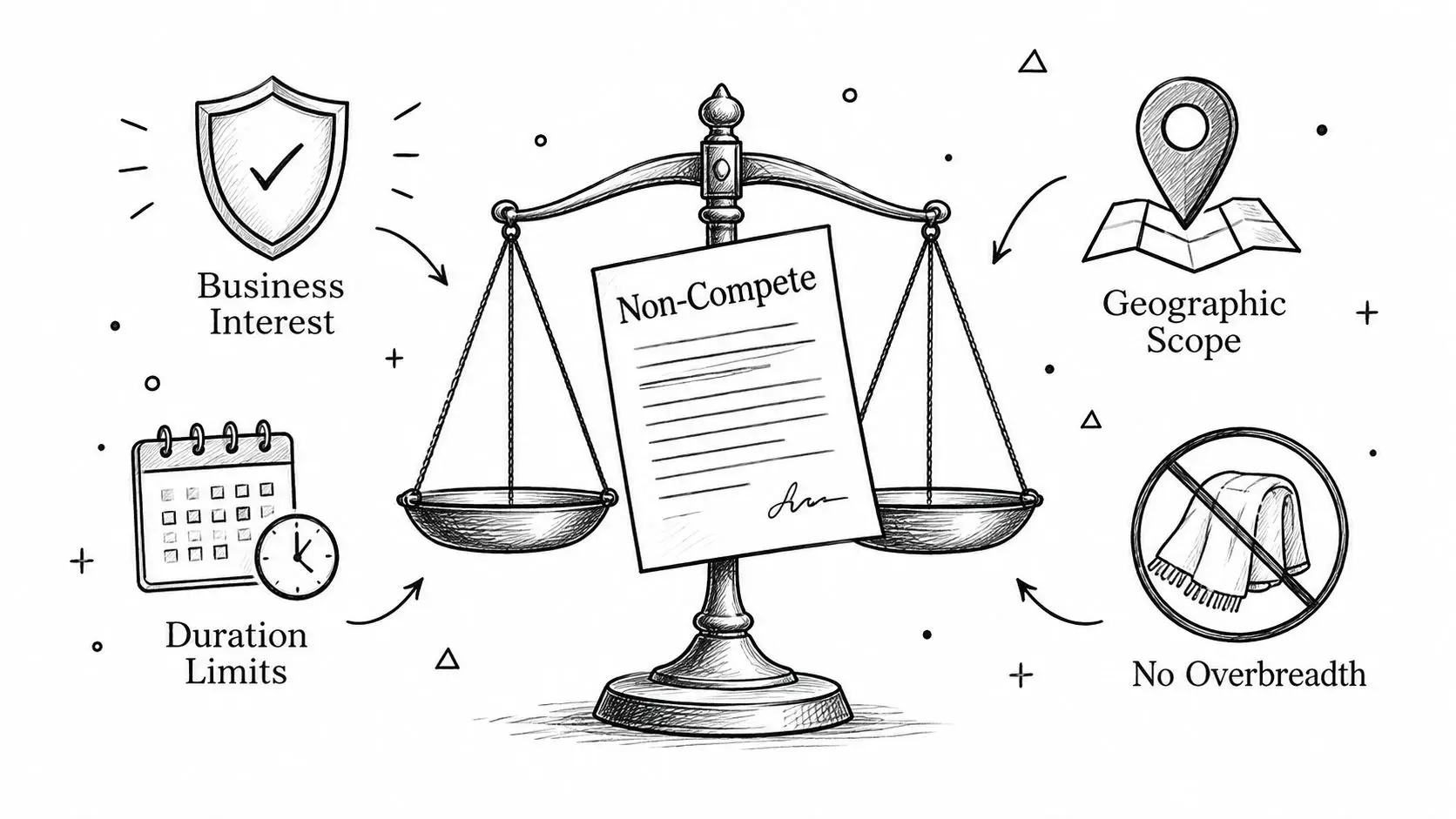
Israeli businesses should resist a common drafting assumption: a clause signed under Israeli law isn't automatically enforceable wherever the employee later works. The enforceability analysis must begin with the business interest being protected, then test whether the restriction goes no further than necessary.
The central interests usually asserted are trade secrets, confidential information, customer relationships, and goodwill. General knowledge of an industry, ordinary professional experience, and the ability to earn a living are different from information that belongs to the employer or creates a genuine competitive risk. A clause drafted only to prevent an employee from joining a competitor, without identifying the interest at stake, is vulnerable at the threshold.
The reasonableness inquiry
A defensible restriction should be connected to the executive's actual role. Duration should reflect the period during which the information remains commercially sensitive. Geographic scope should correspond to the market in which the employee could use the protected information. The prohibited activity should identify the competing work that creates the risk, rather than banning every role with a competitor.
The analysis is practical rather than cosmetic. Reducing the duration or adding a narrow territory won't cure a clause that still prohibits lawful work unrelated to the employer's protectable interest. A blanket ban on working for any competitor may fail because it restrains employment more broadly than the confidential information or customer relationships require.
U.S. materials provide a useful comparison, not a substitute for Israeli legal advice. A verified study covering state-level changes from 1991 through 2014 associated a move from the 10th to the 90th percentile of non-compete enforceability with a 3% to 4% reduction in earnings. A separate NBER study reported that an average increase in enforceability was associated with 16% to 19% fewer citation-weighted patents. Those findings are summarized in the comparative analysis of non-compete enforceability.
California demonstrates why a global template is dangerous. Business and Professions Code section 16600 provides that, subject to statutory exceptions, a contract restraining a person from engaging in a lawful profession, trade, or business is void to that extent. The statute requires broad construction, and the cited authority applies that approach even where a restriction is carefully limited in duration, territory, or customer scope. The California statutory text should be reviewed whenever California-linked personnel, activity, or disputes are involved.
The global drafting consequence
A single worldwide non-compete clause creates false confidence. The recommended strategic path is a jurisdictional schedule that identifies the employee's location, work territory, confidential access, customer responsibility, and legally available alternatives in each relevant country.
California also illustrates the importance of historical agreement reviews. Section 16600.1 created a notice mechanism for certain current and former employees whose non-compliant agreements existed after January 1, 2022, with a specified notice deadline of February 14, 2024. The California notice provision treats a violation as an act of unfair competition. That requirement is jurisdiction-specific and shouldn't be generalized to every restrictive covenant or every employee population.
Available Remedies and Enforcement Tools
The remedy should follow the commercial objective. If the immediate danger is customer solicitation or disclosure of sensitive material, damages after trial may be inadequate. If the evidence of misuse is weak but the financial loss can be measured, a damages claim may be more credible than an aggressive application for interim relief.
A preliminary injunction is usually most valuable when the employer can show a specific protectable interest, a real and imminent risk, and a restriction that is sufficiently precise for a court to enforce. The application should identify the conduct to be stopped, the evidence supporting the risk, and the reason monetary compensation won't provide adequate protection while the case proceeds.
A permanent injunction serves a different purpose. It follows a final determination and can establish a durable prohibition, but it arrives after the most commercially sensitive period may have passed. The employer shouldn't assume that success at trial will restore lost customers, reverse recruitment, or recover information already absorbed into a competing business.
Matching the remedy to the evidence
Damages require proof of loss and causation. That may include diverted customer opportunities, lost transactions, costs incurred to investigate misuse, or other quantifiable harm. The further the employee's conduct spreads across markets, the more difficult it may become to distinguish losses caused by the breach from ordinary market movement.
An account of profits is conceptually different. It seeks to focus on the benefit obtained through wrongful conduct rather than only the employer's loss. Its availability and calculation depend on the legal basis of the claim and the governing jurisdiction, so it shouldn't be presented as an automatic substitute for proving damages.
Interim preservation orders can protect the litigation itself. Where there is a credible risk that electronic records, devices, customer files, or communications will be altered or deleted, the employer should consider urgent measures permitted by the relevant court. Those measures require careful handling because overbroad collection can create privacy, privilege, and evidence-admissibility problems.

Remedy Comparison Matrix
| Remedy | Best Use Case | Evidence Required | Timing |
|---|---|---|---|
| Preliminary injunction | Preventing imminent competition, solicitation, or misuse | Contract, protectable-interest evidence, urgency, and a credible risk of harm | At the start of proceedings |
| Permanent injunction | Stopping prohibited conduct after final determination | Full evidentiary record and proof supporting the requested restriction | After trial or final resolution |
| Compensatory damages | Recovering measurable financial loss | Causation, financial records, customer evidence, and loss calculation | Usually after harm has occurred |
| Account of profits | Focusing on benefit obtained through alleged wrongdoing | Evidence connecting the benefit to the wrongful conduct | During final relief proceedings |
| Preservation order | Protecting records and devices from destruction or alteration | Concrete basis for preservation and carefully defined material | Before or at the beginning of litigation |
The strongest urgent application is usually narrower than the strongest written threat. Courts can act on a precise risk supported by documents. They struggle with general allegations that an employee is simply “dangerous.”
The U.S. federal position reinforces the need for a flexible remedy strategy. The FTC issued a nationwide rule on April 23, 2024, with an intended effective date of September 4, 2024, but a federal court injunction prevented nationwide enforcement. The rule isn't currently enforceable, according to the FTC's current non-compete rule status page. That doesn't eliminate state-law claims, regulatory scrutiny, or the need to protect trade secrets through separate causes of action.
Procedural Steps for Effective Enforcement
A rushed filing can weaken an otherwise credible case. The employer should preserve evidence before confronting the departing executive, unless an immediate intervention is necessary to prevent ongoing harm.
Preserve and assess
The first phase should secure the employment agreement, amendments, policies, access logs, customer records, device assignments, confidentiality acknowledgments, exit interview materials, and communications relating to the departure. Legal counsel should distinguish routine business records from material that may raise privacy, privilege, labor, or data-transfer concerns.
The legal team should then prepare an evidence chart. Each alleged risk should be tied to a document, witness, system record, customer relationship, or specific category of confidential information. The chart should also identify facts that weaken the claim, including the executive's actual access, the duration of the information's sensitivity, and whether the new role overlaps.
Choose the first application
If the executive is about to join a direct competitor or contact key customers, an interim application may be appropriate. The requested order should be framed around conduct, information, and relationships that can be identified with precision. A demand for a complete employment ban is harder to justify when confidentiality, non-solicitation, or restricted-use obligations could address the actual risk.
An emergency route may be available in some circumstances, but its availability, notice requirements, and evidentiary threshold depend on the court and jurisdiction. A standard proceeding may provide more time for evidence development but can reduce the practical value of relief if the executive begins work immediately.
Prepare for the merits
Service of process, jurisdictional objections, and foreign enforcement should be addressed before filing, not after an order is issued. The pleadings should anticipate arguments concerning governing law, forum selection, employee location, public policy, and the scope of the requested restraint.
Trial preparation should preserve a coherent narrative. The employer must show what the executive knew, how the information could be used, what conduct is prohibited, and why the requested relief is proportionate. Post-judgment enforcement requires a separate plan, particularly where the defendant, assets, and business activities are outside Israel.
Delay is not neutral. Every day without a preservation protocol or targeted interim application can increase the cost of proving what happened and reduce the commercial value of eventual relief.
Cross-Border Enforcement Challenges
Cross-border non compete clause enforcement fails when the employer asks only whether the agreement is valid. The more useful question is whether a particular court can grant effective relief quickly against a particular person or entity, while respecting the mandatory rules of the place where the work and competition occur.
Five questions should be answered before proceedings begin.
Will the foreign court recognize the governing-law clause? A clause selecting Israeli law may carry significant weight, but recognition depends on the forum's conflict-of-laws rules and the connection between the parties, employment, and dispute. The employer should avoid treating governing law as a guarantee of the forum or the remedy.
Can mandatory employment law override the chosen law? Some jurisdictions protect worker mobility through non-waivable rules. A foreign court may apply those rules despite an Israeli governing-law provision, particularly where the employee lives and performs work locally.
Can an injunction reach conduct abroad? An Israeli order may bind the employee personally, but enforcement against a foreign employer, local subsidiary, or foreign assets may require recognition proceedings or a parallel application. The wording of the order must also distinguish prohibited activity from lawful work.
How will privacy and evidence-transfer rules affect proof? The employer may have access to company systems but not unrestricted authority to copy personal devices, private accounts, or foreign-resident data. Evidence collection must account for local privacy rules, employment protections, privilege, and transfer restrictions. An unlawful collection process can damage the merits case and create a second dispute.
Can the court distinguish trade-secret protection from a restraint on mobility? Courts are more likely to engage with a concrete misuse risk than with a general demand that an employee remain outside an industry. The employer should identify the information, its commercial sensitivity, the employee's access, and the proposed safeguards.

The domestic injunction problem
A domestic injunction may not prevent competition abroad. The executive might comply formally while performing substantially similar work outside the order's territorial reach, or the new employer might reorganize the role through a different entity. The employer may then face parallel proceedings, notification duties, regulatory scrutiny, and data-protection exposure.
A recent FTC consent order concerning a pest-control non-compete matter required notice to more than 18,000 workers that they could compete, including by starting businesses. The development is identified in the FTC's announcement concerning the Rollins order. It demonstrates the contrarian point: enforcement activity can create obligations for the employer that extend beyond the original contract dispute.
For Israeli companies, the decision framework should therefore combine governing law, forum, employee location, data location, customer location, and remedy reach. A clause that appears strong on paper may be commercially weak if the relevant foreign court won't enforce it or if the employer can't lawfully prove the alleged misuse.
Defenses That Undermine Enforcement
A signed agreement doesn't eliminate the defendant's strongest argument. The executive will usually attack the restriction before addressing the alleged competitive conduct. If the employer cannot articulate a specific protectable interest, the case may weaken before the court considers the employee's new role.
The common defenses are predictable, but their application is fact-sensitive:
- No protectable interest: The employer identifies only general competition, employee retention, or industry knowledge rather than confidential information, trade secrets, customer relationships, or goodwill.
- Overbreadth: The clause covers every competitor, every territory, every customer, or every form of employment, regardless of what the executive did.
- Local mandatory law: The employee argues that the forum's employment rules override the chosen governing law or prohibit the restriction altogether.
- Drafting and procedural defects: The agreement, amendment, notice, consideration, translation, or execution process doesn't satisfy the applicable legal requirements.
- Public policy: The restriction allegedly interferes with lawful work, professional mobility, patient or customer access, or competition in a way the forum won't permit.
California is an especially important warning for international groups. Section 16600 generally voids contracts restraining a person from engaging in a lawful profession, trade, or business, subject to statutory exceptions, and the statute is construed broadly. A narrow duration or geographic area doesn't necessarily cure the defect there.
The employer should also expect an argument that less restrictive protections were available. Confidentiality, trade-secret, non-solicitation, restricted-use, and garden-leave provisions may address the identified risk without preventing all work for a competitor. Those alternatives must be drafted carefully because a restriction that functions as a disguised non-compete can face the same objection.
A court is unlikely to enforce a restriction merely because the employer fears competition. The employer must connect the restraint to a defined business interest and show why the requested scope is necessary.
The practical defense analysis should begin before the employee leaves. A business that cannot explain which information was accessed, how long it remains sensitive, and which customers were within the executive's responsibility may struggle to obtain urgent relief even where the contract looks formal and thorough.
Drafting Best Practices for Enforceability
Drafting should start with the business risk, not with a preferred clause. The agreement should identify the executive's access, customer responsibility, territory, role, and the type of conduct that creates a genuine threat.
Separate protections serve different purposes:
- Non-compete: Use only where the applicable jurisdiction permits it and the business can justify the restraint.
- Non-solicitation: Address defined customers, prospects, employees, or relationships rather than prohibiting all market activity.
- Confidentiality: Identify protected categories and impose obligations on use, disclosure, copying, and retention.
- Trade-secret protection: Preserve evidence of access controls, classifications, policies, and handling procedures.
- Garden leave: Consider whether paid non-working notice can reduce immediate competitive exposure without relying entirely on a post-employment restraint.
Each jurisdiction should receive its own drafting review. The agreement should not assume that a governing-law clause controls employee mobility rules, interim relief, evidence collection, or recognition of judgments.
Severability can preserve part of an agreement where the relevant law permits judicial narrowing, but it isn't a substitute for careful drafting. A severability clause may create false confidence if the forum refuses to rewrite an unlawful restraint or treats the entire restriction as void.
Before relying on an existing global template, the company should verify:
- The employee's current and expected work locations.
- The governing-law and forum provisions.
- The actual confidential access and customer relationships.
- The duration, territory, and prohibited activity.
- The availability of separate confidentiality and non-solicitation protections.
- Any local notice, translation, execution, or remediation requirement.
Strategic Decision Criteria for Enforcement
Litigation should follow a decision matrix, not the emotional reaction to a resignation. The most important factors are competitive urgency, evidence strength, jurisdictional reach, likely compliance cost, and relationship value.
A preliminary application may be justified where confidential information is moving, a competitor is acting immediately, and the employer can present focused evidence. Negotiation may be superior where the clause is broad, foreign law is hostile, the executive's new role is only partly competitive, or the business can secure practical undertakings concerning customers, systems, and information.
The recommended phased escalation is straightforward:
- Stabilize: Preserve evidence, disable inappropriate access, conduct an exit process, and identify the immediate commercial risk.
- Test: Send a targeted legal communication and seek undertakings that match the documented concern.
- Protect: Apply for interim relief in the forum capable of acting against the relevant conduct.
- Resolve or proceed: Compare the cost of parallel proceedings against the value of the customers, information, and market position at stake.
The useful metric isn't whether the clause is theoretically enforceable. It is where effective relief can be obtained quickly, against whom, and at what compliance cost. That analysis is especially important for Israeli companies expanding through foreign subsidiaries, acquisitions, distributors, franchises, and remote workforces.
The FTC rule's current non-enforcement status doesn't eliminate state-law restrictions, case-by-case regulatory action, or future changes. Regulatory uncertainty will remain a material drafting and litigation risk in 2026 and beyond, so businesses should build layered protections rather than depend on one global non-compete.
RNC Group advises Israeli and international businesses on cross-border restrictive covenants, evidence preservation, urgent commercial disputes, and enforcement strategy across jurisdictions. To avoid costly mistakes before an executive departure or foreign expansion creates an irreversible problem, businesses should visit RNC Group and contact the firm now for a jurisdiction-specific assessment.
In our experience, a non-compete holds up best when it is tied to one named confidential asset, one defined role and a forum that can act within days, not weeks.
Enforcing a non-compete? Courts read these clauses narrowly, and wording decides everything.
Scope, geography, duration and consideration decide whether the clause holds. Overbroad wording can void the protection you thought you had.
We draft and enforce non-compete and non-solicitation clauses. Reach us on WhatsApp or by email.
This article is for general information only and does not constitute legal advice. Laws and their application depend on the facts and jurisdiction and may change. Although we aim to keep this information accurate and current, we do not guarantee that it is complete or up to date. The article may contain omissions or errors. Reading this article does not create an attorney-client relationship with RNC Group. Before making a decision or taking action, seek advice from a qualified lawyer in the relevant jurisdiction.