
An Original Equipment Manufacturer (OEM) agreement serves as the legal architecture for a potent and commonplace business partnership. Put simply, it is a production contract wherein one company manufactures a product that another company then brands and markets as its own.
For Israeli tech companies, this is more than a mere supply contract; it is a strategic instrument for accelerated growth. A meticulously drafted OEM agreement is indispensable for scaling operations, accessing world-class manufacturing capabilities, and penetrating global markets without incurring the prohibitive capital expenditure of establishing proprietary production facilities.
The Strategic Role of an OEM Agreement in High Tech
An OEM agreement is far more than a legal document; it is the blueprint for a symbiotic commercial relationship. It empowers a technology innovator—be it a nascent startup or an established firm focused on design and intellectual property—to collaborate with a manufacturing powerhouse possessing the requisite equipment, personnel, and economies of scale. This model is a paradigm shifter in the high-tech sector, where speed-to-market and judicious capital allocation are paramount.

The efficacy of this structure lies in enabling each party to leverage its core competencies. The brand concentrates on research and development, marketing, and sales—its areas of expertise. Concurrently, the manufacturer navigates the intricate complexities of production, logistics, and supply chain management. This clear division of labor generates significant strategic advantages.
Core Benefits of the OEM Model
For any Israeli tech company, from a nascent startup to a global enterprise, the OEM model offers distinct advantages that foster growth while mitigating risk:
- Speed to Market: A product can be launched in a fraction of the time required to establish a proprietary production line.
- Cost Savings: It obviates the substantial capital investment needed for factories, machinery, and a specialized workforce.
- Instant Expertise: It provides immediate access to extensive manufacturing expertise and established quality control processes.
- Flexibility and Scale: Adjusting production volumes to meet seasonal demand or market fluctuations is far more manageable without the burden of factory ownership.
At its core, an OEM agreement transforms a substantial capital expenditure challenge into a predictable operational cost. It affords innovators the agility to focus their resources on what truly matters—creating the next technological breakthrough.
The Legal Framework: Why the Details Matter
Naturally, these benefits are jeopardized if the agreement itself is not robust. A poorly drafted contract is an invitation to significant legal and commercial peril, including intellectual property theft, brand erosion from substandard products, and financial liabilities that could destabilize the enterprise.
The foundational legal pillars of a strong OEM agreement—clauses addressing intellectual property, quality control, and liability—are not mere legal jargon. They are the essential safeguards that protect your most valuable assets and ensure the partnership functions as intended.
While the contract establishes the rules of engagement, a successful partnership also hinges on a strong working relationship. Implementing effective vendor management best practices is critical, as this fosters the operational discipline that brings the legal terms to life. The following sections will delve into these critical components, providing precise guidance on what to prioritize.
Mastering Quality Control and Goods Rejection
Within an OEM agreement, the Quality Control (QC) clause represents the critical juncture where a brand’s reputation is either rigorously protected or left perilously exposed. A vague assurance of “high-quality manufacturing” is legally untenable in a dispute. The objective must be to eliminate all subjectivity and establish a clear, measurable, and enforceable framework.
This framework must precisely define what constitutes an acceptable product. This is not a matter of perfunctory checks; it is about maintaining absolute command over the final product that will bear your company’s name.
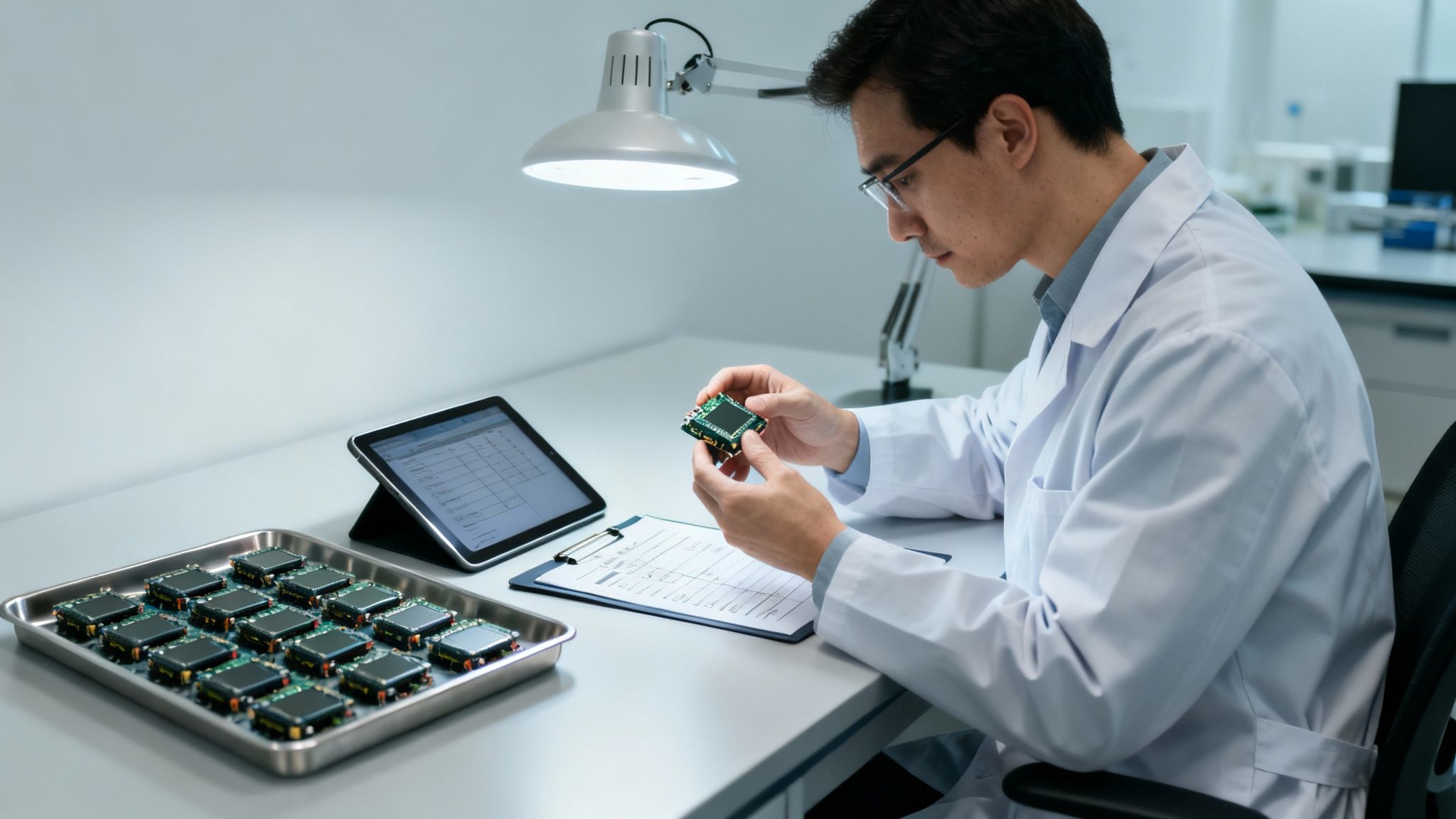
This process must commence long before the first unit is assembled. A robust OEM agreement integrates quality assurance into every stage, from the granular details of raw materials to the final functional testing protocols.
Establishing Objective and Measurable QC Standards
The cornerstone of any effective QC protocol is a detailed Specification Sheet. This document, which must be legally incorporated by reference into the main OEM agreement, serves as the definitive technical rulebook. It must be exhaustive, leaving no room for interpretation.
The Specification Sheet should precisely define elements such as:
- Material Specifications: Specify the exact type, grade, and even the source of all raw materials and components. For example, instead of “high-grade steel,” specify “Grade 316L stainless steel.” Rather than “memory chips,” specify “Samsung K9F-series NAND flash memory.”
- Manufacturing Tolerances: Define acceptable dimensional variations, often to the micrometer. Establish clear performance metrics, such as power consumption ranges, data transfer speeds, or operating temperature limits.
- Aesthetic and Finish Criteria: Include unambiguous standards for color (using Pantone codes), texture, and finish. Define precisely what constitutes a cosmetic defect, such as a scratch exceeding a specified length or a blemish in a designated zone.
This level of granular detail transforms “quality” from an abstract concept into a clear, binary pass/fail criterion.
Designing an Ironclad Inspection and Rejection Protocol
Once the standards are established, the next step is to define the inspection process itself. This protocol dictates how, when, and by whom products will be tested. Even the most stringent QC standards are rendered ineffective by a poorly defined inspection process.
A strong inspection clause in your OEM agreement will meticulously outline several key elements:
- Inspection Windows: Specify precisely when inspections may occur. Effective agreements often mandate multi-stage inspections—upon receipt of raw materials, during in-process assembly, and before final shipment. This proactive approach identifies issues early, conserving time and resources.
- Sampling Method: As testing every unit is often impractical, the agreement should reference a statistical sampling plan like Acceptable Quality Limit (AQL). This standard defines the maximum number of defects permissible in a batch before the entire lot is subject to rejection.
- Third-Party Auditors: The agreement must grant you the right to engage your own independent, third-party inspectors. This provides an objective assessment and is a powerful tool for resolving disputes over non-conforming goods.
The right to reject is your ultimate leverage as the brand owner. This clause must be unequivocal. It needs to state that if a batch fails inspection based on the agreed-upon standards, you have the sole discretion to reject the entire shipment.
The procedure for handling rejected goods must be equally clear. The manufacturer should be contractually obligated to either repair the defects, replace the entire batch, or issue a full credit within a specified timeframe and entirely at their expense. The clause must explicitly cover all associated costs, including shipping, taxes, and any fees related to the failed inspection. Under Israeli contract law, such explicitly defined terms are critical. In the event of a dispute, courts will look directly to the precise language of the OEM agreement to determine each party’s rights and obligations.
Product Liability and Product Recall Protocols
In any manufacturing partnership, a critical question looms: when a product fails in the market, who bears the liability? An expertly drafted OEM agreement must provide a clear, unambiguous framework for risk allocation, liability assignment, and crisis management, including a detailed protocol for a product recall.
Without such clarity, a single defective product can escalate into a legal and financial catastrophe, creating friction between the brand owner and the manufacturer while eroding customer trust. Clauses governing liability, indemnification, and recall procedures are not legal boilerplate; they are essential firewalls that protect your business from systemic failure.
Delineating the Chain of Liability
The agreement must draw distinct lines of responsibility. It needs to specify which liabilities fall to the brand owner (the OEM buyer) and which are borne by the manufacturer. This delineation is crucial to prevent costly disputes when a product failure results in property damage or personal injury.
A well-structured OEM agreement typically allocates liability based on the origin of the fault:
- Manufacturer’s Liability: The manufacturer must be held liable for any defects arising from the production process. This includes substandard workmanship, the use of incorrect materials, or deviations from the agreed-upon quality control procedures.
- Brand Owner’s Liability: Conversely, the brand owner is generally responsible for defects inherent in the product’s design, engineering specifications, or any components they supplied to the manufacturer.
Under Israeli product liability law, an injured party can often sue any entity in the supply chain. A well-defined liability clause ensures that even if you face initial legal action, you have a clear contractual basis to pass the ultimate financial responsibility to the manufacturer if the fault was theirs.
The Power of a Comprehensive Indemnity Clause
An indemnity clause gives the liability framework its enforcement power. It is a contractual commitment by one party (the manufacturer) to cover the losses of the other party (the brand owner) in the event of specific occurrences, such as a product liability lawsuit. This is one of the most potent risk-management tools in an OEM agreement.
A properly drafted clause should obligate the manufacturer to indemnify you for all costs arising from a manufacturing defect, not just the final settlement or court judgment.
An ironclad indemnity clause must be drafted to cover the full spectrum of potential costs, including attorneys’ fees, court costs, expert witness fees, and any other expenses incurred in defending a claim. This ensures the brand owner is made whole, not just partially compensated.
Furthermore, the agreement should grant you control over the legal defense strategy while obligating the manufacturer to bear the cost. It must also require the manufacturer to maintain adequate product liability insurance and to name your entity as an additional insured party, providing a critical financial backstop.
Establishing a Practical Product Recall Protocol
When a defect is systemic, a product recall may become necessary. The OEM agreement must serve as a precise playbook for this high-stakes scenario to manage the logistical and reputational fallout.
A detailed recall protocol should define three key areas:
- Recall Triggers: Define the objective conditions that initiate a recall, such as a specified failure rate, a regulatory mandate, or a mutual determination based on a safety risk.
- Cost Allocation: The clause must be unequivocal. The party at fault—typically the manufacturer for production defects—shall bear all associated expenses. This includes the logistics of retrieving defective units, shipping replacements, and managing public communications.
- Crisis Management and Communication: Delineate the process for notifying customers and regulatory agencies. As the brand owner, you must retain final approval over all public messaging to ensure strategic consistency and brand protection.
Adherence to global standards is a crucial component of this, particularly for international sales. For instance, compliance with EU directives directly impacts liability. Familiarity with resources detailing these regulations, such as a guide to CE Marking Requirements for Electronic Equipment, is fundamental. Integrating such international standards into the OEM agreement ensures your recall plan is not only commercially sound but also globally compliant.
Securing IP Rights for Molds, Tooling, and Designs
When considering intellectual property within an OEM agreement, focus often gravitates toward the product’s intangible assets—patents, trademarks, and software. However, a frequently overlooked yet critical battleground involves the tangible assets used in production: the custom molds, tooling, and jigs.
These are not standard components; they are the physical embodiment of your proprietary designs and often represent a significant capital investment. Securing unambiguous ownership of these assets from the outset is non-negotiable.
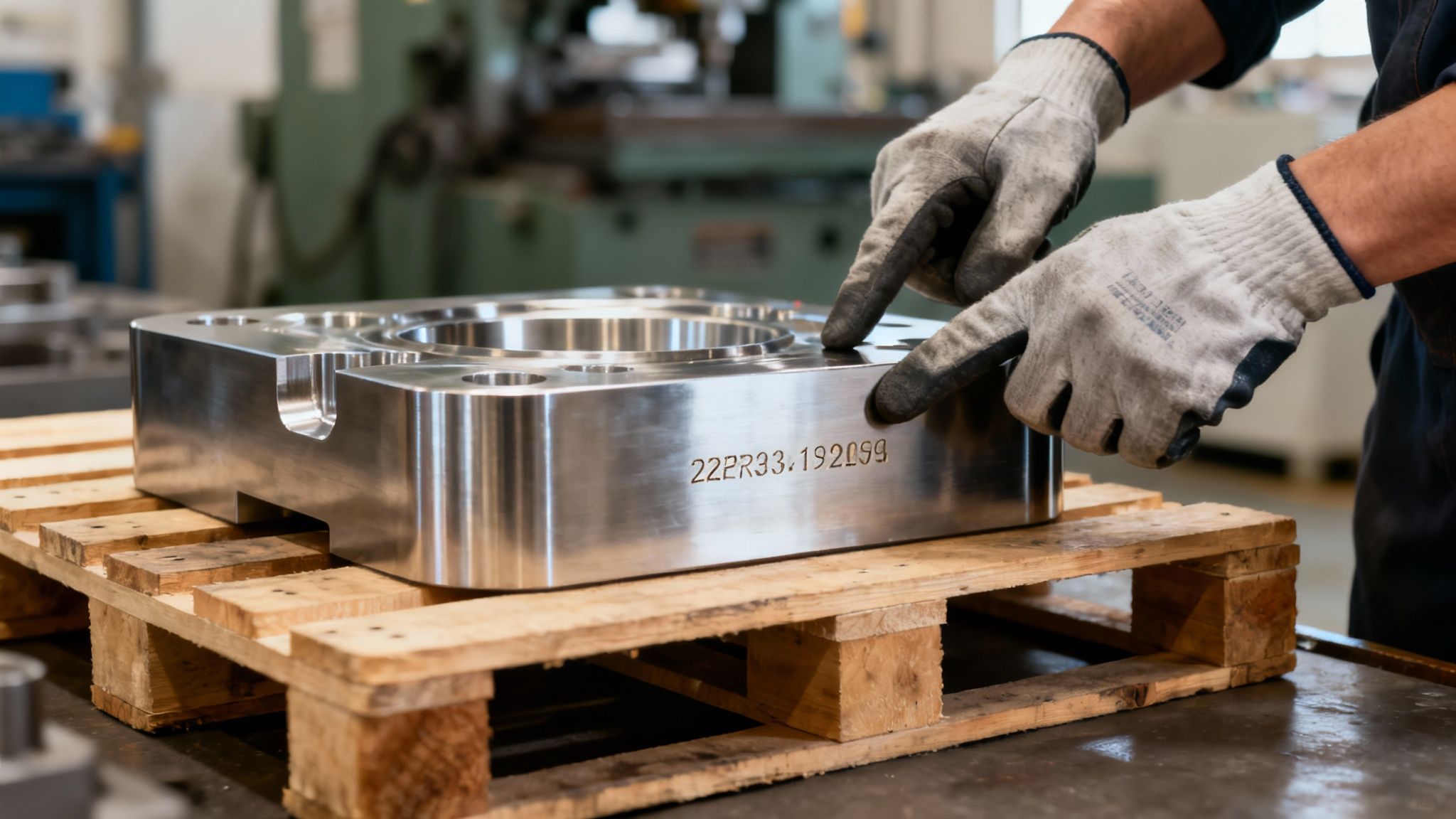
Without ironclad contractual language, you expose your business to severe risks. A manufacturer could exploit your custom tooling to produce near-identical products for a competitor or, worse, hold your essential production assets hostage during a dispute, thereby paralyzing your supply chain. The OEM agreement must function as a legal shield for the very core of your manufacturing process.
Who owns the molds/tooling? Defining Ownership from the Outset
The pivotal question is simple: Who owns the tooling? The answer must be articulated with absolute clarity in the contract. A verbal understanding is a precursor to a costly legal conflict.
Your agreement must state precisely who pays for, owns, maintains, and has the right to retrieve this equipment. Failure to do so creates a dangerous ambiguity of de facto ownership, where the manufacturer’s physical possession grants them leverage that Israeli courts may have to untangle at great expense. The contract must preemptively resolve this by detailing a clear chain of title for every piece of custom equipment, identifying each item with serial numbers or other unique identifiers.
Analyzing Tooling Ownership Models
Several models exist for structuring the ownership and control of these critical assets. Each presents a different balance of risk, cost, and control. The appropriate choice is strategic, but it must be explicitly defined in the agreement.
-
Brand-Owned Tooling: This is the most secure model. You pay for the tooling outright and retain full, unconditional ownership. This provides maximum control and simplifies transitioning production to an alternative manufacturer if necessary.
-
Amortized Tooling: In this model, the manufacturer finances the initial cost, which is then amortized into the per-unit price of your products over an agreed-upon production volume. The contract must state unequivocally that full ownership transfers to you automatically and unconditionally the moment the total tooling cost has been paid in full.
-
Manufacturer-Owned with Exclusive Use: In some cases, a specialized manufacturer may insist on owning the tooling. While this presents a higher risk for the brand, it can be managed through a tightly drafted clause granting you exclusive, perpetual, and irrevocable rights to its use for your products only.
The most perilous scenario is ambiguity. A contract that fails to specify ownership can lead to a manufacturer claiming a lien over the tooling for unpaid invoices or other disputes. This is a common tactic that can paralyze a company’s entire supply chain. Clear title is paramount.
To fully grasp the strategic implications, it is useful to compare these models.
IP Ownership Models for Molds and Tooling
This table breaks down the primary models for owning and controlling physical manufacturing assets, outlining the risks and strategic advantages for you, the brand owner.
| Ownership Model | Primary Benefits for Brand Owner | Key Risks to Mitigate | Recommended Clause Focus |
|---|---|---|---|
| Brand-Owned Tooling | Maximum Control & Flexibility: Simplifies switching manufacturers. Clear Ownership: Prevents hostage situations or liens. | Initial cash outlay. Risk of damage/loss at the factory. | Clear title, right of retrieval, manufacturer’s liability for maintenance and insurance. |
| Amortized Tooling | Lower Upfront Cost: Preserves initial capital. Path to Ownership: Eventually gain full control without a large initial payment. | Ambiguous Transfer: Manufacturer may dispute when the tooling is fully paid off. | Precise amortization schedule, automatic and unconditional title transfer clause upon final payment. |
| Manufacturer-Owned | No Capital Expense: Leverages manufacturer’s investment and expertise. | High Lock-In Risk: Extremely difficult to move production. Unauthorized Use: Risk of manufacturer using tooling for other clients. | Irrevocable & Perpetual Exclusive Use rights, strong non-compete, penalties for unauthorized production. |
Regardless of the chosen model, your agreement must include a Right of Retrieval clause. This grants you the unequivocal right to take immediate physical possession of your tooling upon contract termination or breach. It should also obligate the manufacturer to facilitate this process, including proper packaging and preparation for shipment. Finally, the details of maintenance, repair, and insurance must be defined, assigning the manufacturer responsibility for routine upkeep and for insuring the tooling against damage or loss while in their custody.
Navigating The Global Manufacturing Landscape
Your OEM agreement does not exist in a vacuum. To be effective, it must be commercially intelligent, reflecting an understanding of global market trends, geopolitical shifts, and persistent supply chain pressures. A legally sound agreement is necessary; one that is also commercially astute is what truly protects your business.

The scale of the global manufacturing landscape is immense, particularly in highly competitive sectors like high-tech electronics and MedTech. These markets are characterized by intense competition and narrow margins, creating a high-stakes environment. This global pressure underscores why the legal protections previously discussed—IP, quality control, liability—are not mere formalities. When market pressures intensify, a manufacturer may be tempted to compromise on quality or misuse proprietary designs unless a robust contract expressly forbids such actions.
Understanding Market Dynamics and Strategic Outsourcing
The electronics sector provides a compelling case study. In 2021, the global electronics assembly market—encompassing both in-house OEM production and outsourced Electronic Manufacturing Services (EMS)—reached an astonishing $1.45 trillion in cost of goods sold (COGS). The market’s 47% EMS penetration signals a clear trend: companies are retaining core R&D functions while strategically outsourcing production to specialized partners.
This model is particularly well-suited for foreign businesses establishing operations in Israel. A well-crafted OEM agreement allows them to leverage this global manufacturing ecosystem while ensuring security and compliance. For a deeper analysis, you can explore more data on the worldwide manufacturing assembly market.
An OEM agreement acts as a strategic anchor in a turbulent global sea. It allows a company to remain agile and capital-efficient while mitigating the considerable risks of international supply chains, from semiconductor shortages to sudden shifts in trade policy.
This is not merely a cost-saving measure; it is a calculated business strategy. Strategic outsourcing provides innovators, including many Israeli tech firms, with access to world-class manufacturing capabilities that would be prohibitively expensive to develop internally. This reliance on external partners makes the legal agreement governing that relationship absolutely critical.
Building Resilience Against Global Volatility
Modern supply chains can be remarkably fragile. A single disruption—a factory lockdown, a shipping delay, a new tariff—can trigger a cascade of failures throughout an operation. A forward-thinking OEM agreement anticipates these challenges and integrates mechanisms to manage them.
Key considerations include:
- Geographic Diversification Rights: Does the contract permit you to engage a secondary manufacturer in a different region as a contingency? This is a crucial hedge against regional instability.
- Component Sourcing Flexibility: The agreement must define the protocol for managing component shortages or price spikes, establishing a clear process for approving alternative suppliers without compromising quality.
- Force Majeure Clauses: These clauses must be meticulously drafted to distinguish between unforeseeable events and predictable business risks, protecting you from partners who might exploit minor disruptions to excuse non-performance.
By linking these macroeconomic trends to specific legal clauses, the OEM agreement is transformed from a static document into a dynamic risk management tool. This proactive approach ensures your supply chain becomes a source of competitive advantage, not a point of vulnerability.
Your OEM Agreement Questions, Answered
When navigating a manufacturing partnership, numerous questions arise. A well-drafted OEM agreement not only answers them but also converts potential conflicts into clear, mutually agreed-upon rules of engagement.
Here are the most common issues our corporate clients face, accompanied by strategic insights from our experience in cross-border commercial law.
What’s the Single Biggest Mistake You See in OEM Agreements?
By a significant margin, the most frequent and costly error is the use of ambiguous language for quality control. Phrases such as “industry standard” or “high quality” are legally unenforceable and invite disputes over the acceptability of a product batch.
A robust OEM agreement eliminates this ambiguity by defining quality with objective, measurable metrics. This includes specific testing protocols, precise engineering tolerances, and clear criteria for acceptance or rejection. This approach makes quality a matter of contract compliance, not subjective debate.
How Do I Stop My OEM Manufacturer from Turning into My Competitor?
This is a tangible risk that demands proactive legal drafting. The manufacturing relationship itself offers no inherent protection against a partner leveraging your designs and market knowledge to compete against you.
To construct an effective defense, your agreement must include several key restrictive covenants:
- A Non-Compete Clause: This is non-negotiable. It must explicitly prohibit the manufacturer from producing or selling a similar product for a specific, reasonable period following contract termination.
- Airtight Confidentiality Terms: Standard boilerplate is insufficient. Your confidentiality provisions must specifically identify and protect your trade secrets, from schematics and customer lists to proprietary production processes.
- Unequivocal IP Ownership: The contract must state, without ambiguity, that you own all intellectual property. This includes design files, custom tooling, and any improvements or modifications developed during the production engagement.
Who Should Be in Charge of Sourcing Components?
This is a critical operational point that must be explicitly addressed during negotiations. An incorrect allocation of this responsibility can lead to severe supply chain failures and quality issues. The responsibility must be clearly assigned in the OEM agreement.
There are two primary models:
- The Consignment Model: You, the brand owner, source and provide all components to the manufacturer. This grants you ultimate control over quality and cost but also burdens you with the associated logistics.
- The Turnkey Model: The manufacturer assumes responsibility for sourcing all components. However, they must adhere to a strict approved vendor list (AVL) and detailed specifications that you provide. This model requires incredibly stringent incoming quality control clauses to verify the authenticity and performance of every part.
A Quick Legal Note Before We Dive In
This guide is designed to provide a practical, strategic understanding of OEM agreements, drawing from our direct experience in the field. Consider it a map to help you navigate this complex commercial terrain.
However, it is imperative to recognize that this information is for educational purposes and does not constitute formal legal advice. Every business situation is unique, and the specifics of your transaction require a tailored legal strategy. Please do not take any action—or refrain from taking action—based solely on the information presented here.
The realm of international contracts is complex, and relying on general information entails significant risk. We strongly advise consulting with a qualified attorney who can analyze your specific circumstances and assist you in constructing the strongest possible agreement.
At RNC Group, we specialize in crafting OEM agreements that are not only legally sound but also commercially astute. We assist businesses in protecting their most valuable assets while fostering successful, long-term partnerships. If you are prepared to build your next manufacturing agreement on a solid foundation, we invite you to connect with us. Learn more about our cross-border expertise at https://www.rnc.co.il.
This article does not constitute legal advice and is not a substitute for consulting with a qualified attorney. Do not rely on the contents of this article for taking or refraining from taking any action.