
Most founders assume an IPO represents the ultimate startup exit strategy. The evidence points elsewhere. In EMEA, M&A represented over 85% of venture-backed exits during the last five years, while IPOs represented around 2% of exits since 2021, according to reported EMEA startup exit data.
That reality changes the assignment. A founder shouldn’t wait for a buyer, then discover that missing IP assignments, unclear ownership, weak revenue records, or unresolved litigation have already reduced the price. A serious exit plan treats the next 6 to 12 months as a legal, financial, and operational cleanup operation.
The strongest plan also preserves choice. A strategic acquisition, IPO, secondary sale, continuation fund, tender offer, or acqui-hire can serve different objectives. The right route depends on control, liquidity, tax exposure, execution risk, and the founder’s life after closing.
The 2026 Exit Reality Founders Must Plan Around
Public markets can tighten before a private company has time to adapt. In EMEA, companies going public raised $16.0 billion in 2021, compared with $3.4 billion in 2024, according to the EMEA exit report. Founders therefore need an exit strategy that works without assuming an IPO window will remain open.

The practical starting point is a 12-month readiness program. First, identify plausible strategic buyers, financial sponsors, and partial-liquidity investors. Next, map the approvals and documents that could delay a transaction. Finally, test the company’s financial story against the scrutiny a buyer will apply.
Build optionality before seeking liquidity
M&A usually provides the clearest full-exit route. However, a secondary sale can give founders or early investors liquidity without transferring the company. A continuation fund can extend ownership under a new investment structure, while a tender offer can provide liquidity for selected shareholders or employees.
Those alternatives create different trade-offs. A full acquisition may deliver cash certainty but introduce integration risk, earn-out disputes, and post-closing restrictions. Partial liquidity may preserve upside and control, but it can require investor consent, transfer compliance, and a realistic buyer for the shares.
The company should review these issues before any process begins:
- Governance: Confirm board powers, shareholder approval thresholds, investor veto rights, and transfer restrictions.
- Ownership: Reconcile the cap table, option grants, convertible instruments, and founder interests.
- People: Review employment claims, founder departures, retention arrangements, and key-person dependency.
- Technology: Verify IP ownership, open-source compliance, cybersecurity controls, and data rights.
- Contracts: Identify change-of-control clauses, assignment restrictions, termination rights, and customer concentration.
Practical rule: Treat every unresolved ownership or consent issue as a potential price reduction, not as administrative housekeeping.
Historical U.S. data reinforces this approach. A federal antitrust filing cited research showing that 90% of startup exits from 2008 to 2018 occurred through acquisitions, while 10% occurred through IPOs. The same filing cited another study finding that IPOs represented 4% of startup exits between 2002 and the first quarter of 2020, while acquisitions represented 61%. Those figures appear in this historical startup exit analysis.
Founders should therefore plan around a sale while preserving alternatives. Useful background on closing the value gap at exit also supports a simple conclusion. Value comes from preparation that buyers can verify, not from a hopeful headline valuation.
Choosing the Right Exit Route for Your Startup
The highest headline valuation isn’t always the best outcome. A founder should choose the route that matches personal objectives, investor rights, company economics, governance capacity, and the buyer’s strategic thesis.
| Exit Route | Best Fit | Liquidity / Control | Primary Trade-Off | Execution Risk |
|---|---|---|---|---|
| Strategic acquisition | A buyer can integrate technology, customers, or talent | Full liquidity, limited post-close control | Integration risk and possible earn-out dependence | High if IP, contracts, or approvals remain unclear |
| IPO | A mature company can sustain public-company discipline | Broad liquidity and continued independence | Disclosure, governance, and market exposure | Very high |
| Secondary sale | Selected holders need liquidity without a full sale | Partial liquidity, control often retained | Transfer restrictions and limited buyer universe | Moderate |
| Continuation fund | Investors want additional time and structured liquidity | Partial liquidity, business remains private | Complex alignment among existing and new capital | Moderate to high |
| Acqui-hire | Talent or technology exceeds standalone business value | Usually limited liquidity and reduced enterprise value | Product continuity and employee treatment may weaken | High if IP or employment records are incomplete |
Acquisition
A strategic acquisition fits a founder who values certainty and has identified a buyer with a clear integration rationale. The founder should test whether the buyer values the product, the customer base, the team, or a combination of those assets.
The negotiation must then separate enterprise value from contingent value. An attractive offer can become disappointing if the buyer places too much consideration in an earn-out or conditions payment on targets that the buyer controls after closing.
IPO
An IPO can preserve independence and create public currency. It also requires sustained disclosure discipline, internal controls, governance maturity, and market confidence.
The founder-fit verdict is direct. Choose an IPO only when the company wants to operate as a public company, rather than merely using the IPO as a valuation event.
Partial liquidity
A secondary sale, continuation fund, or tender offer suits a company that remains valuable but doesn’t need a full sale. These paths can address concentrated ownership, employee liquidity, or investor timing without surrendering all future upside.
However, shareholders must examine transfer restrictions, rights of first refusal, board consent, and the effect on future financing. A partial transaction can create a new shareholder group with different expectations.
Acqui-hire
An acqui-hire offers a fallback when the team or technology attracts more interest than the standalone business. Founders should expect lower enterprise value and focus on employment terms, IP treatment, retention, and individual post-close obligations.
The founder-fit verdict is practical. Use an acqui-hire only when preserving the operating company no longer creates greater value than preserving the team.
Building an Acquisition-Ready Company in 6–12 Months
A buyer’s diligence team will test whether the company can prove its story. The seller should therefore appoint one owner for every readiness item and assign a deadline before launching a process.

Corporate records first
Start with ownership and authority. Reconcile the cap table against every financing document, option grant, warrant, convertible instrument, and shareholder agreement. Then confirm board and shareholder approvals for issuances, compensation decisions, related-party transactions, and material contracts.
Update the constitutional documents and commercial agreements where necessary. Review bylaws, shareholder agreements, employment documents, incentive plans, founder arrangements, and delegations of authority.
A buyer may tolerate an old document. A buyer won’t tolerate uncertainty about who owns the company or who had authority to approve a material decision.
Financial proof must withstand challenge
Prepare financial statements, monthly management accounts, tax returns, bank records, budgets, forecasts, and customer concentration information. Build a defensible quality-of-earnings bridge that explains recurring revenue, one-time items, unusual costs, deferred revenue, and revenue-recognition judgments.
The financial file should answer three questions quickly:
- What revenue is durable?
- Which costs will continue after closing?
- Which assumptions support the forecast?
Normalize revenue recognition before the buyer does it. A buyer who discovers inconsistent treatment during diligence will use that discovery to challenge the entire financial narrative.
Protect the assets that create value
Create an IP dossier covering patents, trademarks, domains, source code, trade secrets, contractor assignments, employee assignments, and open-source compliance. Verify the chain of title rather than relying on a general representation that the company owns its technology.
Audit material contracts for change-of-control provisions, assignment restrictions, termination rights, data-processing duties, indemnities, exclusivity, and unusual customer terms. Also review employee equity, compensation compliance, benefits, immigration status, founder arrangements, litigation, insurance, privacy, cybersecurity, and regulatory licenses.
Buyers pay for predictable risk. Sellers create predictability by finding the problem before the buyer does.
Run a mock diligence exercise before inviting bids. Require the management team to answer questions using indexed source documents, not informal explanations. A deal-preparation source reports that prepared sellers can close 2 to 3 times faster than unprepared sellers, as discussed in this startup exit preparation guidance.
Valuation, Deal Structure, and the Negotiation Levers
Valuation doesn’t exist as a single number. It reflects the buyer’s view of durable revenue, growth quality, customer dependence, technology ownership, integration value, and execution risk.
SaaS companies face particular scrutiny around recurring revenue quality, churn, expansion, implementation costs, customer concentration, and the difference between reported ARR and revenue that a buyer can underwrite. A venture capital markup also doesn’t guarantee that a strategic buyer will accept the same valuation.
Separate price from payment certainty
The founder should negotiate the consideration mix early. Cash offers certainty, but the buyer may demand stronger indemnities or a lower headline price. Equity rollover can preserve upside, but it exposes the founder to the buyer’s performance and valuation. An earn-out can bridge disagreement, but it creates measurement and control risk.
| Dimension | Cash Deal | Equity Roll | Earn-Out |
|---|---|---|---|
| Speed | Usually straightforward once funded | Depends on valuation and share documentation | Requires detailed performance mechanics |
| Certainty | Highest at closing | Depends on buyer’s future value | Depends on post-close operations |
| Tax | Requires transaction-specific modeling | May defer or change the tax profile | Timing and characterization need careful analysis |
| Downside protection | Strongest if escrow is limited | Depends on liquidity and transfer rights | Requires protections against buyer interference |
| Founder control | Usually ends or narrows after closing | Often narrows | May continue through measurement period |
| Main risk | Escrow, indemnity, and working-capital adjustments | Share-price exposure and vesting | Disputes over targets, accounting, and integration |
Negotiate the net proceeds
The headline price can move materially through escrow, holdback, indemnity caps, baskets, working-capital adjustments, and deferred consideration. The founder’s counsel should model each clause as a cash-flow outcome, not treat it as boilerplate.
A no-shop clause also deserves attention. The seller should limit its duration, define permitted discussions, and preserve a path to terminate if the buyer delays, changes terms, or fails to obtain approval.
Reverse termination fees can protect the seller when the buyer fails to close. Their value depends on clear triggers, adequate funding, regulatory allocation, and an agreed process for claiming the fee.
Earn-outs require especially precise drafting. Define the metric, accounting rules, reporting access, management discretion, budget assumptions, acquisition treatment, milestone certification, dispute resolution, and payment timing. Also address whether deferred consideration earns interest and how management rollover equity vests after closing.
Don’t accept a 5% to 15% recovery claim without transaction-specific proof. The correct approach is to identify each value leak, quantify its likely effect, and trade concessions only when the buyer gives equivalent certainty elsewhere.
Regulatory, Tax, and Cross-Border Execution Risks
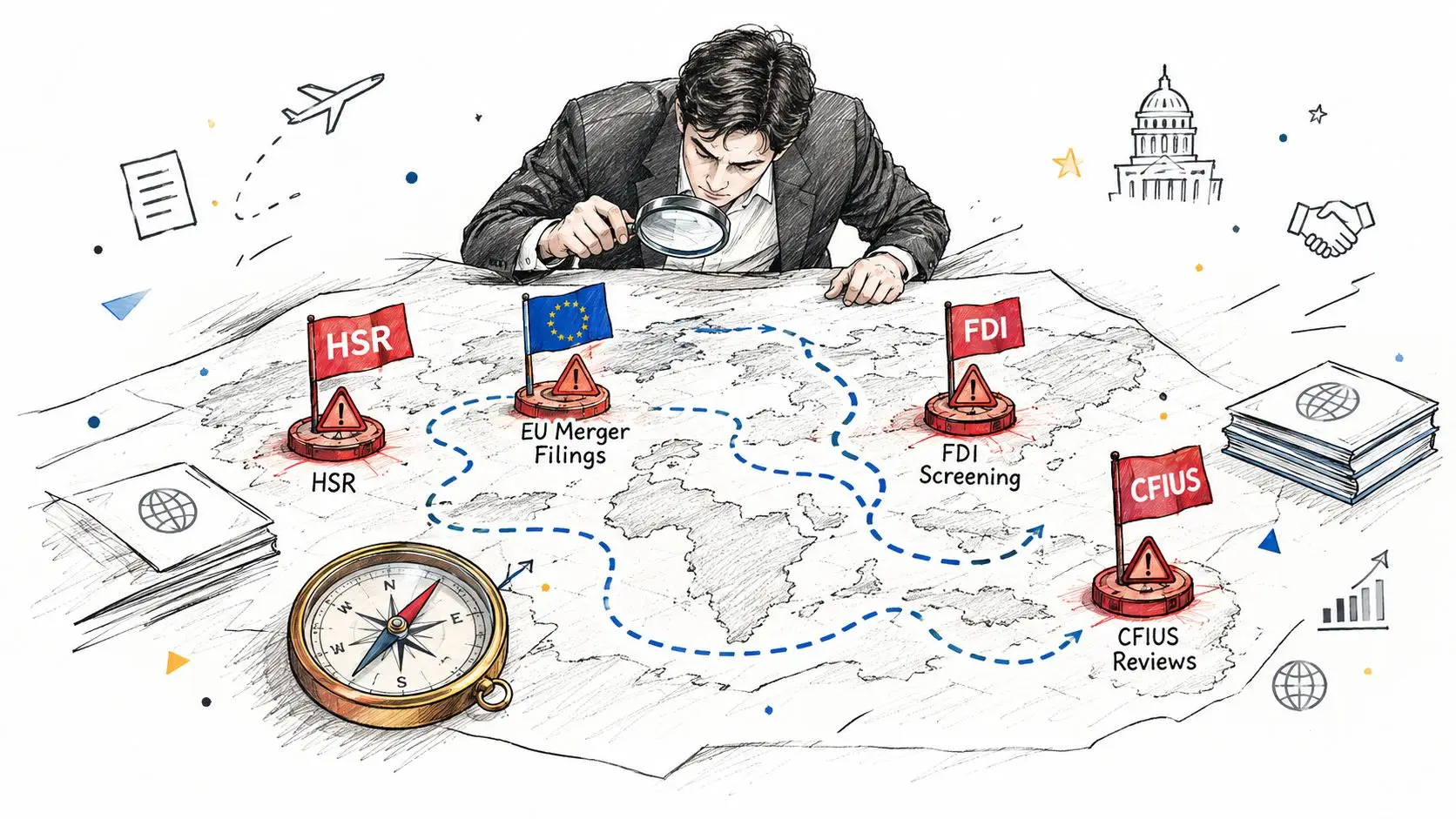
Cross-border exits fail when the transaction team treats regulatory review as a closing formality. Counsel should map filing, screening, tax, employment, and data issues before the parties sign a term sheet.
Regulatory clearance
Map HSR and European Commission merger filing issues where applicable. Then assess foreign investment screening in the United Kingdom, Germany, and France. A U.S. transaction may also require CFIUS analysis, particularly where sensitive technology, personal data, or critical infrastructure creates jurisdictional exposure.
Antitrust remedies can extend the timeline beyond six months. The parties should therefore agree on a pre-filing strategy, information-sharing protocol, remedy allocation, and long-stop consequences before signing.
AI, cybersecurity, sanctions, data, and supply-chain exposure deserve an early review. Buyers now examine these risks as part of the asset’s value and integration profile.
Tax architecture
Model the tax steps before signing. Review entity inversion risk, withholding tax on share transfers, participation exemptions, and any relevant U.S. elections, including 338(h)(10) and 336(e) treatment for eligible targets. Analyze the implications of moving IP before closing, including potential ATAD consequences.
The tax plan should distinguish seller proceeds from company-level taxes, withholding, escrow treatment, rollover equity, and earn-out payments. Founders should also confirm filing deadlines and penalty exposure across jurisdictions. A resource covering San Diego tax deadlines can help frame the administrative discipline required, although it can’t replace transaction-specific advice.
Employees and data
Review TUPE issues in Europe, WARN Act exposure in the United States, works council consultation duties, employee transfer terms, and founder immigration tied to the transaction. Confirm that privacy notices, data-processing agreements, security controls, and cross-border transfer mechanisms support the buyer’s intended use.
Finally, structure representations-and-warranties insurance and escrow with cross-border carve-outs. A policy that appears adequate in one jurisdiction may not cover fraud, tax, sanctions, cybersecurity, or fundamental representations elsewhere.
Communications, Stakeholders, and Closing Certainty
A transaction can collapse through careless communication. The founder should sequence disclosures according to legal rights, operational need, and negotiation strength.
Board and investors
Obtain board approval before signing where required. Confirm investor consent thresholds, information rights, protective provisions, drag-along mechanics, and transfer restrictions before granting broad data-room access.
The largest investor may deserve an early confidential briefing, but that briefing should follow a defined script. Share the strategic rationale, proposed consideration, process timetable, and unresolved issues. Don’t promise an outcome that remains subject to diligence or approval.
Employees, customers, and suppliers
Employees need accurate information at the appropriate stage. Premature disclosure can trigger attrition, internal speculation, and competing offers. Delayed disclosure can create legal problems where labor rules require consultation or notice.
Key customers and suppliers need reassurance when the transaction affects continuity, ownership, payment, data, or service delivery. The message should explain what changes, what remains stable, and who will answer operational questions.
Leaks and public statements
Prepare a leak protocol before the first rumor appears. Assign one spokesperson, preserve privilege, coordinate with public-relations advisers, and avoid inconsistent statements that could undermine representations or trigger market concerns.
Maintain a legal hold for relevant communications and documents. Preserve board materials, diligence responses, customer correspondence, employee notices, and regulatory submissions. This record protects the company when a buyer later claims that pre-signing statements were incomplete.
Closing certainty comes from controlled disclosure. Improvisation gives every stakeholder a different version of the deal.
The founder should also protect the signing-to-closing window. Coordinate regulatory filings, employee communications, integration planning, press timing, and consent collection through one written responsibility matrix. That matrix should identify the decision-maker, deadline, required document, and escalation route for every critical action.
Your Founder Exit Plan and Post-Close Risk Map
A founder needs a short execution plan that turns readiness into decisions. The plan should use checkpoints, not vague preparation goals.

T-90
At T-90, stand up the data room and launch the transaction process. Deliver a reconciled cap table, corporate authority file, financial package, IP dossier, contract review, employee file, tax analysis, and regulatory map.
Pause the process if the company lacks reliable financial records, cannot prove ownership of core IP, or has unresolved cap-table disputes. A buyer will treat those gaps as negotiation power.
T-45
At T-45, test the term sheet against net proceeds. Review cash, equity, earn-out conditions, escrow, indemnity exposure, working-capital mechanics, no-shop limits, reverse termination protection, tax allocation, and post-close employment terms.
Pause if litigation remains undisclosed, material consents remain uncertain, or the buyer’s valuation depends on assumptions that management cannot support. A signed term sheet doesn’t cure a diligence failure.
T-0
At signing, confirm every approval, disclosure schedule, closing condition, regulatory filing, escrow instruction, and employee communication. Verify that the agreement matches the business deal, particularly around control rights, reporting access, earn-out measurement, and post-close restrictions.
After closing, track the risks that founders often underestimate:
- Earn-out measurement: Require reporting access, defined accounting rules, and a neutral dispute process.
- Indemnity clawbacks: Monitor notice deadlines, baskets, caps, escrow releases, and defense rights.
- Retention dilution: Confirm who funds the retention pool and how dilution affects rollover holders.
- Transition services: Specify service levels, response times, credits, and termination rights.
- Personal liability: Review survival periods, fraud standards, guarantees, and insurance protection.
Complete personal hygiene as well. Update the will, arrange a D&O tail policy, document charitable giving intentions, and establish integration governance for the first 30 days after closing.
The recommended strategic path is to treat the exit as a managed legal project, not a celebratory event. RNC Group can coordinate Israeli and cross-border M&A work, founder and shareholder arrangements, commercial agreements, bank restrictions, and high-stakes disputes through a phased strategy focused on closing and post-close protection.
Founders should avoid costly mistakes by reviewing ownership, approvals, IP, tax, diligence, and post-close obligations before signing a term sheet. For specialized Israeli and cross-border exit planning, contact RNC Group and use its legal team to test the transaction before the buyer controls the process.
This article provides general information, not legal, tax, accounting, investment, or regulatory advice. Laws and transaction outcomes vary by jurisdiction and facts, so readers shouldn’t rely on this material without obtaining advice from qualified counsel familiar with the specific transaction.