
Can a CEO still rely on annual planning when 2026 regulations, sanctions exposure, cross-border banking friction, and transaction risk now move faster than board calendars? The serious answer is no.
Conventional strategy decks fail because they separate legal risk, commercial execution, and crisis response. That split is dangerous. In cross-border business, one blocked payment, one sanctions question, or one flawed acquisition structure can turn a growth plan into a containment exercise.
Is Your Strategy Ready for 2026 Regulations
Many leadership teams still treat strategic planning as a finance exercise with legal review at the end. That model is obsolete. Regulation now shapes deal design, counterpart screening, payment flows, and post-closing integration from day one.
The market itself confirms the shift. The global strategic advisory services market is valued at $153.72 billion in 2025 and is expected to reach $164.22 billion in 2026, with a projected $232.2 billion by 2030 according to Research and Markets on the strategic advisory services market. Companies do not spend at that scale on optional insight.
Why old planning fails
Traditional plans assume three things that no longer hold.
- Stable regulation: Cross-border operations now face shifting disclosure, sanctions, banking, and enforcement expectations.
- Linear execution: A transaction can stall because the legal structure, not the economics, triggers extra scrutiny.
- Separable functions: Strategy, M&A, disputes, and crisis management now overlap in real time.
A CEO should reject any framework that waits for a dispute before involving legal strategy. By then, negotiating power has already deteriorated. The board receives a problem that should have been prevented during market entry, partner selection, or deal structuring.
What boards should demand now
A serious 2026-ready strategy must answer five questions before expansion begins.
- Which jurisdictions create the highest regulatory friction
- Which banking channels could fail under stress
- Which counterparties create sanctions or reputational exposure
- Which deal terms become unenforceable or impractical across borders
- Which crisis path activates if the commercial relationship breaks down
A strategy is not credible if it cannot survive first contact with a regulator, a bank compliance team, or a hostile counterparty.
The practical implication is simple. Strategic advisory services should sit closer to the CEO and the board, not as a downstream procurement item but as a core control function. That is especially true when the business involves M&A, franchising, licensing, international trade, or politically sensitive markets.
Defining the Modern Strategic Mandate
A modern advisory team should operate like a corporate special forces unit. Internal management runs the business. Strategic advisors enter when the mission involves complexity, speed, and consequences that ordinary operating routines cannot absorb.

That description matters because many executives still confuse strategic advisory services with generic consulting. They are not the same. Generic consulting often diagnoses. Strategic advisory must also shape decision rights, escalation routes, legal positioning, and commercial advantage.
From compliance to intelligence
The strongest proof of this shift appears inside the professional services market. 94% of U.S. accounting and tax firms now offer advisory services, 63% consider advisory a key service line, and nearly 90% use client data analytics to identify opportunities and tailor recommendations, according to Wolters Kluwer on the shift from compliance to strategic advisory services.
That data signals a structural change. Routine compliance work has become less differentiating. Leaders now pay for interpretation, anticipation, and action.
Three consequences follow.
- First, compliance alone is insufficient. Filing correctly does not protect a company from a failed market entry or a frozen account.
- Second, data without judgment is weak. Analytics may flag anomalies, but counsel must translate them into contract terms, governance controls, and escalation decisions.
- Third, timing decides outcomes. An issue detected early is a negotiation matter. The same issue detected late becomes litigation risk.
What the mandate includes
A modern strategic mandate should cover:
- Forward risk detection: Advisors identify issues before they mature into disputes.
- Cross-functional alignment: Legal, finance, operations, and communications work from one risk map.
- Decision architecture: The board knows who approves, who escalates, and who documents.
- Outcome design: Teams define what success looks like before engagement begins.
This is why CEOs should stop buying advisory by résumé alone. They should buy it by decision utility. Can the advisor convert incomplete facts into a disciplined course of action under pressure? That is the ultimate test.
The right advisor does not merely explain risk. The right advisor reorganizes the company’s response before the risk hardens.
The Spectrum of Strategic Advisory Services
Strategic advisory services cover a wider field than most executives assume. Boards often ask for “strategy” when the true need is sharper. They may need a transaction architect, a regulatory mapper, a crisis coordinator, or a dispute support team that preserves negotiation strength.
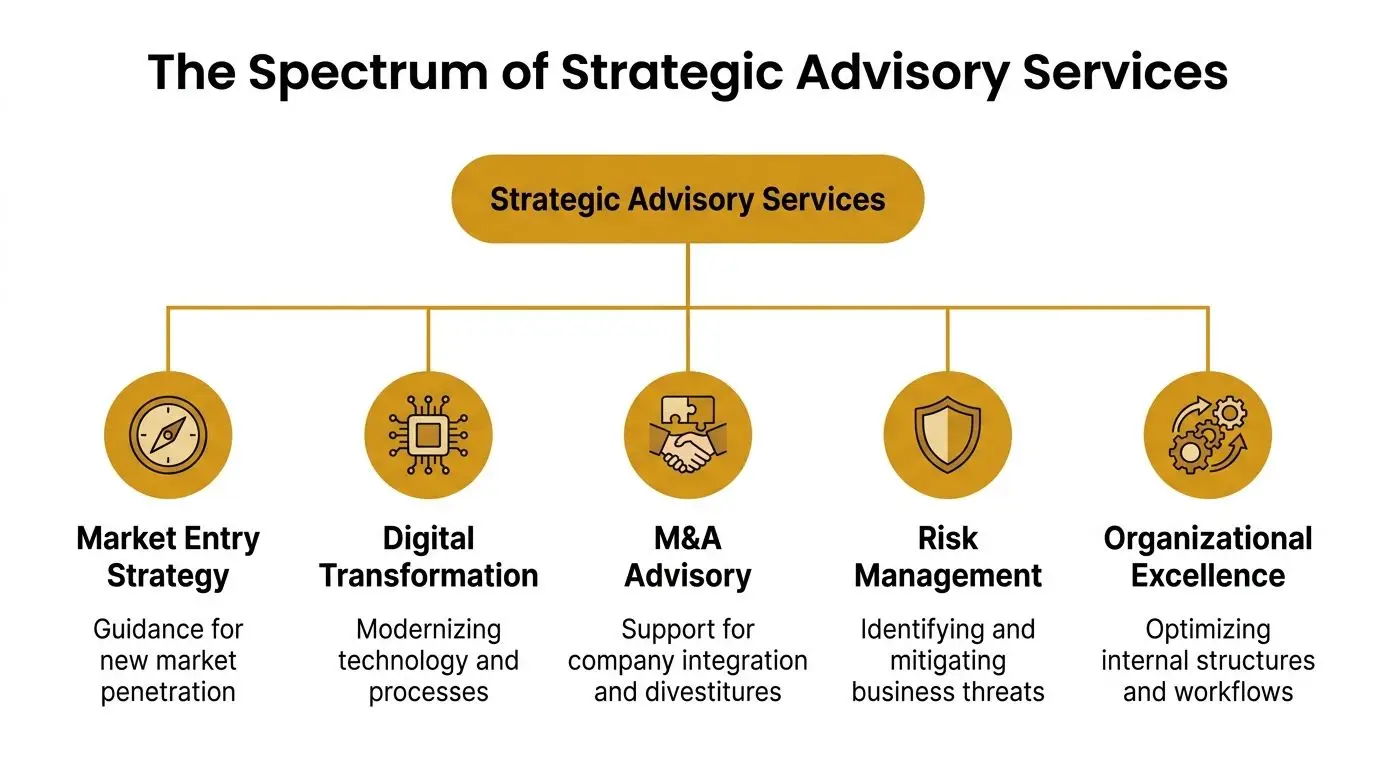
The categories below provide a practical taxonomy for CEOs making high-stakes decisions.
Commercial advisory
Commercial advisory focuses on business model resilience. It tests pricing logic, channel structure, exclusivity terms, distribution control, and incentive design across jurisdictions.
A common error is treating commercial terms as purely economic. They are legal instruments with operational consequences. If a contract rewards growth but ignores compliance burden, the company may create a profitable structure that becomes difficult to enforce.
Example. A franchise network uses commercial advisory to redesign royalty and territory mechanics before expanding into multiple foreign markets.
Legal advisory
Legal advisory translates business ambition into enforceable structure. It addresses governance, corporate form, shareholder rights, contractual architecture, and dispute positioning.
This category matters most when founders, investors, or regional partners have misaligned expectations. Strategic legal work should narrow ambiguity before money moves. It should not merely draft after the commercial deal is already fixed.
Example. A founder group uses legal advisory to revise a partnership agreement before entering a new jurisdiction with different control and liability norms.
Financial advisory
Financial advisory addresses value, exposure, and transaction discipline. It tests assumptions behind growth plans, restructurings, acquisitions, and distressed situations.
This work should connect tightly with legal and tax design. A deal can look attractive on headline value and still fail once banking restrictions, indemnity exposure, or post-closing friction enters the analysis.
Example. A buyer uses financial advisory to challenge revenue assumptions in an acquisition target before final pricing and closing conditions are set.
Regulatory advisory
Regulatory advisory maps the approval environment before execution begins. It reviews licensing, sector rules, reporting duties, sanctions exposure, and documentation requirements that can delay or derail a transaction.
Executives often treat regulation as a filing issue. That is a mistake. Regulatory design influences route-to-market choices, onboarding timelines, and even whether a target structure remains viable.
Example. A health-tech company uses regulatory advisory to choose a market entry structure that aligns with local licensing requirements.
Crisis and continuity advisory
Crisis and continuity advisory prepares the business for pressure events. It addresses account restrictions, reputational attacks, supply disruption, sanctions questions, management conflict, and communication discipline.
The strongest crisis work starts before the event. It creates escalation ladders, message control, privilege strategy, and operational continuity triggers. Without that preparation, executives improvise under scrutiny.
Example. An exporter uses crisis advisory to prepare a phased response if an overseas bank restricts transactional activity.
Market-entry advisory
Market-entry advisory helps management choose where and how to expand. It evaluates partner risk, entry sequencing, contractual safeguards, local enforcement realities, and the gap between formal law and actual business practice.
This service should never rely on market enthusiasm alone. Entry decisions require scenario testing. A market may look attractive until payment enforcement, repatriation, or political risk changes the equation.
Example. A software company uses market-entry advisory to compare direct sales, a distributor model, and a joint venture in a sensitive region.
M and A advisory
M&A advisory remains one of the most consequential categories because a deal magnifies every weakness already present in the target or the buyer. It covers diligence, valuation coordination, deal structure, representations, indemnities, closing conditions, and integration planning.
Boards should insist on integrated M&A analysis. Financial, legal, and operational diligence must feed one decision memo. Fragmented diligence creates false confidence.
The market context reinforces the point. In top-tier firms, M&A advisory often accounts for a significant portion of total strategic advisory revenue.
Example. A manufacturer uses M&A advisory to acquire a foreign distributor while protecting itself through staged consideration and detailed post-closing obligations.
Dispute resolution support
Dispute resolution support begins before a claim is filed. It assesses negotiating position, venue, contract language, evidentiary position, commercial alternatives, and the timing of escalation.
This category differs from pure litigation. The objective is not always to sue. Often the objective is to restore payment, preserve a transaction, pressure a counterparty into compliance, or isolate a problem before it infects a wider relationship.
Example. A company facing a breached supply agreement uses dispute support to build a negotiation record that strengthens settlement options without rushing into court.
How CEOs should use this taxonomy
A CEO should not ask for “general advisory.” That instruction invites vague output. Instead, management should identify the precise problem type, the time pressure, and the decision that must result.
Use this diagnostic grid.
| Advisory type | Primary question | Typical board concern |
|---|---|---|
| Commercial | Does the model work across markets | Margin erosion or weak control |
| Legal | Is the structure enforceable | Governance failure or contract exposure |
| Financial | Is the value thesis credible | Overpayment or hidden liabilities |
| Regulatory | Can the plan survive scrutiny | Delay, penalties, or blocked execution |
| Crisis and continuity | What happens under stress | Business interruption |
| Market-entry | Which route creates least friction | Failed expansion |
| M and A | Is this deal worth doing | Integration and liability risk |
| Dispute support | How should pressure be applied | Costly escalation |
The board should then commission only the advisory lane that serves the decision at hand, while keeping one integrated risk view across all lanes.
Engagement Models and Financial Benchmarks
Buying strategic advisory services badly is common. Companies either under-scope the work, overpay for vague access, or hire specialists too late. A disciplined procurement model avoids all three errors.
The operating backdrop supports flexible engagement. Consulting firms delivered 75% of their work remotely in 2020, and the sector employs approximately 1.5 million people globally, with strategic consulting accounting for 32% of the total consulting market, according to Fortune Business Insights on the strategic consulting market. Remote execution broadened access, but it also made weak scoping easier to hide.
Project-based mandates
Project mandates suit defined decisions. They work well for an acquisition, a sanctions review, a market-entry plan, or a single commercial crisis.
Their strength is clarity. The company buys a specific outcome, a timetable, and named deliverables. Their weakness is discontinuity. Once the project ends, institutional memory can dissipate unless handover is disciplined.
Retainer mandates
Retainers suit businesses facing recurring cross-border complexity. They fit executives who need frequent judgment calls on contracts, counterparties, escalation choices, or regulatory friction.
A retainer should never buy vague “availability.” It should buy structured access, response times, issue triage, and a defined governance rhythm. If the deliverables remain abstract, the retainer becomes expensive comfort.
Hybrid mandates
Hybrid models combine a standing advisory relationship with project-specific workstreams. This structure often works best for acquisitive companies, franchise groups, or exporters in volatile markets.
The hybrid model gives management continuity without forcing every major matter into the retainer scope. It also creates cleaner budgeting because recurring issues and exceptional matters are separated.
Strategic Advisory Engagement Models and Pricing
Because the verified data does not provide fixed fee ranges, responsible procurement should use pricing benchmark qualitatively rather than inventing numbers.
| Engagement Model | Best For | Common Deliverables | Pricing Benchmark |
|---|---|---|---|
| Project-based | Single transaction, market entry, or crisis | Due diligence summary, market analysis report, risk memo, negotiation roadmap | Usually fixed scope, fixed fee, or milestone-based pricing |
| Retainer | Ongoing cross-border decision support | Monthly issue review, escalation advice, contract oversight, board briefing support | Usually recurring monthly pricing tied to access and response framework |
| Hybrid | Businesses with recurring needs plus periodic major events | Baseline advisory plus special reports, deal support, crisis plans, implementation reviews | Usually recurring base fee plus separate project or success-linked components where appropriate |
What deliverables matter
Executives should stop buying slide decks with no operational consequence. The most useful deliverables change behavior, document exposure, or improve advantage.
The preferred list includes:
- Risk register: A live record of threats, owners, triggers, and response actions.
- Due diligence summary: A decision document, not a document dump.
- Escalation map: A sequence for negotiation, legal action, communications, and operational containment.
- Board memo: A concise paper stating options, downside, and recommendation.
- Benchmarking review: A comparison of the company’s contractual and governance terms against market standards.
If a deliverable cannot guide a decision, support a negotiation, or survive board scrutiny, it has little value.
Procurement recommendations
A CEO should insist on the following before signing any mandate:
- Defined scope: State the decision to be made, not only the topic area.
- Named outputs: Require specific documents, workshops, or approval memos.
- Governance cadence: Fix meeting frequency, escalation routes, and executive sponsors.
- Privilege and confidentiality rules: Cross-border matters demand early discipline.
- Exit terms: The company should know how the engagement ends and how knowledge transfers.
A factual market option deserves mention here. RNC Group provides integrated strategic consulting across crisis management, commercial negotiations, M&A, and international legal support, which makes it relevant for companies that need legal and strategic work to operate as one system rather than separate silos.
Navigating Cross-Border Challenges The Israel Nexus
What does a CEO do when a routine overseas transaction involving an Israeli company turns into a sanctions review, a banking delay, and a reputational problem in the same week?
Israeli companies face cross-border pressure in a more concentrated form than many of their peers. The issue is not ordinary expansion risk. It is the collision of legal exposure, payment friction, political scrutiny, and counterparties that start making decisions based on headlines as much as contracts.

Generic advisory models are poorly built for that reality. They usually separate legal work, crisis response, and transaction support into different streams. That is a mistake. For Israel-linked matters, those streams interact from day one. A delayed wire transfer can affect deal certainty. A compliance query can trigger board concern. A public allegation can harden a counterparty’s negotiating position before any claim is filed.
Our experience with Israeli founders, boards, and investors shows the same pattern repeatedly. The first visible problem is rarely the underlying problem. A bank asks for more information, but the underlying issue is sanctions sensitivity. A buyer slows diligence, but the underlying issue is internal committee anxiety about geopolitical optics. A distributor cites contract language, but the commercial driver is fear of becoming the next public example.
Key exposure points
The pressure points are predictable.
- Bank account blockages: Revenue may remain booked while cash becomes inaccessible or delayed.
- Counterparty hesitation: Partners seek revised terms, extra warranties, or a quiet exit.
- Jurisdictional mismatch: Israeli expectations on enforcement, disclosure, and negotiation style may not match local practice.
- Narrative risk: Media pressure, stakeholder complaints, and informal market chatter can alter negotiating advantage before a formal proceeding begins.
These matters should not be treated as isolated legal questions. They are command-and-control problems. The company needs one strategy across legal analysis, communications discipline, banking outreach, and transaction execution.
What a proper response looks like
Start with attribution. Determine whether the trigger is regulatory, reputational, contractual, political, or internal. If management misdiagnoses the source of pressure, every later step becomes more expensive.
Then protect room to maneuver. Preserve documents, centralize outbound communications, and stop executives from sending improvised explanations across jurisdictions. In sensitive cross-border matters, one careless email can undermine privilege, weaken settlement posture, or create a disclosure issue in parallel negotiations.
After that, sequence the response.
- Establish the facts fast: Identify the triggering event, the relevant jurisdictions, and the decision-makers on the other side.
- Set a single control team: Legal, finance, communications, and deal personnel should work from one agreed position.
- Engage in the right order: Banks, counterparties, regulators, and local counsel should hear a coordinated message, not competing theories.
- Escalate deliberately: Start with clarification and correction. Move to pressure only when the record, forum, and commercial objective are aligned.
In many Israel-linked disputes, the fastest route to resolution is neither immediate litigation nor passive accommodation. It is a coordinated pre-dispute strategy using legal correspondence, commercial negotiation, local counsel input, and disciplined external messaging. Used properly, that approach can resolve pressure before it hardens into a filed claim, a failed closing, or a frozen business relationship.
Why this niche requires integrated advisory
This niche rewards firms that can combine legal architecture, crisis management, and M&A judgment in one operating model. CEOs do not need three separate advisors giving partially consistent advice. They need one senior team that understands how a sanctions query can affect financing, how a reputational issue can alter valuation, and how a diligence point can become a closing risk.
That is particularly true in cross-border M&A involving Israeli shareholders, foreign acquirers, offshore holding structures, and lenders with heightened compliance screens. The weak point in the deal is often not the SPA. It is the interaction between approvals, payment channels, disclosure strategy, and external perception.
A proper advisor identifies that weak point early and manages it before the issue spreads. That is where integrated strategic advisory earns its keep.
Actionable Risk Mitigation Strategies for 2026
The strongest strategic advisory services follow a disciplined method. Improvisation is not strategy. It is only delay with better language.

A practical framework appears in the four-phase methodology described by BDO on strategic IT advisory services. It includes assessment and analysis, S.M.A.R.T. goal establishment, production of deliverables such as risk registers and benchmarking studies, and ongoing KPI performance measurement. That method works well beyond technology. It fits legal, M&A, crisis, and cross-border governance.
Phase one assessment and analysis
Start with a hard diagnostic. Management should gather both quantitative and qualitative information on operations, counterparties, governance, contracts, and jurisdictional exposure.
The analysis should include:
- SWOT review: Not as a workshop ritual, but as a decision filter.
- Exposure mapping: Contracts, partners, banks, and regulators by jurisdiction.
- Decision bottlenecks: Who slows approvals or obscures accountability.
- Past incidents: Small failures often preview larger ones.
This phase should end with a concise assessment report. If the report cannot identify the company’s top strategic vulnerabilities, the assessment was superficial.
Phase two S.M.A.R.T. goals
The second phase forces discipline. Goals must be specific, measurable, achievable, relevant, and time-bound.
Boards should frame goals around outcomes such as:
- reducing avoidable transaction delay,
- tightening approval controls for cross-border contracts,
- strengthening sanctions and banking response protocols,
- improving post-acquisition integration governance.
The planning horizon should remain long enough to matter but specific enough to manage. A vague ambition to “expand safely” is not a strategic objective.
Phase three tangible deliverables
This phase converts strategy into operating tools. Executives need documents that teams can use under pressure.
Priority deliverables include:
- Risk register
- Gap analysis matrix
- Modernization or implementation roadmap
- Benchmarking study
- Executive assessment report
Each deliverable should assign ownership. Without named accountability, the document becomes an archive item rather than a management instrument.
Phase four KPI performance measurement
The final phase keeps the strategy alive. KPI tracking should test whether management corrected the vulnerabilities identified earlier.
Good KPI practice asks practical questions.
- Are approvals faster and cleaner
- Are counterparty risks reviewed before commitment
- Are escalation triggers understood by management
- Are cross-border disputes identified earlier
The specific metrics will vary by company. However, the principle is fixed. Measure what predicts failure, not only what reports activity.
CEOs should review strategic risk indicators with the same seriousness they give financial reports.
What to do in the next quarter
A board that wants real risk reduction should complete the following actions within the next operating cycle:
- Commission a cross-border risk assessment covering contracts, counterparties, and payment channels.
- Set three to five board-level objectives tied to execution, not aspiration.
- Create a live risk register with owners and escalation thresholds.
- Benchmark key agreements against the standards used in target markets.
- Install a review cadence so issues surface before they become external events.
This is the practical path into 2026. Not more theory. Better structure.
An Operational Checklist for Commissioning Services
Most advisory failures begin before the engagement starts. The company buys a label instead of a capability. It asks for “support” when it should demand a result.
A CEO should treat the commissioning process as a strategic control exercise. The brief, the scope, and the governance terms will shape the value received long before the first memo arrives.
Questions the board must answer first
Before approaching any advisor, management should answer these internal questions:
- What decision must be made: Expansion, restructuring, acquisition, dispute containment, or crisis response.
- What would failure look like: Delay, blocked funds, unenforceable contracts, reputational damage, or a collapsed deal.
- Who owns the mandate: CEO, general counsel, CFO, board committee, or special situation team.
- What information already exists: Contracts, term sheets, compliance files, board minutes, and incident records.
- What timing controls apply: Financing deadlines, regulatory windows, renewal dates, or litigation risk.
If these points remain unclear, the advisor will spend valuable time diagnosing internal confusion rather than solving the underlying problem.
What to demand from the advisor
The firm under consideration should provide a disciplined answer on method, deliverables, and escalation approach.
Use this checklist during selection.
| Selection issue | What good looks like | Warning sign |
|---|---|---|
| Scope | Clear definition of the decision and workstream | Broad promises with no boundaries |
| Deliverables | Named outputs with decision value | Generic presentations |
| Cross-border capability | Practical handling of multi-jurisdiction issues | Purely domestic framing |
| Crisis readiness | Sequenced escalation logic | “We litigate if needed” as the only answer |
| Commercial awareness | Advice tied to business realities | Legal analysis detached from operations |
| Governance | Regular reporting and executive ownership | No cadence or approval path |
Common procurement mistakes
Executives repeat the same errors.
- Buying prestige instead of fit: A famous name does not guarantee usable advice in a niche cross-border crisis.
- Under-defining success: If no KPI or decision outcome exists, satisfaction becomes subjective.
- Separating legal from strategic work: This creates contradictory recommendations.
- Ignoring implementation: Advice without owners, timing, and escalation rules rarely survives contact with operations.
The commissioning sequence that works
The recommended strategic path is straightforward.
- Write a one-page mandate. State the issue, objective, timeline, and board sponsor.
- Request a proposed workplan. It should identify phases, outputs, and decision points.
- Stress-test assumptions in the pitch. Ask how the advisor would respond if banking, sanctions, or counterparty behavior changes mid-matter.
- Fix communication rules. Define who receives drafts, who approves strategy, and how urgency is escalated.
- Require a closing protocol. The engagement should end with a handover, not a loose conclusion.
The right commissioning process reduces advisory risk before the substantive work even begins.
The central principle is simple. Strategic advisory services should help management act with more control, not more dependency. If the engagement leaves the company with clearer governance, stronger documents, and faster escalation judgment, it worked. If it produced only polished language, it failed.
RNC Group may be a relevant option for companies that need legal, crisis, and M&A advisory integrated into one cross-border strategy, particularly where Israeli exposure, banking friction, sanctions sensitivity, or international commercial disputes require a phased escalation model rather than isolated legal opinions. Contact us now to find out how to do it right.
Disclaimer: The information provided in this article is for informational and educational purposes only and does not constitute binding strategic, legal, or business advice. Managing cross-border risks in 2026 requires a specific analysis of shifting regulations, international sanctions, and local banking restrictions. Any reliance on the content presented is at the user’s sole risk; this information should not be seen as a substitute for professional consultation with qualified authorities familiar with the specific circumstances of each case.