
A contract rarely becomes dangerous when the relationship collapses. It becomes dangerous when management decides to exit quickly and assumes the law will catch up later. For a non-Israeli CEO dealing with an Israeli counterparty, that assumption can turn an orderly business decision into a cross-border claim for wrongful termination.
The smarter question in 2026 isn’t whether a company can walk away. It’s whether the exit route was built into the contract, the facts, and the paperwork before the notice went out. A company that wants to terminate contract without breach needs discipline, timing, and a jurisdiction-aware strategy.
Is Your Contract Exit a Strategy or a Gamble in 2026
Most executives begin in the wrong place. They look for misconduct, poor performance, or a business disappointment that might justify an aggressive termination. In high-value international contracts, that approach usually increases noise before it builds influence.
The contract is the first source of truth. If the agreement gives one party an express right to terminate on notice without alleging fault, management should treat that clause as an operational tool, not as boilerplate. In major commercial markets such as the US, UK, and Israel, termination for convenience has become a standard feature in large-value contracts, and a Goldberg Law Group survey on contract-reading behavior found that 26% of individuals had been surprised by early termination fees and 23% were unaware of automatic renewal terms.
That matters because many disputes begin with misunderstanding, not bad faith. A non-Israeli company reviewing a partnership agreement with an Israeli distributor, franchisee, or service provider should first isolate every clause dealing with duration, renewal, notice, payment at exit, transition duties, exclusivity unwind, and governing law.
Start with the contract, not the dispute
A clean exit starts with a document review that answers four questions:
- Who holds the exit right. Some contracts give only the customer, licensor, or principal the right to exit without cause.
- When the right can be used. The clause may apply only after an initial lock-in period or before an auto-renewal date.
- How notice must be delivered. Email may be permitted, but some contracts still require courier, registered mail, or delivery to a named officer.
- What the exit costs. The contract may require payment for completed work, committed inventory, demobilization, or transition support.
Practical rule: If the business team says the other side “already knows” the relationship is ending, legal risk has already increased. Contracts usually care about formal notice, not commercial atmosphere.
The executive mistake that creates avoidable exposure
The common executive instinct is to frame the exit as a response to “underperformance” without testing whether that language triggers a fault-based dispute. That can be a serious error. Once termination language sounds accusatory, the counterparty often responds with a breach narrative, document preservation, and a claim for damages.
The stronger path is more controlled. If an express no-fault exit exists, the company should use it precisely as drafted. If it doesn’t, management should avoid improvisation and assess whether another legal doctrine or a negotiated separation offers a lower-risk result.
A calculated exit isn’t dramatic. It’s engineered.
Assessing Contractual Termination Rights
The first serious review should focus on whether the agreement contains an express termination for convenience clause. That clause is usually the clearest legal route to terminate contract without breach. However, it only works if the company follows it exactly.
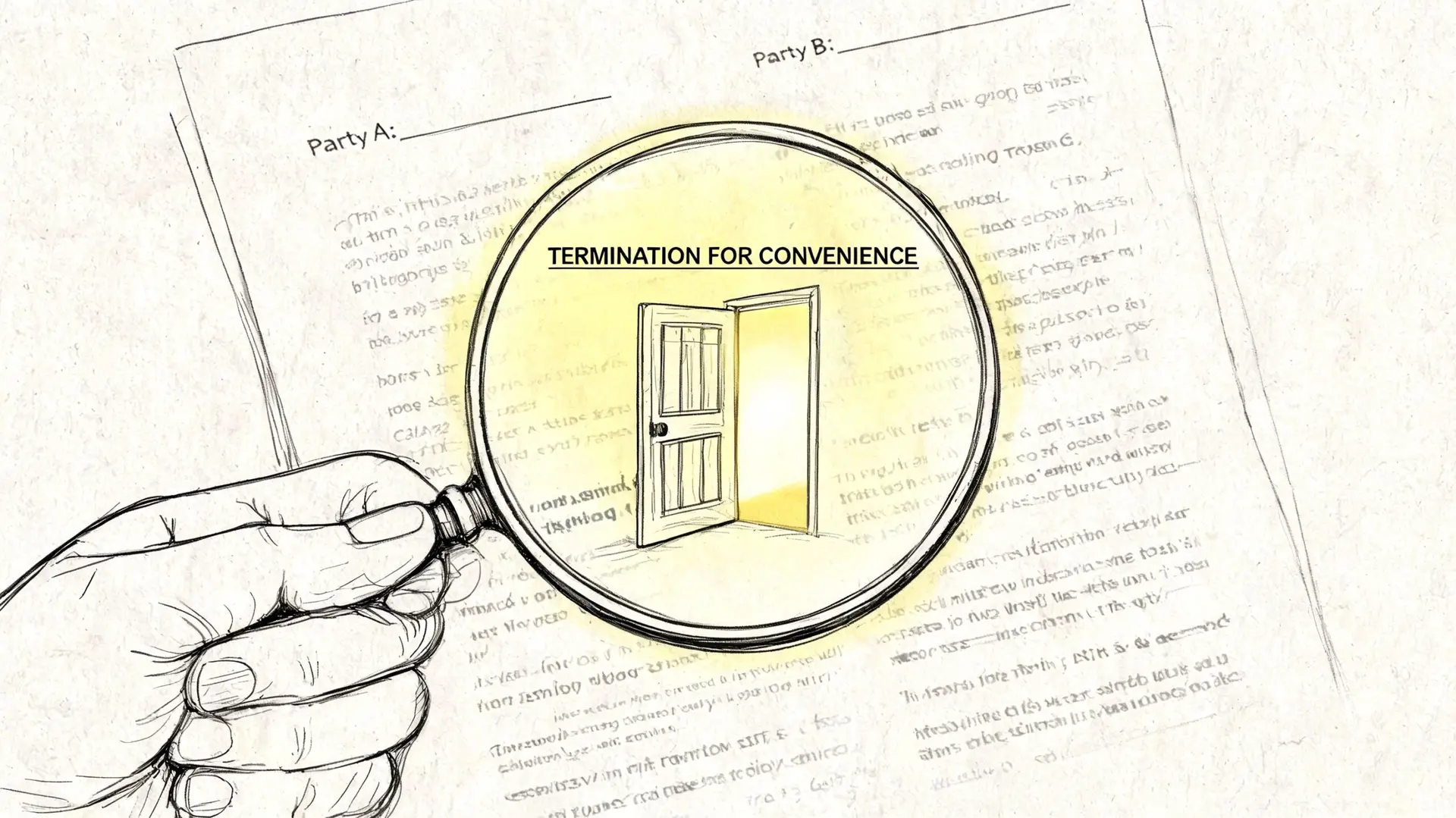
Across common law jurisdictions, these clauses remain uncommon in ordinary domestic agreements. An Osler analysis of termination for default or convenience states that they appear in fewer than 15-20% of standard commercial agreements, and even minor procedural defects can invalidate the notice.
What to examine in the clause
The review should be technical, not impressionistic. A valid clause often includes conditions that look administrative but carry decisive legal effect.
| Issue | What management should check |
|---|---|
| Trigger | Is termination available at will, on notice, or only after a stated event or period? |
| Notice | Does the clause require a specific form, addressee, language, or delivery method? |
| Timing | Is there a waiting period before termination becomes effective? |
| Payment | Must the company pay accrued fees, approved costs, inventory, or wind-down expenses? |
| Transition | Does the exiting party owe handover support, data transfer, or continued service for a limited period? |
A small drafting detail can defeat the entire exercise. If the contract says notice must go to the counterparty’s registered office and CFO, a message to the commercial manager may be useless. If the clause requires notice in Hebrew and English, a one-language notice may invite challenge.
Precision beats commercial intuition
In such situations, legal drafting discipline matters more than business frustration. Executives often focus on whether the exit is “fair.” Courts and arbitrators usually start with whether the process complied with the contract.
That’s especially true in agreements with layered annexes, amendments, and order forms. A framework agreement may contain a convenience clause, while a later schedule narrows it or adds a minimum term. In franchise, licensing, management, and service contracts, exit rights often sit beside renewal and exclusivity language that changes their practical effect. That’s also why a careful review of the elements of a legally binding contract can help management separate enforceable obligations from assumptions carried over from negotiations.
If the termination right exists, the dispute usually shifts from “can we exit” to “did we execute the exit correctly.”
What works and what fails
What works is simple. A company identifies the exact clause, maps each procedural step, calculates the payment consequences, and sends notice only after all internal approvals and supporting records are aligned.
What fails is also predictable:
- Mixing causes. The notice says “for convenience” but then accuses the counterparty of failures.
- Using the wrong address. Notice goes to the operational contact instead of the contractual notice recipient.
- Ignoring settlement mechanics. Management sends notice without calculating what must be paid on exit.
- Forgetting related documents. A side letter, renewal amendment, or purchase commitment limits the supposed exit right.
For non-Israeli corporations, this clause-by-clause discipline matters even more when the governing law, performance location, and enforcement forum don’t sit in the same country.
Alternative Legal Grounds for a No-Fault Exit
When the contract contains no express convenience clause, the legal situation changes immediately. The company is no longer exercising a clear contractual option. It’s trying to identify another lawful basis to end the relationship without turning the exit into a wrongful repudiation claim.
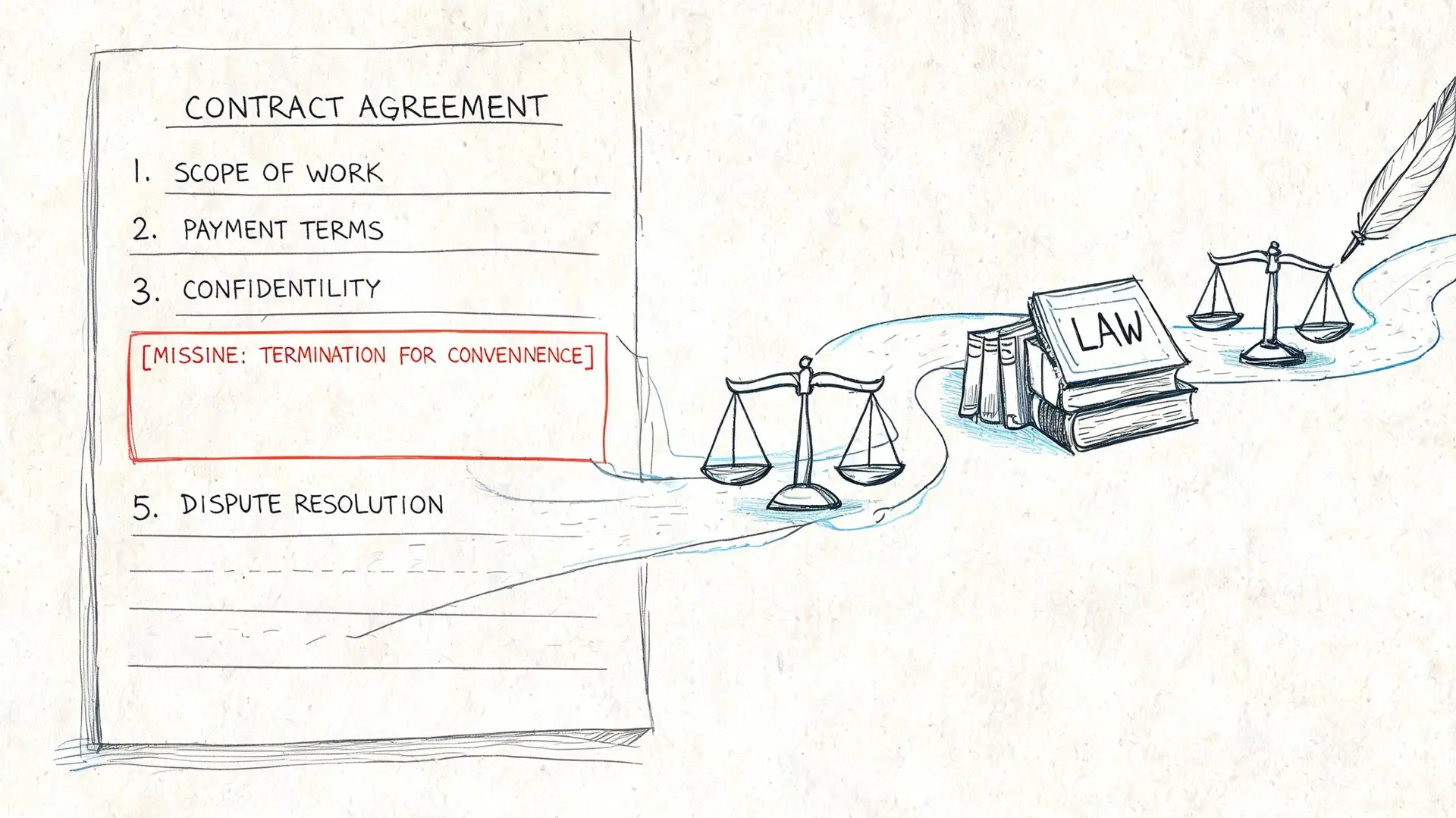
A key unresolved issue in practice is cross-border timing. A Sirion discussion of contract termination gaps identifies a critical uncertainty when parties operate across the UK, EU, Israel, and US without explicit convenience clauses. The question is how courts assess a no-fault termination that arrives immediately after breach discovery, and whether the timing reflects genuine commercial necessity or a strategic relabeling of a fault dispute.
The three doctrines management usually tests
The first alternative is frustration of purpose. This doctrine may apply where an unforeseen event destroys the contract’s underlying commercial foundation or makes performance radically different from what the parties agreed. It isn’t a safety valve for ordinary regret, margin pressure, or a difficult commercial relationship.
The second is force majeure. Unlike frustration, this usually depends on the wording of the clause. A force majeure provision may suspend performance, require mitigation, trigger renegotiation, or permit termination after a prolonged disruption. Companies often overstate its reach. If the clause covers delay but not permanent exit, the company may still need a negotiated solution.
The third is a change-in-law mechanism. In regulated sectors, this can be the most practical route. If a new legal requirement makes performance illegal, substantially more burdensome, or incompatible with licensing and compliance obligations, the exit may be contractually or legally justified. The key is to tie the regulatory change to the specific obligations affected.
Why negotiation usually beats doctrinal combat
These doctrines can bolster a position, but they rarely produce a clean result on their own. They’re fact-sensitive, jurisdiction-specific, and often expensive to test in court or arbitration. That’s why the recommended strategic path is usually negotiated separation before formal legal escalation.
A disciplined no-fault negotiation often moves through these phases:
- Internal legal qualification. Confirm the company’s strongest non-breach basis for requesting an exit.
- Commercial framing. Present the issue as a business realignment, regulatory shift, or operational change.
- Controlled outreach. Open discussions without admissions that undermine future legal positions.
- Settlement architecture. Convert uncertainty into agreed payments, transition support, releases, and confidentiality.
A weak legal doctrine can still support a strong commercial settlement if the company uses it carefully and documents its rationale.
Strategic timing matters
The biggest error here is opportunism without evidence. If a company discovers a breach, decides not to address it, and then sends a “no-fault” termination notice days later, the timing may look tactical rather than neutral. That doesn’t mean the exit is invalid. It means the documents must show a genuine business basis independent of fault.
Management should preserve board notes, compliance analysis, financial review materials, and communications that explain why continued performance became commercially or legally unsuitable. In cross-border Israeli matters, that discipline often decides whether the exit looks strategic and lawful or evasive and unstable.
The Playbook for Tactical Negotiation and Settlement
Most successful exits aren’t won in a hearing room. They’re built in a negotiation process that gives the other side a rational reason to sign. When the company wants to terminate contract without breach, the objective isn’t to “win the argument.” It’s to close the file with finality.
Phase one builds leverage before contact
Before any outreach, management should complete an internal exit memorandum. That document should state the contractual basis, fallback legal theories, payment exposure, operational dependencies, data transfer issues, and reputational risks.
The company should also define its settlement ceiling and its essential terms. If the counterparty controls key know-how, customer access, inventory, software credentials, or regulated interfaces, those issues must be mapped before the first call.
A practical internal checklist helps:
- Financial map. Calculate accrued obligations, disputed invoices, inventory exposure, and likely transition costs.
- Operational map. Identify what must continue temporarily after notice, including systems access, customer communications, and handover dependencies.
- Litigation map. Review forum, governing law, interim relief exposure, and whether the other party has an advantage through publicity or injunction risk.
Phase two controls the first message
The first communication should reduce defensiveness. It should sound deliberate, commercial, and measured. It shouldn’t accuse unless the company is intentionally starting a fault-based dispute.
That opening usually works best when it does three things. It identifies the contractual or business basis for reassessment, proposes a structured transition discussion, and avoids inflammatory labels. It also helps to designate one business lead and one legal lead, so the message stays consistent.
Executive note: Silence after internal decision-making is dangerous. Delay creates mixed performance, contradictory emails, and waiver arguments.
Phase three converts uncertainty into signed terms
The negotiation itself should focus on certainty, not moral victory. Many counterparties will accept a managed exit if they receive clarity on payment, timing, and release from future ambiguity.
A useful structure looks like this:
| Negotiation topic | Preferred outcome |
|---|---|
| Effective date | Fixed date tied to notice and transition milestones |
| Final payments | Defined sums or a clear calculation method |
| Work in progress | Agreed treatment of partial deliverables and approvals |
| Transition support | Limited duties, short timetable, named contacts |
| Claims | Mutual release, with narrow carve-outs if needed |
| Reputation | Confidentiality and neutral external communications |
The legal notice and the settlement document should be drafted together, even if they are signed later. If those documents conflict, the counterparty will use the inconsistency. If they align, the company controls the narrative and the risk.
Drafting Effective Notices and Exit Agreements
A termination strategy becomes real only when it is documented with precision. Many disputes that look substantive prove to be documentary failures. The party had a plausible exit route, but the notice was defective, premature, inconsistent, or incomplete.
The modern importance of this drafting discipline has deep roots. The RJO article on public contract termination practice explains that the move toward widespread contractual termination for convenience accelerated from the 1980s onward, particularly in government procurement, and then spread into private-sector templates as a core risk-management tool.
What a strong notice must contain
A proper termination notice should do only what it needs to do. It should identify the agreement, state the contractual provision or legal basis relied upon, specify the effective date, and confirm any immediate next steps required by the contract.
It shouldn’t include argumentative history unless that history is legally necessary. It also shouldn’t mix convenience language with broad accusations unless counsel has decided to preserve a parallel fault case.
A disciplined notice usually covers:
- Contract identification. Full agreement title, date, parties, and relevant amendment references.
- Legal basis. The exact clause or doctrine relied upon, stated clearly and accurately.
- Effective timing. The notice date, the contractual notice period, and the effective termination date.
- Post-notice conduct. What work continues, what stops, and what transition steps follow.
- Reservation language. Limited rights preservation where appropriate, without overcomplicating the letter.
The settlement agreement does the real protective work
If the notice starts the exit, the Termination and Settlement Agreement finishes it. That document should eliminate ambiguity on money, deliverables, intellectual property handover, access credentials, confidentiality, and future claims.
This is one area where process tools can help, provided lawyers supervise the final text. Teams that use templates or AI-powered legal contract creation can improve consistency in first drafts, but exit documents still need line-by-line legal review because small drafting choices can alter release scope, tax treatment, and enforceability.
The best settlement agreement is not the longest one. It’s the one that leaves no commercial issue unresolved after signature.
Executive checklist before signature
For management and in-house counsel, the final review should be mechanical:
- Confirm the notice clause and delivery method.
- Check names, company numbers, and signing authority.
- Reconcile the notice date with the effective date.
- Match payment terms to finance approval.
- Attach or identify all schedules, including handover items.
- Align confidentiality, release, and governing law clauses.
- Control external messaging to customers, distributors, and staff.
If any one of those points remains open, the company doesn’t yet have a finished exit. It has a draft dispute.
Risk Mitigation and Israeli Cross-Border Strategy
Is your planned contract exit built to survive an Israeli injunction application, a multilingual evidence fight, and a board review six months from now?
The legal basis for termination matters. Execution matters just as much. In cross-border matters involving Israel, I often see foreign CEOs focus on the governing law clause and underweight the practical pressure points that decide whether an exit stays commercial or turns into litigation. Those pressure points usually sit in Israel: witnesses, operating teams, source materials, inventory, payment flows, and market relationships.
Why no-fault exits often outperform breach allegations
A breach-based termination can feel more forceful. It also creates a wider attack surface.
Under legal systems influenced by English common law, a party that terminates for breach without solid grounds can find itself accused of wrongful termination or repudiation. The Gunnercooke analysis of termination disputes in construction contracts illustrates the point. Parties often misjudge whether the alleged breach is serious enough to justify termination at all. For an international company trying to exit cleanly, that is a poor place to create uncertainty.
A no-fault route usually gives management better control. It narrows the factual fight, reduces the need to prove intent or materiality, and leaves more room to settle on money and transition mechanics instead of spending months arguing about blame.
The Israeli angle changes the risk profile
Israel adds a layer of legal and operational complexity that foreign management teams should address early, not after notice is sent. The contract may be governed by New York or English law, but the practical contest can still be shaped by Israeli conduct rules, Hebrew-language communications, local court applications, and the statutory duty to act in good faith in contract performance and enforcement.
That good-faith overlay matters. Even where the agreement gives a clear termination right, an aggressive rollout can still create avoidable arguments if the company withholds information selectively, changes its stated rationale, blocks handover unreasonably, or uses the exit as pressure unrelated to the contract. Israeli law does not erase the contract. It can affect how conduct is judged around the contract.
For a foreign CEO, the point is simple. The contract sets the framework. Israeli doctrine can still influence how a judge or counterparty evaluates the way the company used that framework.
Five Israeli-specific risks that should shape the exit plan
Governing law and enforcement may split
The contract may point to London, New York, or arbitration, while the business pressure sits in Tel Aviv, Haifa, or Be’er Sheva. If the counterparty’s staff, systems access, inventory, or customer-facing operations are in Israel, local proceedings for interim relief can matter before the main forum reaches the merits. Strategy should be built around both the merits case and the enforcement reality.
Hebrew and English records often diverge
Cross-border teams commonly negotiate in English and perform in Hebrew. Problems arise when the formal notice uses one legal theory, internal emails describe another, and the Hebrew version of an amendment says something slightly different from the English version. Those inconsistencies give the counterparty room to argue pretext, waiver, or bad faith.
Israeli commercial networks are dense
A disputed exit can affect far more than the named counterparty. Distributors, founders, lenders, regulators, and future partners often know each other or share information quickly. That does not mean a company should avoid termination. It means the legal step, the business message, and the operational handover should be coordinated from the start.
Interim applications can change leverage fast
A weak final case can still create immediate disruption if the other side seeks temporary relief tied to software access, customer lists, shared facilities, or stock control. By the time management sees the application, the issue may no longer be whether termination was valid. It may be whether the business can keep operating next week.
Multi-jurisdiction legal teams need one command structure
Parallel advice from Israel, the UK, the EU, and the US can help or hurt. It helps when one team controls the theory, chronology, and notice language. It hurts when each adviser drafts for a different audience and no one reconciles the record. In these matters, inconsistency is expensive.
A board-level framework for decision making
I advise executives to test the exit against three questions.
First, is the legal route stable? That means more than identifying a clause. It means checking whether notice mechanics, cure periods, renewal provisions, side letters, pricing adjustments, and prior conduct support the chosen exit path.
Second, can the business absorb the transition? Management should know who controls customer contact, data, stock, passwords, regulatory filings, and local communications on day one after notice.
Third, will the file hold up under immediate scrutiny in Israel or elsewhere? That includes translations, board approvals, signing authority, payment readiness, document retention, and a consistent explanation of why the company acted when it did.
A simple matrix helps:
- Low legal certainty, high operational urgency. Push for a negotiated separation, short standstill, or phased disengagement.
- High legal certainty, moderate operational dependency. Serve notice with a settlement package and a handover protocol ready to issue the same day.
- Mixed forums, sensitive market exposure. Freeze messaging, preserve evidence, align Israeli and foreign counsel, then decide whether speed or containment matters more.
The best exit strategy is the one that still looks disciplined after translation, disclosure, and hostile review.
What a workable cross-border strategy looks like
For non-Israeli companies, the strongest approach is sequential.
Start with the full contract set, not just the signature version. Review amendments, purchase orders, side letters, auto-renewal language, exclusivity commitments, and any course of dealing that may have modified the commercial reality.
Then stress-test the forum picture. Identify where a claim may be filed, where urgent relief may be sought, where the counterparty has assets, and where your company is exposed operationally. Those are not always the same place.
After that, build the evidentiary record in both substance and language. If key documents are in Hebrew, get them reviewed before the notice goes out. If commercial staff have been using informal terminology, align the internal and external narrative before anyone sends another email.
Only then should the company finalize notice, settlement terms, handover steps, payment mechanics, and communications protocol. That sequencing reduces the risk of accidental breach, preserves its advantage in negotiation, and puts the company in a stronger position if the other side chooses to fight.
Disclaimer: This article provides general information only and does not constitute legal advice. Specific outcomes depend on the contract language, governing law, facts, and procedural posture of each matter. Readers should obtain qualified legal advice before acting on any termination strategy.