
A licensing agreement is a legally enforceable contract that lets a licensor allow a licensee to use intellectual property under specified conditions. In mature markets, that contract is rarely just permission, because it is also a tool for risk allocation and recurring revenue capture.
A well-drafted license decides who controls the asset, where the licensee can operate, how the licensor gets paid, and how fast the deal can end if the commercial logic breaks down. That is why the practical answer to what is a licensing agreement is more demanding than the dictionary version.
Why Licensing Agreements Are More Than Permission Slips
A licensing agreement can look simple on paper, but the commercial stakes are usually high. One side wants market access, and the other side wants to keep ownership while monetizing the asset. If the drafting is loose, the licensee can end up with more control than the licensor intended.
That matters because licensing is a major commercial channel, not a side arrangement. A fact-checked industry summary estimated the global licensing industry at $267 billion in 2022 with 5.2% CAGR growth from 2017 to 2022, while another market source reported global sales of licensed merchandise and services at $356.5 billion in 2023 with a 4.6% year-over-year increase. The same summary said 75% of licensing agreements generate revenue through royalties, which shows why these contracts are built to produce ongoing value, not just one-off access payments. Investopedia’s licensing overview
The real function of the contract
A license converts ownership into controlled commercialization. The licensor keeps title to the intellectual property, while the licensee gets permission to use it within defined limits. Those limits decide whether the deal opens a single sales channel or shifts commercial power across an entire market.
Practical rule: if a clause can change who controls the market, it is not a housekeeping term.
That is why a licensing agreement often acts as both a defensive shield and a commercial weapon. It protects the asset, but it also determines how the asset earns.
Why this matters for cross-border business
Foreign companies entering Israel often assume the contract language will travel cleanly from one legal system to another. It usually does not. Territory, enforcement, quality control, and termination rights all need local treatment, especially when the license supports brand expansion or manufacturing abroad.
For a wider commercial context, Kons Law’s business licensing resources show how often licensing issues overlap with broader transactional drafting. The useful lesson is simple. If the deal controls access to a brand, product, or technology, the contract controls the business outcome.
Understanding the Core Concept Behind Licensing Agreements
A licensing agreement splits ownership from use, and that split is the source of its commercial value. The licensor keeps title to the intellectual property, while the licensee receives a defined right to use it for agreed consideration. In practice, the agreement is less a permission slip than a risk-allocation tool that decides who may exploit the asset, on what terms, and with what limits.
How the relationship works in practice
The licensor does not transfer the asset itself. It authorizes the licensee to use patents, trademarks, copyrights, trade secrets, know-how, or business processes under stated conditions. In technology licensing, those conditions usually address the subject matter, scope of rights, field of use, territory, duration, sublicensing rights, and financial terms such as royalties, minimum payments, and reporting obligations. ICERTIS on licensing agreement basics
Those limits matter because they define the commercial footprint of the asset. A license can permit making, using, selling, copying, distributing, or modifying technology in a specific region and period, while the licensor still preserves ownership and enforces boundaries through exclusivity, derivative-rights, future-version, maintenance, and dispute-resolution clauses. WIPO on licensing and commercialization control
The payment structure reflects that control. A strong commercial license is rarely just a single payment for permission. It usually combines an upfront fee, a royalty fee, or both, and the royalty can be calculated as a percentage of sales or as a fixed amount. CFI on licensing agreement payment structures
What market data shows
The 2017 Licensing Executives Society survey reported an average royalty rate of 5.69% and a median royalty rate of 5.0% across surveyed deals. It also found that 34% of agreements expired when the last patent expired, 15% ended after a set time period or agreement expiry, and 20% ended for other reasons, including litigation completion. Those figures point to a basic drafting reality. Term design often follows the life of the underlying rights, not just the business relationship. LES 2017 survey PDF
An academic analysis published in 2023 reviewed 2,942 licensing deals totaling $905.3 billion and found that 86.6% included upfront payments, 85.8% included milestone payments, 65.5% included royalties from sales, and 59.1% were exclusive agreements. The practical conclusion is straightforward. Licensing is usually a bundle of access rights, performance triggers, and exclusivity, not a loose promise to use IP. The same commercial logic appears in broader market commentary, including Kons Law licensing resources.
Commercial takeaway: a license only works when the payment model, control rights, and exit rights match the business model.
A simple way to read any license
- Who owns the IP? The licensor usually does.
- What rights were granted? Use, sell, make, modify, or distribute, depending on the wording.
- What limits apply? Territory, field, term, volume, and exclusivity often decide the value.
- How does payment work? Royalties, upfront fees, milestones, or a mix.
- How does the deal end? Termination and survival language often matter more than the signature page.
That lens helps when reading any draft. It also prevents the common mistake of treating a license as a passive administrative formality.
Major Types of Licensing Agreements and Real-World Applications
Licensing is not one category. The same legal architecture adapts to very different commercial uses, and each use shifts the risk profile. That is why the right label matters before anyone negotiates price.
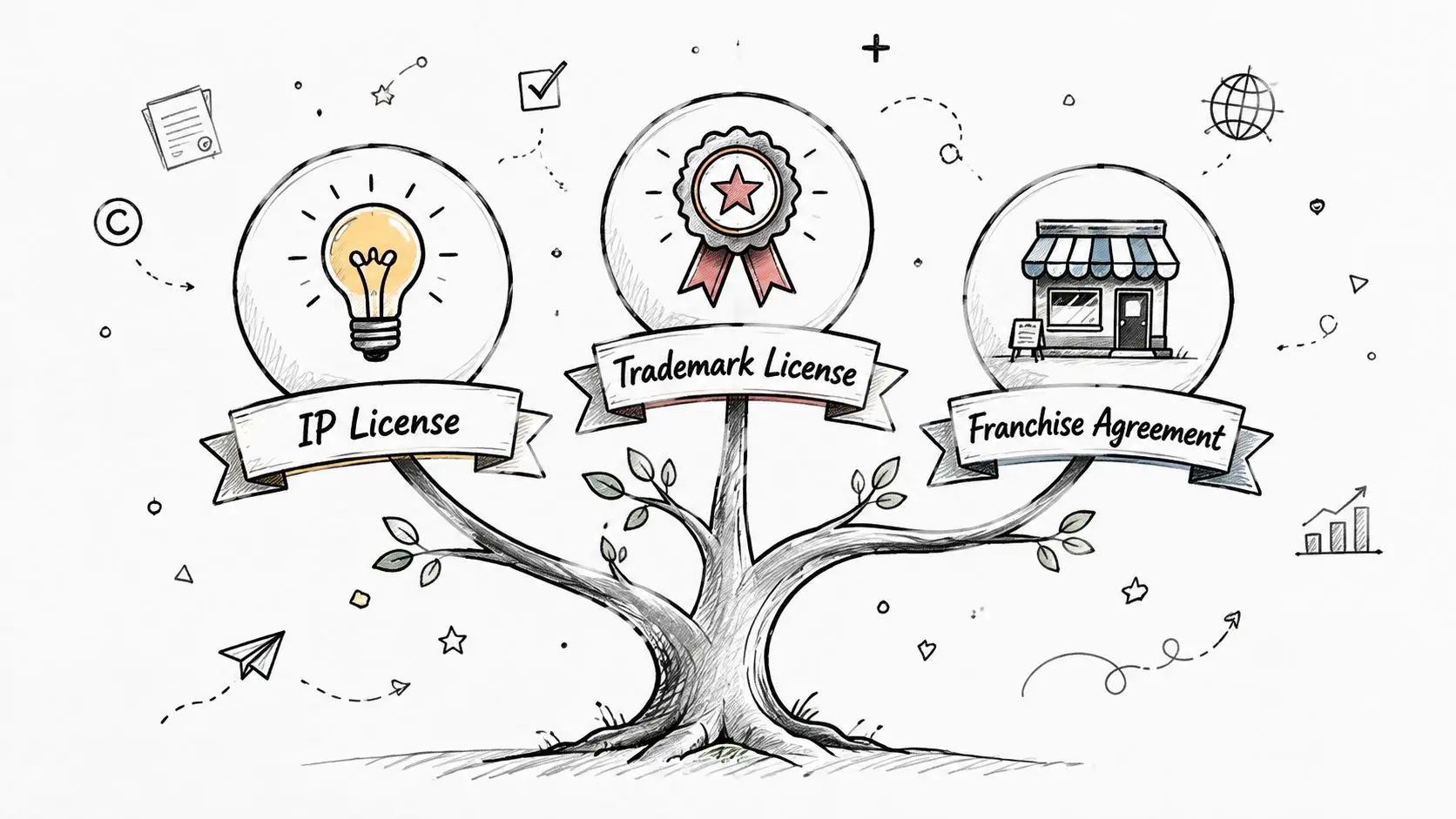
Common licensing forms
Intellectual property licensing covers the broad permission to use protected rights, including copyrights, patents, trademarks, and trade secrets. Businesses use it when they want to commercialize an asset without transferring ownership.
Trademark licensing lets another party use a brand under controlled conditions. It appears in consumer goods, co-branded products, and international distribution.
Patent licensing gives a business the right to exploit an invention. It often appears in manufacturing, medical technology, and industrial systems.
Software licensing governs how users may install, access, copy, or deploy software. The issue is usually not just access, but scope and usage restrictions.
Franchise agreements go beyond a simple license because they often combine brand use, business methods, training, and operational controls. They usually require tighter quality control because the brand experience must stay consistent.
Know-how licensing transfers practical, often confidential operational knowledge. That can matter as much as a formal IP registration, especially where process knowledge creates the market edge.
Exclusive vs Non-Exclusive Licensing Agreements
| Factor | Exclusive License | Non-Exclusive License |
|---|---|---|
| Market access | One licensee gets the granted rights | Multiple licensees can receive the same rights |
| Licensor flexibility | More restricted | More flexible |
| Commercial value | Often higher because competition is limited | Often lower per license, but broader reach is possible |
| Risk profile | Higher dependence on one counterparty | Lower dependence on one counterparty |
| Negotiation pressure | Stronger focus on performance and exit rights | Stronger focus on volume and administrative control |
An exclusive structure concentrates risk and reward. A non-exclusive structure spreads opportunity but usually gives the licensor more room to keep monetizing the asset through other channels.
For readers comparing licensing structures in regulated markets, Inpro Corporate Services on AI licensing in the UAE is a useful reminder that licensing terms often depend on industry-specific compliance, not just contract mechanics. The form of the deal follows the regulatory environment.
Essential Clauses Every Licensing Agreement Must Address
A licensing agreement fails when it leaves the hard questions for later. The wording has to decide what the licensee can do, what the licensor keeps, and how both sides escape if the relationship stops working. If those points stay vague, disputes usually follow the commercial success.
Scope, territory, and exclusivity
The scope of use should state exactly what the license covers. If the grant is too broad, the licensee may claim rights beyond the licensor’s intention. If it is too narrow, the license may become commercially useless.
Territory matters just as much. A local grant, a regional grant, and a worldwide grant create very different risk profiles. Exclusivity also changes the balance, because an exclusive license can prevent the licensor from working with other partners in the same market.
Payment, term, and termination
Royalties, upfront fees, and milestone payments should not sit in vague commercial language. They need calculation mechanics, reporting dates, audit rights, and late-payment consequences. Without those details, the licensor cannot reliably measure revenue, and the licensee can create disputes over what counts as payable income.
The term should also match the business purpose. A short experimental deal needs different exit rights than a long-term brand rollout. Termination provisions must cover breach, insolvency, failure to meet minimum performance, and misuse of the rights.
Control, sublicensing, and dispute management
Quality-control obligations matter especially in trademark and brand licenses. If the licensor does not define quality standards, the licensed brand can weaken quickly. Sublicensing rights need equal care, because an indirect user can multiply the licensor’s exposure.
If a third party can use the asset, the agreement should say who monitors that user and who pays for the mistake.
Dispute-resolution clauses, governing law, and ownership-retention language close the circle. They decide where a dispute gets heard and confirm that the underlying IP stays with the licensor.
Key Licensing Agreement Clauses and Their Commercial Impact
| Clause Category | Typical Provisions | Risk When Missing or Vague |
|---|---|---|
| Scope of use | Permitted acts, products, fields, versions | The license may expand beyond the intended use |
| Territory | Country, region, worldwide reach | Parallel commercial channels may conflict |
| Exclusivity | Exclusive, sole, or non-exclusive grant | The parties may argue over market access |
| Payment terms | Upfront fee, royalties, milestones, reporting | Revenue disputes and unpaid usage |
| Term and renewal | Fixed term, renewal triggers, survival | The deal may continue too long or end too early |
| Termination | Breach, insolvency, misuse, performance failure | The licensor may struggle to exit a bad deal |
| Sublicensing | Allowed, prohibited, consent-based | Control over downstream users can disappear |
| Quality control | Standards, inspection, approval rights | Brand dilution and compliance failures |
| Warranties and indemnities | Ownership, non-infringement, liability allocation | One side may carry hidden infringement risk |
| Governing law and dispute resolution | Court venue, arbitration, applicable law | Cross-border enforcement can become slow or uncertain |
The cleanest drafting strategy is simple. Define the permitted use, measure the payment, and preserve an exit path before the relationship starts to drift.
Cross-Border and Israel-Specific Licensing Considerations
Cross-border licensing changes the risk calculus immediately. A contract that reads cleanly in one country may break down when royalties, taxes, enforcement, and registration obligations cross into another legal system. That is especially true when a foreign business licenses IP into Israel or uses Israeli counterparty channels abroad.
Registration and enforcement risks
Some rights need registration or supporting records to be enforced effectively. Trademarks and patents, in particular, raise separate registration and enforcement questions. A license that ignores those issues can leave the licensor with a contract right that is hard to use in practice.
Israeli enforcement also matters because the licensing agreement may need local litigation strategy, not just a foreign-law clause. If the agreement touches distribution, branding, or technology transfer, the parties should map where the evidence sits and where the counterparty has assets.
Tax, currency, and compliance issues
Royalty payments can trigger withholding or reporting questions, so the payment mechanics should be reviewed before signature. Currency denomination, payment timing, and remittance mechanics also matter in cross-border deals, because each element affects cash flow and enforcement. Sanctions and compliance screening should sit in the same review file, not as a last-minute add-on.
This is also where a firm with both transactional and dispute experience can add practical value. RNC Group handles commercial and international licensing matters, so the contract can be built with enforcement and exit strategy in mind, not just signature-day polish.
Cross-border drafting works best when the contract assumes a future dispute, then narrows the paths to one.
What foreign businesses should verify
- Local enforceability. The clause structure should work in the country where assets or payments sit.
- Tax treatment. Royalty flow should be reviewed before money moves.
- Language and evidence. Translation and recordkeeping should support later enforcement.
- Regulatory fit. Sector rules can override standard licensing language.
- Exit mechanics. Termination and post-termination obligations should remain workable across borders.
The practical point is direct. A license that ignores Israel-specific or cross-border detail can look valid while underperforming as a commercial tool.
Due Diligence Checklist and Common Licensing Pitfalls
Most licensing failures start before signature. The parties focus on commercial optimism, but they skip the checks that determine whether the grant is usable. That is where value leaks out.
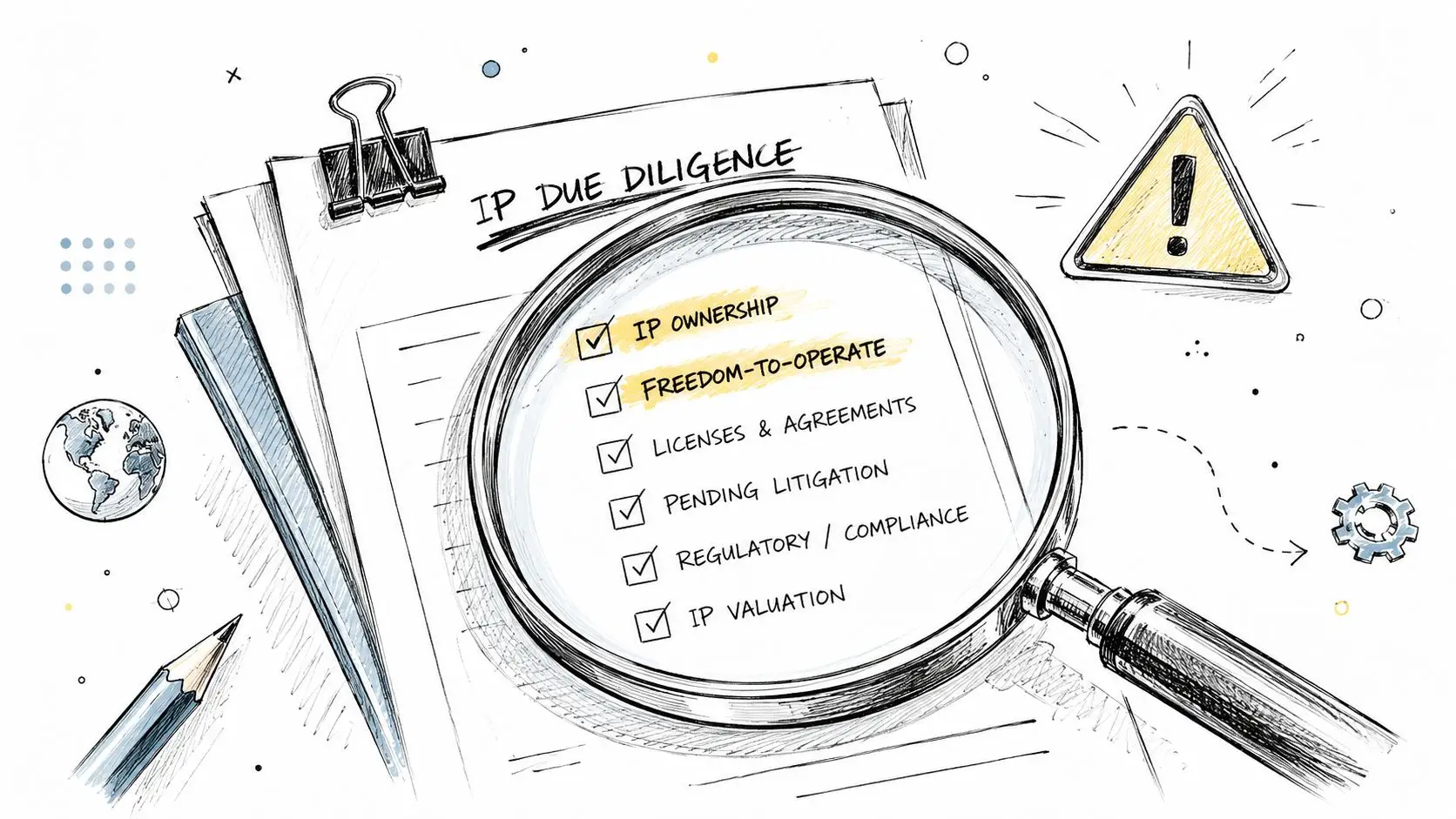
Due diligence questions that matter
Before signing, the licensor and licensee should confirm who owns the rights, whether any prior licenses already burden the asset, and whether the asset is free for the intended use. They should also review pending disputes, exclusivity conflicts, and any regulatory limits that affect commercialization.
Financial viability matters too. A licensee that cannot fund development, reporting, or royalty payments creates a contract problem before launch. The same is true when the licensor cannot maintain the underlying rights.
Common drafting failures
Ambiguous territorial scope creates overlapping market claims. Missing quality-control language can undermine brand value. Undefined derivative-rights treatment can trigger fights over improvements, updates, or derivative works.
Termination language often fails in a quieter way. If the agreement does not give the licensor a usable exit, the licensor may be trapped in a poor relationship while the asset keeps circulating. Poorly drafted indemnity clauses can also shift infringement or compliance loss to the wrong side.
The most expensive licensing mistake is usually not an illegal clause. It is an incomplete one.
A practical review list
- Confirm title. Verify that the licensor controls the rights it is licensing.
- Map prior commitments. Look for existing licenses, pledges, or conflicting obligations.
- Test the business model. Make sure the royalty structure fits actual sales flow.
- Check downstream control. Review quality standards, sublicensing, and approval rights.
- Stress-test the exit. Confirm what happens if performance drops or the relationship turns hostile.
A disciplined review reduces the chance that the deal becomes expensive after signing. It also forces each side to price the risk instead of discovering it later.
When to Engage Specialized Legal Counsel for Licensing Agreements
Specialized review becomes important when the deal crosses borders, grants exclusivity, or ties payment to performance milestones. It also becomes important when the license involves a franchise structure, regulated goods, or a high-value IP asset. Those deals often need more than a template.
The recommended strategic path is to treat licensing counsel as part of deal design, not just dispute response. RNC Group works on commercial and international licensing matters, including agreements that require coordinated drafting, negotiation, and enforcement planning. In the right cases, that support can prevent a contract from becoming a liability after launch.
If the agreement affects a foreign market, a brand, or a key revenue stream, the safer move is to review it before signature. Avoid costly mistakes and contact the firm now through RNC Group.
This article provides general information only and does not create an attorney-client relationship or legal advice. Licensing outcomes depend on the full contract, the governing law, and the facts of each transaction, so any reader should obtain specific legal advice before acting on this information.
RNC Group structures, negotiates, and reviews licensing agreements for commercial parties that need clear rights, workable payment terms, and enforceable exits. For cross-border licensing, franchise structures, and intellectual property control, the firm can help align the contract with the business model and the legal environment, and readers can learn more at RNC Group.