
A distributor in Europe signs an Israel-linked supply agreement. Then shipments stop, payments stall, the Israeli bank requests new compliance materials, and each side threatens proceedings in a different forum. At that point, the question isn’t academic. It’s operational, financial, and reputational.
That is where commercial dispute resolution matters. In practice, what is commercial dispute resolution? It’s the structured set of tools businesses use to contain conflict, maintain their bargaining position, and reach an enforceable outcome without losing sight of the underlying commercial objective.
For a foreign executive dealing with an Israeli counterparty, the challenge usually isn’t just the legal merits. Jurisdiction, language, enforcement, banking conduct, confidentiality, and timing all matter at once. A strong strategy identifies the right mechanism early, because the wrong first move often grants the other side an upper hand.
Navigating Commercial Conflict in 2026
Cross-border disputes tied to Israel rarely begin as lawsuits. They usually begin as pressure points. A payment is delayed, a founder deadlocks a company, a franchisee breaches standards, or a bank account is restricted before payroll or supplier payments clear.
Executives often ask what is commercial dispute resolution only after the conflict has already escalated. By then, speed matters more than theory. The business needs a path that stabilizes operations, protects evidence, and forces disciplined communication.
In practical terms, commercial dispute resolution is the framework for handling those conflicts through negotiation, mediation, arbitration, litigation, and, in many technical matters, expert review. The right route depends on the contract, the business relationship, the urgency, and the enforceability target.
Why foreign companies face a distinct risk profile
A non-Israeli company often underestimates three issues.
- Forum risk: The contract may point to a court or tribunal that wasn’t the executive’s first assumption.
- Enforcement risk: Winning on paper means little if the result can’t be enforced where assets or payment channels sit.
- Control risk: Early informal exchanges can later shape evidence, admissions, and commercial advantage.
Practical rule: The first week of a dispute often determines the next year of procedure.
Many executives also treat dispute resolution as a last resort. That’s a mistake. In high-value Israel-linked disputes, it works better as a management system for sequencing pressure, preserving optionality, and avoiding unforced errors.
What effective commercial dispute resolution actually does
A well-run process should do four things at once:
- Contain immediate damage to cash flow, supply, governance, or banking access.
- Test the facts before positions harden around assumptions.
- Build a strong position without making settlement harder than necessary.
- Deliver an enforceable outcome in the jurisdiction that matters commercially.
That is why experienced parties don’t ask only who is right. They ask which mechanism gives the strongest combination of speed, confidentiality, pressure, and finality.
The Four Pillars of Dispute Resolution
Commercial conflict doesn’t require one universal answer. It requires choosing the right instrument for the right problem. Most business disputes move through four core pillars, even if the sequence differs from case to case.
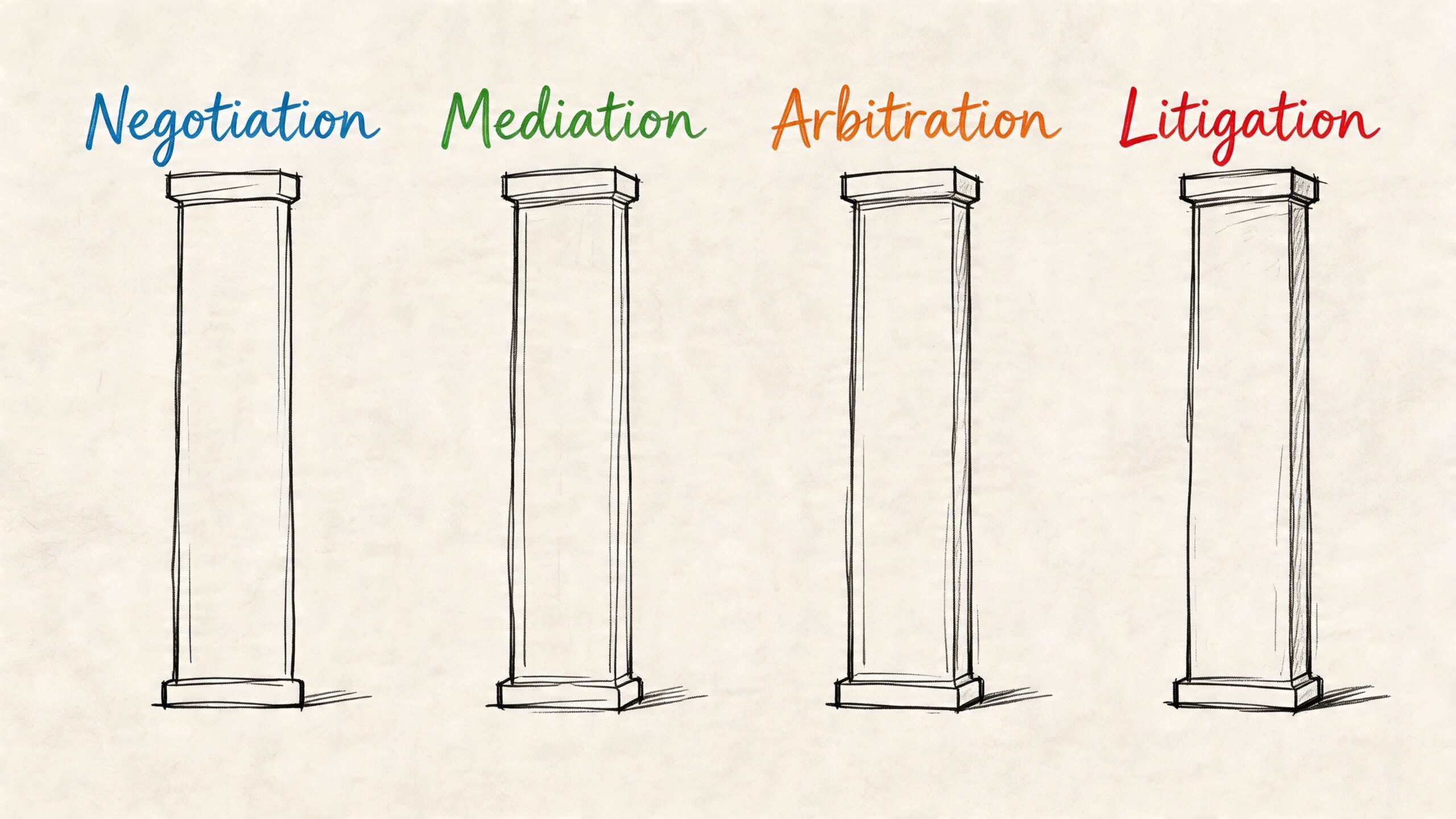
Negotiation
Negotiation is the first and most underestimated pillar. It isn’t casual back-and-forth. In a serious commercial dispute, negotiation is a controlled process of framing the issues, preserving legal positions, and testing whether a business solution remains possible.
Good negotiation works when the parties still share some economic logic. A distributor may want resumed supply. A licensor may want compliance and payment, not a public fight. A joint venture partner may want governance repairs rather than collapse.
Poor negotiation fails for predictable reasons:
- Unclear authority: Nobody across the table can approve a deal.
- Bad sequencing: Parties argue liability before they’ve exchanged the documents that matter.
- Unstructured correspondence: Commercial teams make statements that create legal problems later.
Mediation
Mediation introduces a neutral third party who helps the sides reach a voluntary settlement. The mediator doesn’t impose a decision. The value lies in reality testing, reframing positions, and helping decision-makers move past public posturing.
Mediation is especially useful when parties need a commercial relationship after the dispute. That includes franchise systems, service agreements, licensing structures, and supply chains with an Israeli nexus.
The best mediations don’t produce compromise for its own sake. They produce terms each side can actually perform.
A common misunderstanding is that mediation is soft. It isn’t. In the right hands, it is disciplined, confidential, and highly strategic.
Arbitration
Arbitration is a private adjudicative process. The parties present evidence and legal arguments to one or more arbitrators, who issue a binding decision. For international commerce, arbitration often offers the strongest blend of neutrality, confidentiality, and cross-border enforceability.
It also gives parties more control than court litigation. They can often shape the seat, language, applicable rules, and arbitrator profile. In a technical supply dispute or a founders’ conflict involving valuation or governance, that can matter a great deal.
Arbitration isn’t automatically better. It can become expensive if the clause is poorly drafted or the procedure grows too broad. It also limits appeals, which is a strength when you win and a weakness when you don’t.
Litigation
Litigation is the court process. It remains essential where urgent injunctions are needed, where one party refuses consensual mechanisms, or where a statutory issue belongs before a court. Israeli litigation may be the right path in some banking, shareholder, or enforcement scenarios.
Its strengths are coercive powers, formal evidence procedures, and judicial remedies. Its weaknesses are publicity, reduced party control, and procedural drag.
The key point is simple. Litigation is not the default because it’s superior. It’s the default when the contract says nothing else, when consent has broken down, or when immediate court authority is required.
How the pillars work in real business conflicts
The four pillars are not rival ideologies. They are tools. A dispute may begin with formal negotiation, move into mediation, and end in arbitration. Another may require urgent court relief first, then settlement talks after the injunction hearing.
That is why the right question isn’t which method is best in the abstract. It is which method matches the dispute’s commercial stakes, timing pressure, evidence profile, and enforcement needs.
A Strategic Breakdown of Resolution Mechanisms
Executives need more than definitions. They need a decision model. The table below compares the four principal mechanisms across the factors that usually matter most in an Israel-linked business conflict.
Comparison of Commercial Dispute Resolution Mechanisms
| Factor | Negotiation | Mediation | Arbitration | Litigation |
|---|---|---|---|---|
| Cost profile | Usually the lowest at the outset | Moderate and often controlled by session design | Higher, especially with tribunal and institutional costs | Often the least predictable |
| Typical timeline | Can begin immediately | Often fast once parties commit | Faster than many court routes, but procedure still matters | Often the longest |
| Confidentiality | Can remain private if managed properly | Usually confidential by design | Commonly private | Usually public or more exposed |
| Formality | Low to moderate | Moderate | High | Highest |
| Party control | Highest | High | Moderate | Lower |
| Decision imposed by third party | No | No | Yes | Yes |
| Cross-border enforceability | Depends on settlement drafting | Depends on settlement drafting | Often strongest for international disputes | Depends on judgment recognition rules |
| Best fit | Early commercial reset | Relationship-preserving settlement | Binding international resolution | Injunctions, coercive orders, statutory issues |
The table is only a starting point. The strategic choice depends on what the business needs in the next thirty days, not what looks elegant in theory.
Speed versus leverage
Mediation performs well when the parties are still capable of rational settlement. According to commercial mediation prevalence data, 75-80% of cases reach settlement on the day of mediation or shortly after, and the AAA managed over 13,000 B2B cases in 2024 where large claims resolved in a median of 2.3 months. Those figures matter because many business disputes are won by preserving time and management attention.
However, speed alone doesn’t answer every problem. If the other side needs a binding determination, or if assets sit across multiple jurisdictions, arbitration may offer a greater advantage than a non-binding process. A fast but non-binding discussion can still fail if the counterparty benefits from delay.
Confidentiality versus precedent
Many foreign companies prefer private processes when a dispute touches pricing, compliance failures, trade relationships, or internal governance. Mediation and arbitration usually serve that objective better than court proceedings.
Yet privacy has a trade-off. Public litigation can pressure an unreasonable opponent, and court orders may create practical consequences that a private process cannot. The strategic question isn’t whether confidentiality is good. It’s whether confidentiality helps or hurts the outcome.
Control versus finality
Negotiation gives the parties the most control. They shape every term, every concession, and every commercial workaround. That control disappears if talks become performative.
Arbitration and litigation reduce party control because a third party decides the dispute. In return, they offer finality. When a relationship is broken beyond repair, finality may matter more than flexibility.
Process discipline matters more than labels
A poorly prepared mediation often fails for avoidable reasons. The decision-makers don’t attend. The damages model is weak. The legal correspondence lacks focus. The chronology is incomplete. The remedy sought is unrealistic.
By contrast, a tightly prepared file changes the quality of every mechanism. Many in-house teams now streamline legal workflows with AI before the first formal meeting by extracting clause conflicts, payment terms, notice requirements, and timeline inconsistencies from contract sets and attachments. That doesn’t replace legal judgment. It improves preparation.
A dispute mechanism can’t save a file that nobody has organized properly.
In practice, the strongest results usually come from matching the mechanism to the business objective, then preparing the record as if the matter will later be tested by a tribunal or court.
Arbitration for International Commercial Disputes
For foreign companies facing an Israeli counterparty, arbitration often becomes the center of gravity. The reason is straightforward. International business needs a binding result that can travel across borders.
The most important advantage is enforceability. Arbitral awards benefit from the New York Convention, which the verified data describes as ratified by 172 countries in the ICC context and 170+ states in the phased escalation material. That breadth is why arbitration remains central to cross-border commerce. It solves a problem that court judgments often don’t solve cleanly.
Why international parties choose arbitration
The ICC dispute resolution statistics for 2024 reporting on 2023 activity show why the market continues to trust arbitration. The ICC registered 831 new arbitration cases in 2023, involving 2,392 parties from 136 jurisdictions, and reported a pending caseload valued at US$354 billion. Those figures don’t describe a niche process. They describe a mainstream mechanism for major international disputes.
The same ICC material also shows range. Disputes ran from under US$10,000 to a single matter exceeding US$53 billion, and over one-third did not exceed US$3 million. That matters because many executives assume arbitration is only for mega-disputes. It isn’t.
Institutional arbitration versus ad hoc arbitration
The practical choice often begins here.
| Model | Main feature | Strength | Risk |
|---|---|---|---|
| Institutional arbitration | Administered under established rules | Procedural structure and administrative support | More formal cost layers |
| Ad hoc arbitration | Parties run the process themselves under agreed rules | Greater flexibility | More room for procedural fights |
Institutional arbitration works well when the parties need a framework that keeps the case moving. That includes appointments, timetable control, scrutiny of awards, and multilingual administration. In cross-border disputes, those features reduce friction.
Ad hoc arbitration can work when counsel on both sides are experienced and cooperative. But if the relationship has already deteriorated, procedural flexibility can turn into procedural warfare.
Clause drafting decides later outcomes
Many arbitration problems don’t begin at the hearing. They begin in the contract. A weak clause creates avoidable disputes about seat, language, governing law, scope, interim measures, and consolidation.
A well-drafted clause should address:
- The institution or rules that will govern the procedure.
- The seat of arbitration, because that affects court supervision.
- The language, especially for multilingual commercial records.
- The number and profile of arbitrators, particularly in technical sectors.
- The scope of disputes covered, including affiliates, guarantors, and related claims.
If the clause is vague, the first dispute may be about the dispute process itself.
For Israel-linked transactions, that drafting exercise isn’t clerical. It is risk architecture. Foreign executives should treat it as seriously as pricing, termination rights, and security arrangements.
Arbitration’s real trade-offs
Arbitration is powerful, but it isn’t frictionless. Document production disputes can still become expensive. Emergency relief isn’t automatic. A final award is an advantage until the case turns on an error with limited appeal options.
Still, for cross-border commercial contracts, arbitration usually offers the cleanest route to a neutral forum and a result that can be enforced where assets and counterparties operate. That is why well-developed international agreements continue to rely on it.
Strategic Analysis Israeli Bank Account Restrictions
A foreign company can tolerate many kinds of commercial friction. It usually can’t tolerate losing access to an operational bank account in Israel. Once a restriction hits, payroll, supplier settlements, tax payments, and customer collections can all become unstable at the same time.
That kind of dispute also exposes the limits of generic ADR advice. In routine conflicts, parties can often slow down and negotiate around the edges. In a banking crisis, delay itself becomes damage.
Why this scenario changes the analysis
Bank restrictions often arise from compliance concerns, returned checks, transaction monitoring, source-of-funds questions, governance irregularities, or documentation gaps. The bank may act unilaterally. The company then faces a compressed timetable and a practical burden to answer with credible evidence.
Many executives make a costly error by treating the problem as a customer service issue, not as a legal and evidentiary event. That approach usually produces inconsistent explanations, fragmented document submissions, and correspondence that lacks strategic coherence.
The problem becomes sharper for foreign owners or directors who operate across several jurisdictions. A person who is also planning your move to Israel may already be navigating residence, tax, and operational transitions. That context increases the need for disciplined banking records and unified communications.
Why standard mediation often underperforms in acute banking crises
The verified data on crisis disputes is instructive. According to the CPR-related practical perspectives material hosted by AAA, standard ADR succeeds in 70-80% of commercial cases, but effectiveness drops to around 45% in acute crisis scenarios such as sudden bank account blockages or founder disputes. The reason given is familiar to practitioners. Emotional entrenchment and financial urgency can override rational negotiation.
That doesn’t mean ADR becomes irrelevant. It means the sequence must change. In these matters, mediation usually works only after the company has built a credible factual record and clarified the legal pressure points.
What works better in practice
A stronger response uses several tracks at once.
- Immediate fact consolidation: Gather account history, correspondence, corporate records, explanations for flagged transactions, and the exact operational impact.
- Targeted legal correspondence: Send disciplined notices that preserve rights, request reasons, and frame the dispute in legal rather than emotional terms.
- Forensic review where needed: If the issue touches unusual transfers, shareholder funding, or intercompany flows, a neutral accounting analysis can change the discussion.
- Escalation planning: Prepare for court action, regulatory engagement, or negotiated restoration without committing too early to only one path.
What foreign executives should do in the first days
The first response should be structured.
- Freeze informal messaging. Commercial staff should stop improvising explanations by email or chat.
- Appoint a single response lead. Banks and counterparties should hear one coherent position.
- Map the contractual fallout. Identify which supplier, lease, franchise, or payroll obligations will be affected first.
- Review signatory and governance records. Banking crises often expose internal authority problems.
- Prepare for parallel paths. Negotiation may continue while urgent relief is evaluated.
In banking disputes, credibility is built document by document. It isn’t created by outrage.
What doesn’t work
Several habits consistently make matters worse.
| Misstep | Why it harms the case |
|---|---|
| Sending angry, unstructured complaints | It signals urgency without adding usable facts |
| Submitting documents in waves | It creates inconsistencies and review fatigue |
| Treating the issue as purely operational | It ignores rights, remedies, and evidentiary needs |
| Starting mediation too early | It wastes leverage before the file is ready |
The broader lesson is important. A bank restriction is not just another business disagreement. It is a commercial crisis that may require legal demands, technical review, negotiated engagement, and, if necessary, immediate litigation support. In that setting, dispute resolution remains critical, but only if it is managed as phased escalation rather than wishful dialogue.
Designing Your Phased Escalation Strategy
The most effective answer to what is commercial dispute resolution isn’t a list of options. It’s a sequence. Businesses usually get better outcomes when they move through a disciplined escalation model rather than jumping from frustration straight into court.
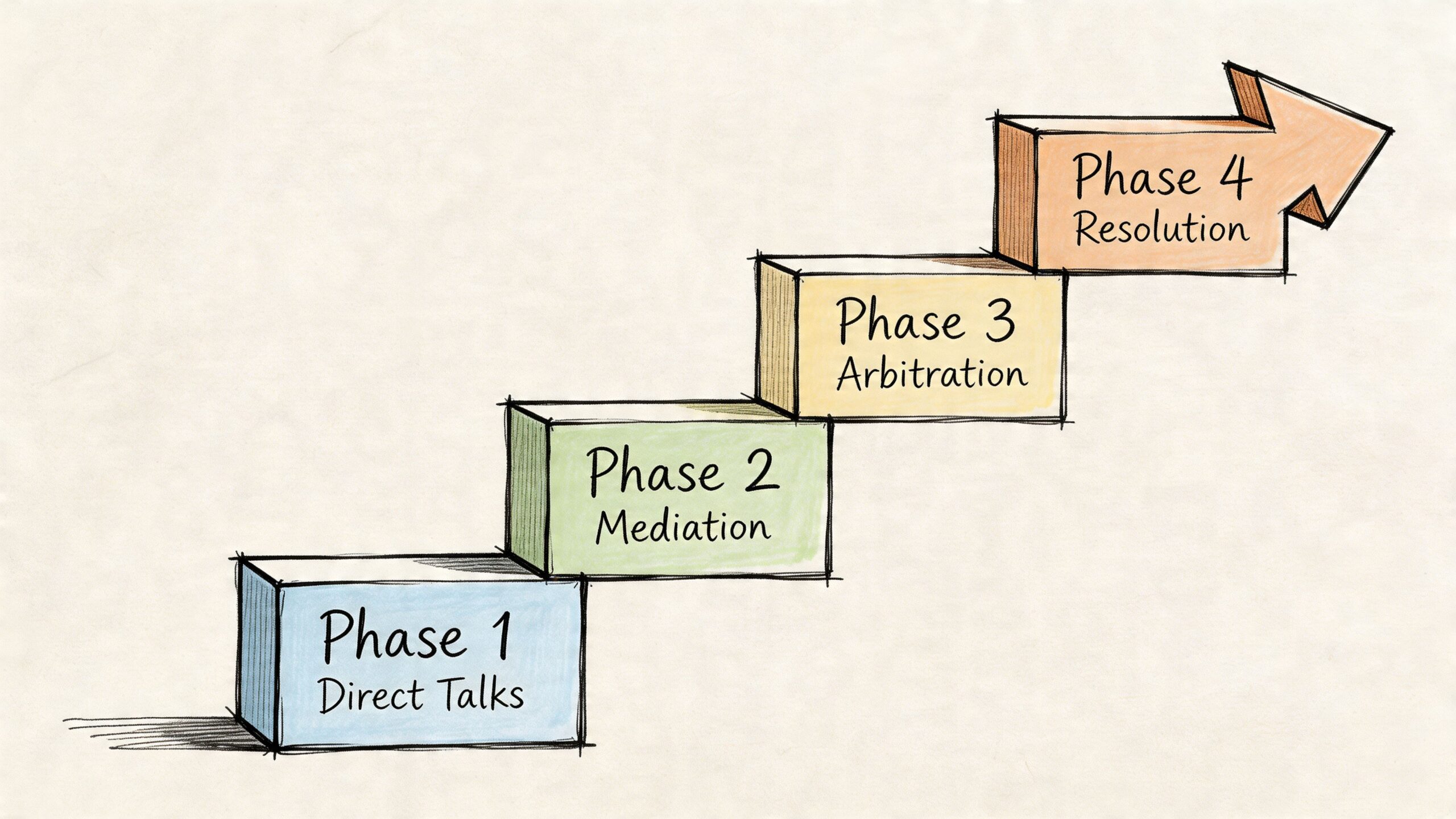
The verified data supports that view. According to the six-stage commercial dispute resolution benchmark, a strategic phased model can cut average resolution costs by 60-80% and shorten timelines by 70% compared with heading directly to litigation. The same material states that embedding expert determination clauses in technical contracts reduces escalation to court by an estimated 40%.
Phase one begins before the dispute
The strongest dispute strategy starts in the contract.
A comprehensive agreement should define notice mechanics, governing law, dispute forum, interim relief rights, confidentiality obligations, document language expectations, and escalation steps. Foreign companies doing business in Israel should pay close attention to clauses in commercial contracts and cross-border agreements, because procedural ambiguity later benefits the better-prepared side.
This phase also includes governance discipline. Signatory authority, payment approval trails, and document retention standards often determine whether a later claim looks persuasive or chaotic.
Phase two uses structured negotiation
Once a dispute arises, negotiation should not begin with broad accusations. It should begin with a controlled issue map.
Useful early steps include:
- Define the breach precisely: Identify the clause, conduct, and remedy sought.
- Separate urgent from non-urgent issues: A supply interruption and a damages claim may need different timelines.
- Document authority: The other side should know who can settle and who cannot.
- Set a procedural clock: Deadlines matter because open-ended exchanges reward delay.
A well-framed demand can often do more than a rushed filing. That is particularly true in legal correspondence and demand letters where wording, attachments, and remedy framing directly affect settlement posture.
Phase three adds expert input where the dispute is technical
Not every disagreement turns on law alone. Some turn on valuation, engineering performance, accounting treatment, software delivery, or franchise compliance metrics. In those matters, neutral expert analysis can de-escalate rhetoric and sharpen reality.
This stage is often overlooked in founder disputes, M&A earnout conflicts, and technical service agreements. Yet it can materially improve the quality of later mediation or arbitration.
A neutral expert does not weaken a legal case. Often, the expert prevents the parties from litigating the wrong issue.
Where the contract allows, expert determination can also create a defined stopping point before the dispute spills into full adversarial proceedings.
Phase four uses mediation to convert pressure into settlement
Mediation works best after the facts, claims, and pressure points are clear. By then, the parties have enough information to negotiate seriously and enough risk to value closure.
For cross-border business disputes, mediation can preserve relationships that still have commercial value. That is common in franchising, distribution, licensing, and commercial litigation strategy involving Israeli and foreign parties. It also allows creative settlements that courts rarely impose, such as revised payment waterfalls, operational covenants, inspection rights, or stepped reinstatement arrangements.
Phase five reserves arbitration or litigation for final determination
If consensual stages fail, the matter moves to binding adjudication. At that point, the earlier phases still matter. They have organized the evidence, clarified the remedy, narrowed the issues, and often exposed the true decision-maker on the other side.
One practical provider in this space is RNC Group, which, according to the publisher background, structures cross-border commercial disputes through phased escalation, multilingual legal correspondence, and Israel-linked crisis management. The strategic value in any such advisor lies not in filing first, but in sequencing pressure correctly.
What an executive should implement now
A useful board-level checklist looks like this:
| Priority | Immediate action |
|---|---|
| Contract hygiene | Audit dispute clauses in key Israel-linked agreements |
| Evidence control | Centralize records, notices, approvals, and payment histories |
| Authority mapping | Confirm who can instruct counsel and settle |
| Expert access | Identify technical experts before a crisis hits |
| Escalation design | Define the move from negotiation to mediation to binding process |
The businesses that handle disputes well don’t rely on optimism. They rely on structure.
The Value of Strategic Counsel in Israeli Disputes
Foreign companies rarely struggle because dispute resolution tools are unavailable. They struggle because those tools are used in the wrong order, with incomplete records, and without a unified cross-border enforcement plan.
That is why strategic counsel matters. The effective advisor does more than explain rights under Israeli law. The advisor coordinates timing, evidence, language, forum, and commercial advantage so the dispute serves the business objective rather than distracting from it.
What specialized counsel changes
In technical matters, expert-led processes can be especially valuable. According to the Resolution Institute guide on expert determination, expert determination often concludes 50-70% faster than arbitration, remains confidential, and gives parties meaningful control over the process. For valuation, accounting, engineering, and IT disputes, that can materially reduce unnecessary escalation.
Counsel also helps manage hidden risks around evidence. Cross-border executives and managers often record calls, preserve chats, or compile internal voice notes without thinking through admissibility and legality issues. Anyone handling multinational evidence gathering should understand state and federal recording rules before building a file around recorded communications.
Strong dispute strategy is orchestration. Law, evidence, pressure, and settlement design must work together.
For non-Israeli businesses, the recommended strategic path is clear. Use counsel that can handle crisis correspondence, technical experts, enforcement planning, and cross-border coordination as one integrated exercise. That approach usually produces better decisions earlier, which is where most commercial disputes are won.
Costly mistakes usually happen early, when a company sends the wrong letter, chooses the wrong forum, or weakens its position before the facts are clear. The prudent next step is to obtain a customized strategic assessment of the dispute, the contract framework, and the enforcement environment. To avoid preventable exposure, contact our firm now.
This article provides general information only and does not constitute legal advice, a legal opinion, or a substitute for fact-specific counsel under Israeli or any other law. Reliance on this material without obtaining professional advice for the specific dispute, contract, jurisdiction, and evidence profile involved is not recommended.