
75.1% of organizations activated a crisis management team in the previous 12 months, and 57.9% faced between one and five crises. Crisis management is the coordinated leadership of prevention, preparation, response, and recovery, not just the public-facing response.
The hard question in 2026 is not whether to issue a statement. It is whether the organization understands the legal anatomy of the event before it speaks, settles, preserves evidence, or escalates. In cross-border disputes, that sequence can shape insurance notice, regulator disclosure, indemnity rights, banking relationships, and later litigation.
Why the Hardest Crisis Question Is Never the Obvious One
The hardest crisis question is rarely whether to apologize. It is usually whether the first sentence will help or harm the legal position that follows.
A statement written for reputation repair can create a factual record that later constrains coverage, weakens a defense, or narrows commercial advantage. That is why crisis management in 2026 sits closer to legal architecture than to public relations. The crisis team has to ask who speaks, who approves, what must be preserved, and what must wait.
The first move is usually a legal one
In many cases, the visible trigger is not the actual problem. A cyber event, an executive misstep, or a regulator inquiry can all look different on the surface, yet each one forces the same sequencing choices. Counsel has to decide whether the priority is containment, privilege, notice, or silence.
Practical rule: a clean response is usually built before the market sees anything.
Cross-border exposure makes that discipline more important. Contracts, data, payments, operations, and decision-makers often sit in different jurisdictions, so one event can create several legal tracks at once. A rushed statement can confuse those tracks and make recovery harder.
The 2024 global survey from the Business Continuity Institute shows why this is no longer a rare-emergency problem. 75.1% of organizations activated a crisis management team in the previous 12 months, and 19.1% faced even more frequent incidents than one to five crises in a year, with extreme weather, third-party failures, and cyberattacks driving the load Business Continuity Institute 2024 global survey.
Defining Crisis Management Beyond the Headlines
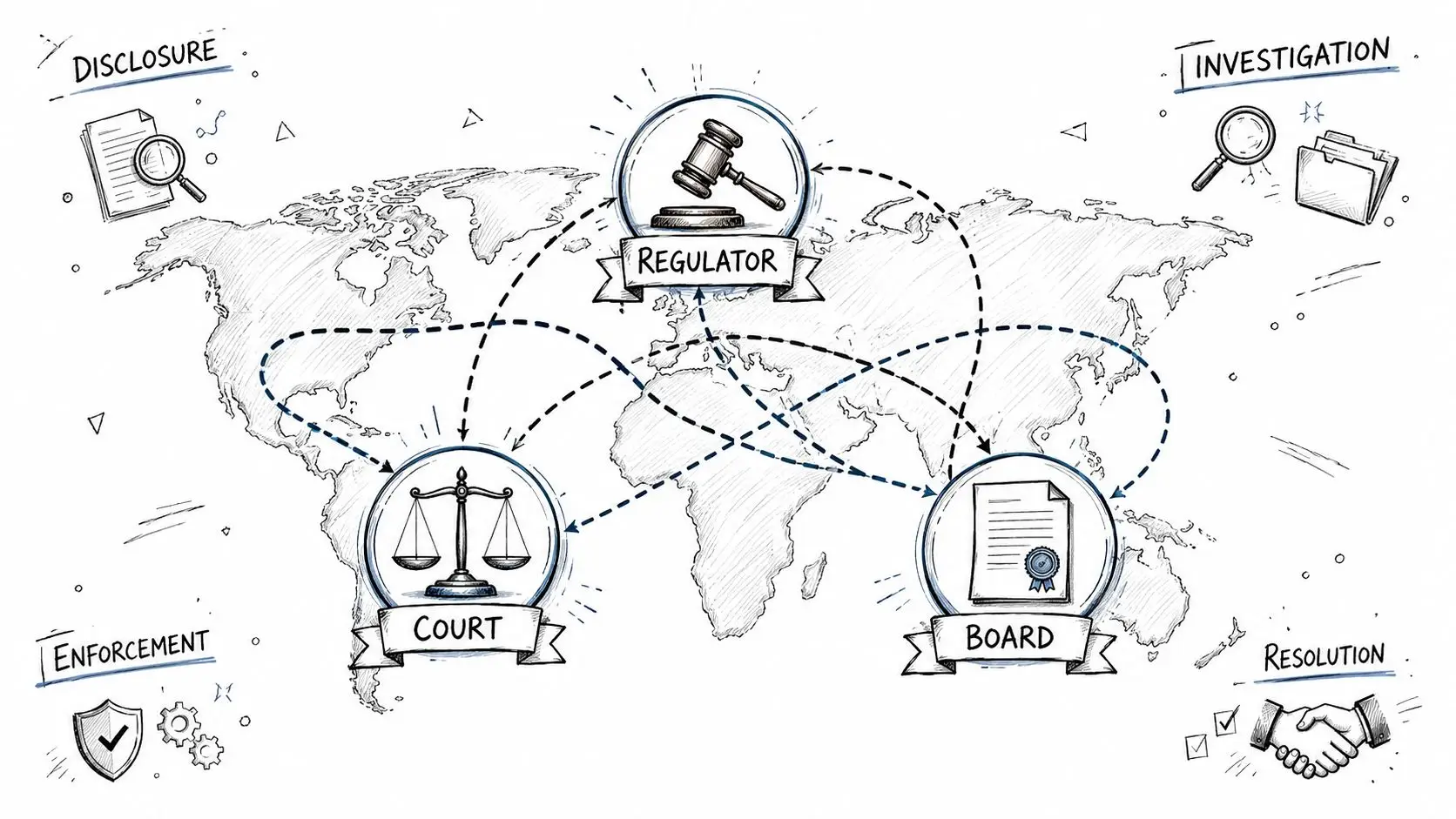
ISO 22361:2022 defines crisis management as coordinated activities to lead, direct and control an organization with regard to crisis. That definition matters because it places crisis management inside leadership, not beside it. It also covers prevention, preparation, response, and recovery, so the work starts long before anyone drafts a press line ISO 22361 overview.
Crisis management is not the same as risk management
Risk management asks what might go wrong and how to reduce exposure. Crisis management assumes the event has arrived, then manages the organization through it before, during, and after the damage. That difference matters because preventive controls alone won’t tell a board how to preserve privilege, notify insurers, or sequence regulator contact.
Public relations plays a different role again. Communications can support crisis management, but it can’t replace legal control, evidence preservation, or operational containment. A polished statement won’t repair a missed notice deadline or a broken decision chain.
A useful test is simple. If the issue spans several jurisdictions, several regulators, or several counterparties, then the organization is no longer managing a message. It is managing a legal and operational system.
A cross-border product recall shows the point. One regulator may expect immediate safety action, another may expect technical disclosure, and a third may expect commercial remediation. If the company treats all three as one media event, it will almost always speak too soon in one place and too late in another.
The Crisis Lifecycle That Most Plans Skip
The lifecycle model is the part many plans mention and few plans use. Authoritative frameworks treat crisis management as precrisis detection and preparation, then acute containment and response, then recovery and organizational learning Sage crisis lifecycle framework.
Preparation sets the speed of the response
Weak preparation adds delay under pressure. Teams that have not identified weaknesses, formed the crisis team, or run drills usually spend the first hours debating roles instead of controlling damage. That hesitation often turns a manageable incident into a broader dispute.
A 2023 Forbes-reported U.S. survey found that only 49% of companies had a structured crisis communication strategy, while 23% had no plan or were unsure whether one existed Forbes-reported U.S. survey. The same brief also notes that annual crisis simulations reduced response times by 32% on average, which fits the basic legal reality. Practice shortens confusion.
Recovery is where recurrence gets prevented
Recovery is not just reopening operations. It is where the organization updates its procedures, tests what failed, and decides whether the same issue can happen again. The OECD frames preparedness, response, and post-crisis feedback as distinct steps, and that distinction is where many public explainers fall short OECD strategic crisis management.
The crisis does not end when the press release goes out. It ends when the organization learns enough to stop repeating itself.
A 2018 Deloitte survey cited by NSF found that 47% of organizations without a crisis management plan reported negative financial impact from a recent crisis, compared with 31% of those that did have a plan Forbes-reported U.S. survey. That gap is not about messaging style. It is about preparation, sequencing, and follow-through.
Legal Anatomy of a Cross-Border Crisis
A serious crisis creates parallel tracks, not one storyline. The company has to think about regulator disclosure, privilege, insurance notice, indemnity rights, evidence preservation, stakeholder mapping, and commercial continuity at the same time.
Decision rights matter as much as decisions
In banking and other regulated sectors, the IMF says a crisis-management framework must define decision rights and institutional roles across the central bank, supervisor, resolution authority, deposit insurer, finance ministry, and, where relevant, home supervisors IMF crisis management framework. That point translates beyond banking. Fragmented authority slows action and weakens confidence.
The same logic applies in ordinary commercial crises. If the board, general counsel, business lead, insurer, and local manager all think they own the first move, the organization will lose time. So will its influence.
Counsel has to protect the record before the story hardens
Privilege protection is not a luxury in high-stakes work. It is part of how the organization preserves candid internal analysis while it decides what to say externally. Insurance notice also has to go out on a disciplined timeline, because late notice can complicate recovery and create avoidable disputes.
The legal-anatomy approach also explains why multilingual correspondence matters. In a cross-border matter, one poorly translated letter can distort position, tone, or legal effect. That risk rises when counterparties, manufacturers, lenders, and regulators sit in different legal systems.
The recommended strategic path is to build a control room before communications go public. Courts and media are tools, but they are not the destination. The destination is containment, continuity, and a record that still supports the client’s position after the crisis has passed.
A Phased Response Framework Boards Can Actually Use
A board needs a sequence it can govern under pressure. The cleanest model is still prepare, identify, respond, recover, because each phase carries a different legal job and a different risk if it is handled too late.
Preparation, identification, response, recovery
| Phase | Primary Objective | Lead Role | Legal Hook to Trigger |
|---|---|---|---|
| Prepare | Build roles, drills, and decision rights | Board and senior counsel | Crisis plan, notice matrix, privilege protocol |
| Identify | Confirm that a critical event is unfolding | Crisis lead | Escalation trigger, fact gathering, evidence hold |
| Respond | Contain harm and control disclosure | Counsel with operational lead | Regulator contact, insurer notice, stakeholder map |
| Recover | Restore operations and revise controls | Management with board oversight | After-action review, contract updates, lessons learned |
The board should ask a harder question than “Should we speak?” It should ask what must be preserved before anyone speaks. If the record is weak, a public statement can become evidence against the company.
What each role must do first
The crisis lead should identify the event and activate the team. Counsel should stop document deletion, control external messaging, and check notice duties. The business lead should contain operations and coordinate practical remediation.
Communications has a real function after that, but it does not lead the response on its own. It should support the operational fix and the legal strategy, not outrun them. That order keeps the company from promising something it cannot prove, deliver, or defend.
One internal rule captures the point.
If the first draft does not protect the record, it is not finished.
The same discipline shows up in crisis planning more broadly. The Business Continuity Institute 2024 global survey reports that crisis activation has become routine for many organizations, which is another reason boards should treat the framework as ordinary governance rather than emergency theater.
Crisis Management Examples That Reveal Sequencing Under Pressure
A product safety event shows how fast sequencing becomes visible. Operations may need to pause before public statements go out, because continued shipment can deepen liability and complicate recall obligations. If counsel is already involved, the company can map regulator contact, preserve testing records, and decide whether to speak to customers first or to authorities first.
A cyber incident creates a different pressure pattern. IT wants to restore systems, finance wants to understand payment exposure, and legal wants to preserve evidence and protect privilege. If the company speaks before it confirms what was accessed, it may box itself into an inaccurate narrative that later collides with forensic findings.
The executive conduct matter is usually the hardest to control
Executive conduct cases often produce the most mixed incentives. Shareholders want quick disclosure, counterparties want assurance, and the board wants to limit contagion. Yet the first decision is still not public messaging, it is governance. Someone has to decide who is suspended, who investigates, and who speaks for the company.
The MIT Executive Education discussion on crisis leadership stresses that crises involve multiple dimensions, including technical, legal, economic, and reputational ones, and that leaders should prepare for the fact that no crisis is only one crisis MIT crisis leadership. That framing matches day-to-day practice. The legal issue rarely travels alone.
These examples point to four questions that keep repeating:
- Who paused operations? The answer should be clear within the first hour, not after a committee discussion.
- Who preserved evidence? If nobody owns that task, facts will disappear.
- Who contacted regulators first? The order matters in regulated matters.
- Who tied statements to an operational fix? A statement without a fix is just noise.
The quality of the response is usually visible in those four answers. If the answers are blurred, the crisis will expand.
How a Law Firm Adds Value at the Highest Stakes
A serious commercial law firm adds value by imposing sequence under pressure. It does not wait for the crisis to become public, then react to it. It audits the facts, the opponent, the forum, the contracts, and the pressure points, then chooses the next move with discipline.
That is where multilingual legal correspondence, Israel-facing representation, and cross-border coordination become practical tools. For clients with Israeli exposure, the recommended path is to use counsel who can carry the matter across jurisdictions without losing tone or legal control. In some matters, that also means using a firm such as RNC Group, which handles strategic crisis management alongside commercial and international disputes.
Why the firm model matters in crisis work
The firm’s value is not only legal drafting. It is also the ability to coordinate stakeholder messages, preserve rights, and escalate in phases rather than by instinct. That matters when contracts, lenders, counterparties, and regulators all move at once.
The client should look for three things in counsel. First, the ability to analyze the dispute systemically. Second, the ability to move between local and cross-border issues without translation loss. Third, the discipline to keep the response narrow until the facts are secure.
The best outcome in a crisis is often invisible. The company avoids the wrong admission, preserves the right records, and keeps the business running while the legal track advances. That is the work.
To avoid costly mistakes, the recommended next step is to involve counsel before the public response is drafted and before the first external call creates an unwanted record. For a confidential consultation, visit RNC Group or use the contact page directly at https://rnc.co.il/contact-us/.
Disclaimer, this article provides general information only and does not constitute legal advice. No reader should rely on it without obtaining advice from qualified counsel about the specific facts, jurisdictions, contracts, and deadlines involved.