
A foreign board usually plans for tax exposure, sanctions risk, and shareholder deadlock. It rarely plans for the moment an Israeli signatory disappears from circulation and a צו אפוטרופסות suddenly dictates who may control money, voting rights, or litigation decisions in Israel.
That gap matters more in 2026, not less. Israeli courts treat guardianship as a rights-sensitive legal tool, yet the commercial impact can still be immediate for any corporation that depends on one Israeli principal, founder, or local partner to move funds, sign resolutions, or instruct counsel.
What Happens When a Key Israeli Partner Goes Silent
Your Israeli joint venture partner stops answering calls. The local bank says it needs court documentation before honoring new instructions. Then someone mentions a צו אפוטרופסות.

For non-Israeli executives, the first mistake is treating that phrase as a private family matter. It isn’t. If the affected person holds signing authority, share control, board influence, or practical custody over commercial records, the order can trigger an operational shutdown before anyone reaches a final legal position.
Where the business risk starts
Most overseas companies build Israeli risk models around contracts and counterparties. They don’t build them around human capacity. That omission becomes dangerous when one person acts as the bridge between foreign capital and Israeli execution.
A guardianship proceeding can affect:
- Bank instructions: local institutions may freeze movement until authority becomes clear.
- Corporate acts: shareholder votes, board approvals, and director consents may stall.
- Deal continuity: counterparties may question whether notices, waivers, or amendments remain valid.
- Evidence control: whoever controls devices, files, and account access can shape the next litigation phase.
A guardianship file can become a commercial control file within days, especially when one person concentrated too much authority.
What doesn’t work
Waiting for family members to “sort it out” usually fails. So does relying on informal assurances from a business associate who has no court-recognized authority.
In cross-border matters, companies should also verify who is communicating on behalf of the affected person. Early factual discipline matters. Basic discreet partner identity verification methods can help separate genuine representatives from opportunists exploiting confusion.
The practical issue isn’t only who cares for the person. The practical issue is who can bind the company, access the account, instruct the bank, preserve the records, and defend or settle claims before damage spreads.
The Legal Framework of a צו אפוטרופסות
A צו אפוטרופסות is a court order. It isn’t a family arrangement, and it isn’t the same as a standard power of attorney.

Under Israeli law, the order is issued under the Legal Capacity and Guardianship Law of 1962. However, a major legal shift arrived in 2016, when the law changed both language and philosophy. As set out in the Israeli guidance on a permanent power of attorney, the amendment prioritized the individual’s autonomy and introduced alternatives such as permanent power of attorney and supported decision-making to avoid full guardianship.
Why that legal shift matters commercially
Before this reform, guardianship often operated in a broader and more paternal model. The 2016 amendment pushed courts toward a least restrictive approach. That matters because a court shouldn’t remove more decision-making power than necessary.
For an international business, this creates a decisive question. Did the court authorize a guardian only for medical decisions, or did it include financial and personal affairs that affect shares, payment approvals, and contract performance?
A disciplined review should identify four points:
| Issue | Why it matters in commerce |
|---|---|
| Scope of authority | A limited order may not affect core business powers |
| Duration | Temporary restrictions may justify interim governance steps, not structural panic |
| Alternatives considered | A valid alternative may narrow room for aggressive third-party action |
| Participation rights | Defects in notice or process may matter later in court or bank disputes |
Guardianship versus power of attorney
Executives from common law jurisdictions often assume a power of attorney solves everything. It doesn’t. Israeli law draws an important distinction.
A power of attorney is created while the person still has capacity, and it becomes effective upon loss of capacity. Guardianship begins only after a court appoints a guardian. That difference changes timing, evidence, and who controls the first move.
Practical rule: If a company depends on one Israeli decision-maker, governance planning should address incapacity before a court file exists.
The commercial lesson is simple. A צו אפוטרופסות is meant to protect a vulnerable person, but it can also re-route business authority overnight. Companies that understand the legal design early can separate genuine protective measures from avoidable overreach.
Distinguishing Between Orders for Minors and Adults
Not every guardianship order creates the same business risk. Israeli law treats minors and adults differently, and the distinction matters for succession planning, family-owned groups, and founder-led businesses.
For minors, the court appoints a guardian if both parents can’t fulfill their duties, and it generally prioritizes family. For adults, the order is limited to defined domains such as financial or medical affairs after a formal assessment of capacity in each area, as explained in Israeli guidance on appointing a guardian.
Why minors matter to commercial structures
International clients often assume minors are irrelevant unless the company itself is party to a family dispute. That view is too narrow. In family businesses, a deceased or incapacitated parent may leave shares, trust interests, or inheritance expectations that place a minor at the center of later control disputes.
If ownership passes toward a minor, the guardian issue can affect:
- Voting strategy: who acts for the minor in shareholder matters.
- Settlement authority: who approves inheritance-linked compromises.
- Asset management: who speaks for the minor regarding business value and liquidity events.
Adults create the sharper operational problem
Adult guardianship usually presents the more immediate commercial threat. The order isn’t supposed to strip every right from the person. Instead, the court defines the guardian’s authority by category.
That means a foreign company should never ask only whether there is a guardianship order. It should ask what the order covers.
A narrow comparison helps:
| Type of order | Typical business consequence |
|---|---|
| Medical only | Little or no direct impact on account operation or share transfer |
| Personal affairs | Possible effect on residence, communications, and practical coordination |
| Financial affairs | Direct impact on banking, ownership control, and payment authority |
A bank, counterparty, or litigation opponent may overread the order. That happens often in practice. If the text grants authority in one sphere, third parties shouldn’t assume authority in every sphere.
The most expensive error is responding to a narrow order as if it were a blanket removal of all legal capacity.
For boards and investors, the commercial response starts with document analysis, not assumption. The exact wording of the adult order usually determines whether the crisis is manageable, containable, or immediately adversarial.
Navigating the Guardianship Appointment Procedure
The appointment process in Israel is formal, document-heavy, and slower than many foreign executives expect. That delay can create a dangerous gap between apparent incapacity and final authority.
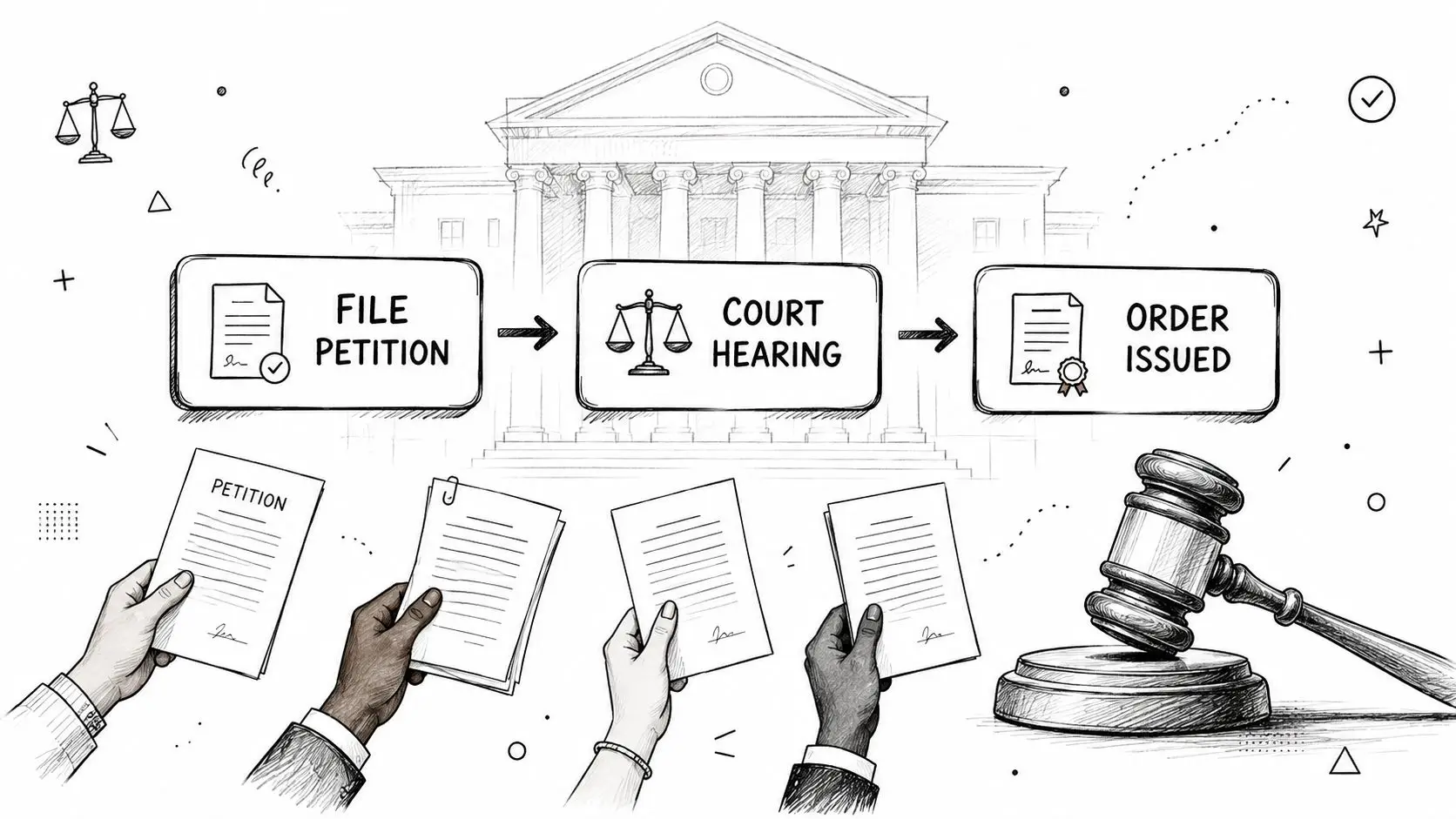
According to Knesset committee material on the guardianship process, appointing a guardian requires a thorough judicial evaluation with expert input and typically takes 3 to 6 months, although urgent orders can issue immediately. For commercial planning, that means a company may face uncertainty for months, not days.
What the court expects
The process doesn’t begin with a casual request. It begins with a formal petition supported by evidence. In practice, the court expects medical or social material, an affidavit filed through counsel, and a social worker assessment before the judge reaches a final position.
That procedural structure matters because each stage creates opportunities for influence for business stakeholders. If the affected person is central to a company, counsel should map those milestones as part of a crisis timetable.
A simplified sequence looks like this:
- Petition filed: the applicant asks the court to appoint a guardian.
- Expert material submitted: the file usually includes medical or social evidence.
- Social worker inquiry: the assessment shapes the court’s understanding of necessity and scope.
- Hearing and participation: the individual must be notified and may challenge the material.
- Order issued or limited: the court defines who acts, in which fields, and for how long.
What foreign companies often overlook
The person who is the subject of the petition remains an active legal actor in the process. That person has participation rights, and those rights can matter later if a bank, board, or opposing shareholder relies on a defective order.
For international corporations, the immediate tasks are often practical rather than doctrinal:
- Preserve internal records: meeting minutes, mandates, bank authorities, and side letters.
- Track interim authority: identify who may sign during the pending period.
- Review notice exposure: determine whether the company should inform banks, auditors, or co-investors.
- Prepare substitution planning: line up alternate signatories and board mechanisms.
A pending petition is not the same as a final transfer of business authority. Companies that treat the filing itself as the endpoint often surrender leverage too early.
Urgent cases require even tighter control. Courts can act quickly when the facts justify it. Therefore, foreign businesses shouldn’t wait for a final judgment before securing operational continuity, document custody, and litigation readiness.
Commercial Litigation Risks and Asset Protection
A צו אפוטרופסות moves from family law into hard commercial exposure. Once authority over financial affairs changes, disputes over assets, banking access, and contractual control often follow.

The cross-border dimension is no longer marginal. Data from the ADVOC network shows that 34% of cross-border crisis cases in the last 12 months involved disputes over enforcement of Israeli guardianship orders on foreign-held assets, as noted by RNC Group. For multinational businesses, that makes the issue a live risk category, not a theoretical anomaly.
Where disputes erupt first
The first commercial conflict usually appears in one of three places. The bank, the boardroom, or the contract file.
A guardian appointed over financial matters may seek to control funds, review ownership positions, or challenge prior transactions. Sometimes the guardian acts cautiously. Sometimes the guardian acts aggressively, especially where family pressure, inheritance concerns, or existing shareholder conflict already existed.
The highest-friction scenarios often include:
- Joint venture bank accounts: one side wants continuity, while the bank demands formal proof of authority.
- Shareholding disputes: a guardian may contest transfers, voting arrangements, or prior undertakings.
- Lease and operations pressure: a counterparty may exploit uncertainty to reopen obligations under a commercial lease dispute framework.
- Payment interruption: suppliers and lenders may freeze performance until authority becomes clear.
Cross-border enforcement and bank restrictions
Foreign executives often ask whether an Israeli guardianship order can affect assets outside Israel. The practical answer is yes, but not automatically and not uniformly. The legal result depends on the foreign bank, local compliance rules, account structure, and the documents presented.
Still, once the issue reaches a bank, delay becomes expensive. Compliance teams don’t reward ambiguity. They contain it.
That is why cross-border exposure often turns into a restrictions problem before it becomes a judgment problem. The same operational instincts that apply to account limitations in other crises also apply here, especially where institutions move toward defensive freezes or review protocols similar to broader bank account blockage scenarios.
A foreign bank doesn’t need to decide the whole Israeli case to restrict movement. It only needs enough uncertainty to pause action.
What works and what fails in litigation posture
Reactive outrage fails. So does sending broad letters that accuse everyone of bad faith before the company has reviewed the order, the petition file, and the current signing matrix.
A better posture usually includes a disciplined split between personal status issues and corporate property issues. They overlap, but they aren’t identical. A guardian may have valid authority over the individual’s affairs while still lacking power over specific corporate acts, beneficial interests, or co-owned assets.
The stronger litigation pathway usually involves:
| Litigation objective | Better approach | Poor approach |
|---|---|---|
| Protect funds | Clarify mandate, ownership chain, and bank authority documents | Assume all assets are personal and exposed |
| Preserve contract rights | Review change-of-control, incapacity, and notice clauses | Suspend performance without legal basis |
| Restrain overreach | Challenge scope with targeted evidence | Attack the concept of guardianship in general |
| Manage cross-border risk | Coordinate Israeli and foreign counsel early | Let each jurisdiction improvise separately |
The strategic aim is control. Not noise. Companies that separate immediate asset preservation from later merits disputes usually keep more room to negotiate, contest, or ring-fence exposure.
Your Strategic Checklist for Corporate Governance
A company can’t eliminate incapacity risk, but it can structure around it. The strongest protection begins long before anyone files for a guardianship order.
Boards, founders, and foreign investors should build incapacity planning into the same governance architecture that already addresses death, deadlock, and misconduct. In practice, that means treating personal legal capacity as a commercial continuity issue.
Preventive measures that belong in the documents
Some protections must be hardwired into the corporate file.
- Incapacity clauses in shareholder agreements: define temporary voting arrangements, substitute signatories, and emergency board mechanics.
- Tiered signing rights: avoid concentrating all local authority in one Israeli principal.
- Access segregation: keep banking credentials, corporate records, and regulatory passwords under controlled internal custody.
- Persistent power planning: where appropriate, use a valid enduring mechanism before incapacity arises, rather than waiting for court intervention.
A company that has already mapped these issues also handles related turbulence better during broader commercial crisis management situations.
Reactive steps once a proceeding starts
Once a petition is filed or an order is issued, speed matters. So does precision. Generic resistance usually wastes time.
A practical response should include the following:
- Obtain the exact court order. Summary descriptions from relatives or employees aren’t enough.
- Compare the order against internal authorities. Check board minutes, bank mandates, shareholder undertakings, and side agreements.
- Freeze avoidable unilateral acts. Don’t allow asset transfers, document destruction, or improvised amendments.
- Engage with the court process where standing exists. Companies sometimes need to protect a defined commercial interest.
- Prepare challenge material if overreach appears. Scope matters more than emotion.
Replacing or terminating a guardian
A guardianship order isn’t untouchable. The court may terminate or replace a guardian if the guardian fails to perform properly, and the revocation process requires a new medical opinion and a reasoned application to the court, as reflected in Israeli legal guidance on replacing a guardian.
That principle matters to business actors for two reasons. First, it provides a basis for action when a guardian mishandles assets or exceeds the mandate. Second, it allows a lawful path to reduce restrictions if the person regains capacity or a more suitable structure becomes available.
Governance discipline works best before the crisis. Legal intervention works best at the first sign of mandate drift.
The best checklist is therefore dual-track. Preventive drafting for calm periods. Immediate evidentiary control for active disputes.
When to Engage Counsel for Guardianship Matters
Counsel should enter the matter when the first sign of formal incapacity appears, not after the bank blocks movement or the counterparty files suit. Delay usually hands the timeline to others.
The legal problem isn’t only the order itself. The problem is the chain reaction around it. Authority to sign, authority to vote, authority to instruct banks, and authority to settle disputes may all splinter at once.
The inflection points that justify immediate action
Certain triggers should move the matter from internal discussion to legal escalation:
- A pending petition affects a key signatory or shareholder
- A bank requests guardianship documents before processing instructions
- A newly appointed guardian challenges prior transactions
- A foreign institution questions whether Israeli authority reaches offshore assets
- A family dispute starts shaping company records or corporate access
The recommended strategic path involves proactive structuring of commercial agreements and immediate legal intervention if a guardianship proceeding begins. That path safeguards its advantage, preserves evidence, and reduces the chance that third parties will define the scope of the crisis before the company does.
Budget questions often slow down the first call. For executives comparing external advice models, a general guide to legal consultation pricing can help frame the issue. In high-stakes guardianship-related commercial matters, however, the larger cost usually comes from delay, not from the consultation itself.
A צו אפוטרופסות may begin as a protective measure for an individual. For international corporations, it can quickly become a dispute about control, enforceability, and asset preservation across borders. Early, specialized analysis remains the prudent course.
Avoid costly mistakes and contact RNC Group now if an Israeli partner, founder, executive, or shareholder becomes subject to a guardianship proceeding that threatens assets, banking access, or commercial control.
This article provides general information and doesn’t constitute legal advice. It isn’t a substitute for legal counsel suited to specific facts, jurisdictions, and documents, and any reliance on it is at the reader’s own risk.
SEO Title: צו אפוטרופסות A Guide for International Firms in Israel
Slug: guardianship-order-in-israel-international-firms
Meta Description: Learn how a צו אפוטרופסות can affect asset control, bank restrictions, and commercial litigation for international firms operating in Israel.
Focus Keyphrase: צו אפוטרופסות
Synonyms: Guardianship Order in Israel, Israeli guardianship order, asset control in Israel, bank account restrictions in Israel
Schema Type: Article