
When entering the Israeli market, one of the most critical preliminary decisions is the selection of your legal structure. This choice extends beyond mere paperwork; it fundamentally shapes liability, tax obligations, and operational autonomy. For partnerships, the partnership agreement in Israel serves as the foundational blueprint, particularly when navigating the distinctions between a General Partnership (GP) and a Limited Partnership (LP). The core of this decision rests on understanding the vastly different liability structures inherent in each.
The Foundational Choice: Partnership vs. Company
For any corporate entity or business client, grasping this initial choice is paramount. A well-informed decision, guided by experienced counsel, establishes a robust foundation for long-term success. The central issue is whether Israeli law recognizes the business as a legal entity separate from its owners, a concept that dictates the level of personal risk you assume.
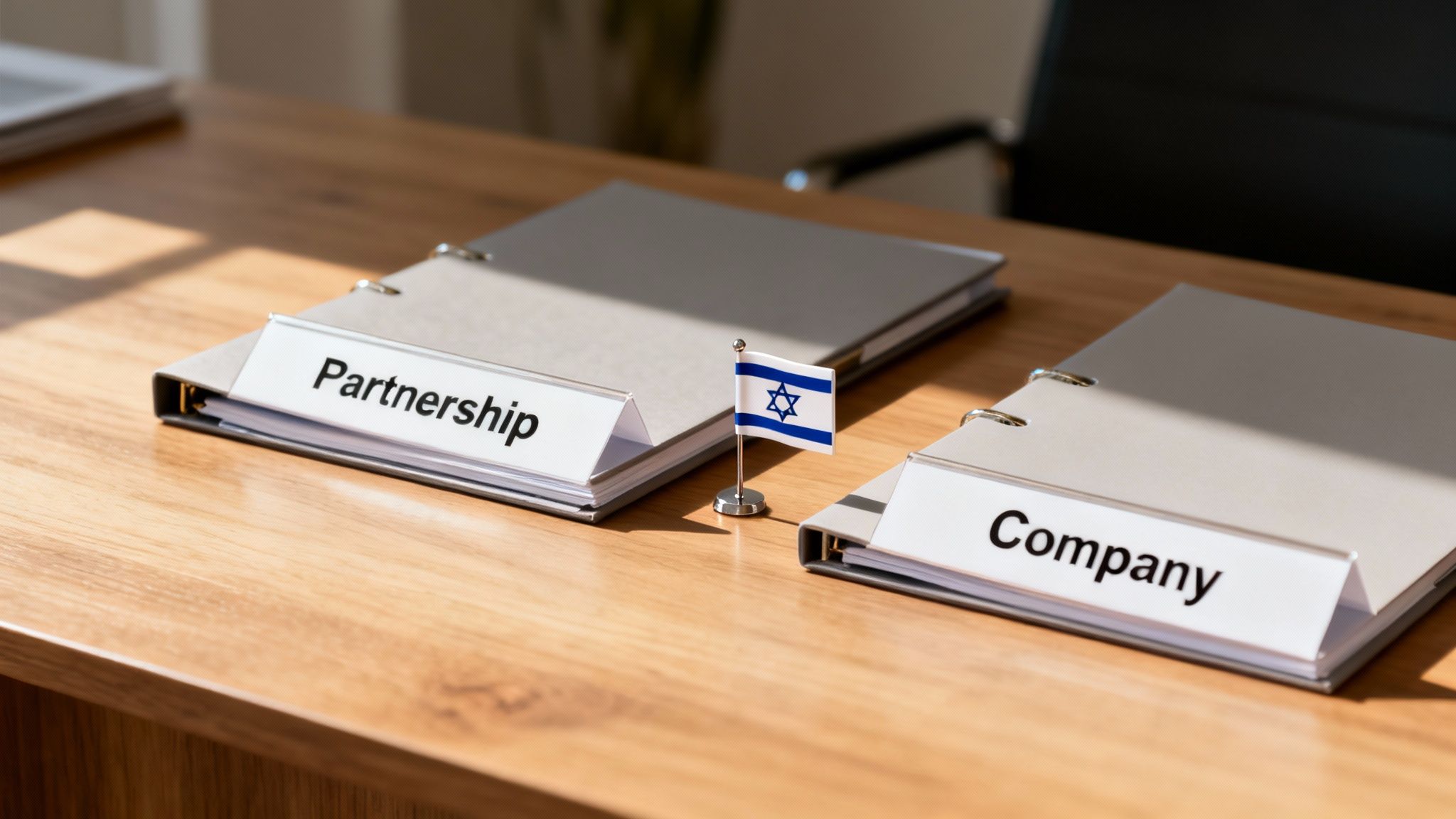
Partnership vs. Company: The Critical Difference of Legal Personality
The most significant distinction between a Registered Partnership (Shutfut Rashuma) and a Company (Hevra Ba’am) is the principle of separate legal personality. A company is its own legal entity, distinct from its shareholders. This separation creates the “corporate veil,” a legal shield protecting the personal assets of shareholders from the company’s debts and liabilities. If the business faces financial distress, shareholders’ personal wealth—their homes, savings, and other assets—is generally secure.
A partnership, conversely, operates under a different legal paradigm. It is not recognized as a separate entity from its partners. Legally, the partnership is its partners. Consequently, there is no corporate veil, meaning the partners’ personal assets are potentially at risk to satisfy the business’s obligations. This structural distinction has profound implications for risk management and strategic planning.
Liability of General Partners vs. Limited Partners
The allocation of personal risk is where the structural differences between partnership types become most pronounced. A clear understanding of these liability frameworks is essential before committing to any agreement.
- General Partners (GPs): Every partnership, whether General or Limited, must have at least one general partner. GPs are typically responsible for the active management of the business. With this control comes unlimited liability. This means their personal wealth is fully exposed to cover the partnership’s debts and legal obligations, without limitation.
- Limited Partners (LPs): Found exclusively in Limited Partnerships, LPs are passive investors. Their defining feature is limited liability, which is contractually capped at the amount of their capital contribution. This structure is ideal for investors seeking to participate in a venture’s potential upside without exposing their entire net worth to its risks.
A well-crafted Limited Partnership allows an investor to capitalize on the potential of an Israeli venture while strictly containing their financial downside to the initial investment. This balanced risk-reward profile makes it a highly popular vehicle for sophisticated capital allocation.
The Advantage of Tax Transparency (Pass-Through Entity)
A significant structural advantage of Israeli partnerships is their “tax transparency,” also known as “pass-through” taxation. Unlike a standard corporation, which is taxed on its profits at the corporate level and whose shareholders are taxed again on dividend distributions (double taxation), a partnership avoids this inefficiency.
The partnership itself pays no income tax. Instead, all profits and losses “pass through” directly to the individual partners. Each partner then reports their share of the income on their personal tax returns. For corporate and international clients, this model offers substantial financial advantages, particularly when integrated into a comprehensive, cross-border tax strategy.
The Defining Factor: Liability in Israeli Partnerships
In business structuring, liability is the foundational element upon which all other considerations rest. In Israel, the choice between a General and a Limited Partnership is dictated almost entirely by this critical factor: the degree of personal financial risk that the partners are willing to assume. This determination must precede any discussion of profit distribution or management roles, as it forms the cornerstone of a secure and sustainable investment.

This is not a matter of mere terminology; it concerns the legal boundary between business debts and personal assets. Selecting the wrong structure without a meticulously drafted partnership agreement in Israel can have devastating financial consequences, exposing partners to liabilities that far exceed their original capital contributions.
The Unshielded Risk of a General Partner
Every partnership in Israel must include at least one General Partner (GP), who actively manages the business. This control is coupled with the highest level of financial exposure: unlimited personal liability.
This liability is governed by the legal principle of “joint and several liability.” In practical terms, this means each General Partner is individually responsible for 100% of the partnership’s debts. A creditor can legally pursue any single GP for the entire outstanding amount, regardless of that partner’s ownership percentage. That partner is then left with the challenging and often litigious task of seeking contribution from the other partners.
This structure necessitates absolute trust and a precisely detailed agreement. One partner’s error in judgment or contractual misstep can place every other General Partner’s personal wealth in jeopardy.
The Protected Position of a Limited Partner
The Limited Partner (LP) role offers a starkly different risk profile, tailored for investors who wish to provide capital without engaging in day-to-day management. This structure, exclusive to Limited Partnerships, establishes a legal firewall around the LP’s personal assets.
The guiding principle is limited liability. An LP’s potential loss is strictly confined to their invested capital. If an LP contributes $100,000, that sum represents the absolute maximum of their financial exposure. Creditors cannot access their personal bank accounts, real estate, or other investments.
However, this protection is contingent upon the LP remaining passive. If a Limited Partner becomes involved in the management of the business, they risk forfeiting their protected status and assuming the unlimited liability of a General Partner.
Structuring Your Partnership Agreement for Liability
While Israeli law establishes these liability frameworks, your partnership agreement is the instrument that implements and enforces them. A generic template is insufficient; the agreement must be a strategic document tailored to your specific circumstances. Key clauses include:
- Role Delineation: The agreement must unambiguously define who is a General Partner and who is a Limited Partner, outlining the specific duties and restrictions for each role.
- Capital Contributions: This section must detail the exact capital commitment of every partner, which serves as the liability cap for LPs.
- Indemnification Clauses: These provisions create internal accountability, protecting partners from liability arising from the negligence or misconduct of another partner.
- Management Authority: The agreement must explicitly prohibit LPs from participating in management to ensure their liability shield remains intact.
Ultimately, the choice of partnership structure represents a strategic trade-off between control and protection. For corporate entities entering the Israeli market, this decision requires a sophisticated understanding of local law and commercial norms. A precisely drafted partnership agreement in Israel is your primary risk management tool, designed to ensure that your financial exposure is defined, intentional, and under your control from the outset.
How Tax Transparency Impacts Your Bottom Line
Beyond liability, the financial architecture of an Israeli partnership offers a significant structural advantage: tax transparency. This “pass-through” model is fundamentally different from the standard corporate tax structure and presents a strategic opportunity for maximizing returns, especially for corporate and international clients.
A standard corporation is subject to double taxation: the entity pays corporate income tax on its profits, and shareholders are taxed again on their personal income when those profits are distributed as dividends. This multi-layered taxation erodes overall returns.
An Israeli partnership circumvents this issue entirely. The partnership itself is not a taxable entity and pays zero income tax. Instead, all profits and losses “pass through” directly to the partners. Each partner reports their allocated share of the partnership’s income on their individual tax returns, resulting in a single layer of taxation at their respective rates.
The Strategic Value of a Pass-Through Structure
This single layer of taxation provides immediate and tangible financial benefits. For ventures anticipating initial losses, such as those in real estate development or technology, partners can often use these losses to offset other taxable income. For profitable enterprises, it ensures that a greater portion of the earnings remains with the investors.
While this structure is advantageous, it introduces cross-border complexities that require expert navigation of tax treaties between Israel and the partners’ home countries. Without strategic counsel, a perceived tax benefit can quickly devolve into a compliance issue with unforeseen tax liabilities in multiple jurisdictions.
The core principle is efficiency. A pass-through structure ensures profits are taxed only once, preserving capital and enhancing the ultimate return on investment. For international entities, a meticulously drafted partnership agreement in Israel is the critical tool that aligns this tax-efficient model with global compliance demands.
Cross-Border Tax Planning and International Agreements
For U.S. investors, the tax implications are deeply interwoven with long-standing economic treaties. The US-Israel Free Trade Agreement (FTA), in force since 1985, is the bedrock of our bilateral commerce. It’s fueled a 473.4% surge in U.S. exports and turned Israel into a trade partner worth over $50 billion a year. But this framework isn’t just about shipping goods; it’s about structuring investments. RNC Group has built FTA-compliant clauses into partnership agreements that have delivered returns over 25% higher for U.S. firms in Israeli tech and real estate, simply by optimizing for these tax efficiencies.
This proves a crucial point: an effective partnership agreement has to be more than a simple contract. It needs to be a sophisticated instrument of financial strategy, crafted for the specific tax realities of every single partner. This means:
- Allocating profits and losses in the most tax-efficient way for everyone involved.
- Structuring distributions to line up perfectly with international tax reporting rules.
- Addressing withholding tax obligations for any non-resident partners.
At the end of the day, the tax transparency of an Israeli partnership is a powerful feature. But its true value is only unlocked through sharp, forward-thinking legal and financial planning. It’s what transforms your partnership agreement from a mere legal formality into a primary driver of your venture’s success.
Crafting Your Strategic Partnership Agreement
Mutual trust is an essential component of any successful partnership, but it is not a substitute for a robust legal framework. A successful international venture is built upon a strategic partnership agreement in Israel—one that anticipates challenges, mitigates risk, and provides a clear path to resolution. The use of a generic, off-the-shelf template is wholly inadequate for a serious investment and invites significant legal and financial peril.

This document is the constitution of your business. Each clause must be meticulously engineered to address the unique dynamics of your venture, eliminating the ambiguity that often leads to costly and relationship-damaging disputes.
A Checklist Of Non-Negotiable Clauses
While every partnership agreement should be customized, certain clauses form the structural core of any resilient framework. Defining these with absolute precision is non-negotiable.
- Capital Contributions: Detail the precise amount, form (cash, property, intellectual property), and timing of each partner’s investment.
- Profit and Loss Distribution: Specify the exact methodology for dividing profits and allocating losses. Whether proportional to capital, tied to performance metrics, or based on another formula, this must be clearly articulated.
- Management and Decision-Making: Define the operational chain of command and establish clear voting thresholds for critical actions such as incurring debt, selling major assets, or admitting new partners.
- Dispute Resolution Protocols: Establish a multi-tiered approach to resolving disagreements, typically starting with mandatory mediation before escalating to arbitration or litigation in a pre-determined jurisdiction.
- Comprehensive Exit Strategies: Implement clear “buy-sell” provisions that dictate the process for a partner’s withdrawal, retirement, incapacitation, or death, ensuring business continuity.
Fortifying Agreements with Geopolitical Realities
A sophisticated agreement must also account for the external operating environment. Israel’s market stability is reinforced by decades of strong international support, a unique strategic asset. Since 1948, U.S. aid to Israel has surpassed $300 billion when adjusted for inflation, creating a security and economic umbrella that mitigates certain regional risks. This underlying stability is an asset that can be leveraged in negotiations and strategic planning. You can learn more about the history of U.S. aid to Israel and its economic implications from the Council on Foreign Relations.
Your partnership agreement is the single most important investment you can make in the future of your venture. It is the strategic foundation that will determine whether your business thrives under pressure or fractures in the face of challenges.
Your Questions About Israeli Partnerships, Answered
Venturing into a new market always brings up questions. For foreign companies and investors looking at Israel, getting a handle on the practical side of forming and managing a partnership is the first step toward making smart, confident decisions. Here are some direct answers to the questions we hear most often.
Can a Foreign Company Be a Partner in an Israeli Partnership?
Yes, absolutely. A foreign corporation or individual can be either a General or a Limited Partner in an Israeli partnership, a structure often used for international joint ventures and real estate deals.
However, it’s not just a matter of signing a document. The process requires specific registrations with both the Israeli Registrar of Partnerships and the Israel Tax Authority to be fully compliant. For non-resident partners, handling these filings perfectly is non-negotiable—it’s what legitimizes your presence and heads off any risk of regulatory trouble.
What Happens If There Is No Written Partnership Agreement?
This is a scenario you want to avoid at all costs. Operating without a formal, written agreement means your entire venture defaults to the rules of the Israeli Partnerships Ordinance.
Think of the Ordinance as a “one-size-fits-all” template that will dictate everything—profit sharing, management control, how the partnership dissolves. It’s almost guaranteed that these generic terms will not align with what you and your partners actually intended. A custom-drafted partnership agreement in Israel is the only way to override these defaults and build a framework that genuinely protects everyone involved.
How Are Partnership Disputes Typically Resolved in Israel?
Your partnership agreement is where you decide this, long before any disagreement arises. You must explicitly define the dispute resolution process. The most common paths are mediation, binding arbitration, or litigation in the Israeli courts.
A well-built agreement will name the governing law and the preferred method and location for handling disputes. For our international clients, we often recommend structured clauses that start with mediation and escalate to arbitration if needed. These methods are private, efficient, and commercially sensible—a far better alternative to a drawn-out, public court battle that can drain resources and destroy business relationships.
Successfully navigating a partnership agreement in Israel demands legal guidance from experts who understand the cross-border landscape. At RNC Group, our deep experience in commercial law and crisis management gives you the strategic edge needed to create agreements that are not just legally sound, but commercially sharp.
Don’t leave your investment to chance. Secure it with a partnership agreement built for the international stage. Contact RNC Group today to structure your Israeli partnership with confidence.
This article does not constitute legal advice and is not a substitute for consulting with a qualified attorney. Do not rely on the contents of this article for taking or refraining from taking any action.