
Will your 2026 dispute strategy survive the moment the tribunal is formed, or will it fail before the merits even begin? For multinationals handling disputes with an Israeli nexus, the arbitrator selection process often decides the practical course of the case long before the first witness statement, jurisdiction objection, or settlement discussion.
That reality is easy to miss. Many businesses still treat arbitrator appointment as an administrative step buried inside a dispute clause. In practice, the tribunal shapes pace, document management, disclosure discipline, procedural fairness, and how quickly pressure builds on the other side.
An Israeli element can sharpen those risks. The underlying contract may sit at the intersection of local business practice, cross-border performance, multilingual evidence, and urgent commercial exposure. That combination rewards a disciplined selection strategy, not a generic search for a prestigious name.
The Arbitrator Selection Process Your Critical First Move
What usually shapes the outcome of an arbitration before the tribunal hears a single witness? In many high-value cases, it is the choice of arbitrator.

The arbitrator selection process decides who will control procedure, define the evidentiary burden in practice, and set the pressure points for settlement. Multinationals often underestimate that at the start. They focus on the underlying contract claim, while the other side focuses on who will hear it. That is a costly mistake.
In disputes with an Israeli nexus, the selection exercise requires sharper judgment than many standard guides suggest. The tribunal may need to assess conduct spread across several jurisdictions, documents in multiple languages, local business norms, and decision-making chains that do not always fit neatly into common law or civil law expectations. A well-credentialed arbitrator can still be the wrong choice if that arbitrator is slow on case management, uneasy with urgent interim issues, or lacks feel for the commercial context in which Israeli counterparties often operate.
Why this decision outranks most early filings
The first serious strategic decision in an arbitration is often not the memorial, the jurisdiction objection, or the interim relief application. It is the appointment process.
A poor choice changes the economics of the case. Procedure becomes heavier than it should be. Disclosure fights expand. Hearing dates slip. Management time increases. Settlement discussions then happen under procedural pressure rather than commercial logic. For a multinational dealing with supply disruption, technology rights, shareholder conflict, or a failed joint venture involving Israel, those process costs can matter as much as the final award.
A good tribunal does the opposite. It narrows what matters, keeps the timetable credible, and distinguishes between necessary evidence and tactical noise. That improves more than efficiency. It improves negotiating position.
Practical rule: Treat arbitrator selection with the same discipline used for choosing lead deal counsel in a major acquisition or response counsel in a corporate crisis.
Appointment systems are also more structured than many clients assume. Institutions often limit party control through roster methods, ranking procedures, confirmation review, and default appointments if the parties stall. The practical point is simple. Selection strategy must start early, because by the time a formal list arrives, the room for influence may already be narrower than management expected.
The commercial lens multinationals should use
The right question is not whether a candidate is prominent. The right question is whether that candidate fits the dispute you are about to fight.
Sometimes the priority is speed. Sometimes it is technical fluency in energy, software, distribution, or life sciences. Sometimes the deciding factor is how the tribunal is likely to handle document production, privilege issues, or parallel court proceedings. In matters touching Israel, I often see another factor move up the list. Can this arbitrator separate genuine regional complexity from advocacy theater, and keep the case focused on the contract, the evidence, and the remedy?
That is where experienced parties gain an advantage. They do not select for prestige alone. They select for procedural discipline, independence under pressure, and commercial judgment that can survive a hard-fought record.
How Arbitrators Are Actually Appointed
Who controls tribunal formation once a dispute has started. The answer is usually less than management expects, and that gap matters.
In a high-value cross-border case, appointment mechanics can affect timing, settlement pressure, and even interim relief strategy before the merits are addressed. For multinationals with an Israeli nexus, I treat this stage as an early risk-allocation exercise. A vague clause or a slow nomination can hand procedural initiative to the other side or to the institution.
The standard three-member architecture
The common structure is a three-member tribunal. Each party appoints one arbitrator, and those two appointees select the chair. If they do not agree within the applicable time limit, the institution or appointing authority takes over. As explained in Wolters Kluwer’s discussion of the three steps in appointing arbitrators, that architecture affects both speed and neutrality, which is why the clause should address it expressly.
The business implication is straightforward. A party appointment gives each side some influence over the tribunal’s composition, but the chair often has the strongest practical effect on the case. Chairs usually set the procedural tone, manage hearing efficiency, and shape deliberations. In closely fought disputes, especially where there are parallel Israeli court applications or urgent operational issues, that role carries obvious strategic weight.
A sole arbitrator can work well for smaller or less complex claims. It reduces cost and can move faster. The trade-off is reduced party input and a greater concentration of procedural discretion in one person.
The main appointment pathways
In practice, appointments usually happen through one of three routes:
- Party nomination under institutional rules: each side nominates, subject to independence checks, confirmation, and deadline rules.
- Direct institutional appointment: the institution appoints one or more tribunal members itself, either from the start or after a default.
- Ad hoc appointment under the clause and an appointing authority: the parties rely on their contract, chosen rules, and a designated authority if cooperation breaks down.
These routes produce different strategic advantages.
Party nomination gives more room to shape the tribunal, but it also creates more scope for challenge, delay, and tactical deadlock. Institutional appointment reduces that risk and can be useful where the commercial relationship has already collapsed. Ad hoc mechanisms offer flexibility, but only if the clause is drafted with enough precision to survive a real dispute rather than a signing-room assumption of future cooperation.
Where control is narrower than clients expect
Even where a party has the right to nominate, that right is rarely absolute. Institutions may review independence, nationality, availability, language ability, and any qualifications required by the clause. If a nomination creates avoidable conflict issues or suggests the arbitrator cannot run the case efficiently, confirmation may become its own fight.
That point is often missed in contracts tied to Israel. Parties focus on seat, governing law, and enforceability. They spend less time on appointment failure scenarios. Yet in disputes involving sanctions questions, regional supply disruption, shareholder breakdowns, or sensitive technology transfers, the first procedural contest is often over who will sit on the tribunal and who will choose the chair.
A poorly drafted clause creates room for satellite disputes over deadlines, qualifications, and fallback authority. A well-drafted clause closes those arguments off early.
What the appointment phase looks like in real cases
The sequence is usually predictable. A request for arbitration is filed. The respondent answers. The clock starts for nominations or comments on the appointment process. Conflict disclosures are exchanged. The institution confirms appointments or intervenes after a missed deadline or failed agreement on the chair.
Problems arise quickly when the clause is silent on basics.
I have seen disputes lose weeks over questions that should have been settled in the contract: whether the tribunal should have one arbitrator or three, whether a chair must have a nationality different from the parties, whether industry expertise is required, and who steps in if one side refuses to nominate. In a fast-moving supply or JV dispute, those lost weeks can affect evidence preservation, executive attention, and settlement posture.
Strong arbitration clauses do more than send disputes to arbitration. They allocate appointment authority, set deadlines, and define the fallback process if cooperation fails.
What works and what fails
What works is specificity. Name the institution. State the number of arbitrators. Set out the appointment method. Include a fallback mechanism. Address language, seat, and any qualification requirements that matter to the dispute profile.
What fails is imported boilerplate. Clauses copied from unrelated domestic contracts often break down under cross-border pressure. That problem is especially common in deals involving commercial collaborations and long-term business arrangements, where the parties expect the relationship to endure and give too little attention to how appointments will function once trust has gone.
For multinational companies dealing with Israeli counterparties, affiliates, assets, or operations, the tactical objective is clear. Reduce discretion where delay would hurt you. Preserve institutional support where cooperation may fail. And draft the appointment mechanism on the assumption that the first real fight may begin before the tribunal is even in place.
Choosing Your Arbitrator Strategic Criteria
Prestige alone is a weak filter. The right arbitrator for a shareholder deadlock may be the wrong one for a supply dispute, a licensing fight, or a post-acquisition fraud claim. Effective selection starts with measurable screens, then moves to strategic fit.

The four filters that matter first
The baseline test is practical, not ceremonial. According to Travers Smith’s guidance on mastering the nomination process, parties should assess expertise, impartiality, availability, and any diversity or nationality requirements. The same guidance stresses that structured pre-screening reduces post-appointment disqualification risk, which is especially important in high-value disputes.
Those filters sound obvious. They are still mishandled all the time.
- Expertise: Industry literacy matters when the record turns on operational details, pricing mechanisms, regulatory context, or technical performance.
- Impartiality: This isn’t a box-ticking exercise. The question is whether any relationship, prior involvement, or pattern of appointments could later distract from the merits.
- Availability: A brilliant arbitrator with no time can damage the case more than a merely good one with disciplined availability.
- Nationality or diversity factors: These can affect party confidence, optics, and legitimacy, especially in disputes with cross-border sensitivity.
The criteria sophisticated parties test next
After the baseline screen, strong legal teams usually test for procedural temperament. Some arbitrators run tight conferences, limit unnecessary submissions, and isolate the key issues quickly. Others permit sprawling process, either from caution or habit.
That distinction has direct business consequences. A company facing parallel regulatory, operational, or reputational stress may need a tribunal that can keep the arbitration from becoming a source of unmanaged escalation. In that sense, procedural discipline connects closely with broader crisis management planning.
A candidate’s résumé shows where they have been. Their case management style shows what your next year will feel like.
Cultural fluency and commercial judgment
Cross-border disputes involving Israeli parties often include evidence that doesn’t translate neatly. Internal messages, board dynamics, negotiation style, distribution practice, and urgency expectations may all carry local commercial context. An arbitrator needn’t be Israeli to understand that context, but the tribunal must be able to read it accurately.
Many selection exercises fail at this stage. Parties overvalue pure doctrinal brilliance and undervalue commercial judgment. They choose someone impressive on paper who doesn’t move the case with practical discipline.
A stronger approach asks narrower questions. Can the arbitrator understand sector-specific evidence quickly? Will the arbitrator distinguish a genuine emergency from procedural theater? Can the arbitrator absorb multilingual material without losing the commercial thread?
What usually backfires
The worst strategy is to choose a familiar name without defining the case objective first. If the business needs a fast and tightly managed process, don’t appoint someone known for expansive procedure. If the dispute turns on technical performance, don’t prioritize general reputation over subject matter command.
A disciplined arbitrator selection process starts with the dispute’s commercial demands, then works backward to the profile.
Comparing Major Arbitration Institutions
Institutional choice changes appointment dynamics in ways many contracts ignore. The institution affects how candidates are generated, how much influence the parties retain, and how challenge decisions are handled. For multinationals with an Israeli nexus, those differences can influence both outcome and settlement pressure.
What the market signals about appointment patterns
Institutional cultures differ, and appointment data shows why that matters. The International Bar Association notes that arbitral panels have historically been predominantly older white males. It also reports that Stockholm Chamber of Commerce data showed only 23% of appointed arbitrators were women in 2019, and that only 13% of LCIA arbitrator appointments in 2018 were first-time appointments, down from 17% in 2017, according to the IBA discussion on diversity and appointment patterns. The same source states that 93% of respondents identified expertise and 91% identified efficiency as the most important features when appointing arbitrators.
Those figures don’t prove one institution is better than another. They do show that repeat appointments and experience preferences remain powerful. That has strategic implications if a party wants a broader field, a more established profile, or a tribunal composition with specific legitimacy considerations.
Arbitral institution selection process comparison
| Institution | Default Appointment Method | Party Influence | Challenge Mechanism |
|---|---|---|---|
| ICC | Party nominations are typically subject to institutional confirmation, with the institution stepping in if the process fails | Moderate to high, but filtered through institutional scrutiny | Institutional review under its rules |
| LCIA | Strong institutional role in appointment under the rules | Moderate | Institutional challenge procedure |
| SCC | Rule-based institutional administration with party input depending on the clause and tribunal structure | Moderate | Institutional challenge procedure |
| ICSID | Uses a list procedure in which each party may strike candidates and rank the remainder, then the best-ranked candidate is appointed, and ties are resolved by ICSID | Structured party input | Institutionally managed under the applicable framework |
| UNCITRAL or ad hoc | Depends on the clause and any appointing authority | Potentially high, but only if the clause is well drafted | Depends on rules and appointing authority |
Why these differences matter in practice
ICC-style scrutiny can help when a party wants stronger oversight around confirmation. LCIA-style administration can suit parties that prefer a firm institutional hand. SCC may be attractive where parties value a structured but commercially familiar framework. ICSID has its own architecture and is especially relevant in investor-state settings or state-linked disputes.
The ad hoc path can work very well, but only with disciplined drafting and realistic counterparties. If relations are already strained, ad hoc appointment can become a tactical battleground.
The algorithm and list-management issue
A quieter issue deserves more attention. Some institutions and major forums increasingly use institutional design and algorithmic tools to generate or manage candidate lists. As noted in Bressler’s discussion of FINRA arbitrator selection process updates, FINRA states that it uses a computer algorithm to randomly generate lists, automatically excludes known conflicts, and has amended rules affecting how public and chair-eligible arbitrators are selected, including changes that can give some public arbitrators two chances to appear on public lists. The same discussion points out that pool management can include drawing from alternate locations when needed.
That matters because the available pool is not always static. It may be dynamic, institution-managed, and shaped by internal design choices the parties don’t fully see. Businesses that assume the pool just “appears” without institutional influence may misjudge how much control they really have.
Institution choice is also arbitrator choice by other means.
For Israeli-facing transactions, the practical lesson is simple. The institution isn’t just a logo in the clause. It is part of the tribunal selection machinery.
Drafting Your Tribunal Appointment Clause
Most arbitrator selection problems begin years before the dispute. They start when the contract treats the clause as boilerplate. A strong appointment clause allocates control in advance and prevents procedural friction when relations have broken down.
The core elements that should never be omitted
A useful clause answers the following questions clearly:
- How many arbitrators will hear the case: A sole arbitrator may suit lower-complexity disputes. A three-member tribunal often suits larger cross-border conflicts.
- Who appoints whom: State whether each side appoints one arbitrator, whether the institution appoints all, or whether a list procedure applies.
- What qualifications are required: Consider industry expertise, language capability, nationality restrictions, or experience with specific contract structures.
- Which institution, seat, and language apply: These choices shape procedure and can reduce future argument over logistics and fairness.
- What is the fallback if a party refuses to cooperate: This point matters more than most parties expect.
Two drafting models
A clause for a sole arbitrator usually favors speed and simplicity. It can fit disputes where confidentiality and procedural economy are more important than broad tribunal composition.
A clause for three arbitrators usually fits high-value or technically complex disputes. It gives each side more confidence in the process, but it also adds cost and can slow appointment if the mechanism isn’t tightly drafted.
Consider these examples:
- Sole arbitrator model: “Any dispute arising out of or in connection with this agreement shall be finally resolved by arbitration administered by [institution]. The tribunal shall consist of one arbitrator appointed in accordance with the rules of that institution. The seat shall be [city]. The language shall be [language].”
- Three-member model: “Any dispute arising out of or in connection with this agreement shall be finally resolved by arbitration administered by [institution]. The tribunal shall consist of three arbitrators. Each party shall appoint one arbitrator, and the two party-appointed arbitrators shall appoint the chair. Failing appointment within the prescribed period, the institution shall appoint the missing arbitrator or chair. The seat shall be [city]. The language shall be [language].”
Draft for the transaction, not for precedent
A franchise agreement may justify a different tribunal profile than a technology license, supply arrangement, or long-term property commitment. The clause should match the risk structure of the deal. That is particularly important in agreements with long performance tails, including commercial lease agreements, where operational disputes can outlast the original business assumptions.
What tends to fail is over-customization without operational clarity. Parties insert qualification language that sounds precise but creates room for later argument. “Internationally recognized expert” is vague. “Fluent in English and experienced in cross-border distribution disputes” is more useful.
The best drafting style is short, direct, and executable under stress.
Challenging And Replacing An Arbitrator
What should a company do when concerns about an arbitrator arise after the tribunal is already in place?
Act early, and act on evidence. A challenge can protect the legitimacy of the award. It can also disrupt the case, strain credibility with the institution, and hand the other side an argument that your team is trying to change the tribunal because the merits are going badly. In disputes with an Israeli nexus, that judgment is often sharper because parallel court applications, enforcement risk, and management attention can all become more difficult if the arbitration process starts to look unstable.
When a challenge becomes necessary
The usual grounds are lack of independence, lack of impartiality, or a conflict that was not disclosed in time. Sometimes the problem is obvious. A professional or financial connection appears that should have been revealed from the start. Sometimes it develops more gradually through procedural conduct, selective responsiveness, or new facts that make an earlier disclosure look incomplete.
The practical point is simple. Challenge analysis is rarely about one fact in isolation. It is about whether the record, taken together, creates a legitimate concern that the parties will not get a fair hearing.
That is why weak challenges are expensive. They consume time, invite procedural delay, and can harden the tribunal’s view of the challenging party even if the application fails.
The strategic calculation
A sound challenge starts with two questions. Is the concern serious enough to affect confidence in the process? Is the timing still defensible?
Counsel should not wait until an adverse procedural ruling or a difficult evidentiary hearing to raise an issue that was visible weeks earlier. Institutions notice that pattern. So do co-arbitrators. For multinational parties, the cost is not only legal. Delay can affect reserves, reporting lines, deal planning, and enforcement strategy across more than one jurisdiction.
A disciplined response usually includes:
- Immediate fact collection: Preserve disclosures, correspondence, hearing transcripts, and any procedural directions that give context to the issue.
- Rule and deadline review: Check the applicable rules, challenge procedure, and any time limits before sending accusations or informal complaints.
- Privilege and messaging control: Keep the internal assessment tight. Challenge papers often become the factual foundation for later arguments about due process.
- Business impact analysis: Measure the likely delay, cost, and hearing disruption against the risk of keeping the arbitrator in place.
- Replacement planning: Assess how a substitute will be appointed, whether prior procedural steps will stand, and how much of the timetable may need to be rebuilt.
A challenge should strengthen the enforceability of the process, not weaken your position in the name of short-term tactics.
Replacement is not an administrative detail
Replacement can be as consequential as the challenge itself. A new arbitrator may need time to review the record, revisit procedural decisions, or ask for parts of the hearing to be repeated. In a fast-moving supply, construction, technology, or shareholder dispute, that can materially change settlement pressure and litigation posture outside the arbitration.
This matters in Israel-linked disputes because parties are often managing a wider risk picture at the same time. Asset exposure, interim relief strategy, and potential court interaction do not pause just because the tribunal composition is in flux.
In practice, astute parties make their replacement plan before filing the challenge. They identify what must be preserved, what can be reheard, and how to explain the application as a process-protection measure rather than a tactical complaint. That preparation usually separates credible challenges from failed ones.
The same discipline applies in other business crises that become harder and more expensive once left unattended, including operational disruption caused by bank account blockages. Early review usually gives management better options than emergency repair.
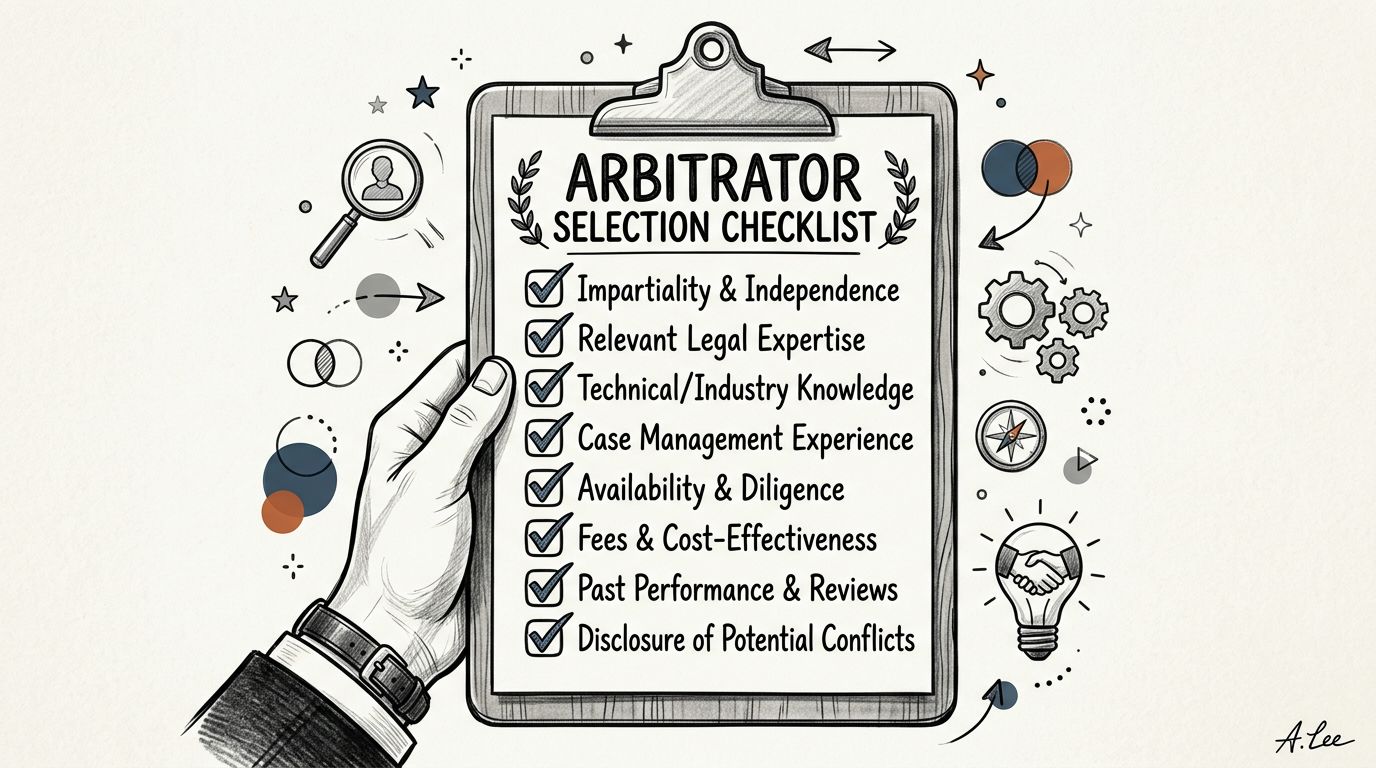
Arbitrator Selection Checklist For Your Company
A busy in-house team needs a working checklist, not abstract guidance. The right checklist should operate before the dispute, during the selection phase, and after appointment.
Before any dispute arises
- Audit dispute clauses: Confirm the institution, seat, language, number of arbitrators, and fallback appointment mechanism.
- Match clause to contract risk: Use different appointment structures for low-value operational disputes and high-value strategic disputes.
- Define qualification priorities early: Decide whether industry expertise, speed, language capability, or cross-border experience matters most.
During the arbitrator selection process
- Build a long list before names are exchanged: Include realistic alternatives in case disclosures remove a preferred candidate.
- Test for availability in real terms: Ask whether the candidate can manage conferences, submissions, and hearing dates without drift.
- Review conflict risk aggressively: Consider not only direct conflicts but also relationships that could later create pressure.
- Assess procedural temperament: Look for signs of disciplined case management, not only subject matter strength.
After appointment
- Monitor new disclosures: Keep reviewing developments throughout the case.
- Track procedural behavior: Watch whether the tribunal is preserving proportionality and timetable integrity.
- Prepare for replacement risk: If concerns emerge, gather facts early and preserve every relevant communication.
A strong checklist should also connect arbitration planning to the broader transaction framework. That is especially true when the dispute sits inside multilingual negotiations, layered side letters, or related corporate arrangements such as partnership and founders’ agreements, where governance friction can spill directly into tribunal selection choices.
Conclusion The Strategic Imperative
What is the first decision in an arbitration that can still change the economics of the case before positions harden?
In many cross-border disputes, it is the arbitrator selection process. For multinationals dealing with an Israeli nexus, that decision affects more than hearing management. It can shape interim relief strategy, the tribunal’s tolerance for delay, the pressure each side feels to settle, and the odds that an eventual award will be practical to enforce across jurisdictions.
The companies that handle this well treat tribunal selection as part of dispute design. They do not default to familiar names or recycled clauses. They set the appointment mechanics at the contract stage, choose candidates against the business reality of the dispute, and stay alert to disclosure, timetable, and replacement risk once the tribunal is in place.
That discipline matters most where the legal file sits inside a broader commercial problem. Israeli-related disputes often involve parallel court applications, multilingual records, urgent business decisions, and counterparties using procedure as a pressure tool. In that setting, the wrong arbitrator can increase cost, slow relief, and weaken settlement position. The right one can impose order early and protect the value of the claim or defense.
This article provides general information only and doesn’t constitute legal advice. Legal outcomes depend on the contract, the facts, the applicable rules, and the relevant jurisdiction, so specific advice should be obtained before acting on any issue discussed here.