
A court win in 2026 can still produce a commercial loss. If the counterparty moved value across borders before judgment, the actual dispute is no longer liability alone. It becomes asset recovery international, and that changes how boards should allocate risk from the first week of the case.
Too many companies still treat enforcement as a postscript. That approach fails when the opponent uses nominee shareholders, layered holding vehicles, or a bank in a jurisdiction that respects local pressure more than foreign paper. In cross-border disputes, recovery planning must begin before pleadings harden and before assets drift into structures designed to waste time.
The Strategic Framework for Complex Commercial Litigation
Cross-border litigation works only when the legal theory and the recovery path support each other. A strong merits case can still underperform if counsel sues in the wrong forum, asks for relief too late, or ignores where the defendant stores value.
The scale of the problem explains why this isn’t a niche concern. The World Bank has estimated the cross-border flow of proceeds from criminal activity, corruption, and tax evasion at US$1–1.6 trillion per year, with roughly half looted from developing and transition economies, as summarized in this overview of international asset recovery. That volume tells boards something simple. Money moves fast, and bad actors already understand jurisdictional arbitrage.
Litigation must be built for enforcement
A domestic statement of claim often reflects local habits. International recovery requires a different discipline. Counsel must ask where the assets are, who controls them, what emergency relief can preserve them, and which findings will later matter in recognition or enforcement proceedings abroad.
That changes early decisions in practical ways:
- Choose the lead forum carefully: The recommended path is the forum that combines procedural speed, credible interim remedies, and a record likely to travel well abroad.
- Plead tracing facts early: If value passed through affiliates, trusts, service companies, or family offices, the pleading should reflect that structure from the start.
- Build an evidence chain for foreign judges: Foreign enforcement courts often care less about the rhetoric of the dispute and more about process, notice, and defensible proof.
Practical rule: A judgment isn’t an asset. It’s leverage. Value appears only when the claimant can identify, restrain, and execute against property the defendant can’t move in time.
What boards often misjudge
Boards usually focus on merits, publicity, and legal spend. They often underweight timing risk. Delay favors the defendant because delay allows transfers, refinancing, debt layering, and strategic insolvency filings.
A second error is overreliance on formal victory. In practice, successful campaigns treat litigation, intelligence gathering, settlement pressure, and enforcement preparation as one coordinated file, not four separate projects.
A disciplined board should ask management for answers to these questions before approving major litigation:
| Board question | Why it matters |
|---|---|
| Where is the recoverable value likely held | It determines whether the case should be designed around shares, receivables, bank funds, or real property |
| What can be frozen before trial | Interim pressure often matters more than final wording in the judgment |
| Which affiliates may hold beneficial ownership | The formal debtor may be judgment-proof by design |
| What settlement pressure exists outside court | Commercial leverage can shorten a long enforcement cycle |
Immediate steps for risk mitigation
The recommended strategic path is front-loaded.
- Map the asset universe first. Start with corporate records, transaction flows, public filings, and counterparties.
- Test urgency early. If dissipation risk exists, prepare emergency applications before sending threatening correspondence that gives the target time to move value.
- Align local and foreign counsel. Pleadings, affidavits, and orders should be drafted with later cross-border use in mind.
- Separate symbolic wins from recoverable outcomes. A smaller claim with executable targets often beats a broader claim that ends with an empty judgment.
- Review adjacent pressure points. Licensing, banking, governance, insolvency, and reputational exposure can all affect settlement behavior.
Boards that understand this framework stop asking, “Can we win?” They start asking, “Can we convert a win into money?”
Understanding Global Legal and Procedural Frameworks
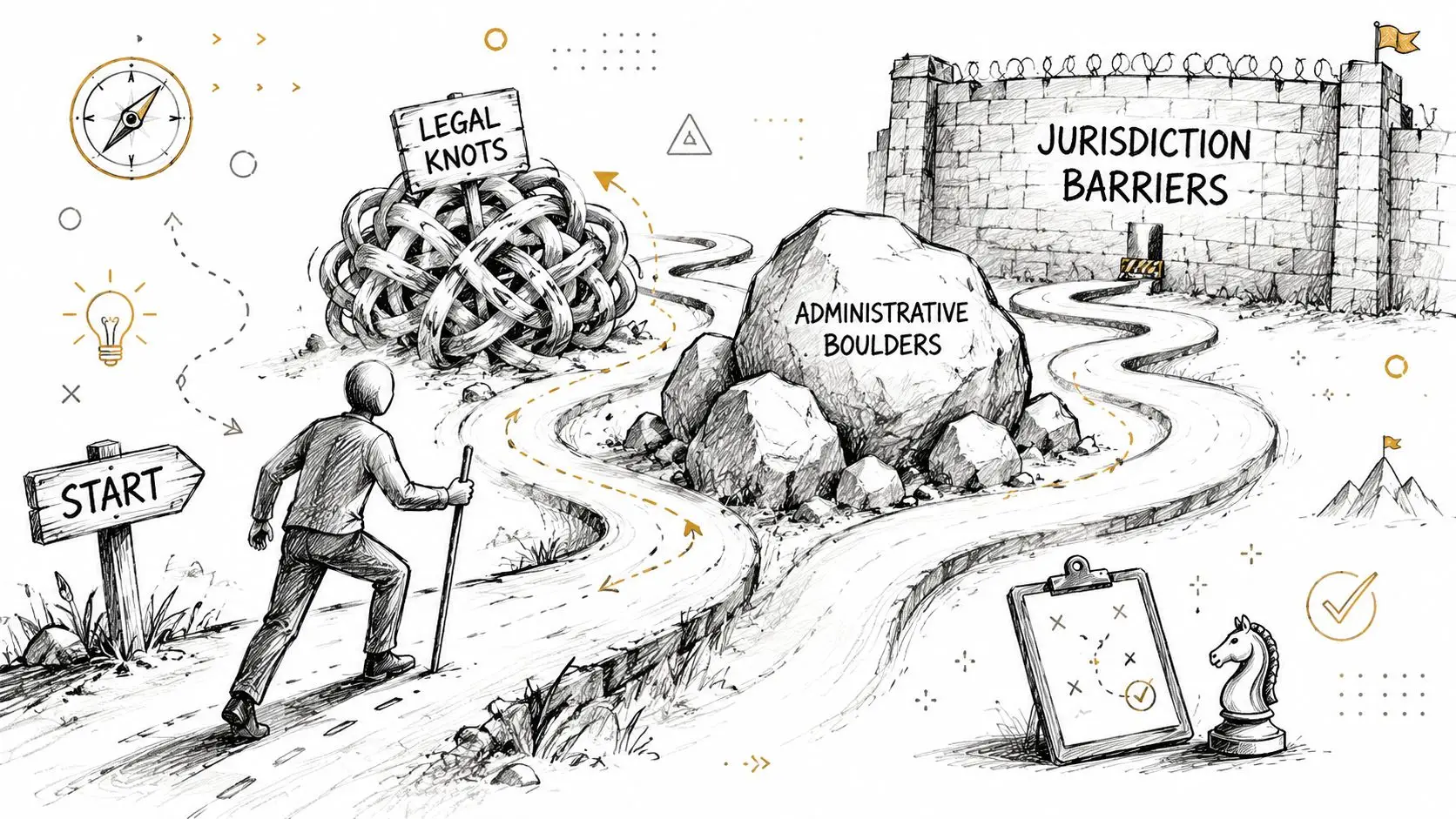
What converts a strong claim into money once the assets, decision-makers, and payment routes cross three or four jurisdictions?
The answer usually lies in a patchwork of court rules, treaty mechanisms, regulatory constraints, and local filing practice. Boards often overestimate what formal cooperation can achieve on its own. In politically complex matters, especially those involving Israeli and multinational firms, the legal framework matters less as a theoretical system and more as a crisis-management toolset that must be sequenced under pressure.
What the formal framework can do
International asset recovery rests on several recognized channels. UNCAC treats asset recovery as a fundamental principle and provides a common basis for cooperation on tracing, restraint, confiscation, and return of assets. In practice, that shared language can help counsel frame requests in a way that foreign authorities and courts are prepared to process, even where the underlying dispute is commercial and the local politics are difficult.
The main instruments are familiar, but their value depends on timing and fit:
- Jurisdictional gateways: These determine where proceedings can be issued and whether the court can bind the defendant, third parties, or the asset itself.
- Recognition and enforcement rules: These govern whether a judgment, freezing order, or insolvency-related decision from one forum can be recognized abroad.
- Mutual legal assistance channels: These can support evidence gathering and public-law restraint measures, but they rarely move at the pace a private claimant wants.
- Local procedural devices: Disclosure orders, attachment processes, shareholder remedies, insolvency filings, and third-party debt procedures often matter more than treaty text.
Practitioners should also use better primary references when citing cross-border recovery activity. The underlying data discussed by commentators is better traced to the StAR initiative’s Asset Recovery Watch than to secondary commentary. That distinction matters because weak attribution is often a warning sign of weak case preparation.
Where formal channels lose time and value
Formal rights do not create speed. They do not reduce political resistance. They do not preserve assets that have already been transferred to a cooperative affiliate, pledged to a lender, or moved into a regulatorily sensitive account.
That gap between legal availability and commercial usefulness is where many campaigns fail.
A board should expect friction in four recurring areas:
- Delay: Service, translation, judicial scheduling, and foreign evidence requirements can consume the window in which relief would still matter.
- Mismatch: Some cooperation channels are designed for state enforcement, not a private claimant trying to secure a commercial recovery.
- Political drag: Local influence, corruption risk, sanctions exposure, or state-linked counterparties can affect how enthusiastically a request is handled.
- Evidentiary conversion: Material gathered lawfully in one jurisdiction may need a different form, witness foundation, or authentication process before another court will accept it.
In urgent matters, the practical question is not whether a treaty route exists. The question is whether that route should run in parallel with private court applications, regulatory outreach, insolvency pressure, or negotiated standstill arrangements.
A practical operating model
The strongest recoveries are built country by country. Counsel should decide early which forum is suited for merits litigation, which forum is suited for interim restraint, and which forum is suited for execution against actual value. Those are often three different places.
That approach becomes even more important where currency controls, banking approvals, or central bank reporting rules affect how funds can be frozen, repatriated, or settled. A useful primer on understanding SA exchange control rules illustrates how regulatory friction can affect timing and settlement structure even when South Africa is only one part of a wider enforcement picture.
| Tool | Useful for | Common limitation |
|---|---|---|
| Local court proceedings | Getting immediate orders against parties, banks, or assets in that forum | Little direct effect outside the forum |
| Recognition actions abroad | Converting an existing judgment into executable relief | Procedural delay and merits-related resistance framed as public policy |
| Treaty and convention channels | Supporting cross-border cooperation and official requests | Slow handling times and uneven state participation |
| Informal coordination among counsel and investigators | Identifying the fastest route, preserving evidence, and adapting to local practice | Results depend heavily on network quality and disciplined case management |
A judgment is not the recovery. It is a tool for creating pressure, preserving options, and positioning the claimant to collect before value disappears. The legal framework matters, but in serious cross-border disputes, results usually turn on execution discipline, sequencing, and the willingness to adjust course as facts change.
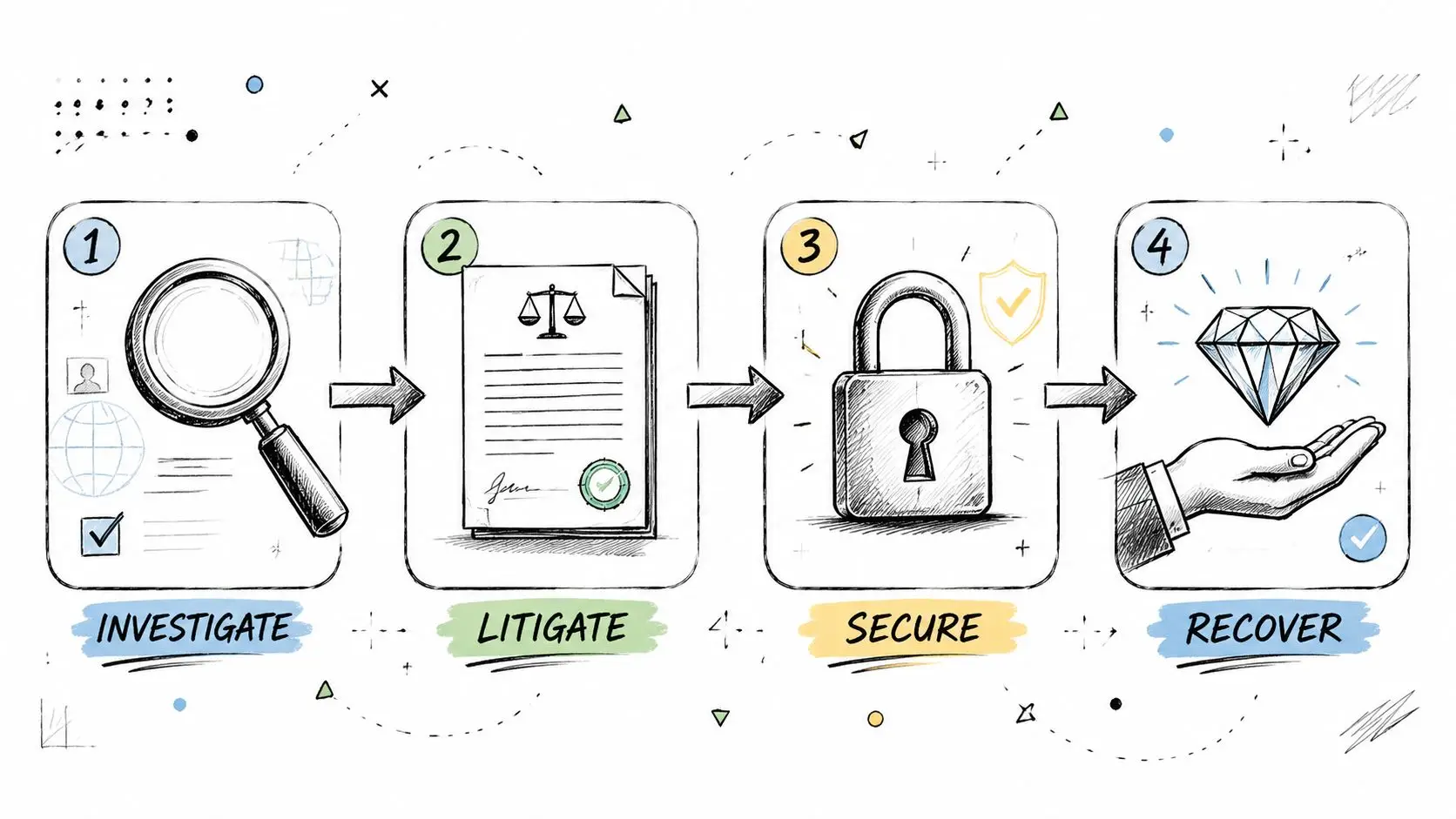
The Four Phases of a Strategic Asset Recovery Campaign
An effective campaign moves in phases, but the phases overlap. Investigation informs emergency relief. Emergency relief shapes settlement. Enforcement planning affects what claims are worth pleading at all.
Phase one investigates and traces
The first task is to identify what exists and who really controls it. That usually means corporate registry work, document review, payment reconstruction, open-source intelligence, and targeted forensic accounting.
The key question isn’t only where money went. It’s which assets are realistically reachable and worth preserving. A claimant can spend months proving suspicious movement that leads nowhere executable.
Useful outputs from this phase include:
- Ownership maps: Direct and indirect shareholding, nominee structures, and controlling persons.
- Transaction chronologies: Payment routes, intercompany transfers, refinancing events, and unusual pre-dispute movements.
- Asset priority lists: Banked cash, receivables, vessels, inventory, shareholdings, intellectual property revenue streams, and real estate each require different tactics.
- Evidence preservation plans: If the counterparty may destroy records, the litigation team must preserve proof before confrontation escalates.
Phase two secures emergency relief
Once dissipation risk becomes concrete, delay can destroy value. Counsel should assess whether freezing relief, disclosure orders, preservation measures, or urgent interim injunctions are available before the defendant receives advance warning.
The nexus of recovery and operational pressure is evident. A targeted freeze can shift the commercial balance far more than a forceful letter sent too early. In serious disputes, that sequencing forms part of broader crisis management strategy.
Board-level insight: Emergency relief should target the asset that changes behavior fastest. Freezing the wrong asset can increase cost without improving settlement position.
Not every case justifies immediate applications. Some defendants panic and move badly when confronted. Others already have a playbook and will react with speed, insolvency threats, and offshore transfers. The right choice depends on the profile of the counterparty, not on abstract doctrine.
Phase three runs the main legal action
The principal proceedings must serve the recovery objective. That means the claim should produce findings and orders that help later enforcement rather than merely perform well in the original court.
A disciplined merits strategy usually includes:
- Claims against the right defendants. The contracting party may not be the only relevant target.
- Relief that travels. Declaratory language can matter less than executable monetary or proprietary orders.
- Evidence adapted for multiple forums. Witness statements and exhibits should anticipate scrutiny elsewhere.
- Settlement pressure at defined moments. Mediation, without-prejudice dialogue, and negotiated standstills work best when tied to measurable procedural advantage.
Many claimants over-litigate the merits and under-litigate control. If the defendant’s holding company, lender group, or distribution partner feels no pressure, the case may remain legally strong and commercially weak.
Phase four enforces and repatriates
Enforcement begins before judgment. By the time a final order arrives, the team should already know where to register it, which assets to target first, and what local obstacles are likely.
A realistic enforcement file may involve:
- Recognition applications in one jurisdiction
- Execution against bank balances in another
- Share seizure or charging orders elsewhere
- Negotiation with receivers, banks, or custodians
- Tax, regulatory, or compliance steps before funds return
The most common mistake at this phase is fragmentation. Separate lawyers in separate states can each do competent local work and still fail collectively because no one controls the sequence.
What tends to work and what usually doesn’t
| Tactic | Usually works when | Often fails when |
|---|---|---|
| Fast tracing before notice | The target still uses formal institutions | The structure is already fully offshore and opaque |
| Early freezing application | There is real dissipation risk and identifiable value | The application is rushed and under-evidenced |
| Aggressive merits litigation | The defendant still has reputation or financing to protect | The defendant is prepared to absorb delay |
| Multi-forum enforcement | One team controls timing and message | Local actions proceed without coordination |
Asset recovery international succeeds when teams respect sequence. Investigate first, freeze decisively where justified, litigate with enforcement in mind, and execute before the structure goes cold.
Navigating Common Challenges and Strategic Obstacles
The defendant’s best asset-protection move often happens before the claimant files anything. By the time the dispute becomes visible, ownership may already sit behind shell companies, layered trusts, secured creditors, and service providers who claim limited knowledge.

Structural opacity
Offshore entities aren’t unlawful by themselves. The problem arises when they fragment proof and raise the cost of attribution. A claimant may know the economic reality and still struggle to prove beneficial ownership in a form the court will accept.
Three patterns appear repeatedly:
- Layering across affiliates: Funds move through related entities under invoices or loan agreements that are hard to challenge quickly.
- Trust and nominee arrangements: Formal title and real control split apart.
- Strategic debt loading: The target grants security or creates insider claims to move the claimant down the queue.
These structures don’t always block recovery. However, they do force counsel to shift from a simple debt claim to a control-and-tracing campaign.
Political and procedural drag
Some problems are legal. Others are institutional. Courts may be slow, local banks may respond conservatively, and regulators may freeze decision-making where sanctions or politically exposed persons appear in the background.
A claimant should expect trouble if any of the following appear early:
| Obstacle | Why it matters |
|---|---|
| Unclear beneficial ownership | It weakens interim applications and slows execution |
| Competing insolvency filings | It can pause or fragment the recovery route |
| Sanctions exposure | It changes communication, payment, and enforcement mechanics |
| Weak disclosure culture | It raises the cost of obtaining admissible evidence |
The hardest cases rarely fail because the legal theory is weak. They fail because the evidence arrives too late, the freeze comes too late, or the claimant treats a hostile jurisdiction as if it were merely unfamiliar.
Evidence across borders
Foreign evidence creates recurring friction. Different systems apply different standards to affidavits, notarization, translation, privacy, banking secrecy, and chain of custody.
That has two strategic consequences. First, collection must begin before the dispute hardens. Second, legal teams should assume that some evidence will need adaptation, supplementation, or replacement before a foreign judge will rely on it.
The recommended mitigation steps are practical:
- Secure native records early: Screenshots and summaries rarely suffice when the other side contests authenticity.
- Use translators who understand litigation risk: In cross-border files, a poor translation can distort a corporate resolution, guarantee, or payment instruction.
- Prepare for sanctions review: Even lawful recovery efforts can stall if payment rails, counterparties, or beneficial owners trigger compliance alarms.
- Challenge the structure, not only the debt: If the defendant uses shell companies, the response must address ownership architecture, not just non-payment.
The point isn’t to romanticize difficulty. It’s to recognize that complex obstruction is usually systematic. Recovery succeeds when the claimant responds with a more disciplined system.
Special Considerations for Israeli and Multinational Firms
What happens when a company has a sound claim, a plausible forum, and collectible assets on paper, but the case still does not move? For Israeli and multinational firms, that is often the primary challenge. In politically sensitive or institutionally cautious jurisdictions, recovery can stall for reasons that have little to do with the merits and everything to do with timing, local credibility, compliance concerns, and the defendant’s ability to recast a commercial dispute as a political or reputational risk.

Political sensitivity changes the recovery model
Boards should assume that some jurisdictions will treat an Israeli claimant, or a multinational linked to Israeli ownership, financing, technology, or management, as a higher-friction file from the outset. The paperwork may be in order. The court route may exist. The execution path may still narrow once local banks, registries, counterparties, or officials decide the matter carries added sensitivity.
That is why formal treaty analysis is only the starting point. The practical question is who can test institutional appetite early, identify where resistance is likely to appear, and adjust the sequence before the defendant gains time to move value or harden local opposition.
Why local credibility matters
In difficult forums, private professional relationships often determine whether a filing receives serious attention or quiet delay. Trusted local counsel can assess how a judge is likely to react to an urgent application, whether a bank will freeze or merely request more documents, and which arguments will be seen as commercial rather than geopolitical.
This does not replace legal process. It improves the chances that legal process will produce a commercial result.
For Israeli companies, the trade-off is usually straightforward. A purely formal approach may look cleaner from a head office perspective, but it can miss the operational realities that decide speed and enforceability. A more customized approach can produce better movement, provided the claimant keeps strict control over local agents, evidence handling, communications, and settlement authority.
A crisis-management approach is often more effective than a litigation-only approach
The stronger campaigns usually run on several tracks at once, with one team controlling sequence and message.
- Forum track: Choose the jurisdiction that offers the best combination of interim relief, enforcement prospects, and judicial predictability.
- Local execution track: Use trusted in-country professionals to test what can be enforced, against which assets, and with what degree of resistance.
- Compliance track: Review sanctions exposure, banking sensitivities, beneficial ownership issues, and payment route constraints before taking public or procedural steps.
- Commercial pressure track: Examine distributors, lenders, insurers, customers, and joint venture partners who may influence the defendant’s settlement calculus.
- Communications track: Keep public statements, regulator contact, and internal stakeholder messaging disciplined. In sensitive jurisdictions, careless rhetoric can damage the file.
This is the point many companies miss. Asset recovery in a politically complex setting is often a controlled incident-response exercise, not a sequence of isolated court applications.
Israeli firms should prepare for institution-to-institution resistance
Some resistance comes from the defendant. Some comes from the surrounding system. Banks may ask for more than the legal minimum. Registries may process more slowly. Counterparties may become harder to approach once they sense political risk. Counsel should plan for that from the first week, not treat it as a surprise halfway through the matter.
The same pattern appears in domestic pressure situations. Sudden bank account blockages in Israel often show how quickly technical rights can be overtaken by compliance caution and internal risk controls. Cross-border recovery raises that problem to a higher level. The winning response usually combines legal pressure, document discipline, and carefully timed engagement with the institutions that control payment or transfer.
What multinational groups should change internally
Multinational groups can improve outcomes well before any dispute arises.
- Keep ownership and authority records current. If the claimant’s own structure is unclear, foreign courts and banks become harder to persuade.
- Draft contracts with enforcement in mind. Jurisdiction, security, notice, payment, and information rights often determine what recovery options remain later. The same discipline appears in well-structured commercial agreements and contract planning.
- Preserve multilingual records in native form. Boards should expect contested authenticity, translation disputes, and demands for original corporate documents.
- Set escalation triggers early. Waiting for certainty usually benefits the asset holder, not the claimant.
- Control who speaks for the company. In cross-border disputes, inconsistent messages from legal, finance, compliance, and commercial teams can damage settlement and enforcement at the same time.
A board confronting a hostile or politically complex jurisdiction should ask two practical questions at the outset. Which filing route is legally available? Which combination of local credibility, compliance planning, and commercial pressure gives that route a realistic chance of producing recovery?
Illustrative Cases and Realistic Cost Timelines
The clean cases are rare, but they do exist. Consider a supplier dispute between companies in two jurisdictions with a stable enforcement relationship. The defendant holds receivables and a disclosed bank account in the same country where its operating subsidiary trades. The claimant secures judgment, registers it abroad, attaches the receivables, and resolves the matter through payment before a full execution sale becomes necessary.
That is the textbook file. The legal path is visible, the assets are commercial and documented, and the defendant still has something to lose from continued non-compliance.
A more difficult pattern
Now compare a harder case. A technology company claims diversion of funds by a former partner. The partner routes value through service entities, uses offshore vehicles, and threatens insolvency while denying control over the destination accounts.
No single filing solves that problem. The claimant must trace movement, test beneficial ownership, seek targeted interim relief, and sequence pressure across more than one forum. Settlement may still happen, but only after the defendant sees that the claimant can convert suspicion into executable proof.
Cost discipline matters, but false economy is common. Companies often save money on early tracing and then spend much more later trying to fix avoidable gaps.
Costs and funding expectations
No serious adviser should promise a universal budget. Cross-border recovery costs depend on the number of forums, urgency, resistance level, translation burden, and whether enforcement requires parallel insolvency or regulatory work.
The usual cost models include:
- Hourly billing: Useful where the scope is still moving.
- Stage-based fees: Useful where the campaign has clear procedural phases.
- Conditional or success-linked elements: Sometimes appropriate, but they require careful definition of what counts as recovery.
- Third-party funding: Potentially useful in high-value cases with identifiable assets and a credible enforcement path.
A board should ask for a budget range by phase, not a single all-in number. Investigation, interim relief, merits litigation, and enforcement create different risk profiles and should be priced accordingly.
Timelines should be measured realistically
Simple matters can move quickly if the asset is visible and the forum is responsive. Complex recoveries usually take years, not months. That isn’t pessimism. It’s the consequence of multiple courts, disclosure fights, ownership disputes, and resistance tactics designed to exhaust patience.
A useful internal planning model separates the file into three clocks:
| Clock | What it measures |
|---|---|
| Legal clock | Time to obtain orders, judgments, and recognition |
| Asset clock | Time before the defendant can move or dilute value |
| Commercial clock | Time before management fatigue or business distraction changes settlement appetite |
The shortest clock usually controls strategy. If the asset clock is shortest, emergency action outranks perfection. If the commercial clock is shortest, negotiated containment may preserve more value than procedural maximalism.
Knowing When to Engage Specialist Counsel
Some warning signs mean the matter has already crossed from ordinary litigation into recovery risk. Once that shift happens, delay becomes expensive in ways that standard case management won’t capture.
The first red flag is movement across borders. If funds, shares, inventory, or intellectual property revenue moved into another jurisdiction, the board should assume recovery complexity has increased sharply. The second is structural opacity. Shell companies, nominee directors, insider security interests, and sudden restructuring almost always signal deliberate friction.
A practical escalation checklist
The recommended path is immediate specialist review when any of these appear:
- Assets moved abroad: The enforcement plan must start before the merits case is mature.
- Affiliates now hold value: The formal debtor may no longer be the true recovery target.
- A politically exposed person or sanctions issue appears: Ordinary collection assumptions no longer apply.
- Banks, custodians, or counterparties stop cooperating: Institutional risk has entered the file.
- Document control is weak across languages: Evidence quality may collapse at the worst moment.
- Management still treats the matter as a standard debt claim: Strategic underreaction often causes the largest losses.
A specialist team adds value early because it reframes the question. Instead of asking how to finish the lawsuit, it asks how to secure its strategic advantage, align jurisdictions, and create a route to actual payment.
That shift should happen before the defendant completes the transfer chain, before witnesses disappear into separate entities, and before local counsel in three countries begin making uncoordinated moves. Early intervention doesn’t guarantee success, but late intervention usually guarantees a harder and more expensive path.
Avoiding costly mistakes in cross-border disputes requires early judgment, disciplined sequencing, and a recovery plan built for the jurisdictions that matter. Businesses facing asset flight, foreign freezing risk, or politically complex enforcement issues can contact RNC Group now to assess the strategic path before their strategic position weakens.
Disclaimer: This article provides general information only and doesn’t constitute legal advice. It doesn’t create an attorney-client relationship, and any reliance on it is at the reader’s own risk. Specific matters require advice suited to the facts, jurisdictions, and procedural posture involved.
SEO Title: Asset Recovery International and Cross-Border Litigation Strategy
Slug: asset-recovery-international
Meta Description: Asset recovery international requires more than treaties. Learn the legal frameworks, recovery phases, Israeli cross-border risks, and when to act fast.
Focus Keyphrase: asset recovery international