
A failed deal, a disputed board vote, or a founder fallout often gets dismissed as ordinary commercial friction. In cross-border ventures, that assumption can be expensive. The harder question is whether the conduct reflects a breach of fiduciary duty, because that changes the remedies, the evidence, and the bargaining power on both sides.
Foreign directors and partners often focus on contract wording, valuation mechanics, and jurisdiction clauses. Those matter. Yet fiduciary exposure usually turns on something less visible: whether a decision-maker used entrusted power in a way that violated the beneficiary’s justified expectations.
That distinction matters in Israel-facing disputes because the commercial reality is rarely local only. The documents may be governed by one law, the assets may sit in another state, and the people making the decisions may live elsewhere. Once a claimant frames the case as a breach of fiduciary duty instead of mere negligence or bad judgment, the dispute can move from compensation to control, tracing, disclosure pressure, and personal exposure.
Your Fiduciary Duty in 2026
A weak outcome doesn’t always mean anyone did anything wrong. But a weak outcome paired with undisclosed interests, selective disclosure, or misuse of position often marks the beginning of a far more dangerous case.
For foreign executives involved in Israeli companies, that line is easy to miss. Many assume that if the company approved the transaction and the paperwork exists, the risk is mostly contractual. That is often the wrong starting point.
A fiduciary claim asks a different question. It asks whether the person trusted with authority used that authority for the beneficiary’s interest, or for another purpose. That is why the same facts can support a contract dispute, a fraud claim, and a breach of fiduciary duty claim at the same time.
Why this becomes a crisis quickly
A fiduciary allegation rarely stays confined to legal pleadings. It affects governance, investor communications, internal reporting, banking relationships, and board cohesion.
Globally, 49% of companies possess a formal crisis management plan, and fewer than 25% actively practice these plans through drills, according to RNC’s crisis management analysis. That matters because a breach allegation often converts a board problem into a reputational and operational event before the court decides anything.
Practical rule: Treat a fiduciary allegation as both a litigation file and a crisis file from day one.
Three immediate consequences usually follow:
- Decision paralysis: Directors stop acting freely once personal exposure becomes plausible.
- Document sensitivity: Emails, WhatsApp messages, side letters, and informal approvals suddenly matter.
- Narrative risk: The claimant frames the case as betrayal of trust, not just commercial disappointment.
That is why knowledgeable parties don’t ask only, “Who breached the contract?” They ask whether the facts also support a fiduciary theory that changes the pressure points in the case. In disputes involving founders, investors, and management, that framing often determines who gains an advantage first.
For readers assessing wider boardroom exposure in Israeli ventures, the broader scope of complex commercial litigation in Israel is often the better context than any single cause of action.
Defining The Fiduciary Relationship
A fiduciary is not just someone who owes performance. A fiduciary holds power that must be exercised for someone else’s benefit within the scope of the relationship.

A useful business analogy helps. A vendor sells a service at arm’s length. A fiduciary acts more like a trusted guardian of assets, authority, or decision-making power. The first relationship is transactional. The second is relational and duty-laden.
Who usually falls into this category
In commercial practice, fiduciary questions most often arise around people who control decisions or information on behalf of others. That commonly includes directors, officers, partners, controlling managers, and agents with meaningful authority.
The defining feature is not job title alone. It is entrusted discretion. If a person can steer company opportunities, influence disclosure, approve related-party transactions, or deploy company resources, fiduciary analysis usually enters the picture.
What makes the duty different
The core issue is not whether the fiduciary made a bad call. The issue is whether the fiduciary violated the beneficiary’s justifiable expectations. A Duke Law discussion of Restatement (Second) of Torts § 874 treats breach of fiduciary duty as a tort for harm caused by the breach, which is why plaintiffs often plead it alongside fraud or contract theories.
That distinction matters because fiduciary breach can give rise to remedies that ordinary negligence may not reach as directly. In practical terms, the legal theory may target gain removal, transaction unwinding, or trust-based relief, not just compensatory damages.
A poor decision can be defensible. A decision infected by concealed self-interest usually isn’t.
The two duties business clients must understand
- Duty of loyalty: The fiduciary must place the company’s or beneficiary’s interest ahead of personal advantage within the scope of the role. Hidden interests, side benefits, and diverted opportunities usually create the highest risk.
- Duty of care: The fiduciary must act on an informed basis and with appropriate diligence. That doesn’t require perfection. It does require process, attention, and a record showing the decision was made responsibly.
For foreign participants in Israeli ventures, the practical mistake is assuming that board approval cures everything. It doesn’t. Approval without informed disclosure can deepen the problem rather than solve it.
The Four Elements of a Breach Claim
When clients say, “This feels wrong,” that may be true and still not be enough. Litigation turns on proof, not instinct.
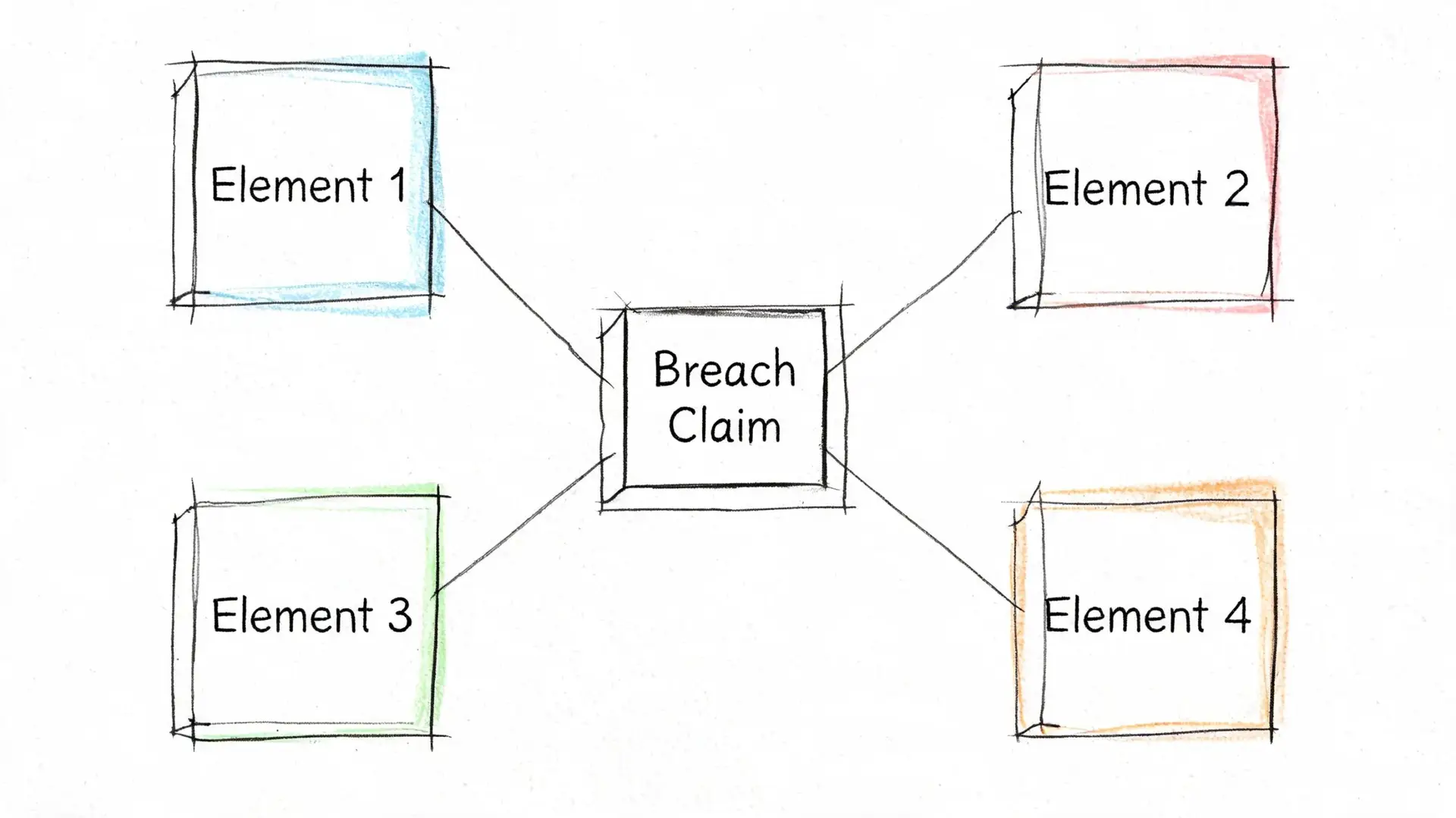
A breach claim typically requires four elements. The defendant owed a fiduciary duty, the duty was breached, the plaintiff suffered damages, and the breach was the substantial contributing cause of those damages, as summarized in this explanation of the elements of a breach of fiduciary duty claim.
Element one and two
The first question is structural. Did the relationship create a fiduciary duty at all?
In cross-border disputes, this is often contested. A founder may say he acted as a shareholder only. The claimant may say he functioned as a de facto director or controlling manager. Titles help, but conduct usually decides the issue.
The second question asks what conduct breached the duty. Common allegations include hidden conflicts, selective disclosure, side deals, and using company opportunities for personal benefit. Vague criticism of management style usually won’t carry the claim.
Element three and four
Damages matter because courts do not award relief for abstract ethical discomfort alone. The claimant must identify an actual loss, or in some settings a gain improperly taken by the fiduciary.
Causation is where many otherwise strong-sounding cases weaken. The plaintiff must connect the breach to the injury and show the conduct was a substantial contributing cause. In business terms, that means separating the alleged misconduct from market decline, execution risk, financing pressures, or unrelated management failures.
Litigation insight: The strongest fiduciary cases usually win on records, not rhetoric.
What evidence actually moves the case
The most valuable materials are usually ordinary business records created before the dispute began:
- Board minutes: They show what was disclosed, questioned, approved, or omitted.
- Conflict logs and recusal records: These documents often expose whether the process was clean.
- Drafts and communications: Earlier versions can reveal what changed and why.
- Financial tracing materials: They link movement of value to the alleged breach.
A strategic defense often wins by proving process. A strategic claimant often wins by proving the process was staged, partial, or misleading. That is why experienced counsel starts evidence mapping early, before memories harden and before documents get lost inside routine retention systems.
Common Breach Scenarios in Business
Most breach of fiduciary duty cases do not begin with dramatic theft. They begin with a transaction that looked normal until someone asked better questions.
Self-dealing in a boardroom
A director supports a vendor agreement. The pricing appears acceptable, and the company needs speed. Months later, it becomes clear that the vendor was linked to the director through an undisclosed ownership interest.
That dispute is no longer about whether the contract performed. It becomes a loyalty case. The board’s process, the timing of disclosure, and the director’s private benefit move to the center.
Misappropriation through operational control
A partner has signing authority and broad access to company funds. Payments flow to entities described as consultants, introducers, or project support. The descriptions are vague, and the approvals are informal.
This is a classic pattern. Business litigation guidance on fiduciary breach identifies self-dealing, misappropriation, and nondisclosure of material information as major breach patterns. The same source notes that remedies may include monetary damages, disgorgement of profits, and injunctions, which is why forensic tracing becomes central.
The financial issue is rarely only the amount taken. The deeper issue is whether the fiduciary redirected decisions and resources for private gain.
Taking the company’s opportunity
An executive learns of a valuable commercial opening during internal discussions. Instead of presenting it fully to the company, the executive channels it into a separate vehicle controlled personally or through nominees.
That fact pattern often creates more pressure than a simple compensation claim. The plaintiff can argue that the fiduciary used entrusted access to capture value that should have been evaluated for the company first.
Nondisclosure before a strategic vote
A board approves a financing round, merger step, or key services arrangement. After approval, investors discover that material information was withheld from the people who had to decide.
That scenario matters in Israeli ventures because many disputes arise in fast-moving companies where decisions are compressed and minutes are thin. Speed does not excuse nondisclosure. In practice, hurried process often becomes the claimant’s best exhibit.
Strategic Litigation in Israel and Abroad
A fiduciary claim is often chosen because it changes the battlefield. It is not just another label attached to a commercial dispute.

When the claimant pleads breach of contract, the case often narrows to promises, performance, and direct loss. When the claimant pleads fraud, the burden shifts toward misrepresentation and reliance. When the claimant pleads breach of fiduciary duty, the court may focus on entrusted power, loyalty, disclosure, and whether the defendant profited from misuse of position.
Why plaintiffs use this theory
The strategic attraction is obvious. Fiduciary duty can support remedies aimed at control and accountability, not only compensation. That matters in founder disputes, joint ventures, shareholder conflicts, and distressed exits where one side wants access to records, a freeze on conduct, or removal from decision-making.
Under ERISA 29 U.S.C. § 1109, a fiduciary who breaches duties is personally liable to restore plan losses and any profits made through misuse of plan assets, and may face equitable relief including removal. That U.S. statutory framework is not Israeli corporate law, but it is an important reference point for international clients because it shows how seriously major markets treat fiduciary misconduct. The same context is often illustrated by Enron’s 2001 collapse, which became a global shorthand for failed oversight and unmanaged conflicts.
The cross-border pressure points
Foreign directors often underestimate three litigation variables.
First, choice of law can reshape the duty itself. The governing law of the contract may differ from the law governing corporate conduct or internal affairs. Those are not interchangeable questions.
Second, forum changes yield advantages. A party may litigate in Israel while tracing assets, witnesses, or counterparties abroad. That requires early planning around document preservation, witness handling, and enforceability.
Third, remedy design affects settlement dynamics. A claimant seeking only money may settle on price. A claimant seeking injunctions, governance changes, accounting relief, or profit disgorgement usually negotiates from a different position.
What works and what fails
What works is a disciplined case theory built around chronology, authority, disclosure, and value flow. Counsel must map who knew what, when they knew it, what authority they held, and where the benefit moved.
What fails is pleading every possible grievance without hierarchy. Courts usually respond better to a clean theory with a few hard documents than to a sprawling complaint that confuses bad management with disloyal conduct.
For Israeli-facing disputes, parties also need to evaluate surrounding commercial tools. In some cases, the same conflict spills into unpaid obligations, director pressure campaigns, or banking friction. That is why related issues such as commercial debt collection in Israel and bank account restrictions and returned check disputes can become part of the broader enforcement strategy even when the core claim sounds purely fiduciary.
In high-stakes cases, the legal claim is only one instrument. The real contest is over pressure, timing, and control.
Navigating Remedies and Defenses
Once a breach of fiduciary duty claim is properly framed, the next question is practical. What can the claimant obtain, and how can the defendant reduce exposure?
The answer usually depends on whether the case is really about loss, improper gain, future risk, or governance breakdown. Different remedies address different problems.
Remedies for Breach of Fiduciary Duty
| Remedy | Description | Typical Application |
|---|---|---|
| Monetary damages | Compensation for loss caused by the breach | Where the claimant can trace a measurable financial injury |
| Disgorgement of profits | Strips profit obtained through disloyal conduct | Where the fiduciary benefited personally from the misconduct |
| Injunctions | Court order stopping or requiring conduct | Used to block a transaction, preserve assets, or prevent further misuse |
| Accounting relief | Forces detailed financial explanation and tracing | Useful where money flow is unclear or records are incomplete |
| Removal or governance relief | Limits or ends the fiduciary’s role | Used when continued control creates ongoing risk |
| Rescission or unwinding relief | Attempts to reverse a tainted transaction | Considered where informed approval was missing or conflict was concealed |
The defense side of the case
Defendants usually need more than denial. They need a theory that explains the process and neutralizes the inference of disloyalty.
Common defense themes include:
- Good-faith decision-making: The fiduciary acted on an informed basis and for a proper corporate purpose.
- Full disclosure: The alleged conflict or interest was disclosed before approval.
- No causation: The losses came from market conditions, execution failures, or independent business risk.
- No fiduciary relationship: The defendant acted as a counterparty, not as a trusted decision-maker.
- Ratification or approval: The relevant body approved the conduct after receiving sufficient information.
A practical point often gets overlooked. Defense preparation is document-heavy, and good case assembly often depends on disciplined review support. For larger disputes, structured help from experienced Paralegal Assistants can improve chronology building, exhibit control, and issue tagging without diluting legal supervision.
A strong defense rarely begins with argument. It begins with records that show the process was fair, informed, and disclosed.
Compliance and Prevention Strategies
The most effective response to breach of fiduciary duty risk is not better courtroom language. It is better governance before the dispute begins.
Foreign directors and partners usually need a system, not a slogan. The system should make conflicts visible early, force documentation of major decisions, and create a record that distinguishes informed risk-taking from concealed self-interest.
What directors and partners should do now
- Adopt a conflict protocol: Require written disclosure of direct and indirect interests before major approvals.
- Record recusal decisions: If someone steps out of discussion or voting, the minutes should state that clearly.
- Document the decision path: Minutes should show what materials were reviewed, what questions were asked, and why the board chose that route.
- Separate personal and company channels: Informal messaging creates avoidable evidentiary problems.
- Map authority carefully: Clarify who can approve payments, sign commitments, and negotiate side arrangements.
- Review related-party transactions rigorously: These transactions deserve enhanced scrutiny, not routine treatment.
- Preserve records early in tension scenarios: Delay destroys evidence and credibility.
- Use multilingual controls where needed: Cross-border ventures often fail because key legal nuance is lost in translation. In those settings, multilingual legal document translation is not an administrative detail. It is risk control.
Sample governance language to consider
The exact wording must be adapted to governing law and the company’s structure, but clauses often work better when they are direct.
A conflict clause might state that any director or officer with a personal interest in a proposed transaction must disclose that interest fully and promptly before discussion or vote.
A board process clause might require that materials for material transactions be circulated in advance, with any exceptions documented in the minutes together with the reason for accelerated review.
A corporate opportunity clause might require officers and directors to present business opportunities within the company’s line of activity to the company before pursuing them personally, unless the board declines after informed consideration.
What doesn’t work
Three habits repeatedly create exposure. First, boards rely on oral disclosure and assume everyone understood. Second, related-party issues are treated as relationship matters instead of governance matters. Third, the company waits until the dispute has escalated before preserving records and controlling communications.
Those habits are avoidable. So are many claims.
Companies and investors can avoid costly mistakes by getting ahead of fiduciary risk before a dispute hardens into litigation. The recommended strategic path is to obtain specific guidance from RNC Group and, where urgency exists, contact the firm now for a confidential review of the governance, litigation, or cross-border enforcement position.
This article provides general information only and does not constitute legal advice, a legal opinion, or a substitute for case-specific counsel. Reliance on any part of this article without obtaining advice on the facts, governing law, jurisdiction, and applicable procedural rules may create risk.