
A partner dispute doesn’t become dangerous when trust breaks down. It becomes dangerous when the contract, the forum, and the enforcement path were designed for a local disagreement, but the business now operates across borders.
That gap defines modern business partner dispute resolution for companies connected to Israel. Many executives still ask how to settle the argument. The harder question is whether any settlement, award, or judgment will control the assets, the bank access, the operating company, and the decision-makers in the jurisdictions that matter.
Your Partnership Agreement A Cross-Border Liability in 2026
Will a partnership agreement signed for a domestic venture still protect an international business in 2026? In many disputes, the answer is no, because the document governs governance, but fails to govern mobility, enforcement, and bargaining power.

A non-Israeli company entering Israel often uses a template agreement from its home market. That document may define profit shares and voting rights, yet still leave critical issues unresolved. It may say nothing useful about forum, language, interim relief, evidence preservation, or the seat of arbitration.
That omission becomes expensive fast. A dispute over capital calls, IP ownership, or management authority can spread across several legal systems at once. One partner may control the Israeli operating company, another may hold key contracts abroad, and a third party bank may react to internal conflict before any tribunal reaches the merits.
The real issue is enforceability
Most guidance still treats partner disputes as a communication problem. However, cross-border partnership disputes involving Israel often turn on where a resolution can actually be made to stick. Forum, language, seat, and interim relief aren’t drafting details. They determine control.
A commercially sound agreement answers the enforcement question before anyone asks who was right.
Cross-border friction also appears in the documents themselves. If shareholders, founders, lenders, or counterparties rely on different language versions, a drafting dispute can become an evidentiary dispute. In that setting, precise certified contract translation is not an administrative add-on. It’s part of risk containment.
Why standard domestic drafting fails
Domestic agreements usually assume one court system, one business language, and one asset base. International ventures linked to Israel rarely fit that model. Key stress points usually include:
- Forum mismatch: The chosen court may have jurisdiction on paper, but weak practical reach over offshore assets or foreign decision-makers.
- Language risk: The operative version of the agreement may not match the language used in negotiations, board materials, or side letters.
- Interim relief gaps: The contract may require negotiation or mediation first, even where immediate restraint is needed.
- Exit ambiguity: A buyout clause may exist, but the mechanics for valuation, payment timing, and transfer restrictions may be unusable in crisis.
A business can survive a disagreement. It often can’t survive an agreement that gives each side a different map of authority.
What sophisticated counterparties plan for
International counterparties don’t draft only for cooperation. They draft for misalignment. That means defining where emergency relief may be sought, which version of the contract controls, how deadlock will be broken, and which process governs if one side blocks access to books, systems, or funds.
For executives, this isn’t legal housekeeping. It’s operational resilience. A weak agreement turns every dispute into a race for procedural advantage. A strong one narrows the battlefield before the first demand letter is sent.
Building a Dispute-Proof Partnership Agreement
Prevention doesn’t mean removing conflict. It means structuring conflict so that it can’t destroy enterprise value. The contract should allocate authority, define escalation, and preserve an exit before personalities harden.
A good agreement also has to reflect the business as it operates. If the venture uses shared premises, inventory, or build-out rights, disputes may spread beyond equity and governance into assets governed by commercial lease agreements. Drafting should anticipate that overlap.
The clauses that actually matter
The strongest agreements don’t chase elegance. They remove ambiguity where disputes usually start.
- Decision rights and reserved matters: Separate daily management from strategic matters. Define which actions require one signatory, board approval, supermajority consent, or unanimity.
- Role allocation: State who controls finance, operations, sales, compliance, and hiring. Unclear roles let one partner claim implied authority after the relationship collapses.
- Information access: Require regular reporting, document access, and financial visibility. If one partner controls the books, silence creates an advantage.
- Capital contribution mechanics: Set timing, remedies for non-payment, dilution effects if any, and consequences for emergency funding.
- Transfer restrictions: Control who may sell, pledge, or transfer interests, and under what preconditions.
- Exit and buy-sell triggers: Cover deadlock, prolonged breach, incapacity, fraud allegations, change of control, and material non-performance.
Deadlock clauses need more than slogans
Many agreements say deadlocks will be negotiated in good faith. That language sounds cooperative and performs poorly under pressure. The clause should instead define sequence, timing, and consequence.
For example, the agreement can require executive negotiation within a fixed timetable, then mediation, then a buy-sell mechanism or binding forum. If the clause stops at “parties shall discuss,” the deadlock hasn’t been solved. It has only been delayed.
Practical rule: A deadlock clause is useful only if it produces movement when one side wants paralysis.
Choice of law and forum require strategic discipline
Non-Israeli companies often ask whether a neutral governing law is safer than Israeli law. The answer depends on the business footprint, the location of assets, the expected evidence, and the likely pressure points. A neutral law may look balanced, yet still create translation burdens, proof complexity, and enforcement friction.
The forum clause needs the same discipline. It should answer several questions in one integrated structure:
- Which disputes must go to arbitration, and which may go to court for urgent relief.
- Which language governs the proceeding.
- Which seat applies if arbitration is chosen.
- Whether exclusive jurisdiction applies to specific interim applications.
- Which documents control if language versions diverge.
Operationally, the agreement should also be maintained, not forgotten. Teams that use a tracked contract workflow usually catch silent amendments, side letters, and inconsistent approvals earlier. A practical resource on this point is CatchDiff on contract management, especially for businesses handling multiple drafts across jurisdictions.
Draft for breakdown, not optimism
A dispute-proof agreement should also address implementation. If a settlement, forced transfer, or buyout occurs, who signs? Who releases liens or approvals? Who notifies banks, landlords, distributors, and regulators? If the contract doesn’t answer those questions, the parties may win the clause and still lose control of execution.
The best drafting posture is unsentimental. Assume pressure, delay, and selective cooperation. Then write the agreement so that none of those tactics can change the result.
The Phased Escalation Playbook for Active Disputes
When the dispute has already started, improvisation usually helps the more aggressive party. A disciplined response restores control, protects evidence, and creates settlement options without sacrificing your advantage.
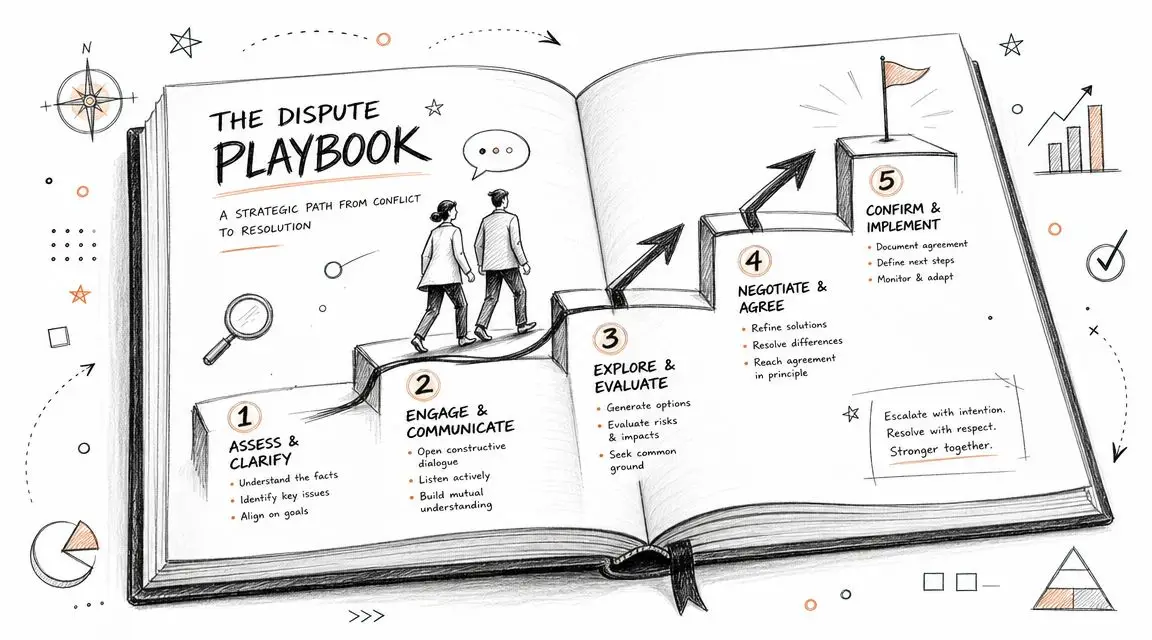
A practical framework exists. A high-probability workflow for resolving partnership disputes starts with reviewing the agreement, moves to direct negotiation with documented positions, escalates to mediation, and reserves arbitration or litigation as the binding backstop. That sequence works because it preserves optionality while reducing the chance that the conflict becomes business-killing.
Phase one starts with record control
The first move is not always to call the other side. The first move is often to secure the internal record. That includes board materials, accounting files, access logs, communications about authority, and any evidence tied to ownership, approval, or misuse of assets.
At the same time, management should identify the actual dispute set. Many partner conflicts appear emotional but are structurally narrow. They usually involve a finite list of issues such as signing authority, access to funds, dilution, distributions, exclusivity, compensation, or IP use.
A disciplined issue list does two things. It stops rhetorical expansion, and it creates a negotiation file that later supports mediation, arbitration, or court.
Phase two uses negotiation as a leverage tool
Direct negotiation is often the fastest path, but only if it is structured. Casual conversations rarely help once accusations begin. The parties need written positions, defined asks, deadlines, and a clear record of what has been offered or refused.
Legal strategy and corporate response must align. A partner dispute is a business crisis, not just a legal disagreement. The same discipline used in effective crisis management for companies applies here. Control communications, preserve continuity, and avoid unnecessary public signals.
Settlement without a documented implementation plan often creates a second dispute within months.
Structured negotiation should also test the other side’s real objective. Some parties want money. Others want control, delay, vindication, or a route to exit. If counsel misreads that objective, the negotiation becomes theatre.
Phase three uses mediation selectively
Mediation can be useful, but not because it is automatically fair or gentle. Its real value is that it can surface hidden priorities, narrow factual disagreements, and test whether a counterpart can still make decisions. In some matters, that is enough to facilitate a buyout, governance reset, or controlled separation.
Mediation works best when the file is already organized. Bring a chronology, decision matrix, draft settlement architecture, and implementation assumptions. Without preparation, mediation becomes a forum for speeches.
A strong mediation posture usually includes:
- A narrow agenda: Don’t mediate every grievance. Mediate the issues that facilitate progress.
- Decision-maker attendance: Representatives must have real authority, not only authority to “take it back.”
- Parallel contingency planning: Prepare arbitration or court filings while mediation proceeds, if risk exposure remains live.
Phase four reserves binding process for the right issues
Not every unresolved point deserves a hearing. Binding proceedings should focus on issues that require enforceable relief, expose serious breach, or affect control of the business. Those usually include ownership, transfer validity, fiduciary claims, asset diversion, and authority over key accounts or contracts.
The escalation path also isn’t perfectly linear. A company may negotiate one issue, seek urgent relief on another, and mediate the broader separation at the same time. That mixed approach often reflects reality better than a rigid sequence.
What usually fails
Business partner dispute resolution tends to fail for operational reasons before it fails for legal reasons. Common breakdowns include:
- Personalized conflict: Once teams frame every move as betrayal, they stop evaluating commercial options.
- Late escalation: Waiting until systems access, bank control, or customer confidence has already eroded.
- Undocumented concessions: Parties settle in principle but leave timing, conditions, and implementation unclear.
- Misjudged advantage: One side overestimates legal strength and underestimates the other side’s practical control.
The best playbook stays commercial. Protect the company first. Then decide which forum, pressure point, and settlement structure serve that objective.
Choosing Your Forum Arbitration vs Litigation in Israel
The forum decision shapes speed, confidentiality, appeal risk, enforceability posture, and settlement pressure. In Israel-connected disputes, that choice often matters more than the underlying legal theory.
Alternative dispute resolution usually offers the clearest business advantage when confidentiality and continuity matter. One practical benchmark is that court proceedings can take months or years, while ADR often costs less and produces more predictable, confidential outcomes. That matters when the operating business, the investors, and the employees are all watching the conflict unfold.
What the market data suggests
Formal ADR is not a niche path in commercial conflict. In major U.S. securities disputes, FINRA recorded 3,382 new arbitration filings in 2023, with 1,496 cases settled directly by the parties and another 489 settled through mediation, meaning 66% were resolved without a hearing award. FINRA also reported an 18.3 months overall turnaround time.
Those figures matter for two reasons. First, experienced parties routinely build negotiation and mediation into serious disputes. Second, even formal arbitration can take substantial time, so parties should treat it as a controlled forum, not as instant relief.
The commercial rationale for arbitration also appears in institutional design. The AAA expressly offers arbitration and mediation services for partnership and shareholder disputes, reflecting how often these conflicts are diverted from court into private resolution channels.
Dispute Resolution Forums A Strategic Comparison
| Factor | Arbitration | Litigation (Israeli Courts) |
|---|---|---|
| Confidentiality | Usually better for protecting business value, internal conflict, and investor sensitivity | Public process can increase commercial exposure |
| Speed profile | Often faster than court, but still requires active case management | Can extend significantly, especially where procedure becomes contested |
| Decision maker | Parties can often shape tribunal selection through the clause or process | Judge assigned through the court system |
| Procedural flexibility | More room to tailor timetable, language, and evidence handling | Formal court rules drive procedure |
| Appeal rights | Usually narrower, which can support finality but reduce error correction | Broader avenues for review may exist |
| Cross-border posture | Often stronger where enforceability abroad is central | May be harder to deploy internationally depending on the target jurisdiction |
| Interim pressure | May require court support unless the clause addresses urgent relief well | Courts can be critical for injunctions and coercive orders |
| Commercial signaling | Private process can lower reputational damage | Filing in court can be a pressure tactic, but it also escalates visibility |
How to choose in practice
Arbitration is often the better fit where the business needs privacy, technical decision-makers, or cross-border enforceability. It also suits disputes where the relationship is damaged but the business still has value worth preserving.
Litigation becomes more attractive where one party needs urgent coercive measures, broad disclosure tools, or a public process to constrain non-cooperation. It can also be useful as pressure when the other side is testing procedural delay.
Choose the forum by asking one question first. Which process gives the company the fastest path to control, not merely the loudest path to accusation.
Israeli-connected disputes often require a hybrid view. A contract may send merits to arbitration, while urgent court applications remain available for asset restraint or access orders. That split can be effective if drafted and used carefully.
Executives should also watch for tactical bank pressure. In some conflicts, a partner may try to create operational distress by triggering payment friction or account disruption. That risk is one reason to assess exposure around bank account blockages before launching open hostilities.
Enforcement The Final Move in Cross-Border Disputes
A favorable result means little if the other side still controls the cash, the records, the customers, or the movable assets. In cross-border business partner dispute resolution, enforcement isn’t the final administrative step. It is the central design constraint from the start.

That is why soft process cannot always come first. In high-stakes founder disputes involving freeze-out threats or bank account restrictions, the better opening move may be evidence preservation, interim injunctions, and forensic accounting. If one party can move funds, alter records, or strip value while the other side pursues dialogue, the legal file may improve while the business deteriorates.
Start with the asset map
Before filing anything, identify what can be reached. That includes bank relationships, receivables, shares, IP, contractual rights, inventory, and control over digital systems. Also identify where each asset sits, who controls it, and what legal mechanism can restrain or transfer it.
A weak asset map produces performative litigation. A strong one drives realistic forum choice, settlement pressure, and interim relief strategy.
Preserve leverage before offering peace
Some disputes still deserve early negotiation. Others don’t. If there is evidence of diversion, concealment, or unilateral lockout, the first objective is containment.
A containment posture usually includes:
- Evidence preservation: Secure communications, accounting records, signature histories, and system access trails.
- Interim remedies: Seek orders that preserve the status quo before assets move or authority changes.
- Forensic review: Test whether the commercial story matches the financial record.
- Enforcement sequencing: Plan where the eventual award or judgment will need to be recognized and acted upon.
Arbitration awards and court judgments are not equal everywhere
For international businesses, enforceability often drives the choice between private and public forums. Arbitration can offer a more portable enforcement route in many cross-border situations because recognition frameworks are often clearer than for foreign court judgments. That advantage matters only if the clause, the seat, and the relief requested were designed with enforcement in mind.
Winning on liability but losing on collection is not a legal victory. It is an expensive diagnostic exercise.
The most expensive mistake is assuming that a good merits case will solve a bad enforcement posture. It won’t. The correct sequence is the reverse. Start with where payment, control, or asset restraint can happen. Then build the merits strategy around that endpoint.
Conclusion From Crisis Containment to Strategic Advantage
The strongest approach to business partner dispute resolution treats conflict as a control problem, not just a legal problem. Companies that draft for deadlock, map assets early, and choose forums with enforcement in mind usually keep more options open when the relationship breaks down.
That’s the strategic advantage. A dispute doesn’t have to become a public collapse, a frozen operation, or a years-long war of attrition. It can be contained, structured, and resolved through a sequence that protects value and maintains an advantageous position.
The recommended strategic path is clear. Draft for breakdown before the venture starts. Escalate in phases once friction appears. Move quickly to protective measures when control, funds, records, or assets are at risk. Then push toward an outcome that is enforceable where the business lives.
Avoid costly mistakes and protect cross-border interests before a partner dispute hardens into an enforcement crisis. For a bespoke strategy on Israeli and international commercial conflict, contact RNC Group through its contact page.
This article provides general information only and doesn’t constitute legal advice. Commercial disputes depend on specific facts, contract language, jurisdictional issues, and procedural timing, so any action should follow specific advice from qualified counsel.
SEO Title: Effective Business Partner Dispute Resolution for Cross-Border Israel Disputes
Slug: business-partner-dispute-resolution
Meta Description: Learn a strategic approach to business partner dispute resolution involving Israel, with guidance on contracts, escalation, forum choice, and enforcement.
Focus Keyphrase: business partner dispute resolution