
Will your Israeli contracts still protect the business when a 2026 restructuring starts under pressure, not on your timetable?
Many boards still treat the corporate restructuring process as a finance project. That assumption fails early. In practice, the company lives inside its contracts: supply terms, distribution rights, franchise obligations, service levels, leases, banking undertakings, employment terms, and change-of-control triggers.
For a multinational with Israeli operations, that reality matters more than the slide deck. A restructuring succeeds when management regains control over obligations before counterparties, regulators, employees, or lenders do it first.
The 2026 Corporate Restructuring Imperative
What puts a 2026 restructuring on your calendar. falling EBITDA, or a contract portfolio that can be turned against the business before management is ready?
In practice, the second issue usually forces the first. Restructuring pressure starts when core agreements no longer fit current operations and counterparties decide to use the gap. A pricing mechanism erodes margin. A minimum purchase obligation becomes unrealistic. A consent right in a financing, supply, or distribution contract gives the other side a veto over a transaction the board assumed it could control.
That is imperative for 2026. Management has to identify which contracts preserve optionality and which ones can accelerate distress.
Contracts decide who controls the timeline
Israeli and cross-border groups rarely lose control in a single event. They lose it through paper. One lender reserves rights after a covenant discussion. One supplier shortens payment terms. One distributor claims exclusivity. One landlord withholds consent for a site change that operations treated as routine. Each point may look containable. Together, they shift negotiating power away from the company.
For multinational businesses operating in Israel, this point is sharper than many headquarters teams expect. A local agreement signed years ago may contain Hebrew language that prevails over the English summary, a side letter that changes the economics, or a change-of-control clause that lets a counterparty terminate, reprice, or demand consent as soon as a sale process, equity infusion, or internal group reorganization becomes visible. That kind of clause can give a creditor or commercial counterparty real pressure well before any formal court process begins.
Restructuring is therefore a legal and commercial control exercise. The board needs a clear view of who can stop cash flow, interrupt performance, call a default, refuse consent, or demand concessions at the moment the company needs flexibility most.
Practical rule: If the contract map is incomplete, the company does not yet know what it is restructuring.
What strong boards do differently
Strong boards start with the contract stack, not the org chart. They ask which agreements carry the business, which clauses can be triggered by stress, and which counterparties are likely to act first.
The highest-risk review areas usually include:
- Revenue concentration: Identify the customer contracts that carry cash generation, then isolate termination rights, rebate exposure, dispute mechanisms, and service failures that can be used to delay payment.
- Operational choke points: Review supply, logistics, technology, manufacturing, and outsourced service contracts that can interrupt delivery or give counterparties pricing power at the wrong moment.
- Control clauses: Check assignment, consent, change-of-control, exclusivity, information rights, and material adverse change provisions.
- Real estate exposure: Test whether lease terms, landlord approvals, and exit costs fit the operating plan the company may need to implement under pressure.
- People risk embedded in paper: Examine retention arrangements, bonus commitments, restrictive covenants, and confidentiality obligations tied to the managers and technical staff the restructuring will depend on.
This work is not academic. It tells the board where to negotiate early, where to seek waivers discreetly, where to isolate a hostile counterparty, and where an Israeli law issue may affect enforcement, timing, or drafting interpretation.
A contract-led restructuring process is easier to control because it starts with the rights that can move the business.
Diagnosing Distress Beyond the Balance Sheet
By the time the balance sheet looks distressed, the legal position may already be weaker than management assumes. The earlier diagnosis comes from the contract file, the reporting line, and the pattern of exceptions the business now needs to keep operating.
Research on insolvency law-making across more than 30 economies shows that restructuring rules are heavily shaped by crisis conditions. The same research supports a practical conclusion: timing is a legal variable, and restructuring usually works better before distress becomes visible because, once creditor pressure appears, the process shifts from optimization to damage control, as discussed in this cross-country study on insolvency law-making.
Early distress leaves documentary fingerprints
Executives usually see the same pattern before a formal crisis. Teams ask for one-off waivers. Procurement keeps renewing temporary arrangements. Finance tolerates overdue receivables from accounts that were once predictable. Country management says a local issue will pass. It might not.
The legal diagnosis should start with a disciplined contract audit. Not every agreement matters equally. The first pass should isolate agreements that can stop cash generation, trigger defaults, or block a strategic transaction.
A useful review frame is below.
| Contract group | Core question | Main restructuring risk |
|---|---|---|
| Customer contracts | Can revenue continue during operational changes? | Termination rights, service credits, exclusivity disputes |
| Supplier contracts | Can delivery continue if volume or timing changes? | Minimum purchase commitments, pricing resets, security demands |
| Finance documents | What triggers lender intervention? | Covenants, reporting obligations, cross-defaults |
| Leases | Can the footprint shrink or relocate? | Notice periods, restoration duties, guarantees |
| Partnership and JV agreements | Who must consent to change? | Deadlock, veto rights, transfer restrictions |
Distress often hides in routine clauses
The most dangerous clauses are rarely the ones management negotiated most heavily. Problems often sit in standard provisions that nobody revisits during growth.
Focus first on:
- Termination for convenience or cause: A counterparty with a short exit right can force a rushed concession.
- Change-of-control and assignment language: Internal reorganizations can trigger third-party consent issues even when ownership economics stay stable.
- Most-favored customer terms: Restructuring one commercial relationship can spread pricing pressure elsewhere.
- Financial reporting undertakings: Extra information rights can become an advantage in negotiation.
- Set-off rights and holdbacks: A commercial dispute can become a cash-flow problem overnight.
The best time to review a critical contract is before the counterparty knows you need it.
For Israeli businesses in international groups, one more issue deserves attention. The contract owner and the operating reality often diverge. The Israeli entity performs. Another affiliate invoices. A parent guarantees. That split can complicate both renegotiation and enforcement.
The timing question is operational and legal
Leaders often ask whether they should wait for more clarity. Usually, waiting benefits the other side. Once distress becomes obvious, counterparties protect themselves first. Suppliers tighten terms. Employees start exploring exits. Creditors ask harder questions.
A sound diagnosis therefore answers three questions together:
- What is failing operationally
- Which contracts can amplify that failure
- What action must happen before the market sees the weakness
That sequence turns the corporate restructuring process into a controlled intervention instead of a public reaction.
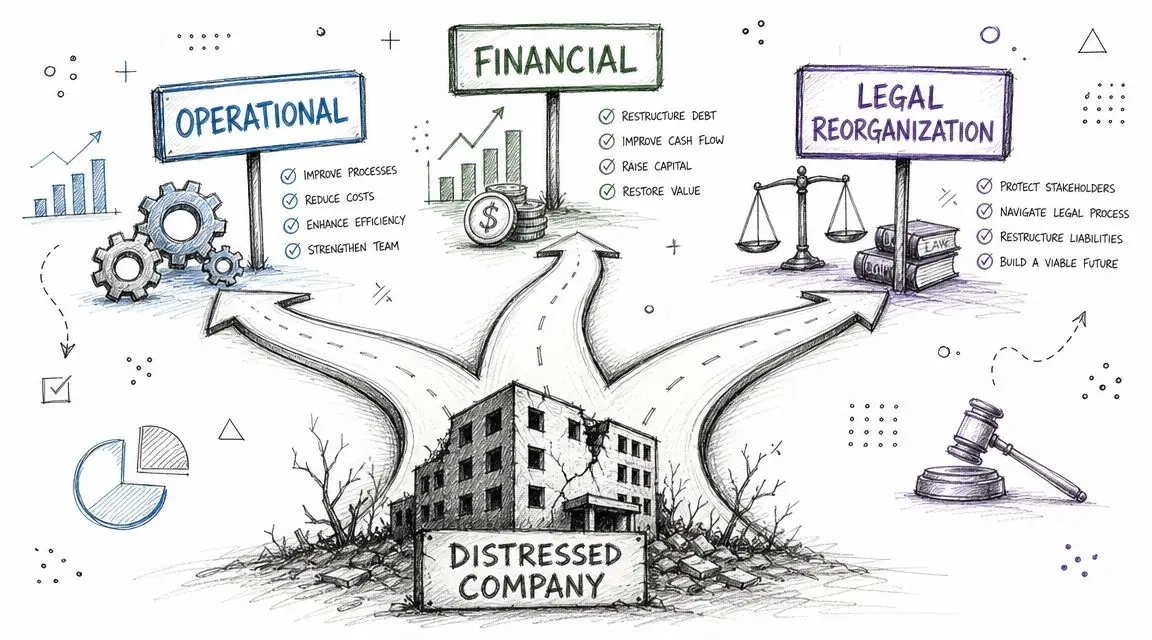
Mapping Your Strategic Restructuring Options
Which restructuring path protects the contract base that still holds the business together, and which path triggers a wider failure?
That is the right starting question. In an Israeli restructuring, the legal form matters, but the contract map usually decides whether value can be preserved, transferred, or lost under pressure. Boards often begin with balance sheet labels such as operational, financial, or legal. I prefer to start with a harder test: which customer, supplier, financing, lease, license, and guarantee arrangements must remain stable for the business to keep trading.

Three routes and their contractual impact
| Path | Best used when | Contract effect | Main legal pressure point |
|---|---|---|---|
| Operational restructuring | The business model remains sound, but the cost base, governance, or reporting structure interferes with performance | Requires amendment, consolidation, and disciplined vendor management | Employment, leases, service continuity |
| Financial restructuring | The business can still trade, but the capital structure prevents recovery | Focuses on waivers, covenant resets, and creditor negotiation | Intercreditor alignment, cross-default exposure |
| Formal legal reorganization | The company needs court protection or a binding process to impose a deal on dissenting stakeholders | Can restrain holdout behavior, subject to the governing legal regime | Jurisdiction, voting thresholds, court supervision |
The table is simple. The choice is not. Each route changes the company’s bargaining position with different counterparties, and each route carries a different risk of forcing consent requests before management is ready.
Operational restructuring succeeds only if the contracts tolerate redesign
Operational restructuring works where the business still delivers, but the structure around it has become expensive or slow. That usually means duplicated teams, support functions spread across entities, underused sites, or management layers that delay decisions and hide accountability.
Hierarchy review often sits at the center of that exercise. For leaders testing whether excess layers are slowing execution or obscuring control, The OKR Hub’s guide to tall structures is a useful reference point.
The legal mistake is to treat this option as an internal housekeeping exercise. It is not. If key customer contracts define service teams by entity, if software licenses are non-transferable, or if leases restrict occupancy changes, a redesign on paper turns into a live consent process with commercial counterparties who now know the company needs cooperation.
For multinational groups in Israel, that risk is sharper where the local entity operates under one set of contracts but another group company holds the strategic IP, procurement framework, or customer master agreement. A clean org chart can produce a messy contract perimeter.
Financial restructuring is wider than lender negotiations
Financial restructuring is appropriate when the business can survive, but the debt package cannot. The immediate work usually centers on maturities, covenant relief, security, liquidity support, and waiver mechanics.
The contract issue is broader. Loan amendments can trip pricing clauses, cross-defaults, collateral sharing questions, customer assurance demands, and supplier credit limits. A lender deal that stabilizes one part of the capital structure can unsettle the trading platform if commercial contracts were not reviewed at the same time.
Management teams lose control. They negotiate with the bank group while procurement, sales, and operations deal with the consequences one counterparty at a time.
A debt fix that leaves key trading contracts exposed is not a restructuring plan. It is a short extension of the problem.
Use this route where the commercial engine still works and counterparties are likely to continue performance if financing pressure eases. Avoid relying on it alone where major customers, landlords, or strategic suppliers already have termination rights or active disputes.
Formal legal reorganization is a control tool for holdout situations
Formal legal reorganization becomes the better option when consensual bargaining no longer produces a stable outcome. That can happen because one creditor class blocks a deal, a shareholder dispute prevents fresh money, or a small number of counterparties exploit consent rights for commercial advantage.
As noted earlier, court supervised reorganizations are designed to keep the business operating while claims are renegotiated under a binding process, and plan approval commonly depends on creditor voting thresholds. That matters less as an abstract legal point than as a control point. If the company cannot get the required support out of court, a formal process may be the only route that prevents a value-destructive scramble.
For non-Israeli firms with Israeli operations, the harder question is enforcement reality. Which forum can issue orders that Israeli banks, employees, regulators, landlords, and commercial counterparties will respect in practice? The answer is rarely driven by a single entity’s place of incorporation. It depends on where assets sit, where contracts are governed, where cash moves, and where business continuity can be defended day to day.
The right path is the one that protects enterprise value while keeping contract risk contained. That requires more than choosing between operational, financial, and legal labels. It requires choosing the process that gives management the best chance to preserve performance, control counterparties, and impose sequence on a deteriorating situation.
Executing a Phased Implementation Plan
Restructuring plans fail in execution more often than they fail in diagnosis. One industry guide states that roughly 70% of restructuring efforts fail to meet their objectives, that simple organizational restructuring usually takes 3–6 months, and that complex strategic restructuring can take 18–36 months, according to Miro’s company restructuring guide. The lesson is straightforward. The process needs sequence, ownership, and disciplined communication from day one.

Phase one secures authority before negotiation starts
Boards often rush into external conversations before they lock internal authority. That is backwards. The first phase should define who decides, who signs, who approves concessions, and who controls the message.
At minimum, management should produce:
- A decision matrix: Set approval thresholds for contract amendments, settlement authority, workforce actions, and public statements.
- A controlled issues list: Track every high-risk contract, dispute, and consent requirement in one place.
- A privilege protocol: Separate legal analysis from broad business circulation where appropriate.
- A stakeholder map: Rank lenders, key customers, critical suppliers, landlords, and regulators by influence and timing.
Without this discipline, counterparties exploit internal inconsistency. One executive offers reassurance. Another hints at exit. A third promises a payment date finance can’t meet.
Phase two reviews contracts in operating order, not alphabetical order
The legal team should not review contracts as an archive project. It should review them in the order the business needs them to keep trading next week, next month, and next quarter.
That usually means this order:
- Cash-in contracts first. Preserve customer revenue, collection rights, and service continuity.
- Cash-out bottlenecks second. Address suppliers, technology dependencies, and logistics.
- Premises and infrastructure third. Review real estate, warehousing, utilities, and outsourced services.
- Capital structure fourth. Align lender discussions with what the operating review has already shown.
This phase often exposes old friction points that now need legal surgery. A company may need to renegotiate consent mechanics in a distribution agreement, rationalize obligations under commercial lease agreements, or close side arrangements that no longer match group policy.
Treat each critical contract as either a value-preserving asset, a manageable burden, or a live threat. Most execution errors come from failing to classify them early.
Phase three manages employment and continuity together
Many restructuring plans handle employment too late. That creates compliance risk and operational loss at the same time. The better approach treats people risk as part of service continuity, not as an HR afterthought.
The implementation record should identify:
| Workforce issue | Why it matters during restructuring |
|---|---|
| Impacted roles | Reduces confusion and supports defensible execution |
| Required notices and severance analysis | Prevents avoidable legal exposure |
| Retention needs for critical staff | Preserves customer delivery and internal knowledge |
| New reporting lines and job descriptions | Avoids paralysis after formal changes |
Multinational groups often make costly mistakes in Israel. Group headquarters assumes a global script will work. Local law, local practice, and local documentation say otherwise.
Phase four controls the external message
Every restructuring creates a market narrative. If management doesn’t control it, counterparties will. Communication therefore isn’t a soft layer around the process. It is one of the process controls.
Messages should differ by audience:
- Lenders need credibility: Provide a coherent plan, not optimism without documentation.
- Suppliers need predictability: Explain continuity, ordering logic, and payment protocol.
- Customers need stability: Confirm performance capability and escalation contacts.
- Employees need clarity: Give real information about timing, roles, and reporting.
A badly sequenced communication can escalate into liquidity pressure. In stressed situations, operational confusion and payment disputes can contribute to severe banking problems, including scenarios discussed in RNC’s overview of bank account blockages.
Phase five documents every concession
A restructuring often fails after the “deal” because teams rely on calls, understandings, and half-updated templates. Every waiver, amendment, standstill, side letter, and approval should move into a controlled documentation set.
That set should record effective dates, dependencies, notice mechanics, and any conditions precedent. If the company later sells assets, raises capital, or moves to a formal process, this record becomes essential.
Navigating Cross-Border Restructuring Complexities
A multinational restructuring involving Israel rarely fails because leaders lack a high-level strategy. It fails because one jurisdiction’s practical solution collides with another jurisdiction’s mandatory rule.

The strongest restructuring is not the one that cuts fastest. It is the one that preserves critical people, contracts, and cash-generating operations. That point becomes sharper in multinational groups, where cross-border employment rules and supplier contracts can turn a simple reorganization into a multi-jurisdiction problem, as explained in this legal analysis of restructuring implications.
The governing law clause isn’t the whole answer
Executives often ask which law governs the contract. That matters, but it isn’t enough. Enforceability, interim relief, recognition, notice rules, and local employment limits may sit elsewhere.
Cross-border review should test at least four layers:
- Entity layer: Which group company signed, guaranteed, or performs the contract.
- Law layer: Which legal system governs the agreement and dispute mechanism.
- Operations layer: Where the goods, people, systems, or regulated activities sit.
- Approval layer: Which board, shareholder, or lender approvals are needed across the group.
When these layers don’t match, the restructuring team needs a single command document. Otherwise, one country negotiates economics while another country creates accidental defaults.
Language and documentation are execution issues
Multilingual business groups often underestimate translation risk. A restructuring memo in English may not match the Hebrew operative document. Internal approvals may use one set of defined terms while the amendment uses another. Those inconsistencies create disputes later, usually when the company needs certainty most.
That is why complex cross-border work relies on controlled drafting, translation review, and escalation planning. In high-pressure matters, the broader discipline resembles strategic crisis management, not ordinary contract administration.
Cross-border restructuring works best when one legal workstream owns the definitions, the approval path, and the final document hierarchy.
Israeli execution requires local realism
Israeli counterparties often negotiate quickly, but they also test practical bargaining power hard. A supplier may accept revised economics if payment discipline improves. A landlord may agree to a phased solution if the alternative is vacancy. An employee issue may become manageable if timing, documentation, and internal messaging align.
The mistake is importing a global template and assuming local friction will adjust itself. It won’t. The plan must fit the jurisdiction where performance happens.
Building a Resilient Post-Restructuring Framework
A restructuring isn’t complete when signatures are collected. It is complete when the new structure can operate without constant exception handling.
The most reliable post-restructuring controls are workforce analysis, scenario planning, and communications architecture. Guidance on organizational restructuring also points to practical tools such as updated org charts, clear job descriptions, training needs analysis, named impacted roles, and formal feedback loops, as outlined in AIHR’s restructuring guidance.
What resilience looks like in practice
The post-restructuring framework should be specific and boring. That is a good sign. It means the business no longer depends on improvisation.
Leadership should require:
- Rebuilt contract standards: Update templates for assignment, consent, notice, service levels, and dispute escalation.
- A live obligations register: Track material commercial commitments, renewal dates, guarantees, and approval rights.
- Post-close governance: Align boards, delegated authority, and reporting lines with the new operating model.
- Scenario drills: Test what happens if a major customer leaves, a supplier tightens terms, or a banking issue interrupts payments.
A resilient company also revisits old habits. If pricing exceptions, undocumented side promises, or informal guarantees helped cause the stress, those practices need to end.
The long view is the only useful one
The best corporate restructuring process doesn’t merely reduce cost. It restores control. That means management can see risk early, negotiate from a position of preparation, and protect the contracts that do carry enterprise value.
For non-Israeli businesses with Israeli exposure, that standard is even higher. The company must align local legal execution with group strategy, and it must do so before urgency collapses the range of options.
Businesses that want to avoid expensive mistakes should act before counterparties force the timetable. The recommended step is to obtain a coordinated legal and strategic review from RNC Group, then move quickly from diagnosis to an executable restructuring plan. For a confidential discussion, contact the firm now.
This article provides general information only and doesn’t constitute legal advice. It doesn’t create an attorney-client relationship, and no reader should act or refrain from acting based on it without obtaining legal advice suited to the specific facts, jurisdictions, and contractual arrangements involved.