
Most cross-border contracts fail at the same silent point. The dispute clause assumes that if talks collapse, a court will fix the problem.
In 2026, that assumption is a serious commercial error. A foreign company entering the Israeli market needs more than a governing law line and a forum clause. It needs a sequenced plan for pressure, settlement, and enforcement before a dispute starts burning time, cash flow, and bargaining power.
Your 2026 Commercial Contracts Guide to Dispute Resolution Alternatives
A significant risk in standard boilerplate isn’t bad drafting alone. It’s false confidence. Many executives still treat dispute resolution alternatives as a secondary option, useful only if litigation feels too expensive or too public.
That framing misses the commercial reality. In a cross-border contract, the dispute mechanism often matters more than the liability cap, because it determines who controls timing, confidentiality, and the path to a collectible result.
For non-Israeli parties, that point gets sharper in Israel-linked transactions. A supply contract, franchise arrangement, distribution deal, founders’ agreement, or licensing structure can fail across several fronts at once. Evidence sits in different countries. Witnesses speak different languages. Assets may sit outside the forum where the dispute starts.
Boilerplate no longer protects against strategic loss
The old fallback was simple. Sue if necessary. That approach no longer gives reliable control.
A stronger approach treats the clause as a phased escalation device. First, force structured business negotiation. Next, use mediation where a commercial compromise still has value. Then move to arbitration when a binding decision and enforceability matter more than preserving flexibility.
Practical rule: If the clause doesn’t tell the parties what happens in the first days of conflict, it won’t help much when the conflict escalates.
That is why advanced legal teams now connect clause design with operational readiness. They also support that work by streamlining legal workflows with tech, so contract review, escalation triggers, and document control don’t depend on scattered email chains.
The strategic question for 2026
The core question isn’t whether ADR is cheaper than court. The better question is this: which process protects the business before delay, publicity, and enforcement risk destroy the value of the claim?
Three contract categories usually need the closest review:
- Cross-border revenue agreements: Distribution, licensing, SaaS, and supply agreements need a forum that can produce a usable outcome abroad.
- Relationship-dependent deals: Franchise, joint venture, and shareholder structures often need a process that can preserve business continuity.
- Control-sensitive arrangements: IP, confidential know-how, and management contracts often require privacy and procedural discipline.
A dispute clause isn’t clerical language anymore. It’s a risk-management system in contract form.
Why Court Is No Longer the Default Arena
Court still has a place. However, many commercial parties no longer treat it as the starting point.

The pressure isn’t ideological. It’s economic. As the University of Florida Law Review discussion of civil justice delay notes, the World Justice Project’s 2024 Rule of Law Index continued to flag civil justice delays as a persistent problem across many countries. The better question is no longer ADR or court. It’s which sequence of ADR, injunctive relief, and forum selection preserves strategic advantage before delay itself becomes the main loss.
Delay changes the value of the case
Executives often focus on legal merit. They should also focus on timing risk.
A claim can look strong on paper and still become commercially weak if the process takes too long. During that period, management attention shifts. Key employees leave. Payment defaults spread. A distributor replaces your product. A founder conflict hardens into an operational shutdown.
Court delay also affects negotiation behavior. A counterparty that expects years of procedure has less reason to compromise early. By contrast, a contract that forces quick executive talks, followed by mediation or a private adjudicative process, changes incentives much earlier.
Waiting isn’t neutral. It usually benefits the party already holding money, data, inventory, or operational control.
Why sophisticated parties now design around congestion
This shift has become visible in formal systems as well. In the U.S. federal-sector EEO system, the EEOC reported 33,496 completed counselings in FY 2021, with ADR offered in 29,424 pre-complaint matters, or 87.8%, and accepted in 18,595, or 55.5%. At the formal complaint stage, ADR was offered in 2,645 of 15,549 complaint closures, or 17.0%, and accepted in 998, or 6.4%. Only about 33.6% of formal-stage ADR closures ended in resolution. The historical lesson is clear. ADR works best early, before positions harden and costs expand, as shown in the EEOC federal-sector ADR effectiveness report.
That lesson applies far beyond employment systems. Commercial actors face the same human pattern. Early process design preserves room for rational settlement. Late-stage process design usually manages damage after trust has collapsed.
What court still does well
Court remains necessary in some situations. It may be the right tool when a party needs urgent coercive relief, public precedent, broad third-party disclosure, or remedies that private process can’t deliver cleanly.
Still, many cross-border businesses don’t need a public fight first. They need controlled escalation, document discipline, and a route to an enforceable outcome before litigation destroys the economics of the transaction.
Understanding Your Core ADR Options
Mediation and arbitration are often grouped together. That shortcut causes bad decisions. They serve different business objectives, and each works best under different pressure conditions.
Mediation works through facilitated settlement
Mediation is a non-binding, collaborative process where a neutral third party helps the parties reach a mutually acceptable resolution. The mediator doesn’t impose a result. Instead, the process is designed to improve communication, test assumptions, and move the parties toward a workable business outcome, as described in this overview of alternative frameworks.
That makes mediation useful when the dispute is heavy on information gaps, business relationships, or reputational sensitivity. It often fits founder disputes, franchise conflicts, cross-border commercial friction, and bank account restriction crises where speed and continuity matter more than precedent.
Mediation also preserves optionality. A party can explore settlement without surrendering its right to litigate or arbitrate later. In practice, that makes mediation a useful decision filter before the parties spend heavily on discovery, expert evidence, or public filings.
Arbitration delivers a private decision
Arbitration is different in structure and purpose. It is an adjudicative process in which the parties submit defined issues to an arbitrator or panel that hears evidence and renders a binding decision. The process is generally confidential, and the resulting award is generally not appealable except on limited grounds.
That trade-off is central. Arbitration gives finality and procedural control. It also limits the safety valve of layered appellate review.
For international commerce, that design can be attractive because parties can tailor the process in advance. They can choose the seat, language, number of arbitrators, confidentiality standards, and the scope of issues submitted.
Mediation asks whether the business can still be repaired. Arbitration asks who wins under a controlled private process.
They are not interchangeable
A poor clause treats both mechanisms as interchangeable boxes to tick. A strong clause uses each for its real function.
Use mediation when business logic still supports a negotiated solution. Use arbitration when the dispute needs a decisive ruling that can travel across borders with less enforcement friction.
That distinction matters in Israel-related commercial work. A foreign company may need to preserve an operating relationship with a local partner on one file, yet require a fast and binding determination on another. The contract should reflect that reality instead of forcing every dispute into the same channel.
Comparing Mediation and Arbitration for Contracts
Choosing between mediation and arbitration isn’t about which process is better in the abstract. It’s about which process fits the commercial objective of the contract.
Mediation vs Arbitration A Strategic Overview
| Factor | Mediation | Arbitration |
|---|---|---|
| Decision-maker | Neutral facilitator helps the parties negotiate | Arbitrator or panel decides the dispute |
| Outcome | Usually non-binding unless converted into a settlement agreement | Binding award |
| Primary goal | Preserve options and reach a workable settlement | Obtain finality and a definitive ruling |
| Relationship impact | Often better where parties must keep working together | More adversarial, even if private |
| Confidentiality | Typically private and commercially discreet | Typically private and commercially discreet |
| Process design | Flexible and collaborative | Structured and adjudicative |
| Best use case | Information-heavy and relationship-sensitive disputes | High-stakes disputes needing enforceable closure |
| Cross-border collection | Depends on settlement structure and enforcement pathway | Usually stronger due to arbitral award framework |
The business consequences of those differences are substantial.
When mediation creates more value
Mediation usually works best where the parties need a solution that a court or tribunal wouldn’t design. A franchise disagreement may require revised territory terms, temporary fee relief, compliance deadlines, and messaging control. A founder dispute may require governance changes and staged exits rather than a single winner-take-all order.
In those settings, mediation can reduce commercial damage because it allows negotiated redesign. It also helps when both parties have something to lose from public escalation.
A similar logic applies in broader crisis work. Contract disputes often spill into operations, reputation, and banking relationships, which is why disciplined escalation belongs inside wider crisis management for companies.
When arbitration is the stronger instrument
Arbitration is usually the better fit when the business needs a conclusive answer. That includes licensing disputes, major supply breaches, earn-out fights, control disputes, and conflicts over confidential know-how where delay creates compounding harm.
Arbitration also helps when one party expects tactical obstruction. A drafted process can limit procedural gamesmanship by setting the forum, language, confidentiality, and evidentiary framework in advance.
Board-level view: Mediation preserves room for deal logic. Arbitration preserves room for legal certainty.
What doesn’t work
Two common mistakes appear again and again.
- Using mediation as a ritual: If one side has no authority to settle, mediation becomes theatre.
- Using arbitration without procedural detail: A clause that says only “the parties will arbitrate” invites satellite fights over seat, rules, language, and scope.
The contract should match the likely dispute pattern. If the relationship matters, preserve room for settlement. If collectability matters most, build toward a binding award.
The Critical Enforceability Test for Global Contracts
A favorable outcome isn’t enough. The real question is whether that outcome can be enforced where the assets, accounts, or pressure points exist.
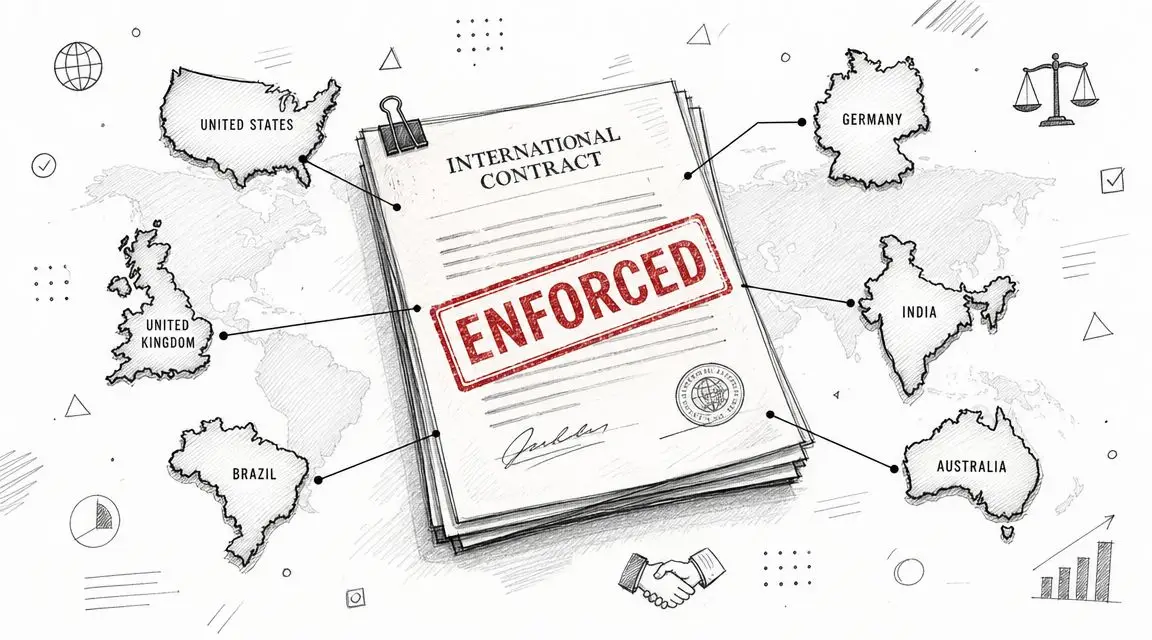
That is why cross-border dispute planning should start with enforceability, not sentiment. A clause that feels balanced but produces a weak enforcement pathway can leave the winning party with a paper victory.
Arbitration’s structural advantage abroad
Arbitration is usually the strongest cross-border ADR tool because arbitral awards are widely enforceable under the New York Convention, which has 170+ parties, as explained in this summary of alternatives to court.
That doesn’t mean every award enforces automatically. It does mean the legal architecture is familiar, established, and generally more predictable across borders than many private settlement outcomes.
For a non-Israeli company contracting with an Israeli party, or the reverse, that predictability matters. It affects negotiating position before the hearing starts, because each side knows the result may be collectable in another jurisdiction.
Mediation can still work, but only with planning
Mediated settlements now have a more direct international framework through the Singapore Convention on Mediation. However, it has far fewer ratifications than the New York Convention.
That gap creates a practical distinction. Mediation may still be the right first move, especially where the parties want to preserve a relationship or solve a complex business problem. Yet the settlement structure must account for where enforcement may later be needed.
A weakly drafted mediated settlement can force the winner back into fresh litigation abroad. That defeats much of the value the parties thought they had gained through speed and privacy.
If the target country won’t treat the result as readily enforceable, the process may solve the argument but not the collection problem.
The right question to ask before signing
A foreign CEO should ask counsel three things before the contract is signed:
- Where are the assets? Enforcement should track the actual location of money, receivables, inventory, or decision-makers.
- What result will the process produce? A negotiated settlement, interim order, or arbitral award each carries different enforcement consequences.
- Which jurisdiction will have to recognize it? The answer often determines whether mediation should be a first stage only, with arbitration reserved as the final stage.
Many generic ADR discussions fail. They compare speed and cost, but they ignore collection architecture. In international commerce, that omission is expensive.
Drafting an Effective ADR Escalation Clause
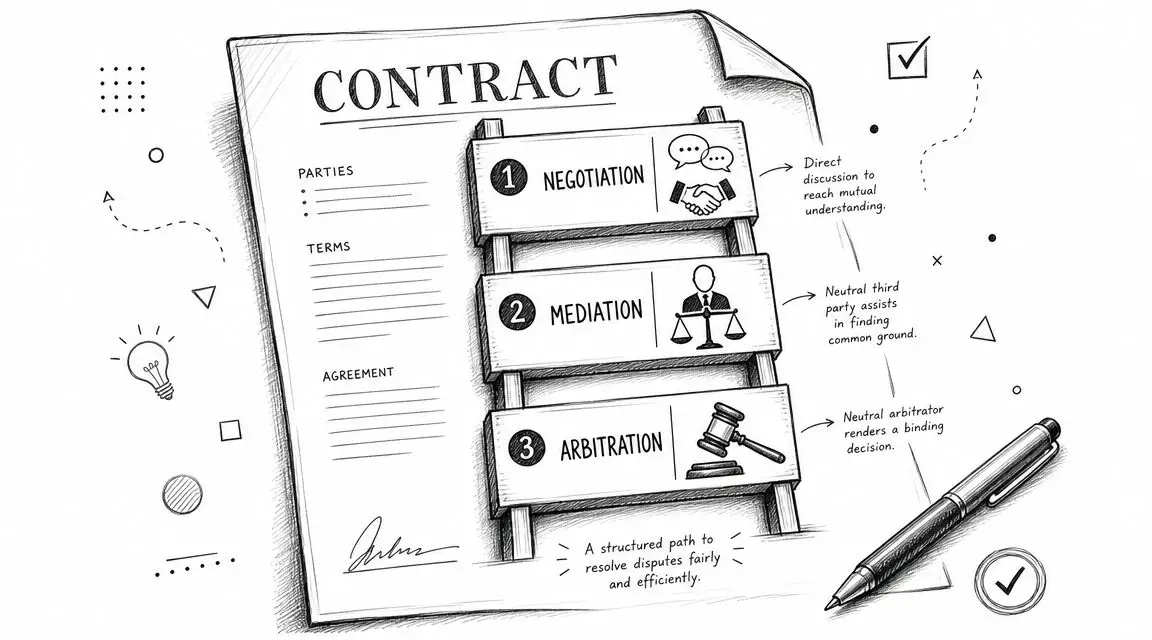
The best clause doesn’t choose one process blindly. It builds a sequence. That sequence should filter routine disputes cheaply, preserve room for commercial settlement, and still deliver a binding result if needed.
The market already shows that experienced parties draft dispute architecture intentionally. In WIPO’s survey on technology transaction disputes, court litigation was the most common standalone clause at 32%, followed closely by expedited arbitration at 30%, while mediation appeared in 12% of clauses. The survey also found that when technology disputes were resolved, court litigation in the respondent’s home jurisdiction was most common, followed by court litigation in another jurisdiction, then arbitration and mediation. The broader point from the WIPO dispute resolution survey results is that parties now design clauses as part of cross-border risk management.
A practical escalation model
A useful clause often follows this structure:
- Executive negotiation first: Require written notice of dispute and a short period for senior decision-makers to meet.
- Mediation second: If negotiation fails, send the dispute to mediation under defined rules, language, and location.
- Arbitration last: If mediation ends without settlement, require binding arbitration with clear procedural terms.
That sequence works because each stage does a different job. The first stage tests whether the dispute is operational rather than legal. The second tests whether a confidential compromise is possible. The third delivers finality.
Sample clause language
A contract might say:
Any dispute arising out of or in connection with this agreement shall first be referred to good-faith negotiations between senior executives of the parties. If the dispute is not resolved within the specified period, the parties shall submit the dispute to mediation under the agreed rules. If mediation does not result in a signed settlement within the specified period, the dispute shall be finally resolved by binding arbitration in the agreed seat, language, and procedural framework.
That sample is only a skeleton. The serious work lies in the details.
The terms that parties often miss
An effective clause should also address:
- Seat of arbitration: This affects supervisory court involvement and procedural law.
- Language: Cross-border disputes often collapse into cost and delay if language isn’t fixed in advance.
- Scope: Decide whether all disputes go to arbitration or only specific categories.
- Interim relief: Preserve the right to seek urgent court measures where necessary.
- Confidentiality: State it expressly rather than assume it.
- Service and notice mechanics: Avoid later fights over whether the process was properly triggered.
These issues matter in long-term real estate and operations contracts as much as in technology deals. The same logic often appears in complex commercial lease agreements involving foreign investors, local operators, and layered default scenarios.
Your Action Plan for Dispute Mitigation
A multinational business shouldn’t wait for a demand letter before reviewing its dispute architecture. By then, the commercial facts are already moving against it.
Immediate actions for in-house teams
- Review core contracts now: Focus on supply, distribution, licensing, franchise, shareholder, and management agreements tied to Israel.
- Map enforcement exposure: Identify where counterparties keep assets, accounts, receivables, and controlling entities.
- Sort disputes by likely pattern: Some contracts need relationship preservation. Others need fast adjudication and collection.
- Build one approved escalation template: Internal consistency reduces drafting mistakes and speeds negotiation.
- Create trigger rules: Decide who can issue a dispute notice, when executives must engage, and when outside counsel enters.
Strengthen process, not just paper
Contract language alone won’t solve a badly managed dispute. The legal team needs clean records, version control, notice discipline, and fast access to bilingual evidence.
That is one reason legal departments are now exploring tools for leveraging private AI in legal work, especially where confidentiality, internal document review, and cross-language workflows matter. Technology won’t decide forum strategy, but it can reduce delay inside the company before the formal process even starts.
Watch for spillover risk
Commercial disputes rarely stay inside the contract file. They can trigger payment holds, director conflict, reputational pressure, and banking consequences. In some matters, unresolved commercial friction can contribute to operational disruptions severe enough to intersect with issues like bank account blockages.
The recommended strategic path is simple. Treat dispute resolution alternatives as part of contract design, not post-crisis improvisation. The earlier the sequence is drafted and operationalized, the more advantage the business retains when the relationship deteriorates.
Avoid costly mistakes in Israel-linked commercial disputes. Contact RNC Group now through the firm’s contact page to assess contract exposure, enforcement risk, and the right escalation strategy for cross-border disputes.
Disclaimer: The articles and information provided in this publication are for informational and educational purposes only and do not constitute legal advice. Reading this article does not create an attorney-client relationship. Readers should consult a qualified attorney for advice on any specific legal matter.