
A multinational can spend months refining a geopolitical risk plan and still fail at the first bank notice in Israel. If the plan doesn’t protect the company’s ability to receive funds, clear payments, and answer compliance queries fast, it doesn’t control the fundamental risk.
Most boards still treat geopolitical risk management as a forecasting discipline. In practice, the first commercial shock is often narrower, faster, and more damaging. It lands in treasury, legal, and finance before it appears in a strategy deck.
Your First Geopolitical Crisis May Be a Bank Notice
The dangerous assumption is simple. Executives think geopolitical stress first appears as war, sanctions headlines, or regulatory announcements. In many Israeli matters, the first operational signal is smaller. A bank asks for documents, delays a transfer, questions beneficial ownership, or flags unusual activity.
That moment matters because banking friction can escalate faster than most cross-border firms expect. Once cash movement slows, supplier confidence drops, payroll planning tightens, and contract performance risk rises. Legal exposure follows quickly because delayed payment can trigger breach notices, defaults, and disputes that were never part of the original geopolitical scenario.
Why the first signal is often operational
Banks act before courts do. Compliance teams act before counterparties explain themselves. Therefore, a company with Israeli exposure needs a risk model that starts with transactional continuity, not just macro monitoring.
A geopolitical event abroad can change how a bank interprets a transaction inside Israel. The event may involve a shareholder jurisdiction, a customer route, a sanctioned intermediary, a politically exposed person, or a sector under added scrutiny. The company may still be lawful and commercially sound, but the payment flow slows while the review runs.
Practical rule: If treasury can’t explain a payment path in plain language with supporting documents, the legal risk has already started.
A useful parallel appears outside Israel in analysis of this bank security incident. The facts differ, but the lesson is relevant. Banks react aggressively when security, compliance, or trust breaks down, and clients feel the commercial damage immediately.
What boards usually miss
Traditional geopolitical planning often overweights public events and underweights banking mechanics. That approach fails because a company doesn’t trade through headlines. It trades through accounts, payment approvals, credit lines, and compliance tolerance.
Three failures appear repeatedly:
- Weak ownership files: Corporate groups can’t quickly prove control chains, source of funds, or board authority.
- Mismatched narratives: Sales, finance, and legal describe the same transaction differently.
- No escalation path: A routine bank query sits in email until it becomes an account problem.
The stronger approach starts with a narrower question. Can the company defend its account activity, customer flows, and cross-border purpose on short notice, in a form an Israeli bank will accept? If the answer is uncertain, the geopolitical plan has a structural gap.
Defining Geopolitical Risk for Your Business in Israel
For a business active in Israel, geopolitical risk isn’t a background issue. It’s a commercial variable that can alter payment behavior, compliance scrutiny, logistics routes, and board decisions. The useful definition is operational. It asks which external developments can impair lawful performance, cash conversion, and contractual reliability.
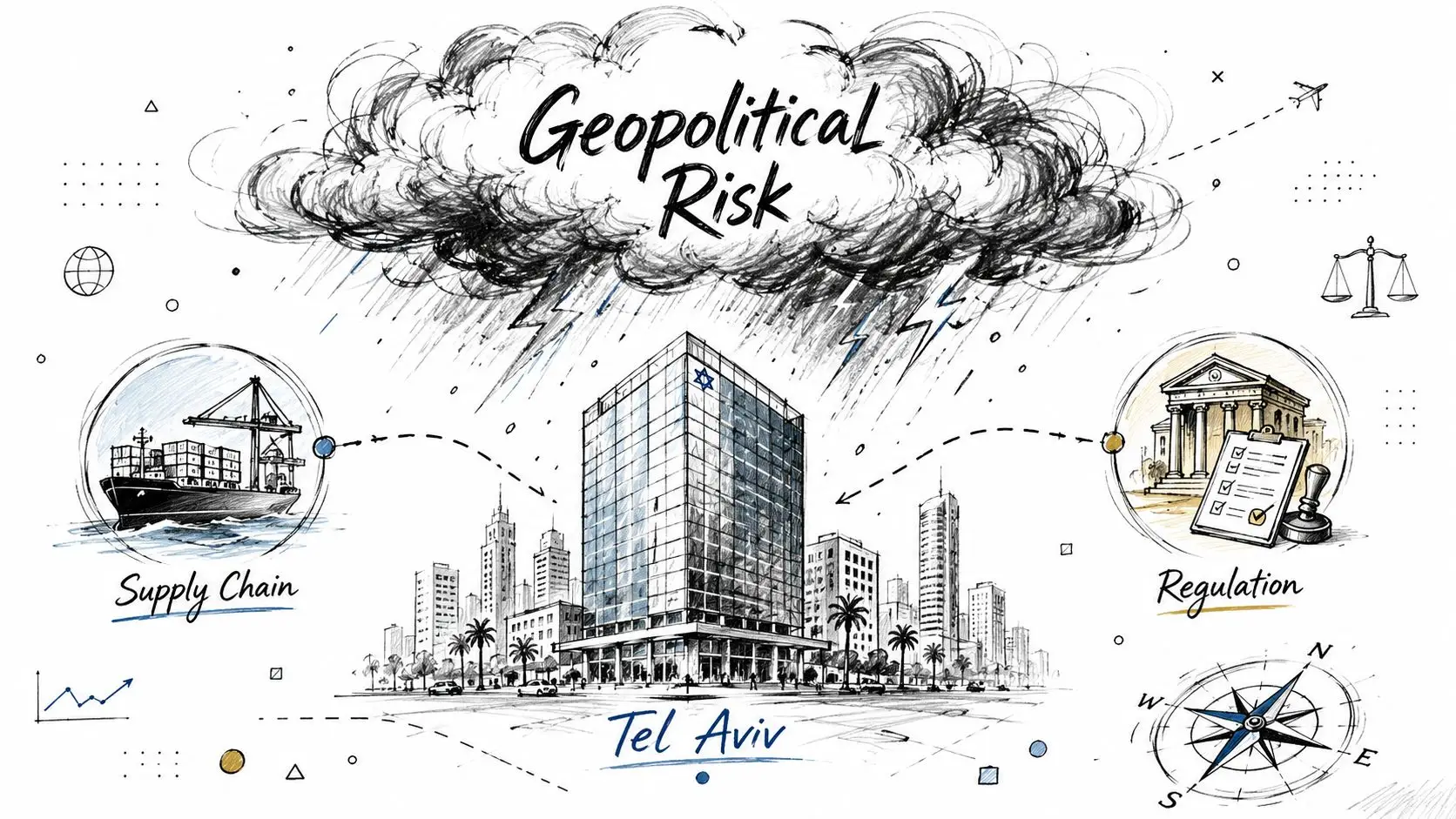
A practical definition, not a headline definition
A company in Israel should treat geopolitical risk as a cluster of external forces that can change how banks, regulators, customers, suppliers, and counterparties behave. That includes sanctions pressure, export control sensitivity, shipping disruption, regional instability, and rapid policy shifts in major economies.
The point isn’t to predict every event. The point is to identify which external developments can force a local commercial consequence. In Israel, that often means delayed funds, tougher compliance review, altered supply timing, and strained contract performance.
The long historical view matters here. The widely used geopolitical risk index developed by Dario Caldara and Matteo Iacoviello is built from newspaper coverage of geopolitical tensions and has been tracked monthly since 1900, which gives firms a long-run basis for comparing temporary shocks with structural change (historical geopolitical risk index methodology).
The categories that actually matter
A workable taxonomy usually includes these categories:
- Banking and compliance risk: Enhanced KYC review, transaction questions, account friction, and payment delays.
- Trade and sanctions risk: Counterparty exposure, indirect prohibited dealings, export control issues, and routing sensitivity.
- Supply chain risk: Delayed inputs, shipping rerouting, customs friction, and dependency on vulnerable jurisdictions.
- Contract risk: Force majeure disputes, payment default, pricing pressure, and termination triggers.
- Reputation risk: Public scrutiny around trading partners, jurisdictions, or crisis response decisions.
These categories overlap. A sanctions question can become a banking issue. A logistics disruption can become a payment default. A reputational issue can trigger deeper compliance review.
The company that labels a risk correctly acts faster. The company that labels everything as “regional instability” reacts too late.
Why Israel requires a narrower lens
Israel creates a sharper intersection between geopolitics and commercial law than many foreign managers expect. Banking sensitivity, beneficial ownership review, multilingual documentation, and cross-border counterparty issues often converge in the same matter. Therefore, a generic country-risk score isn’t enough.
A useful Israeli lens asks different questions. Which transactions will trigger bank questions first. Which counterparties create indirect sanctions concern. Which commercial agreements assume uninterrupted payment channels. Which group entities can answer an Israeli compliance inquiry without contradiction.
That is geopolitical risk management in legal practice. It turns abstract uncertainty into identifiable pressure points inside the company’s operating model.
The First Domino Bank Account Restrictions
The first domino is often the bank account, not the market forecast. Once an Israeli bank questions incoming or outgoing activity, the issue moves from abstract risk to immediate commercial impairment. Cash flow becomes conditional. Internal explanations become evidence.
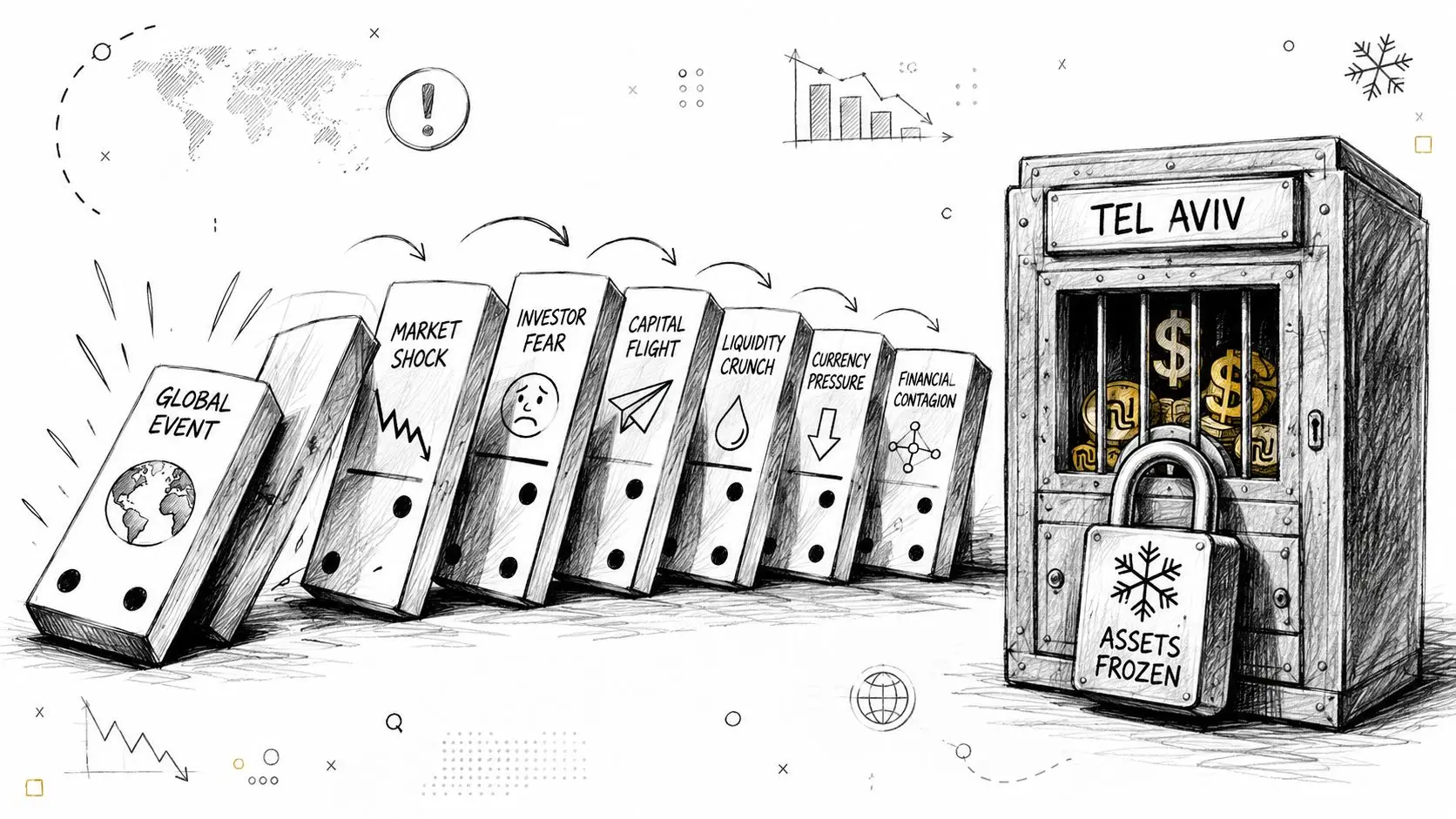
How a distant event reaches a local account
The path is usually short. Global tension rises. Financial institutions tighten screening. Israeli banks then ask harder questions about ownership, transaction purpose, counterparties, and jurisdictional links.
For an international group, that can create a severe mismatch between commercial reality and compliance presentation. The transaction may be lawful and ordinary from management’s perspective. Yet the bank sees complexity, incomplete documentation, unusual routing, or exposure to a sensitive geography.
That mismatch creates friction in stages:
| Trigger | Immediate bank reaction | Commercial effect |
|---|---|---|
| Sensitive jurisdiction link | Request for clarifications and supporting files | Payment delay |
| Complex ownership structure | Review of beneficial ownership and authority | Counterparty concern |
| Unusual transaction pattern | Enhanced monitoring or temporary hold | Working capital pressure |
| Weak document trail | Repeated compliance questions | Escalation to legal dispute |
Why restrictions become legal crises
A delayed transfer is rarely just a delayed transfer. If a supplier isn’t paid, the supplier may suspend performance. If customer receipts slow, the company may issue checks without adequate coverage. If those checks return, the account can face serious consequences under Israeli banking practice and law.
That is why guidance on bank account blockages belongs inside geopolitical planning, not outside it. The operational problem and the legal problem are the same problem viewed from different desks.
The core mistake is waiting for formal restriction before acting. By then, the company may already face contract default, internal liquidity stress, and loss of banking confidence.
What a foreign company should review immediately
When geopolitical pressure rises, management should test the account position before the bank does. That review should cover legal structure, payment purpose, transaction narrative, and account conduct.
A focused review usually includes:
- Authority documents: Board resolutions, signatory powers, and corporate approvals must align across all group entities.
- Ownership records: The beneficial ownership chain must be current, coherent, and easy to prove.
- Transaction files: Invoices, contracts, shipment logic, and commercial purpose must tell one story.
- Customer discipline: Receivables delay can become a checks problem if treasury relies on expected funds that don’t arrive.
- Bank communication logs: Every query needs a controlled, documented response path.
A bank rarely sees an isolated transfer. It sees a pattern, a structure, and a risk narrative.
What doesn’t work
Several responses usually fail.
First, companies often send too much paper and too little explanation. Second, headquarters sometimes answers in broad strategic language while the bank asked for transaction-level proof. Third, local teams try to solve a legal issue as if it were a customer service issue.
The better course is controlled escalation. Answer quickly. Answer consistently. Match documents to the exact concern. If the issue escalates, move early to legal containment instead of arguing informally after commercial damage has spread.
A Framework for Risk Identification and Assessment
Awareness isn’t enough. Geopolitical risk management works only when management can rank exposures, assign ownership, and decide what happens at each threshold. A practical framework turns scattered concern into a board-ready tool.
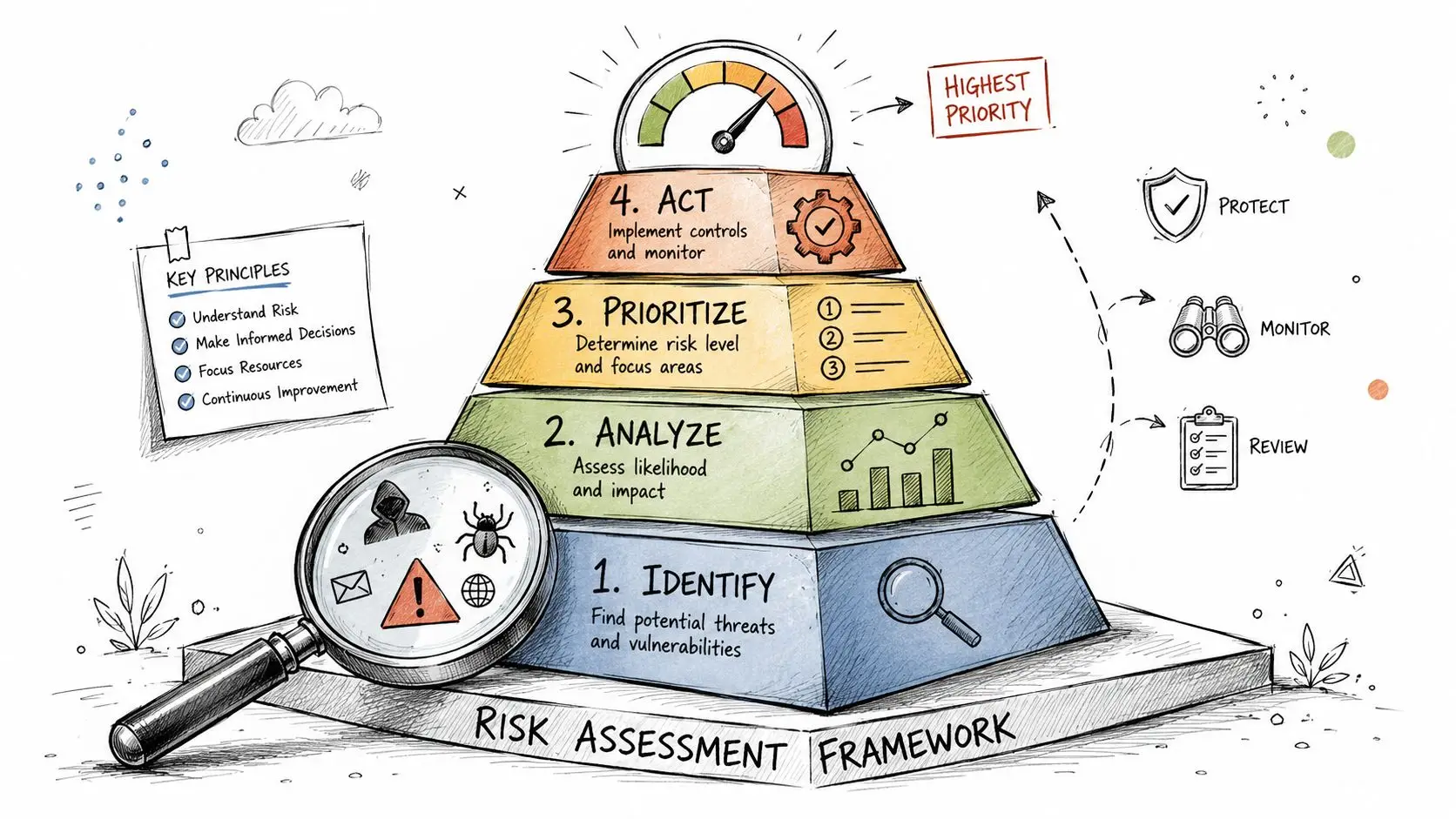
Start with events and threats
An effective process should treat risk as both an event and a threat, then score exposures on a 0 to 100 scale. It should also prioritize them by clear bands: 0 to 20 very low, 21 to 40 low, 41 to 60 moderate, 61 to 80 high, and 81 to 100 very high (multi-level scoring method for geopolitical risk).
That distinction matters in Israeli commercial practice. An event is the trigger, such as a sanctions change or regional escalation. A threat is the business vulnerability that already exists, such as a fragile banking arrangement, a concentrated supplier base, or a contract that assumes uninterrupted currency flow.
A four-part assessment model
The assessment should answer four questions.
-
What happened or might happen
Identify the external event with enough precision to matter. “Regional instability” is too vague. “Counterparty jurisdiction now under enhanced screening” is usable. -
Where the company is exposed
Map the exposure by legal entity, bank account, contract, supplier, and customer. Exposure sits in documents and relationships, not in headlines. -
What the next-order effects look like
Evaluate second- and third-order effects on operations, suppliers, customers, sanctions exposure, export controls, alliances, and regulatory shifts. For cross-border firms, that broader mapping is essential because the first trigger is often less dangerous than the ripple effect through the value chain (operational guidance on second- and third-order impacts). -
Who acts and at what trigger
Set trigger points for treasury, legal, compliance, and management. If no one owns the response threshold, the score has no value.
A sample working matrix
| Exposure area | Typical Israeli consequence | Assessment question |
|---|---|---|
| Banking channel | Delayed or blocked transfers | Can the company explain each payment route clearly |
| Customer receivables | Returned checks and account stress | What happens if expected receipts slip |
| Supplier dependency | Delivery failure and breach exposure | Which inputs lack a viable substitute |
| Contract structure | Weak remedies and unclear allocation | Do agreements assign disruption risk properly |
What good assessment looks like
A strong assessment is specific enough to drive action on Monday morning. It doesn’t stop at “monitor developments.” It names the account, contract, route, customer, or product line that could fail first.
That is also why broad risk commentary has limits. General overviews can be useful for orientation, including expert insights on business risk. However, multinational firms in Israel need a narrower discipline that links external tension to account operations, legal obligations, and evidence files.
Score the exposure, not the headline. The same event can be low risk for one entity and severe for another.
The minimum governance standard
Management should insist on a living register, not a quarterly slide. Every high or very high item needs an owner, a trigger, a mitigation step, and a legal review path. Moderate items need monitoring criteria. Low items should stay visible but not consume scarce response capacity.
The most useful register also records assumptions. If the company assumes a banking route will remain open, that assumption should appear in the file. Once assumptions become visible, management can test them before the market or the bank does.
Building Your Mitigation and Escalation Playbook
Risk ranking has no value unless it changes behavior. The practical question is simple. What does management do before friction starts, when warning signs appear, and when the crisis is already active.
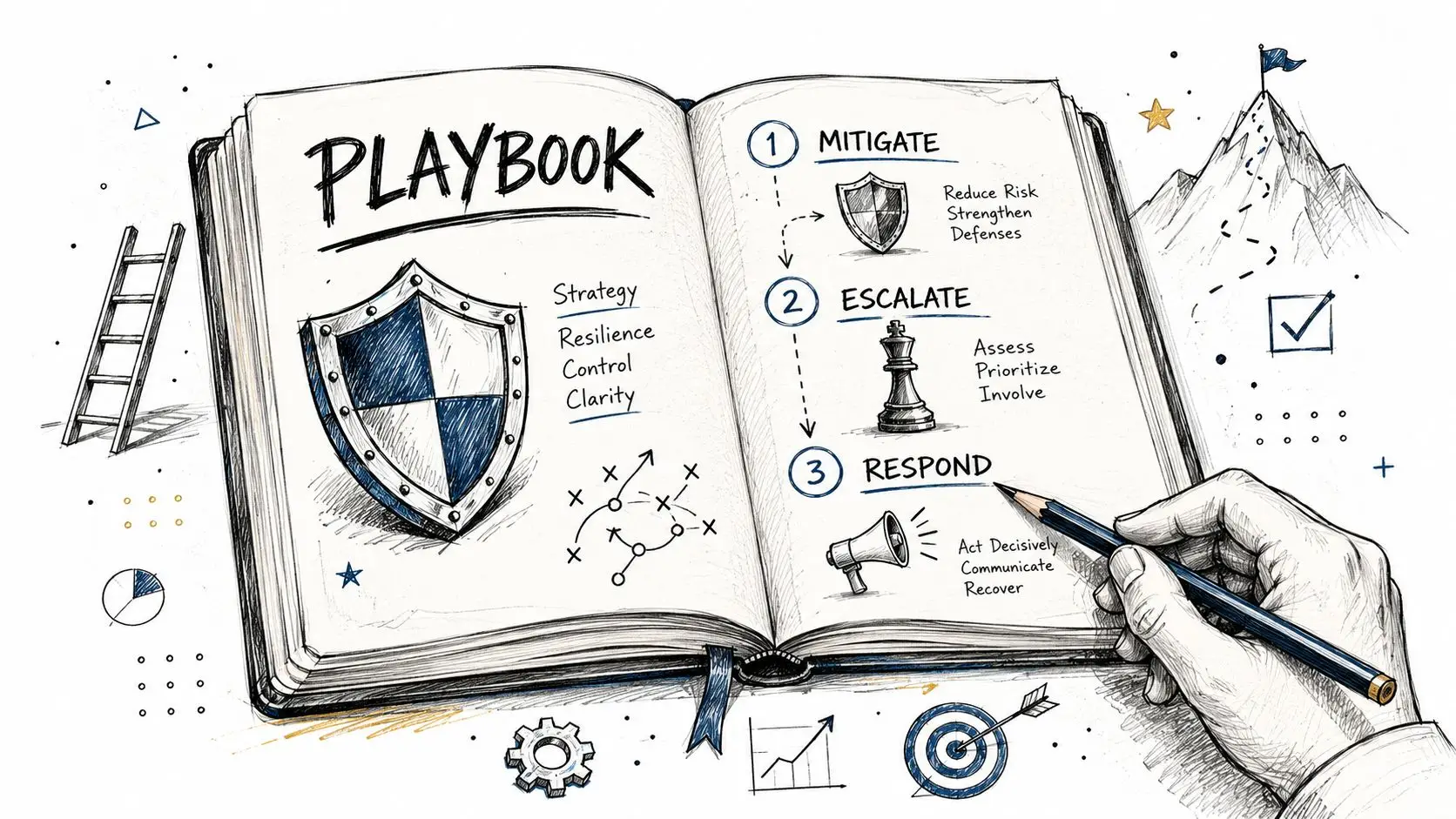
A long-run macroeconomic warning supports that discipline. A Federal Reserve study using annual data from 26 countries over 1900 to 2019 found that higher country-specific geopolitical risk is associated with lower expected GDP growth, lower expected total factor productivity growth, and higher expected military spending (Federal Reserve research on measurable macro effects of geopolitical risk). For businesses, that means mitigation can’t wait for certainty because the surrounding commercial environment may deteriorate while internal teams still debate labels.
Phase one before the account is under pressure
The first phase is structural. It focuses on legal drafting, banking hygiene, and documentary coherence.
Key steps include:
- Harden commercial agreements: Payment clauses, notice mechanics, governing law choices, information duties, and termination rights should reflect disruption risk. In property-heavy operations, commercial lease agreement strategy matters because location commitments can outlast the assumptions behind them.
- Simplify transaction narratives: Every major payment flow should have a clean explanation supported by contracts, invoices, and authority documents.
- Pre-clear internal ownership files: Beneficial ownership, corporate charts, and signatory authority should be updated before the bank asks.
- Segment sensitive exposure: High-friction customers, routes, and jurisdictions should not sit in one unmanaged cluster.
This phase often determines whether a later bank inquiry stays manageable or turns adversarial.
Phase two when warning signs appear
The second phase begins when the company sees friction, not only when it sees restriction. A delayed transfer, repeated compliance query, or customer payment slippage should trigger active intervention.
Management should then:
- move one legal owner and one business owner onto the file
- freeze inconsistent communications
- rebuild the transaction record in one place
- assess whether contract notices must go out now
- protect liquidity while the review continues
This is also the point where broader stakeholder exposure needs attention. Banking pressure can spill into public criticism, vendor anxiety, and executive reputational risk. In sensitive cases, outside guidance on strategies for reputation protection can complement legal containment, especially when online attacks try to convert a compliance review into a credibility crisis.
The first response should reduce ambiguity. Banks escalate when the facts are unclear, inconsistent, or late.
Phase three when the crisis is active
The third phase starts when the account is blocked, restricted, or functionally unusable. At that point, the company needs coordinated legal, financial, and communications control.
A disciplined response usually includes this sequence:
| Crisis task | Purpose |
|---|---|
| Immediate legal review | Determine the bank’s basis, the contractual fallout, and urgent remedies |
| Counterparty triage | Preserve critical suppliers, customers, and payroll channels |
| Evidence consolidation | Prevent conflicting explanations and missing records |
| Litigation readiness | Prepare injunction strategy or related court relief if necessary |
| Controlled messaging | Reassure stakeholders without creating admissions |
A separate but related capability often becomes decisive at this stage. Crisis management protocols matter because the dispute may now involve banks, counterparties, regulators, and potential court filings at once.
What effective playbooks do differently
Weak playbooks say “monitor” and “diversify.” Strong playbooks assign decision rights, timing rules, and legal triggers. They identify which contracts need notice, which bank queries require executive sign-off, which customers create the highest liquidity risk, and when outside litigation counsel must step in.
They also reflect a simple truth. In cross-border Israeli matters, prevention often looks legal before it looks strategic. The companies that respond best have already aligned contract structure, banking evidence, and escalation authority before the first formal restriction arrives.
From Theory to Actionable Corporate Strategy
Many companies track geopolitics. Far fewer translate it into operating controls. That gap is the primary vulnerability.
Guidance from Deloitte highlights the problem clearly. Many firms still use ad hoc approaches, and the failure isn’t lack of awareness. The failure is not connecting political risk to P&L-relevant decisions, KPIs, and escalation playbooks inside identification, measurement, mitigation, monitoring, and internal controls (Deloitte on operationalizing geopolitical risk management).
What actionable strategy looks like
Actionable strategy starts with a narrow premise. A geopolitical issue becomes real when it disrupts a bank account, delays a receivable, weakens a contract right, or creates legal inconsistency across entities. Therefore, strategy should begin with those friction points.
Management should adopt a direct checklist:
- Map decision triggers: Define when treasury, legal, compliance, and the board must act.
- Test key assumptions: Verify that payment routes, counterparties, and internal authority files still hold.
- Align legal structure with operations: Contracts, leases, and corporate documents should support the actual business model.
- Prepare crisis escalation: Build a litigation and communications path before pressure appears.
Why specialist execution matters in Israel
Israel’s commercial environment can compress banking, contractual, and litigation risk into one timeline. That requires more than country monitoring. It requires disciplined commercial law execution, multilingual coordination, and a phased response that starts with prevention and ends with enforceable remedies if needed.
The firms that avoid costly mistakes don’t treat geopolitical risk management as a watchlist exercise. They turn it into a commercial control system.
Avoid costly mistakes by addressing banking exposure, contractual structure, and escalation planning before geopolitical stress turns into a commercial dispute. For specialized guidance on Israeli cross-border risk, account restrictions, and crisis response, contact RNC Group now.
This article provides general information only and doesn’t constitute legal advice. It doesn’t create an attorney-client relationship, and readers should obtain advice for their specific facts and jurisdictional exposure before acting.