
A cross-border dispute rarely turns on who has the better legal argument alone. It turns on who chose the forum first, preserved evidence early, secured interim advantage fast, and can still enforce the outcome where assets sit.
That is the gap in most discussions of international commercial dispute resolution. They catalogue options. They don’t treat dispute resolution as a sequenced crisis framework that starts at contract signature and ends only when money, shares, goods, or control change hands.
Your 2026 Contract Is It a Shield or a Ticking Clock
Will your 2026 contract contain the pressure, or start the countdown on a cross-border dispute?
That question is not academic. By the time a supply failure, payment default, IP breach, or shareholder conflict surfaces, strategic choices are often already fixed by the contract. The party that treated the dispute clause as a final drafting formality usually discovers the problem too late.
For boards and management teams, this is not a narrow legal issue. It is a risk allocation decision that affects speed, cost, confidentiality, operational control, and the practical path to recovery. In cross-border trade, especially where Israel is one of several relevant jurisdictions, a weak clause creates room for parallel proceedings, threshold objections, translation disputes, and early fights over interim relief or service.
Most guides stop at listing the options. The harder question is how to sequence them. A well-built contract should do more than identify a forum. It should set the order of play if the relationship starts to break down, including who must receive notice, whether senior executives must meet first, whether interim court relief remains available, and how fast the dispute can move from commercial negotiation to binding process.
The dispute clause is part of crisis planning
A good clause works as a business control mechanism before any claim is filed. It answers practical questions that matter in the first 72 hours of a serious dispute:
- Where the first fight happens: court, arbitration, or a staged process
- Who bears procedural friction: language, seat, governing law, and service mechanics
- What pressure can be applied early: interim injunctions, emergency relief, asset restraint, or document preservation
- How much becomes public: a material issue for financing, listed companies, and sensitive supply arrangements
- Whether the final outcome can be turned into cash or control: through enforcement against assets, shares, receivables, or local operations
Those are commercial questions first, legal questions second.
A vague clause does not preserve optionality. It hands the other side room to delay, fragment the dispute, and increase cost. I have seen counterparties use a badly drafted clause to force months of argument about forum, language, and the validity of the clause itself before the underlying breach was even addressed.
That risk is sharper in Israel-linked deals. Parties often assume they can sort out procedural details later. They cannot. If the deal may require urgent court support, protection of IP, action against assets in more than one country, or evidence from Hebrew, English, Russian, or Arabic sources, the clause should reflect that at signing.
Practical rule: If the contract does not tell management where, how, and in what language a dispute will be handled, it is not finished.
The strongest contracts also account for enforcement reality at the front end, not after the hearing. There is little value in winning in a forum that gives you no practical route to assets. That is why the dispute clause should be drafted with the endgame in mind from day one.
The Four Arenas of Global Commercial Conflict
Where should management apply pressure first when a cross-border dispute breaks out?
There are four main arenas, and each performs a distinct role. The mistake is to treat them as interchangeable options on a checklist. In practice, they should be sequenced as part of a control plan. The right order depends on what the business needs in the first 72 hours, what can still be preserved before positions harden, and where assets or counterparties can be reached, especially in Israel-linked matters.
Litigation in national courts
Court proceedings matter when a party needs state power, fast. That includes injunctions, disclosure orders available under local procedure, orders against local assets, and relief tied closely to statutory rights or regulated conduct.
The trade-off is obvious. Court litigation is usually public, procedure can be rigid, and a foreign party may see the other side’s home court as a tactical disadvantage rather than a neutral forum. Cross-border enforcement of judgments also remains uneven. A judgment that is decisive in one country may trigger a second fight elsewhere.
In Israel-linked disputes, courts can be the right first move where immediate local relief is the priority. They are rarely the whole strategy in a multi-jurisdiction conflict.
Arbitration in an institutional framework
Arbitration is usually the main adjudicative forum for international contracts because it gives parties a neutral process and a more practical route to cross-border enforcement than court judgments often provide.
That does not automatically make arbitration efficient. It works well when the clause is disciplined, the tribunal fits the dispute, and the parties control scope from the start. It works badly when counsel import full-scale court tactics into the case or when the clause leaves open basic procedural fights about seat, rules, consolidation, or language.
For many Israel-connected transactions, arbitration is the core forum but not the only one. The stronger approach is to pair arbitration with defined access to local courts for urgent relief, evidence preservation, or targeted action against assets.
Mediation as a controlled settlement process
Mediation is useful early, before cost and hostility become irreversible. It gives management room to protect a supply chain, preserve a joint venture, reset payment terms, or agree an exit that no tribunal could order.
Its limits are just as important. Mediation fails when one side wants delay more than resolution. That is why timing and structure matter. If parties want mediation in the clause, they should set short deadlines, identify who starts the process, and state clearly when a party may move to arbitration or court if settlement efforts stall.
Used properly, mediation is not a soft alternative. It is a pressure valve.
Expert determination for technical points
Expert determination is often the best tool for a narrow issue that should not consume a full arbitration or court case. Typical examples include valuation disputes, completion accounts, pricing formulas, quality metrics, reserve calculations, and engineering performance questions.
It succeeds only when the mandate is tightly framed. If the clause does not define the issue, the appointment process, the binding effect of the decision, and the relationship to parallel claims for breach or fraud, the parties can end up litigating about the expert process itself.
For that reason, expert determination usually belongs inside a larger dispute architecture. It resolves a specific technical point. It does not replace a forum for broader commercial conflict.
Dispute resolution methods compared
| Method | Confidentiality | Speed | Cost | Enforceability |
|---|---|---|---|---|
| Litigation | Usually public | Varies by court | Can escalate fast | Often harder across borders |
| Arbitration | Usually private | Structured, but depends on clause and tribunal | Significant, but predictable when managed well | Strong for cross-border awards |
| Mediation | Private | Often fastest when parties engage seriously | Usually lower than formal proceedings | Depends on settlement documentation |
| Expert determination | Usually private | Often quick for defined technical issues | Narrower and more contained | Depends on contract drafting and local law |
What works and what doesn’t
The companies that handle disputes well do not ask which method is best in the abstract. They decide which arena should come first, which should stay available in reserve, and what result each step is meant to produce.
What usually works:
- Mediation first for commercial friction that can still be repaired: Common in supply, distribution, licensing, and shareholder disputes where the relationship still has value.
- Arbitration as the main merits forum for cross-border contracts: Particularly where neutrality and enforceability matter more than local procedural tools.
- Expert determination for tightly defined accounting or technical questions: Especially where speed matters and the legal issues are secondary.
- Targeted court action for immediate pressure: Such as injunctions, asset restraints, or orders that only a local court can give quickly.
What usually fails:
- Hybrid clauses with no order of operations
- Mandatory mediation without a hard stop
- Arbitration clauses that omit seat, rules, or language
- Domestic court clauses pasted into international contracts without considering enforcement
A dispute process should operate like a crisis protocol. Management should know what happens first, what happens if that step fails, and where the final result can actually be enforced.
Choosing Your Battlefield Forum and Governing Law
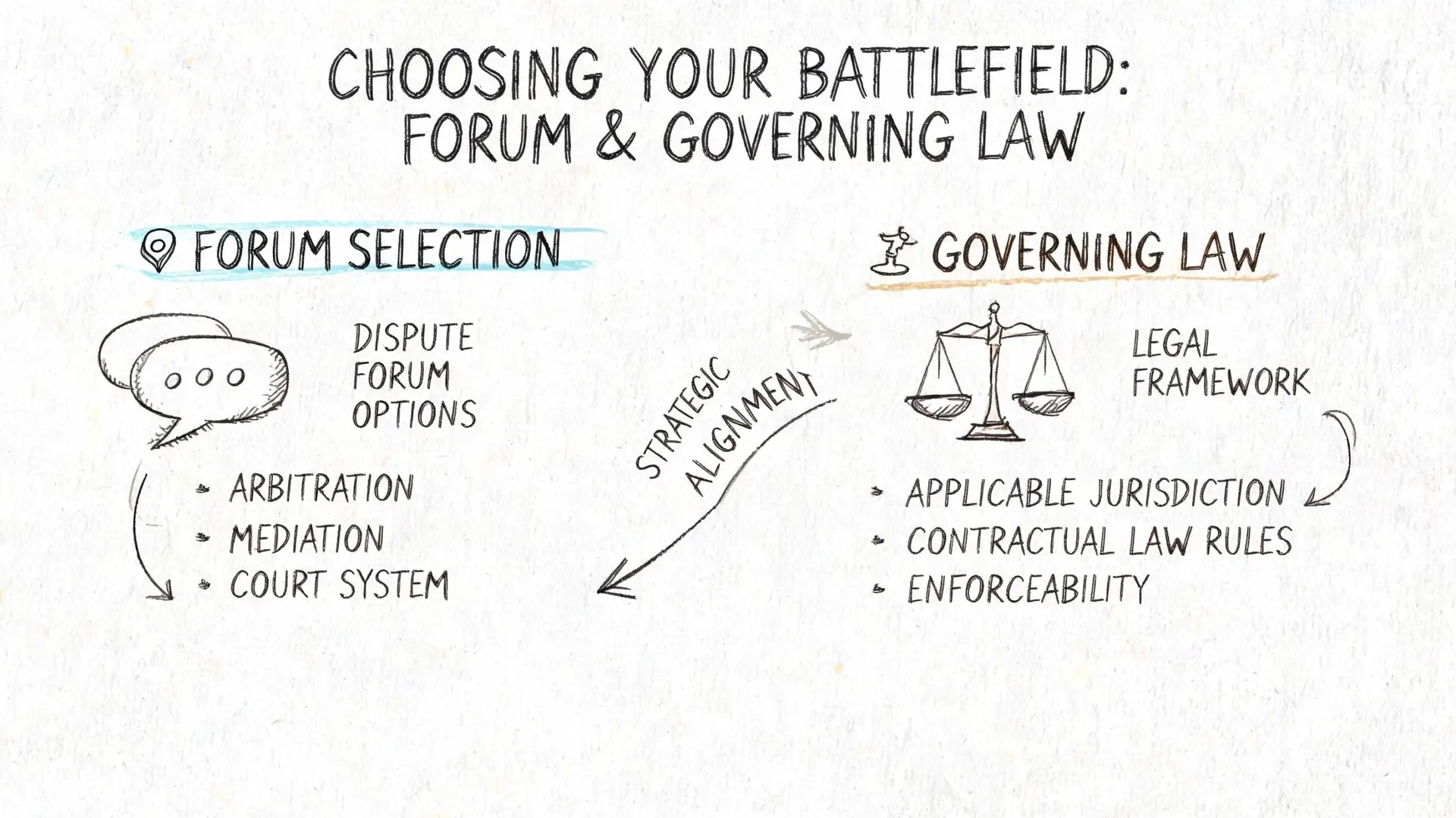
The first serious strategic choice isn’t whether to sue. It’s where the fight will occur and which legal system will govern the contract.
Those are different questions. Governing law decides how the contract is interpreted. The forum decides who hears the dispute. In arbitration, the seat adds a third layer because it determines the legal home of the arbitration and the court support available around it.
Three decisions, not one
Boards often collapse these issues into a single line item. That’s a mistake.
- Governing law: This controls contract interpretation, remedies, limitation issues, and implied duties.
- Forum: This determines whether judges, arbitrators, or both will manage the conflict.
- Seat of arbitration: This shapes procedural supervision, annulment risk, and court support.
A contract may use English law, ICC arbitration, and a seat in Singapore. It may also use Israeli substantive law with a neutral arbitral seat if that better fits the transaction and enforcement plan. The point is deliberate design, not habit.
Why neutral forums keep their advantage
Businesses are increasingly using established arbitral institutions for high-value disputes. Leading centers such as the ICDR, HKIAC, and SCC all reported significant increases in dispute value in 2024, with the SCC reaching US$15.93 billion, as noted in Global Arbitration News’ 2024 arbitration statistics review. That trend reflects a practical preference for neutral systems over the other side’s home court.
Neutrality matters for more than optics. It affects witness cooperation, board confidence, insurer reporting, settlement posture, and financing discussions during a live dispute.
Israel-specific drafting judgment
When Israel is part of the transaction, forum analysis should include more than textbook neutrality. Counsel should assess where the contract will be performed, where the documents and bank flows sit, whether urgent local relief may be necessary, and whether a dispute might overlap with shareholder, insolvency, or account restriction issues.
That is why meticulous contract drafting sits at the center of risk management. The legal architecture used in commercial agreements should match the deal structure, the counterparties’ bargaining power, and the likely enforcement route.
Choose the forum with the enforcement phase already in mind. Don’t choose it because the template looked familiar.
Drafting an Ironclad Dispute Resolution Clause
A dispute clause should operate like a machine. When conflict starts, management should know exactly what happens next.
Most failed clauses don’t fail because they are short. They fail because they are ambiguous at the points where pressure rises. One side then argues over forum, service, language, arbitrator appointment, or preconditions instead of addressing the merits.
The components that must be explicit
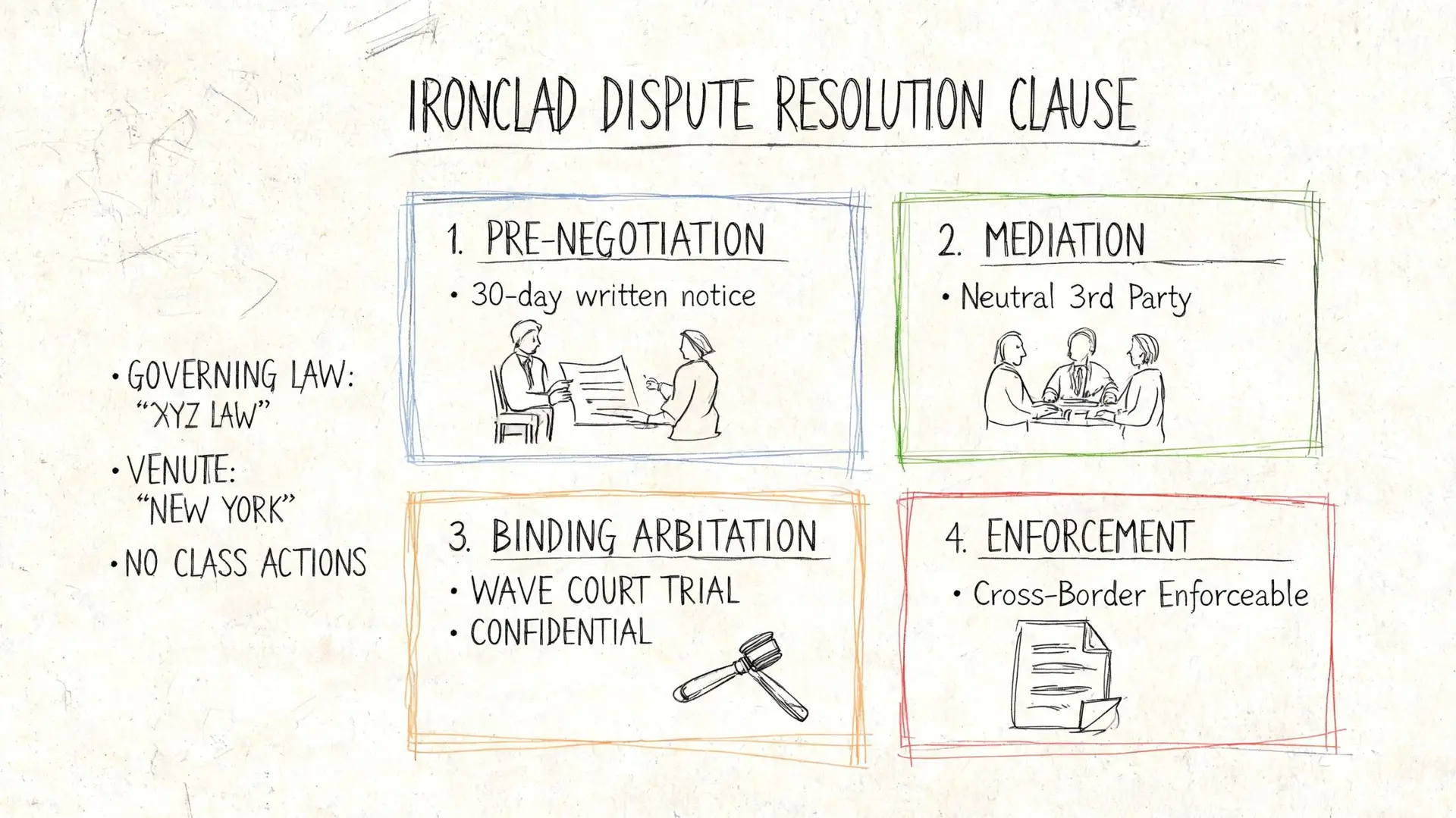
An effective clause usually identifies the following without hesitation:
-
The trigger for escalation
State when a dispute formally exists and when notice starts the clock. -
A short pre-arbitration phase
Use negotiation or mediation only if the timetable is fixed and non-compliance doesn’t paralyze later action. -
The institution and rules
Name the institution clearly. Don’t mix terms from different rulebooks. -
Seat, language, and number of arbitrators
These are not cosmetic details. They affect cost, timing, and procedural control. -
Scope of covered disputes
Include contractual and related non-contractual claims if that is the intent.
Expedited process as a serious tool
For the right dispute, speed is more valuable than procedural sprawl. The ICC Expedited Procedure Provisions can deliver a final award within six months, according to the ICC 2024 dispute resolution statistics. That can be decisive when a delayed outcome would damage financing, inventory planning, franchise continuity, or shareholder stability.
Expedited procedures are not for every case. They suit disputes that need binding closure quickly and can tolerate a more compressed process.
Common drafting failures
Poor clauses usually contain one of these defects:
- Pathological hybrids: “Any dispute shall be submitted to the courts and, if needed, to arbitration.”
- Undefined mediation stages: No deadline, no trigger for completion, no consequence for refusal.
- Seat confusion: The contract names one city, one court, and another institution without saying which governs.
- Language silence: Critical in multilingual relationships and document-heavy cases.
A clause should leave as little room as possible for tactical debate about process.
Financial evidence often drives these disputes harder than legal rhetoric does. For valuation disputes, payment defaults, and accounting allegations, parties often need precise financial documentation support before any hearing begins. Clean records narrow issues, strengthen settlement bargaining power, and reduce procedural drift.
Navigating Immediate Threats Interim and Emergency Relief
Some disputes don’t allow a measured rollout. A distributor starts diverting customers. A joint venture partner moves funds. A former manager copies confidential material. Delay then becomes a business loss, not a legal inconvenience.
In those moments, the question changes. It is no longer which final forum is ideal. It is which mechanism can stop damage now while preserving the company’s broader strategic position.
When speed outranks completeness
Interim measures exist to preserve the status quo or prevent irreversible harm. They may target assets, information, contracts, board control, or evidence.
A typical crisis pattern looks like this:
- Day one: suspicion of diversion, misuse, or breach
- Day two: document preservation and internal control steps
- Day three: notice strategy, local counsel coordination, and urgent relief analysis
- Next phase: emergency application, negotiated standstill, or immediate filing
The legal answer depends on where the assets are, what the contract allows, and whether a court or arbitral body can act fast enough.
Emergency arbitration and court support
Emergency arbitration can be highly effective where the parties agreed to institutional rules that support it. It gives the applicant a route to urgent orders before the full tribunal is constituted.
Courts still matter. If bank accounts, local injunctions, evidence seizure, or third-party orders are essential, national courts may provide the only practical route. In Israel-related disputes, early coordination between arbitral strategy and local court options is often critical.
When the other side changes facts on the ground, a delayed filing becomes a strategic concession.
A disciplined crisis response also depends on non-litigation control measures. Internal reporting lines, communications discipline, and document retention protocols often decide whether emergency relief succeeds. In urgent matters involving reputational exposure, operational breakdown, or hostile counterparties, the framework used in commercial crisis management offers a useful model for synchronizing legal action with business control.
What decision-makers should approve immediately
Senior management should authorize a short, focused package:
- Evidence hold: Secure messages, approvals, payment records, and access logs.
- Authority map: Confirm who may speak, settle, or suspend performance.
- Asset map: Identify where cash, receivables, inventory, shares, and IP sit.
- Forum check: Confirm whether the contract permits emergency arbitration, court recourse, or both.
One practical option for companies handling Israeli and international disputes is RNC Group, which provides commercial dispute resolution work across negotiation, mediation, arbitration, litigation, and multilingual cross-border coordination. That sort of integrated model matters when legal action must track business continuity rather than proceed in isolation.
Enforcement The Final and Most Critical Hurdle
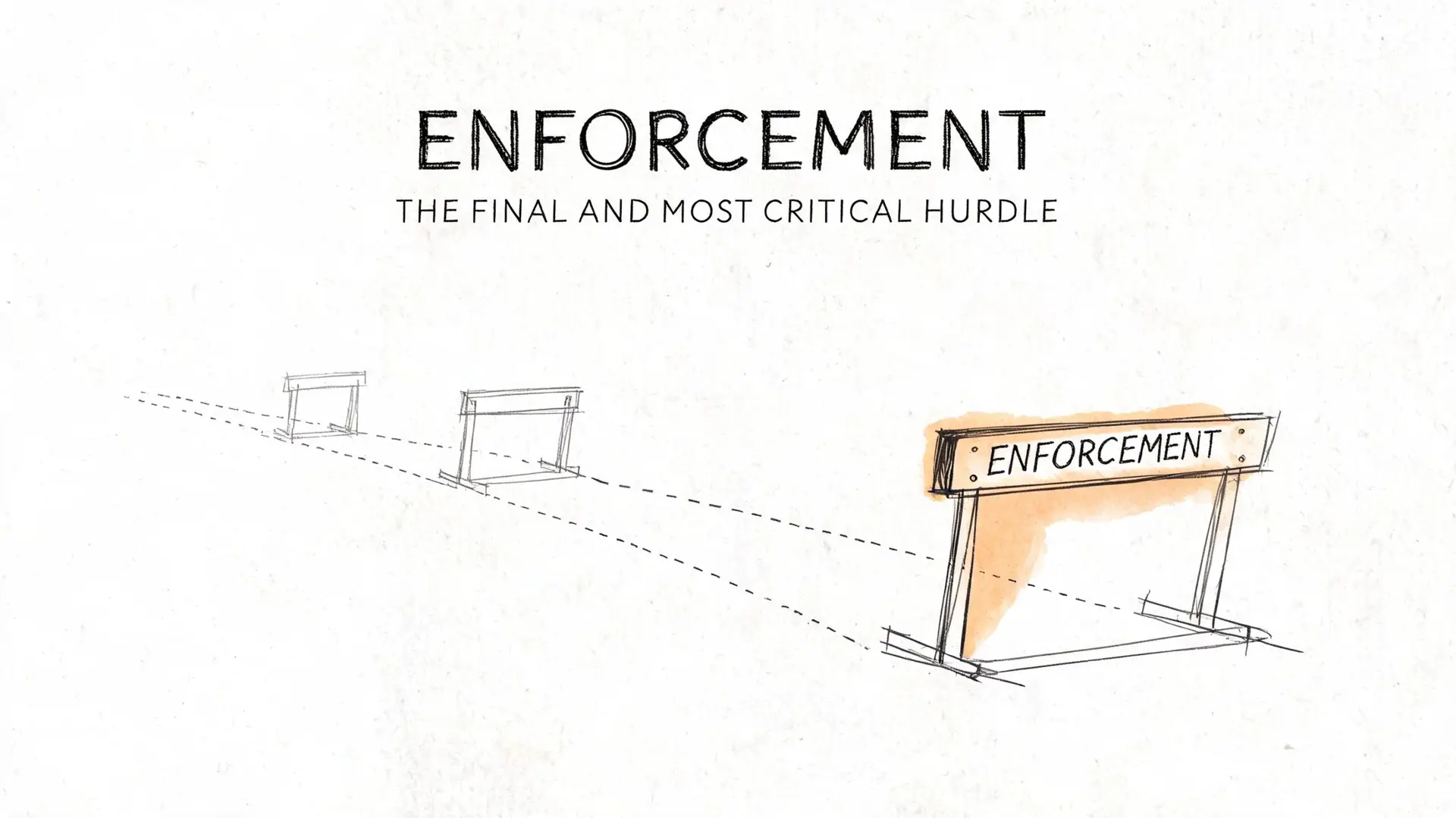
A favorable ruling can create false comfort. It may confirm liability, define damages, and vindicate management’s position. Yet if the respondent can shield assets, exploit local resistance, or operate in a weak enforcement environment, the ruling remains unfinished business.
That is why enforcement deserves attention at contract stage, not after the award arrives. In international commercial dispute resolution, enforcement is not the last administrative step. It is the commercial test of whether the chosen process was sound.
Arbitration’s major advantage and its limits
Arbitration retains a major practical advantage because arbitral awards benefit from the New York Convention framework across 172 countries, as discussed in JAMS’ analysis of international commercial dispute resolution preferences. That is a powerful reason many multinationals prefer arbitration over foreign court litigation.
But coverage on paper doesn’t eliminate execution risk. The same analysis notes that 44 economies lack commercial mediation infrastructure, which signals a broader institutional gap in some markets. A well-drafted arbitration clause can still collide with weak local courts, procedural obstruction, or practical hostility to enforcement.
The enforcement gap boards often miss
Executives often ask whether an award is enforceable in theory. The better question is whether enforcement will work against this counterparty in this asset environment.
That requires answers to practical issues such as:
| Enforcement question | Why it matters |
|---|---|
| Where are the assets located | A strong award means little if assets sit outside reachable jurisdictions |
| Does the counterparty rely on local political protection | Local resistance can slow or distort execution |
| Are assets liquid, movable, or held through affiliates | Recovery planning changes if value sits in layered entities |
| Will local courts support interim preservation | Delay before recognition can invite dissipation |
Israel requires practical, not generic, planning
When the dispute touches Israel, parties should evaluate both legal route and commercial pressure route. Some matters can involve urgent local filings, enforcement applications, company registry issues, or banking restrictions that affect strategic advantage more than the merits phase does.
That is why enforcement strategy should examine:
- Counterparty structure in Israel
- Banking exposure and payment channels
- Shareholdings, pledges, and receivables
- Any pressure points linked to operational continuity
In some disputes, pressure appears through ordinary commercial systems rather than headline litigation. Issues tied to payment failures, compliance stress, or creditor action can evolve into practical barriers such as bank account blockages in Israel. Counsel who understand that overlap can convert a paper victory into a recoverable result.
A dispute clause should be drafted backward from enforcement. If enforcement looks doubtful, the clause needs a different architecture.
The right pre-dispute enforcement review
Before entering a new market or signing with a new counterparty, management should ask for an enforcement memo, not just a contract markup. That review should identify likely award destinations, interim relief options, local resistance risks, and the forms of security worth requesting at signing.
Good strategy may include escrow, parent guarantees, share pledges, payment staging, document control, or a carefully sequenced escalation clause. These tools do not replace arbitration or litigation. They make those processes economically meaningful.
Your Strategic Path to Dispute Resilience
The strongest dispute outcome often comes from actions taken before any formal dispute exists. That is why a resilient company treats dispute planning as part of transaction design, governance, and market entry.
There is also a clear commercial case for sequencing. Research highlighted by Harris Sliwoski’s discussion of international dispute strategies notes that a stepped process beginning with documented negotiation and early mediation can achieve settlement rates of 70 to 80 percent before formal proceedings begin. That doesn’t mean every case should settle. It means disciplined sequencing often maintains advantage while reducing unnecessary cost.
A board-level checklist
A practical resilience plan should include the following:
- Audit contract clauses now: Review governing law, forum, seat, language, service mechanics, and escalation triggers.
- Map enforcement before signing: Identify where the counterparty’s assets sit and where an award would need recognition.
- Use stepped escalation carefully: Negotiation and mediation should have strict deadlines and clear exit points.
- Define emergency pathways: Confirm in advance when courts may be approached and when emergency arbitration fits.
- Build the evidence system early: Preserve correspondence, approvals, pricing changes, delivery records, and decision logs.
- Separate technical disputes from legal disputes: Use expert determination for valuation or accounting points where that narrows the core fight.
What disciplined sequencing looks like
A strong framework usually follows this order:
-
Document the issue fast
Secure records, identify decision-makers, and freeze inconsistent messaging. -
Apply contained commercial pressure
Use notices, contractual suspensions, and executive escalation where justified. -
Attempt early resolution within a fixed window
Mediation works only if the timetable prevents drift. -
File in the selected forum with enforcement in mind
The filing strategy should target a recoverable result, not just a legal declaration.
The best time to solve an international dispute is before anyone can honestly call it a dispute.
What readers should do next
Non-Israeli companies dealing with Israeli counterparties should review whether their current contracts reflect actual enforcement realities in Israel and abroad. Israeli companies expanding outward should stop relying on domestic templates for international relationships.
The recommended strategic path is simple in concept and demanding in execution. Build the clause carefully, sequence the response deliberately, and assess enforcement before the first signature. That approach protects revenue, preserves optionality, and gives management control when conflict becomes unavoidable.
To avoid costly mistakes and secure cross-border commercial interests, the recommended next step is to seek customized guidance from RNC Group through its contact page.
Disclaimer: This article provides general information for educational purposes only. It does not constitute legal advice, and no attorney-client relationship is formed. You should consult a qualified professional for advice appropriate for specific facts, jurisdictions, and contractual arrangements. Reliance on this article is solely at the reader’s own risk.